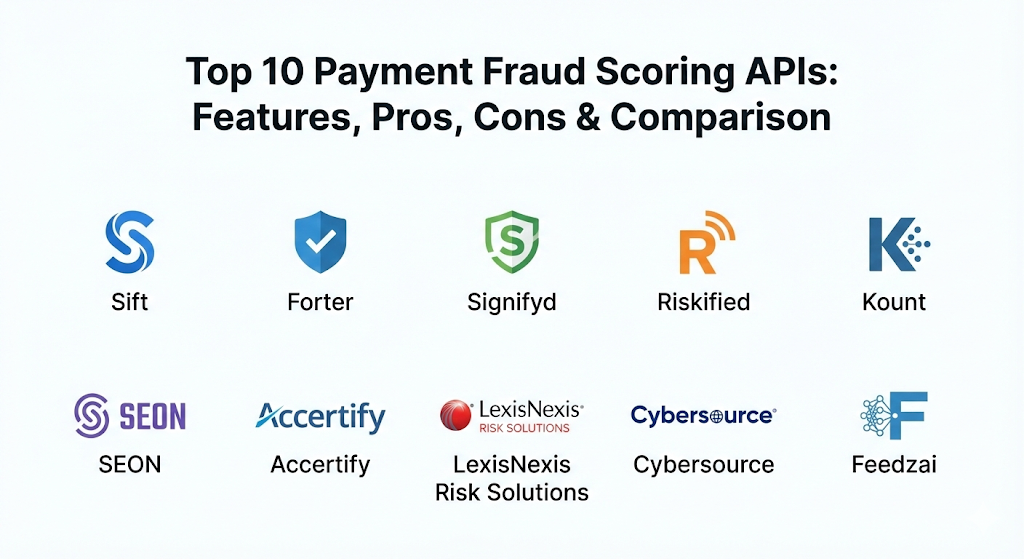
Introduction
Payment Fraud Scoring APIs are sophisticated software interfaces that allow businesses to evaluate the risk level of a financial transaction in real-time. These APIs act as a digital gatekeeper between the customer’s “buy” click and the final bank authorization. When a transaction is initiated, the API instantly analyzes hundreds of data points—including IP addresses, device fingerprints, behavioral patterns, and historical purchase data—to return a numerical “fraud score.” This score tells the merchant whether to approve the order, flag it for manual review, or decline it immediately.
In the current digital economy, these tools are no longer optional. As fraudsters move toward sophisticated synthetic identities and automated bot attacks, manual rule-setting is insufficient. Fraud scoring APIs allow for dynamic, data-driven decisioning that minimizes “false positives” (blocking good customers) while maximizing detection. By leveraging massive global networks of transaction data, these APIs can recognize a fraudster on your site even if they have never visited your shop before.
Key Real-World Use Cases:
- E-commerce Checkout: Preventing stolen credit card usage and “friendly fraud” chargebacks.
- Account Onboarding: Detecting bot-driven mass account creations or synthetic identities.
- High-Value Transfers: Adding extra friction (like 2FA) only for transactions that exceed a specific risk threshold.
- Account Takeover (ATO): Identifying when a legitimate user’s login behavior suddenly shifts, suggesting a hacked account.
When choosing an API, businesses should prioritize low latency, explainable AI (knowing why a score was given), and integration ease.
Best for: These tools are essential for mid-market to enterprise-level e-commerce retailers, global marketplaces, fintech platforms, and neobanks. They are particularly valuable for companies processing high volumes of cross-border transactions where local risk patterns vary significantly.
Not ideal for: Micro-businesses or hobbyist sellers with very low transaction volumes. In those cases, the built-in fraud filters provided by standard payment processors like Stripe or PayPal are usually sufficient and more cost-effective.
Top 10 Payment Fraud Scoring APIs
1 — Sift
Sift (formerly Sift Science) is a leader in the “Digital Trust & Safety” space. It uses a massive global data network and machine learning to predict fraud with high accuracy across the entire customer journey, not just the checkout page.
- Key Features:
- Global Data Network: Learns from over 1 trillion events per year across thousands of sites.
- Dynamic Scoring: Real-time risk scores that update as user behavior changes.
- Workflows Engine: Automated “if-then” logic to handle various risk levels.
- Content Integrity: Detects spam and scam content in addition to payment fraud.
- Device Fingerprinting: Identifies the specific hardware used, even if the user hides their IP.
- Consensus-Based Learning: If a fraudster is caught on one Sift-enabled site, they are immediately flagged on all others.
- Pros:
- Highly intuitive dashboard that makes complex data easy for analysts to read.
- Exceptional at identifying account takeovers and synthetic identities early.
- Cons:
- Can be expensive for smaller merchants due to minimum monthly fees.
- Integration of the full suite (Payment, Account, Content) can take significant engineering time.
- Security & Compliance: SSO, data encryption at rest/transit, audit logs, SOC 2 Type II, GDPR, and PCI DSS Level 1.
- Support & Community: Comprehensive Help Center, Sift EDU (video training), and a responsive enterprise support team.
2 — Forter
Forter is known for its fully automated, “black box” approach. It aims to eliminate manual review entirely by providing a simple “Approve” or “Decline” decision in milliseconds, backed by a 100% fraud chargeback guarantee.
- Key Features:
- Instant Decisions: Zero manual review needed for the vast majority of transactions.
- Identity Interaction: Focuses on the “who” behind the device, not just the transaction data.
- Smart Routing: Optimizes payment authorization paths to increase bank approval rates.
- Policy Abuse Protection: Detects coupon abuse and returns fraud.
- Invisible Friction: Uses behavioral biometrics to verify users without adding 3D Secure pop-ups.
- Chargeback Recovery: Automated representation for legitimate disputes.
- Pros:
- Dramatic reduction in operational overhead as manual review teams can be repurposed.
- The financial guarantee shifts the risk entirely from the merchant to Forter.
- Cons:
- Less transparency; it can be difficult to see the specific data points behind a decline.
- High premium pricing based on a percentage of transaction volume.
- Security & Compliance: SOC 2, GDPR, HIPAA, and ISO 27001 compliant.
- Support & Community: Dedicated success managers for enterprise clients and highly rated 24/7 technical support.
3 — Signifyd
Signifyd is a pioneer of the “Guaranteed Fraud Protection” model. It combines a powerful scoring API with a financial indemnity service, making it a favorite for retailers who want predictable costs.
- Key Features:
- 100% Financial Guarantee: Signifyd pays the merchant back for any fraud chargebacks on approved orders.
- Agent Console: Provides detailed reports on why specific orders were flagged.
- On-Hold Workflows: Automatically pauses suspicious orders for a secondary AI look.
- Passive Device Probing: Gathers technical signals without interrupting the user’s flow.
- Order Automation: Can be configured to cancel fraudulent orders in your Shopify or Magento store automatically.
- Pros:
- Predictable ROI—the cost of the service is often offset by the recovered “false decline” revenue.
- Replaces the need for internal fraud insurance and manual review staff.
- Cons:
- The automated cancellation can occasionally be too aggressive for niche businesses.
- Primarily designed for e-commerce; less effective for pure fintech or crypto use cases.
- Security & Compliance: PCI DSS Level 1, GDPR, and SOC 2.
- Support & Community: Strong presence in the Magento and Shopify developer communities with robust documentation.
4 — Riskified
Riskified is an enterprise-grade platform that specializes in high-volume, global e-commerce. They focus on turning “maybe” transactions into approvals, specifically for complex cross-border orders.
- Key Features:
- Dynamic Checkout: Optimizes the checkout UI based on the user’s risk profile.
- Decoction Logic: Analyzes deep links between accounts to find hidden fraud rings.
- PSD2/SCA Optimization: Manages 3D Secure challenges to meet EU regulations with minimal friction.
- Account Guard: Specialized protection against account takeover attacks.
- Dispute Resolve: An end-to-end platform for managing and winning chargeback disputes.
- Pros:
- Exceptional performance for luxury goods and high-ticket items.
- Very low false-decline rates compared to standard industry averages.
- Cons:
- Integration is deeply coupled with the checkout flow, making it harder to swap out.
- Pricing is generally at the high end of the market.
- Security & Compliance: GDPR, SOC 2, and PCI DSS.
- Support & Community: High-touch account management and detailed case studies for complex industries.
5 — Kount (An Equifax Company)
Kount leverages Equifax’s massive identity database to provide a unique “Identity Trust” score. It is one of the most data-rich platforms in the world, combining digital signals with traditional credit data.
- Key Features:
- Identity Trust Global Network: Access to billions of historical data points.
- Omniscore: A sophisticated AI score that ranks the risk of the digital identity.
- Near Real-Time Reporting: Dashboard for visualizing fraud trends across the organization.
- Case Management: A robust interface for manual review teams when they need to dig deep.
- Customer Account Protection: Monitors login and profile changes for suspicious activity.
- Pros:
- The integration with Equifax data provides a level of identity verification others can’t match.
- Flexible pricing models, including per-transaction or subscription options.
- Cons:
- The UI can feel a bit traditional/clunky compared to newer startups.
- Custom rule-tuning can be complex and time-consuming.
- Security & Compliance: SOC 2, ISO 27001, PCI DSS, and GDPR.
- Support & Community: Massive library of webinars and whitepapers; extensive enterprise training programs.
6 — SEON
SEON is a “Fraud Fighters” platform that takes a modern, developer-first approach. Its standout feature is its ability to perform “social media lookups” based on an email address or phone number.
- Key Features:
- Social & Web Signals: Checks 50+ social platforms to see if a user’s digital footprint is real.
- Email & Phone Profiling: Detects temporary or “disposable” contact info instantly.
- Device Fingerprinting: Free, lightweight SDK for tracking hardware and software signals.
- Machine Learning Rules: Suggests new rules based on your unique transaction data.
- Modular API: You can use just the parts you need (e.g., just the Email API).
- Pros:
- The most transparent pricing on the market, including a “free” tier for low volumes.
- The social media lookup is a game-changer for identifying synthetic identities.
- Cons:
- Requires more manual rule configuration than Forter or Signifyd.
- Smaller historical transaction network compared to giants like Sift or Kount.
- Security & Compliance: GDPR, SOC 2, and PCI DSS compliant.
- Support & Community: Excellent documentation and an active “Fraud Fighters” blog and community.
7 — Accertify (An American Express Company)
Accertify is a veteran in the industry, used by some of the world’s largest airlines and retailers. It provides a highly customizable, enterprise-grade risk engine.
- Key Features:
- Strategic Analytics: A team of fraud analysts helps you tune your models.
- Community Data: Shares risk insights across the American Express network.
- Chargeback Management: Highly specialized tools for fighting airline and travel fraud.
- Digital Identity: Tracks the evolution of a user’s identity across the internet.
- Device Intelligence: In-depth analysis of the user’s browser, hardware, and location.
- Pros:
- Unrivaled expertise in the travel, airline, and hospitality industries.
- Extremely deep customization options for teams that want total control.
- Cons:
- The setup process can be very long (weeks or months).
- Customization is based on a SQL-like language, which can feel dated.
- Security & Compliance: ISO 27001, SOC 2, GDPR, and PCI DSS.
- Support & Community: High-level professional services and dedicated analyst support.
8 — LexisNexis Risk Solutions
LexisNexis provides “FraudPoint,” an API that leverages billions of public records and alternative data points to score the risk of a person’s identity during a transaction.
- Key Features:
- Dynamic Identity Intelligence: Uses real-world data (mortgages, utilities, property) to verify people.
- ThreatMetrix Integration: Advanced device and behavioral intelligence.
- Score Builder: Allows businesses to customize the weighting of different risk factors.
- Physical vs. Digital Linking: Checks if the shipping address matches the person’s historical records.
- Global Coverage: Deep data sets in almost every country.
- Pros:
- The ability to link digital sessions to real-world public records is a massive advantage.
- Very strong at detecting “First Party Fraud” (when a real person lies about receiving a package).
- Cons:
- The data-heavy approach can sometimes feel slow (latency concerns).
- Not primarily an e-commerce “checkout” tool; more of a “risk intelligence” layer.
- Security & Compliance: HIPAA, SOC 2, GDPR, and ISO 27001.
- Support & Community: Enterprise support via phone and email; extensive regulatory compliance documentation.
9 — Cybersource (A Visa Solution)
Cybersource provides the “Decision Manager” API. Being owned by Visa, it has access to one of the largest transaction datasets on Earth, often called the “World’s Largest Fraud Detection Radar.”
- Key Features:
- Visa Intelligence: Analyzes billions of Visa transactions to spot global fraud patterns.
- Flexible Rules Engine: Over 260 variables available for building custom rules.
- Decision Manager Replay: Allows you to “test” new rules on old data before going live.
- Unified Platform: Manage payments and fraud in the same API.
- Identity Behavior Analysis: Looks at the history of an identity across different sellers.
- Pros:
- One of the most reliable and “battle-tested” platforms available.
- Perfect for companies that already use Cybersource for payment processing.
- Cons:
- Can be very difficult to navigate the complex “legacy” interface.
- Rule-building can be tedious compared to modern AI-first platforms.
- Security & Compliance: PCI DSS Level 1, GDPR, and SOC 2.
- Support & Community: Massive global support network; developer portal with extensive SDKs.
10 — Feedzai
Feedzai is a specialized platform for banks, fintechs, and high-stakes payment processors. It is known for its “Human-in-the-Loop” AI that explains exactly why a transaction was scored high-risk.
- Key Features:
- Omnichannel View: Monitors fraud across ATM, branch, mobile, and web.
- Explainable AI (Whitebox): Provides clear reasons for every risk score.
- GenAI Insights: Uses generative AI to summarize fraud cases for human analysts.
- Behavioral Biometrics: Tracks typing speed and mouse movements to identify bots.
- Automated Data Profiling: Cleans and prepares your data for the AI model automatically.
- Pros:
- The transparency of the AI is a major plus for regulatory compliance in banking.
- Incredibly powerful for finding complex “typologies” like money laundering.
- Cons:
- Targeted specifically at the financial sector; less “plug-and-play” for e-commerce.
- Highly technical implementation requires a data science background to manage.
- Security & Compliance: ISO 27001, SOC 2, GDPR, and HIPAA.
- Support & Community: High-end professional services and a strong academic focus on AI ethics.
Comparison Table
| Tool Name | Best For | Platform(s) Supported | Standout Feature | Rating |
| Sift | Digital Trust & Safety | Web, API, Mobile | Global Consensus Data | 4.8/5 |
| Forter | Hands-off Automation | Web, API, SDK | 100% Chargeback Guarantee | 4.9/5 |
| Signifyd | Mid-market Retail | Web, Shopify, Magento | Liability Shift Guarantee | 4.7/5 |
| Riskified | High-volume/Global | Web, API, Mobile | Frictionless Checkout Opt. | 4.8/5 |
| Kount | Identity-rich Verification | Web, API, SDK | Equifax Identity Integration | 4.6/5 |
| SEON | Startups & Social Proof | Web, API, Chrome Ext | Social Media Lookup | 4.7/5 |
| Accertify | Airline/Travel/Travel | Web, API, Mobile | Community Risk Network | 4.5/5 |
| LexisNexis | Identity Risk Context | Web, API, Batch | Public Records Linking | 4.4/5 |
| Cybersource | Visa-heavy Merchants | Web, API, SDK | Visa Transaction Radar | 4.5/5 |
| Feedzai | Banking & Neobanks | Web, Cloud, Mobile | Explainable AI (Whitebox) | 4.6/5 |
Evaluation & Scoring of Payment Fraud Scoring APIs
When choosing your fraud partner, you should evaluate them across several weighted criteria. A tool that is “best” for an airline might be “worst” for a small digital gift card shop.
| Criteria | Weight | Explanation |
| Core Features | 25% | Real-time scoring, device fingerprinting, and behavioral analytics. |
| Ease of Use | 15% | Dashboard clarity and the quality of the developer SDKs. |
| Integrations | 15% | How well it fits with Stripe, Adyen, Shopify, or custom platforms. |
| Security | 10% | Compliance standards (PCI, GDPR) and data privacy controls. |
| Performance | 10% | Latency (ms) and the ability to handle peak season spikes. |
| Support | 10% | Availability of experts and documentation depth. |
| Price / Value | 15% | ROI—balancing fee costs against recovered revenue. |
Which Payment Fraud Scoring API Is Right for You?
Selecting the right API depends on your business model, your internal resources, and your risk appetite.
Solo Users vs SMB vs Mid-Market vs Enterprise
If you are an SMB looking for a “set it and forget it” solution, Signifyd or Forter are the best choices because of their financial guarantees. Mid-Market companies with internal fraud teams will likely prefer Sift or SEON because of the deep transparency and manual review tools. Enterprises with complex needs (like airlines or global banks) should look toward Accertify, Feedzai, or Cybersource.
Budget-Conscious vs Premium Solutions
If you are Budget-Conscious, SEON is the winner due to its transparent per-transaction pricing and free starting tier. If you have a large budget and are focused purely on Revenue Optimization, premium solutions like Riskified or Forter are worth the cost because they approve more “good” orders that other tools might flag as suspicious.
Feature Depth vs Ease of Use
For Ease of Use, Sift and Forter have the most modern, instinctual interfaces. For Feature Depth, where you want to write your own SQL-like rules and control every data point, Accertify and Cybersource offer a degree of control that modern AI-only tools lack.
Integration and Scalability Needs
If you are already on a major e-commerce platform like Shopify Plus or BigCommerce, look for tools with “native connectors” like Signifyd. If you are building a custom mobile app, prioritize a tool with a robust, lightweight SDK like Kount or SEON to ensure you don’t slow down the mobile user experience.
Frequently Asked Questions (FAQs)
1. What is a “False Positive” in fraud scoring?
A false positive occurs when a legitimate customer’s transaction is incorrectly flagged as fraudulent and declined. This is the “silent killer” of e-commerce revenue, often costing businesses more than actual fraud.
2. How does a chargeback guarantee work?
Providers like Forter and Signifyd offer a guarantee where they pay for the loss and shipping if a transaction they approved turns out to be fraudulent. This shifts the risk from the merchant to the provider.
3. Does fraud scoring slow down my website?
Modern APIs are designed for “low latency,” usually responding in under 200 milliseconds. If integrated correctly via an asynchronous SDK, the user should never notice the background risk check.
4. What is “Device Fingerprinting”?
It is a technique that identifies a specific computer or phone based on its unique combination of hardware, software, and browser settings. This helps catch fraudsters using multiple accounts on the same device.
5. Why should I use an API instead of just rules?
Rules are static (e.g., “Block all orders over $500”). Fraudsters know these rules and work around them. APIs use Machine Learning to spot complex patterns that a human could never write a rule for.
6. Is my customer data safe with these providers?
Yes, top-tier providers are PCI DSS and GDPR compliant. They use “hashing” to anonymize sensitive data like credit card numbers so they can analyze patterns without seeing the actual secret info.
7. What is 3-D Secure (3DS)?
3DS is a security protocol that adds a verification step for the customer (like a bank code). Fraud scoring APIs can help you decide when to “trigger” 3DS and when to skip it for a smoother experience.
8. Can these tools stop “Friendly Fraud”?
Friendly fraud is when a real customer buys something and then falsely claims they never received it. Tools like Riskified and Sift use historical behavioral data to flag users who have a habit of doing this.
9. How do these APIs handle “Synthetic Identities”?
They look for inconsistencies. If a person has a social media profile that is 10 years old but a phone number that was registered yesterday, the API will flag this as a high-risk synthetic identity.
10. What is the biggest mistake when choosing a fraud API?
Choosing solely on the “Detection Rate.” If a tool catches 100% of fraud but blocks 20% of your good customers, your business will fail. You must balance detection with approval rates.
Conclusion
The landscape of payment fraud is shifting from simple theft to sophisticated bot-driven attacks and complex identity manipulation. The key insight is that data is your best defense. By choosing a fraud scoring API that connects to a massive global network, you gain the collective intelligence of thousands of other merchants.
For most modern e-commerce businesses, Forter and Sift represent the “best of breed” for balance between speed and accuracy. However, if your business is niche—like an airline or a neobank—you should prioritize specialized expertise in Accertify or Feedzai.
Ultimately, the goal of a fraud API is to make the “trust decision” invisible. When you pick the right partner, your legitimate customers enjoy a frictionless experience, while fraudsters find themselves blocked at every turn. Start by requesting a “data study” from a few providers to see how their AI would have scored your last 30 days of transactions.

- Top 10 Payment Orchestration Platforms: Features, Pros, Cons & Comparison - October 27, 2026
- Top 10 Email Deliverability Tools: Features, Pros, Cons & Comparison - September 6, 2026
- Top 10 Pharmacovigilance Software: Features, Pros, Cons & Comparison - September 6, 2026