Introduction
Enterprise Search Platforms are advanced software solutions that enable organizations to search across disparate data sources—such as internal documents, databases, cloud storage, intranets, email systems, and collaboration tools—in a unified, intelligent way. Unlike basic desktop or web search engines, these platforms use AI, natural language processing, machine learning, and semantic understanding to deliver highly relevant results, even from unstructured data, while respecting permissions and security policies.
In 2026, enterprise search is critical as companies generate massive volumes of data and face hybrid/remote work challenges. Effective search reduces time wasted hunting for information, boosts employee productivity, accelerates decision-making, and improves customer support. With AI-driven features like generative answers, contextual relevance, and personalization, these platforms transform data into actionable insights while maintaining compliance.
Key real-world use cases include enabling employees to find internal policies or project documents instantly; helping support teams access knowledge articles and customer history; powering R&D teams with research papers and patents; and providing sales teams with quick access to contracts and client data.
When choosing an enterprise search platform, evaluate search relevance and AI capabilities; data source connectors; security and permissions enforcement; scalability for large data volumes; user experience (natural language queries, generative answers); integrations with productivity tools; analytics for usage insights; and total cost of ownership.
Best for: Knowledge workers, IT, HR, support, and R&D teams in mid-market to enterprise organizations; industries such as finance, healthcare, legal, technology, consulting, manufacturing, and government that deal with large volumes of internal data and require fast, secure access. Not ideal for: Small teams with minimal data sprawl (where simple file search or shared drives suffice); or organizations focused solely on public-facing search (where web search engines or basic CMS search tools are better).
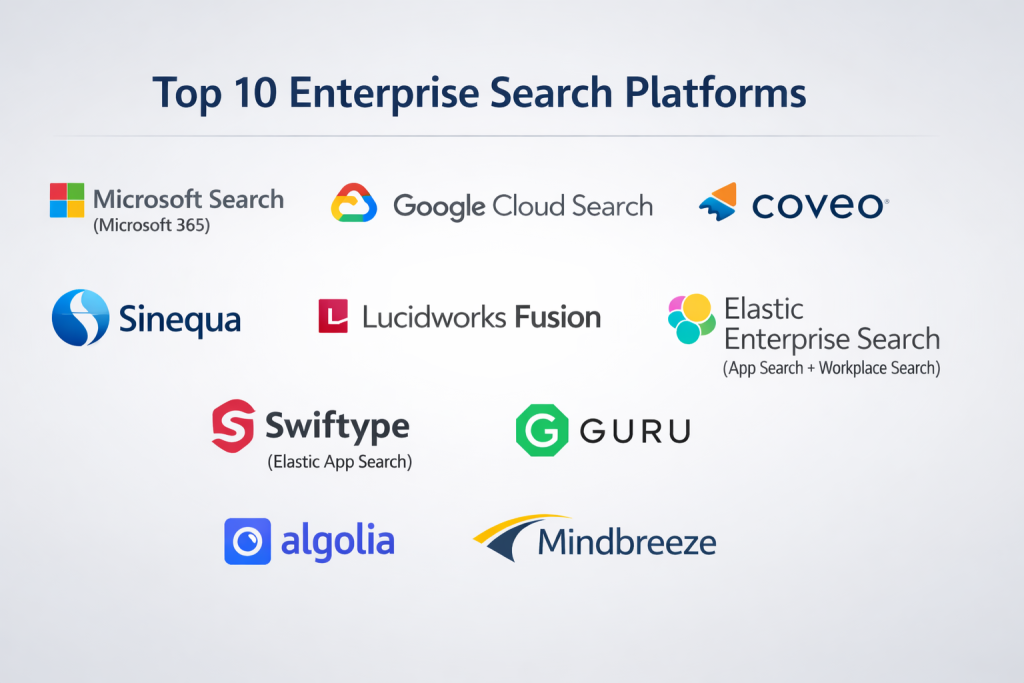
Top 10 Enterprise Search Platforms
1 — Microsoft Search (Microsoft 365)
Microsoft Search is an enterprise search solution integrated into Microsoft 365, designed for organizations using the Microsoft ecosystem to unify search across all tools and data sources.
Key features:
- Unified search across SharePoint, OneDrive, Teams, Outlook, and third-party apps.
- AI-powered relevance and natural language understanding.
- Personalized results based on user context.
- Graph-powered insights and generative answers.
- Security trimming with Microsoft Entra ID.
- Custom verticals and refiners.
Pros:
- Seamless integration with Microsoft 365 ecosystem.
- Excellent for large enterprises already on Microsoft.
- Strong personalization and generative AI features.
Cons:
- Limited outside Microsoft ecosystem.
- Requires Microsoft 365 licensing.
- Less flexible for non-Microsoft data sources.
Security & compliance: SOC 2, GDPR, HIPAA, ISO 27001, encryption, audit logs, SSO.
Support & community: Comprehensive Microsoft documentation, enterprise support, vast community.
2 — Google Cloud Search
Google Cloud Search is an enterprise-grade search platform that unifies data across Google Workspace and third-party sources, ideal for organizations using Google tools.
Key features:
- Unified search across Google Workspace and connected apps.
- Machine learning-powered relevance.
- Natural language queries and smart answers.
- Security trimming with Google Workspace permissions.
- Customizable interfaces and verticals.
- Integration with BigQuery and other Google services.
Pros:
- Intuitive search experience similar to Google Search.
- Strong for Google Workspace users.
- Excellent scalability.
Cons:
- Less effective outside Google ecosystem.
- Limited advanced customization.
- Data residency concerns in some regions.
Security & compliance: SOC 2, GDPR, ISO 27001, encryption, audit logs, SSO.
Support & community: Google Cloud support, extensive documentation.
3 — Coveo
Coveo is an AI-powered search and relevance platform, designed for enterprises needing intelligent search across customer-facing and internal experiences.
Key features:
- AI-driven relevance and natural language understanding.
- Unified search across multiple data sources.
- Personalization and recommendations.
- Headless search APIs.
- Security trimming and permissions.
Pros:
- Exceptional search relevance.
- Strong for customer-facing and internal use.
- Excellent analytics.
Cons:
- Higher cost.
- Complex implementation.
- Requires expertise.
Security & compliance: SOC 2, GDPR, HIPAA, ISO 27001.
Support & community: Enterprise support, detailed documentation.
4 — Elastic Enterprise Search (App Search + Workplace Search)
Elastic Enterprise Search combines App Search and Workplace Search, ideal for organizations using the Elastic Stack.
Key features:
- Unified search across internal and external sources.
- Relevance tuning and machine learning.
- Security trimming and permissions.
- Integrations with Slack, Microsoft 365, Google Drive.
- Analytics and observability.
Pros:
- Highly customizable.
- Strong for technical teams.
- Excellent performance.
Cons:
- Requires Elastic expertise.
- Complex setup.
- Higher cost for enterprise.
Security & compliance: SOC 2, GDPR, ISO 27001.
Support & community: Elastic community, enterprise support.
5 — Sinequa
Sinequa is an enterprise search and knowledge discovery platform focused on AI-driven insights.
Key features:
- Unified search across structured and unstructured data.
- Natural language processing and generative answers.
- Knowledge graph and semantic search.
- Security trimming.
Pros:
- Powerful AI and semantic capabilities.
- Strong for knowledge discovery.
- Scalable for large data volumes.
Cons:
- High cost.
- Complex implementation.
- Steeper learning curve.
Security & compliance: SOC 2, GDPR, ISO 27001.
Support & community: Enterprise support.
6 — Lucidworks Fusion
Lucidworks Fusion is an enterprise search platform with AI-driven relevance, designed for customer and employee search.
Key features:
- AI-powered relevance and personalization.
- Unified search across sources.
- Security trimming.
- Analytics and tuning tools.
Pros:
- Strong AI capabilities.
- Good for customer-facing search.
- Scalable.
Cons:
- Expensive.
- Complex setup.
- Less known.
Security & compliance: SOC 2, GDPR.
Support & community: Good support.
7 — Swiftype (Elastic App Search)
Swiftype, now part of Elastic, is a search platform for customer-facing and internal use.
Key features:
- Relevance tuning.
- Unified search.
- Integrations with CMS and databases.
Pros:
- Easy to implement.
- Good for customer search.
- Scalable.
Cons:
- Less advanced AI.
- Elastic-dependent.
- Limited for internal use.
Security & compliance: SOC 2, GDPR.
Support & community: Elastic support.
8 — Guru
Guru is an AI-powered knowledge management platform with strong search capabilities.
Key features:
- AI-driven search and suggestions.
- Card-based knowledge.
- Slack integration.
Pros:
- Excellent for internal knowledge.
- Easy content creation.
- Good AI features.
Cons:
- Less for external search.
- Pricing for scale.
- Limited customization.
Security & compliance: SOC 2, GDPR.
Support & community: Responsive support.
9 — Algolia
Algolia is a search-as-a-service platform with strong relevance, used for enterprise search.
Key features:
- Instant search and relevance.
- AI-powered ranking.
- Security and permissions.
Pros:
- Extremely fast and relevant.
- Great for customer-facing search.
- Easy to implement.
Cons:
- Less for internal knowledge.
- Pricing for high volume.
- Limited content management.
Security & compliance: SOC 2, GDPR.
Support & community: Developer-friendly support.
10 — Mindbreeze
Mindbreeze is an AI-powered enterprise search platform for complex data environments.
Key features:
- Semantic search and knowledge graph.
- Unified search across sources.
- Security trimming.
Pros:
- Strong semantic capabilities.
- Good for complex data.
- Scalable.
Cons:
- Less known.
- Complex setup.
- Higher cost.
Security & compliance: SOC 2, GDPR.
Support & community: Enterprise support.
Comparison Table
| Tool Name | Best For | Platform(s) Supported | Standout Feature | Rating |
|---|---|---|---|---|
| Microsoft Search | Microsoft 365 organizations | Cloud | Unified Microsoft ecosystem | N/A |
| Google Cloud Search | Google Workspace users | Cloud | Natural language understanding | N/A |
| Coveo | AI-powered relevance | Cloud | Personalization & recommendations | N/A |
| Elastic Enterprise Search | Technical teams | Cloud, self-hosted | Relevance tuning | N/A |
| Sinequa | Knowledge discovery | Cloud, on-premise | Semantic search | N/A |
| Lucidworks Fusion | Customer & employee search | Cloud | AI relevance | N/A |
| Swiftype | Customer-facing search | Cloud | Instant results | N/A |
| Guru | Internal knowledge sharing | Cloud | AI suggestions | N/A |
| Algolia | Fast, relevant search | Cloud | High-performance indexing | N/A |
| Mindbreeze | Complex data environments | Cloud, on-premise | Knowledge graph | N/A |
Evaluation & Scoring of Enterprise Search Platforms
| Tool Name | Core Features (25%) | Ease of Use (15%) | Integrations & Ecosystem (15%) | Security & Compliance (10%) | Performance & Reliability (10%) | Support & Community (10%) | Price / Value (15%) | Total Score |
|---|---|---|---|---|---|---|---|---|
| Microsoft Search | 9 | 9 | 10 | 10 | 9 | 9 | 8 | 9.15 |
| Google Cloud Search | 9 | 9 | 9 | 9 | 9 | 9 | 8 | 8.85 |
| Coveo | 9 | 8 | 9 | 9 | 9 | 9 | 7 | 8.6 |
| Elastic Enterprise Search | 9 | 7 | 9 | 9 | 9 | 9 | 8 | 8.55 |
| Sinequa | 9 | 7 | 9 | 9 | 9 | 9 | 7 | 8.4 |
| Lucidworks Fusion | 8 | 7 | 8 | 9 | 8 | 8 | 7 | 7.9 |
| Swiftype | 8 | 8 | 8 | 8 | 9 | 8 | 8 | 8.05 |
| Guru | 8 | 8 | 8 | 8 | 8 | 8 | 8 | 8.0 |
| Algolia | 9 | 8 | 8 | 8 | 9 | 8 | 7 | 8.2 |
| Mindbreeze | 8 | 7 | 8 | 9 | 8 | 8 | 7 | 7.9 |
Which Enterprise Search Platform Is Right for You?
Choosing the right enterprise search platform depends on your existing tech stack, data volume, and use case. For solo users or small teams, simpler tools like Guru or Notion suffice, but true enterprise search is overkill.
Small to medium businesses (SMBs) benefit from Google Cloud Search or Elastic Enterprise Search, offering good scalability at reasonable costs. If feature depth versus ease of use is key, Coveo for AI relevance; Guru for internal knowledge.
For mid-market or enterprise organizations, premium solutions like Microsoft Search, Coveo, or Sinequa excel in scalability, integrations, and compliance. Budget-conscious? Start with Google Cloud Search; premium tools justify costs through productivity gains.
Feature depth versus ease of use: Microsoft Search for seamless integration; Coveo for advanced AI. Integration needs favor Microsoft or Google. Prioritize security and compliance for regulated industries, ensuring features like encryption and audit logs.
Frequently Asked Questions (FAQs)
What is an enterprise search platform? It unifies search across internal data sources, delivering relevant results with security and permissions.
Why use enterprise search? It saves time, reduces information silos, and boosts productivity in data-rich environments.
Are there free enterprise search tools? Basic options exist (e.g., open-source like Elasticsearch), but enterprise features require paid plans.
What security features matter? Encryption, permissions trimming, audit logs, and compliance (GDPR, SOC 2).
How scalable are these platforms? Enterprise options handle petabytes of data; cloud-based scale easily.
What are common implementation challenges? Data connector setup; start with a proof-of-concept.
How much do they cost? Varies; SMB plans $10-50/user/month; enterprise custom.
What alternatives exist? Basic search in file systems or Google Workspace for simple needs.
What mistakes do buyers make? Ignoring permissions or underestimating data volume.
What best practices help? Define use cases, secure data sources, train users, and monitor usage.
Conclusion
Enterprise search platforms transform how organizations find and use information, driving efficiency and informed decisions. Key insights highlight Microsoft Search’s ecosystem dominance, Google Cloud Search’s intuitive experience, and Coveo’s AI relevance as top performers.
What matters most is aligning the platform with your data landscape, team needs, and compliance requirements. The “best” enterprise search tool isn’t universal; it fits your specific environment. Evaluate options through trials to find the perfect solution and unlock your organization’s knowledge potential.

- Top 10 Email Deliverability Tools: Features, Pros, Cons & Comparison - September 6, 2026
- Top 10 Pharmacovigilance Software: Features, Pros, Cons & Comparison - September 6, 2026
- Top 10 Manufacturing Execution Systems (MES) - July 30, 2026