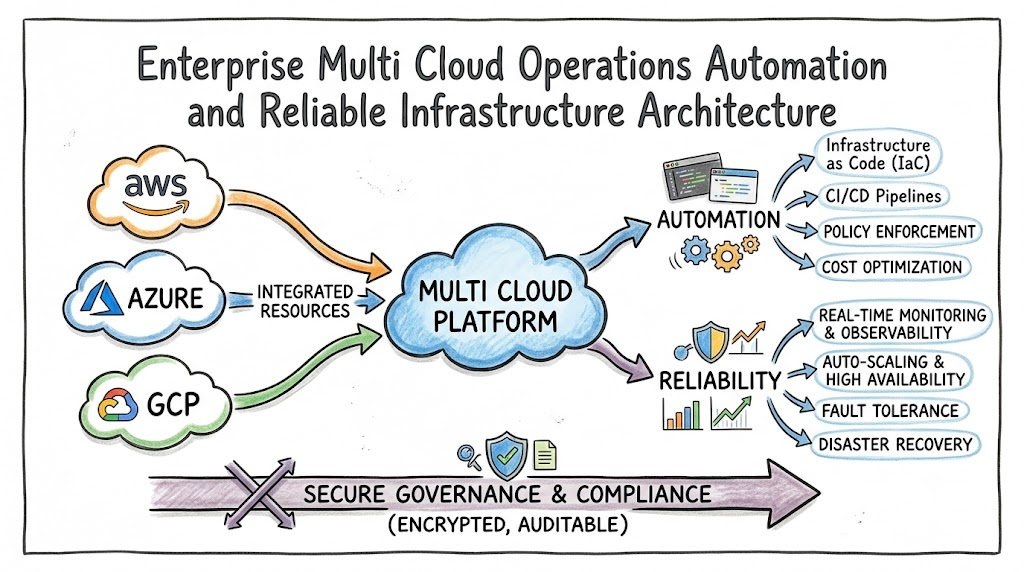
Setting Up Resilient Cloud Infrastructure
Building enterprise-grade cloud systems demands precision engineering, continuous optimization, and structured administration. Organizations encounter major service interruptions, rising cloud expenses, and configuration discrepancies whenever operational engineers perform maintenance manually.
Adopting a rigorous operational framework completely transforms how engineering departments deploy applications and manage production clusters. Technical teams require standardized procedures that synchronize software deployments with real-time operational oversight.
Implementing modern infrastructure operations safeguards platform uptime, accelerates incident recovery speeds, and guarantees stable hosting across distributed environments.
Unpacking Cloud Operations
Cloud operations, frequently termed CloudOps, encompasses the proactive management, optimization, and continuous monitoring of distributed cloud assets. This discipline blends traditional systems administration with iterative DevOps practices to maintain responsive, secure, and elastic environments.
Engineering teams apply proactive management strategies to avoid severe production disruptions. Instead of addressing service outages after end-users report errors, platform operators continuously analyze performance metrics, network traffic flows, and operational dependencies.
A proficient operations team manages everything from virtual compute instances to network routing rules. This structured approach helps growing enterprises scale system throughput seamlessly without causing downtime for existing services.
Core Pillars Of Cloud Operations Management
Comprehensive cloud operations management targets organizational governance, budget control, security enforcement, and performance tuning. Technical managers organize day-to-day infrastructure duties with structured blueprints to ensure optimal performance.
This management methodology organizes cloud resources systematically. Operations leaders enforce clear service level targets, audit infrastructure expenditures, and mandate consistent configurations across all development stages.
| Management Pillar | Primary Focus Area | Core Operational Value |
|---|---|---|
| Governance | Identity access and regulatory compliance | Auditable and secure infrastructure |
| Financial Operations | Resource tagging and cost tracking | Minimized cloud waste and clear budgets |
| Incident Response | Alert management and rapid remediation | Reduced MTTR and dependable uptime |
Establishing transparent operational policies prevents uncontrolled resource sprawl and maintains predictable cloud costs across active enterprise accounts.
Essential Cloud Infrastructure Management
Reliable cloud infrastructure management provides the foundation for stable business workloads. Infrastructure specialists configure virtual machines, database engines, block storage, and virtual networks to handle enterprise traffic demands.
Disciplined platform administration ensures balanced workload distribution across multiple virtual private networks. When system administrators enforce granular identity rules, they safeguard mission-critical business assets against external threats.
Handling cloud resources correctly prevents critical resource bottlenecks during high-traffic intervals. Routine maintenance schedules streamline data throughput and maintain balanced server loads throughout peak operational windows.
Accelerating Delivery With Cloud Automation
Cloud automation eliminates tedious manual intervention from repetitive administrative tasks. When engineers automate system patching, resource scaling, and configuration audits, they eliminate costly human configuration errors.
Automated routines accelerate deployment velocity and expand engineering capacity. Technical staff focus on building product features rather than executing repetitive server reboots.
Organizations utilizing automated remediation resolve common infrastructure incidents up to sixty percent faster. Programmed workflows guarantee dependable execution whenever incoming user demand surges.
[System Event / Alert] ➔ [Automated Trigger] ➔ [Policy Verification] ➔ [Auto-Remediation / Scaling]
Implementing Infrastructure As Code For Automation
Modern cloud infrastructure automation transforms physical and virtual compute resources into declarative, machine-readable configuration files. Administrators manage complex fleets predictably by using declarative templates and automated deployment pipelines.
Adopting Infrastructure as Code (IaC) solutions like Terraform, OpenTofu, and Ansible delivers uniform configurations across staging, testing, and production tiers. Template-driven provisioning eliminates configuration drift because declarative files establish the desired target state.
- Version Control: Document every infrastructure change through Git repositories.
- Predictable Execution Plans: Review resource modifications prior to launching production updates.
- Reusable Blueprints: Construct modular components for compute instances, storage volumes, and network gateways.
- Automated Policy Enforcement: Validate compliance policies before creating cloud assets.
Consequently, site reliability engineers generate, alter, and decommission testing environments within minutes.
Real-Time Cloud Monitoring Frameworks
Continuous cloud monitoring captures application latency, hardware utilization, network traffic, and system error rates. Monitoring software harvests raw operational telemetry continuously to provide systems engineers with clear visibility into overall system health.
Automated alerting notifies engineers before minor memory leaks escalate into major database crashes. Responsive alerting prevents extended system outages and preserves uninterrupted operational delivery.
Collecting infrastructure metrics methodically enables administrators to identify inefficient database queries and right-size computing instances with precision.
Elevating System Telemetry To Full Observability
Basic monitoring alerts engineers when a service crashes, whereas full-stack observability reveals why an application component behaves abnormally. Engineering teams investigate internal system behaviors by analyzing consolidated operational telemetry.
Comprehensive observability relies on three primary telemetry inputs that connect distributed application actions:
- Metrics: Quantifiable time-series data tracking CPU load, memory limits, and request latency.
- Logs: Timestamped event records highlighting specific error exceptions and runtime executions.
- Distributed Traces: End-to-end request journeys traversing microservices, caching layers, and API endpoints.
Synthesizing these telemetry signals helps site reliability engineers diagnose root causes in distributed microservices environments rapidly.
Practical Cloud Operations Best Practices
Executing proven cloud operations best practices delivers sustainable platform stability and strict budgetary control. Successful technology organizations secure platform resilience through continuous experimentation, wide-ranging automation, and strong operational guardrails.
- Deploy Full-Stack Observability: Unify metrics, event logs, and distributed traces to gain complete runtime visibility.
- Standardize Infrastructure Deployments: Provision all computing environments using version-controlled Infrastructure as Code pipelines.
- Embed Automated Security: Run automated vulnerability scans across application code, container images, and runtime clusters.
- Enforce Resource Tagging: Tag every provisioned asset clearly to track financial expenditure across business units.
- Execute Chaos Engineering Drills: Trigger deliberate system failures to confirm automated disaster recovery workflows.
Applying these engineering standards enables technical teams to construct dependable platforms that handle enterprise-scale traffic.
Managing Heterogeneous AWS, Azure, And GCP Clouds
Engineering teams regularly manage hybrid infrastructure across AWS, Microsoft Azure, and Google Cloud Platform simultaneously. Because each provider utilizes distinct service terminology, management interfaces, and identity systems, engineers need unified multi-platform administration skills.
| Provider | Virtual Compute Engine | Identity Management | Built-in Telemetry Suite |
|---|---|---|---|
| AWS | Amazon EC2 / ECS | AWS IAM | Amazon CloudWatch |
| Azure | Azure VMs / AKS | Microsoft Entra ID | Azure Monitor |
| GCP | Google Compute Engine / GKE | Google Cloud IAM | Google Cloud Operations Suite |
Mastering AWS Azure GCP cloud management empowers operations specialists to pick optimal native tools for specific enterprise workloads.
Unified Multi Cloud Management Strategies
Multi cloud management encompasses the centralized governance, provisioning, and optimization of operational workloads distributed across several cloud vendors. This architectural strategy eliminates single-vendor dependencies and maximizes platform availability.
Engineering teams distribute specialized workloads across multiple providers, hosting analytical databases on one platform while running customer-facing services on another. Unified management simplifies security enforcement across all active zones.
A resilient multi-cloud architecture requires strict access governance and consolidated telemetry dashboards to prevent critical operational blind spots.
Engineering High System Reliability
Constructing high-availability infrastructure requires intentional architectural planning, automated failover routines, and continuous recovery rehearsals. Engineers remove single points of failure by implementing multi-region disaster recovery mechanisms.
Reliable platforms utilize automated rate-limiting policies, graceful service degradation, and dynamic health probes. Services self-heal automatically when individual virtual machines encounter unexpected hardware failures.
Focusing on system resilience protects customer confidence and ensures core business operations persist during vendor-level cloud disruptions.
Leveraging CloudOpsNow Knowledge Base
CloudOpsNow provides educational guidance for modern cloud engineers, DevOps practitioners, and infrastructure architects. The resource platform delivers in-depth technical blueprints, practical deployment tutorials, and operational strategies for modern infrastructure environments.
The platform translates complex distributed systems topics into practical, step-by-step guides. Readers discover effective approaches to manage AWS, Azure, Google Cloud, and Kubernetes clusters efficiently.
Reviewing industry perspectives, tooling benchmarks, and automation templates equips engineers with actionable strategies to elevate their daily infrastructure administration.
Frequently Asked Questions About CloudOpsNow
- What primary purpose does CloudOpsNow serve?
The publication delivers actionable tutorials covering cloud operations, infrastructure automation, multi-cloud platforms, and observability workflows.
- Who benefits most from the instructional content?
DevOps engineers, cloud architects, Site Reliability Engineers, and technology leaders seeking to maximize infrastructure reliability gain high value.
- Does the platform analyze multiple public cloud providers?
Yes, the guides deliver deep technical analysis across Amazon Web Services, Microsoft Azure, and Google Cloud Platform.
- Do these tutorials focus on real-world production environments?
Yes, each article addresses realistic engineering hurdles, practical architectural patterns, and verified operational troubleshooting steps.
- How does the material advance infrastructure automation skills?
It explains Infrastructure as Code, CI/CD pipeline integration, automated security checks, and self-healing system configurations through hands-on guides.
- What observability elements do the guides explore?
The content covers metrics collection, distributed tracing, structured logging, intelligent alerting thresholds, and end-to-end performance monitoring.
- Does the platform provide cloud governance and FinOps recommendations?
Yes, the resources examine resource tagging conventions, identity management policies, security guardrails, and cost-reduction techniques.
- Can both beginners and senior platform engineers use these resources?
The articles address everything from foundational operational concepts to advanced multi-cloud deployments and enterprise Kubernetes patterns.
- How regularly does the platform add new operational playbooks?
The team updates the library frequently with fresh guides, architectural analyses, and best practices covering emerging cloud technologies.
- Do the guides include direct tooling comparisons?
Yes, readers can evaluate side-by-side technical breakdowns comparing open-source utilities, proprietary monitoring platforms, and native cloud services.
Navigating Modern Infrastructure Operations
Sustaining enterprise-scale platform resilience requires active leadership, disciplined automation, and robust architectural planning. Replacing manual maintenance with version-controlled Infrastructure as Code empowers technical teams to release features faster while eliminating human error. Furthermore, combining full-stack observability with structured multi-cloud governance keeps distributed platforms stable, cost-effective, and secure. Technical organizations that adopt these proactive principles operate resilient cloud infrastructure with total confidence.

- Accelerating Modern Business Growth Through Intelligent Software Engineering And Scalable Cloud Architectures - September 5, 2026
- Building Resilient Enterprise Cloud Platforms Through Automation And Modern Reliability Engineering - September 5, 2026
- Building Resilient Software Platforms Through Modern Engineering And Enterprise Automation - September 4, 2026