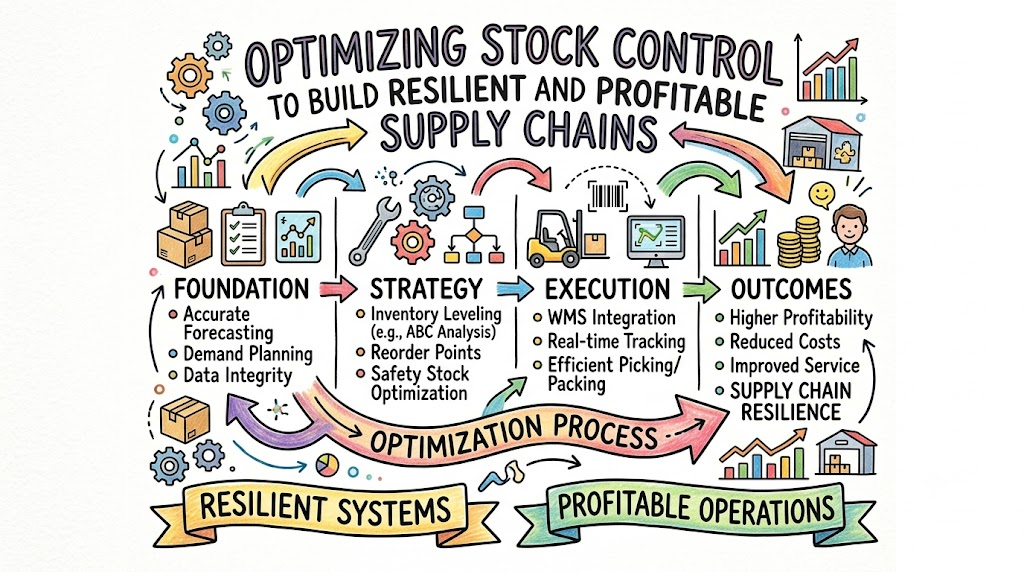
Effective stock control serves as the central nervous system of any modern distribution network. Without continuous oversight of physical stock, businesses encounter severe disruptions, ballooning holding costs, and disappointed buyers. Inventory management involves systematically supervising the purchase, storage, tracking, and fulfillment of items across every node of your fulfillment network. For this reason, forward-thinking organizations collaborate with digital platforms like SCMGALAXY to automate tracking workflows and gain real-time transparency across their entire operation.
When a company lacks a cohesive inventory control framework, warehouse staff frequently struggle with stock discrepancies, overstocked holding areas, and frequent out-of-stock scenarios. Consequently, financial capital remains trapped in slow-moving goods while popular products sell out unexpectedly. By transitioning to a streamlined, automated approach, organizations balance product availability against storage costs smoothly.
Understanding the fundamental dynamics of inventory control enables enterprises to scale fulfillment without increasing administrative strain. As end-user expectations for rapid shipping increase, maintaining exact stock counts becomes vital for customer retention. Ultimately, the long-term success of your logistics network depends directly on how effectively you control the flow of materials from procurement to the final customer delivery.
Defining Stock Control Within Modern Distribution Networks
To build an agile fulfillment framework, you must understand how materials travel through the procurement, production, and distribution stages. Inventory represents a company’s largest active asset, encompassing raw components, work-in-progress assemblies, and ready-to-ship goods. Managing these resources requires continuous visibility into replenishment timelines, lead times, and supplier performance metrics.
As consumer purchasing behaviors fluctuate across physical and digital channels, static spreadsheets fail to deliver the accuracy logistics managers require. If warehouse teams rely on manual data entry, counting errors create stock visibility blind spots across regional facilities. Therefore, modern distribution networks utilize cloud-connected tracking platforms to update stock levels instantly after each inbound delivery or sales transaction.
Managing multi-echelon stock requires balancing safety buffers against holding expenses. For instance, excessive safety stock inflates warehousing utility and insurance expenses, while inadequate reserves risk stockouts during unexpected disruptions. Consequently, modern supply chain leaders utilize dynamic inventory models to maintain optimal stock reserves at every facility.
Why Stock Control Determines Overall Supply Chain Success
A supply chain cannot function effectively if warehouse operations lack visibility into available product quantities. For the customer, placing an order only to receive a delayed backorder notification damages brand loyalty immediately. Therefore, poor stock tracking directly degrades customer satisfaction and drives buyers toward competitors.
Furthermore, inventory precision directly determines the financial health and cash flow velocity of your enterprise. Carrying unneeded inventory ties up working capital, increases product obsolescence risks, and incurs ongoing handling costs. Because holding expenses consume a large portion of inventory value annually, reducing buffer stock through visibility provides instant cost savings.
Ultimately, organizations that master inventory control build resilient operations capable of navigating external supply disruptions. When real-time data informs purchasing decisions, procurement teams reorder goods precisely when needed. Investing in automated inventory tracking secures your margins and ensures reliable customer fulfillment across all distribution channels.
Key Operational Concepts You Must Know
ABC Analysis and Category Stratification
To organize warehouse stock efficiently, management teams group products based on annual consumption value. High-value items with significant turnover receive tight monitoring, while lower-value materials undergo less frequent reviews. As a result, operations personnel direct their labor toward safeguarding the most critical stock items.
Economic Order Quantity (EOQ) Calculations
To avoid inflated ordering and holding expenses, planners calculate the optimal batch size for every replenishment cycle. This formula evaluates demand rates, purchase order costs, and unit carrying fees simultaneously. By ordering the ideal volume at designated intervals, companies minimize excess warehouse storage demands.
Just-in-Time (JIT) Material Replenishment
To eliminate unnecessary warehouse footprint, companies synchronize raw material arrivals directly with manufacturing schedules. This model removes excess holding expenses by receiving goods only as needed on the assembly floor. Consequently, organizations reduce physical storage requirements while speeding up overall inventory turnover.
Dynamic Reorder Points and Safety Stock Buffers
To safeguard operations against unexpected demand surges, managers configure automatic reorder thresholds for every stock keeping unit (SKU). These parameters continuously evaluate current supplier lead times against average daily consumption rates. When stock dips below the threshold, the system triggers purchase orders before stockout risks materialize.
Platform Implementation vs. Culture — What’s the Real Difference?
| Operational Element | Platform Implementation Focus | Cultural Integration Focus |
|---|---|---|
| Primary Goal | Deploying warehouse management software and barcode scanners | Establishing team-wide accountability for stock accuracy and clean recordkeeping |
| Execution Method | Integrating automated RFID checkpoints and cloud databases | Training floor associates to log stock movements and investigate count discrepancies immediately |
| Measurement Metrics | System uptime, scanning throughput, and database sync speeds | Reduction in shrinkage, cycle count accuracy, and operational compliance |
| Long-Term Impact | Provides digital visibility and centralized tracking data | Creates an agile organization that proactively eliminates fulfillment errors |
When you deploy a new inventory software suite, you are establishing the underlying technological foundation. However, technology alone cannot fix inconsistent warehouse processes. If receiving teams bypass scanning protocols or misplace incoming pallets, software dashboards display incorrect stock counts. Sustainable success requires merging modern digital tools with disciplined inventory management habits across all shifts.
Building a culture of stock integrity means encouraging warehouse personnel to view data accuracy as a shared responsibility. For example, when an operator notices a damaged carton or an unreadable barcode label, they need clear protocols to resolve the issue immediately. Technology provides visibility, but employee ownership ensures long-term operational precision.
Ultimately, high-end software solutions struggle if operational personnel resist standard operating procedures. Supply chain teams must embrace regular cycle counts and real-time logging as standard operational habits. When everyone from receiving dock workers to logistics analysts aligns on stock integrity, overall operational efficiency follows naturally.
Real-World Use Cases of Modern Operations
Automated Cycle Counting in Omnichannel Retail
A large clothing retailer struggled with discrepancy rates between its physical stores and online inventory records. To eliminate canceled web orders, management introduced automated RFID scanning protocols for daily cycle counts. Floor staff verified store stock levels within minutes instead of conducting slow manual tallies. Consequently, inventory accuracy rose, enabling ship-from-store fulfillment across all locations.
Supplier-Managed Inventories in Automotive Assembly
An automotive parts manufacturer faced regular production line halts due to unexpected fastener shortages. To resolve these bottlenecks, the company established shared cloud visibility with tier-one component suppliers. Suppliers monitored assembly line consumption in real time and automatically replenished storage bins before parts ran low. This change eliminated assembly downtime while reducing the manufacturer’s holding footprint.
Temperature-Controlled Tracking in Pharmaceutical Distribution
A pharmaceutical logistics provider needed to manage strict expiry dates and temperature requirements for distributed medications. They implemented automated batch-tracking software coupled with smart IoT environmental sensors. The system prioritized the dispatch of oldest valid batches while tracking refrigeration stability throughout transit. As a result, product write-offs decreased and the firm maintained regulatory compliance across its operations.
Common Mistakes in Operations Engineering
Relying on Infrequent Annual Physical Audits
Many businesses postpone physical inventory audits until the end of the fiscal year to reconcile accounting books. This delayed approach hides shrinkage, picking errors, and damaged items for months. By the time accountants notice the discrepancy, resolving the root cause is impossible. Replacing yearly audits with continuous cycle counts prevents compounding data errors.
Over-Ordering to Compensate for Poor Visibility
When dispatchers lack trust in warehouse data, they inflate purchase orders to create artificial safety margins. This practice fills storage facilities with excess inventory, driving up warehouse lease and utility costs. Furthermore, tied-up working capital cannot be deployed toward business expansion or high-demand product lines. Improving tracking visibility allows organizations to reduce safety stock safely.
Neglecting Warehouse Slotting and Layout Design
Storing high-velocity goods in remote corners of a warehouse forces picking staff to travel unnecessary distances during shifts. This poor organization slows down order processing and increases labor fatigue across warehouse teams. By analyzing SKU velocity data and optimizing rack layouts, managers reduce travel times and accelerate daily dispatch operations.
How to Become an Operations Expert — Career Roadmap
- Inventory Planners
- Learn how to build demand forecasting models using statistical analysis tools and historical sales data.
- Master economic order quantity formulas and lead-time variability metrics to balance holding expenses against replenishment frequency.
- Establish regular cycle count schedules to maintain database accuracy across all storage facilities.
- Supply Chain Managers
- Negotiate collaborative vendor-managed inventory agreements with strategic suppliers to optimize replenishment cycles.
- Implement warehouse management systems (WMS) that automate stock allocation and picking routes.
- Track inventory turnover ratios and carrying costs to identify slow-moving stock before obsolescence occurs.
- Logistics Directors
- Formulate comprehensive enterprise inventory strategies that align financial goals with rapid fulfillment capabilities.
- Oversee multi-facility network design to place inventory closer to major consumer markets.
- Establish company-wide governance standards for data integration across ERP, WMS, and e-commerce platforms.
FAQ Section
- What is the primary purpose of inventory management in logistics?The core purpose is balancing product availability with carrying costs to fulfill orders promptly without tying up excess working capital.
- How does inventory accuracy affect customer satisfaction?Accurate stock counts prevent backorders and shipping delays, ensuring that customers receive their purchased items on time.
- What is the difference between physical inventory audits and cycle counts?Physical audits count the entire warehouse at once, whereas cycle counting inspects specific subsets of inventory on a continuous schedule to catch errors early.
- Why are inventory carrying costs important to monitor?Carrying costs, including storage, insurance, and obsolescence, consume significant capital annually and directly reduce business profitability.
- How does ABC analysis improve warehouse productivity?It categorizes items by annual consumption value, allowing teams to focus tracking and replenishment efforts on the highest-value products.
- Can automated inventory systems reduce operational overhead?Yes, automation eliminates manual tallying errors, streamlines reordering, and optimizes warehouse labor allocation.
Final Summary
Controlling inventory efficiently is essential for running a sustainable, modern supply chain operation. When you maintain real-time visibility over stock movements, your order accuracy improves and operating overhead decreases. Conversely, neglecting stock discipline results in tied-up capital, frequent stockouts, and strained vendor relationships. Businesses must view inventory tracking as an indispensable operational strategy rather than a routine administrative task.
As global distribution demands grow more complex, companies that embrace data-driven inventory practices will lead the market. By combining automated tracking tools, dynamic replenishment models, and disciplined warehouse processes, you protect profit margins and elevate the fulfillment experience. Evaluate your stock management workflows today and remove the data bottlenecks limiting your operational efficiency.

- Accelerating Modern Business Growth Through Intelligent Software Engineering And Scalable Cloud Architectures - September 5, 2026
- Building Resilient Enterprise Cloud Platforms Through Automation And Modern Reliability Engineering - September 5, 2026
- Building Resilient Software Platforms Through Modern Engineering And Enterprise Automation - September 4, 2026