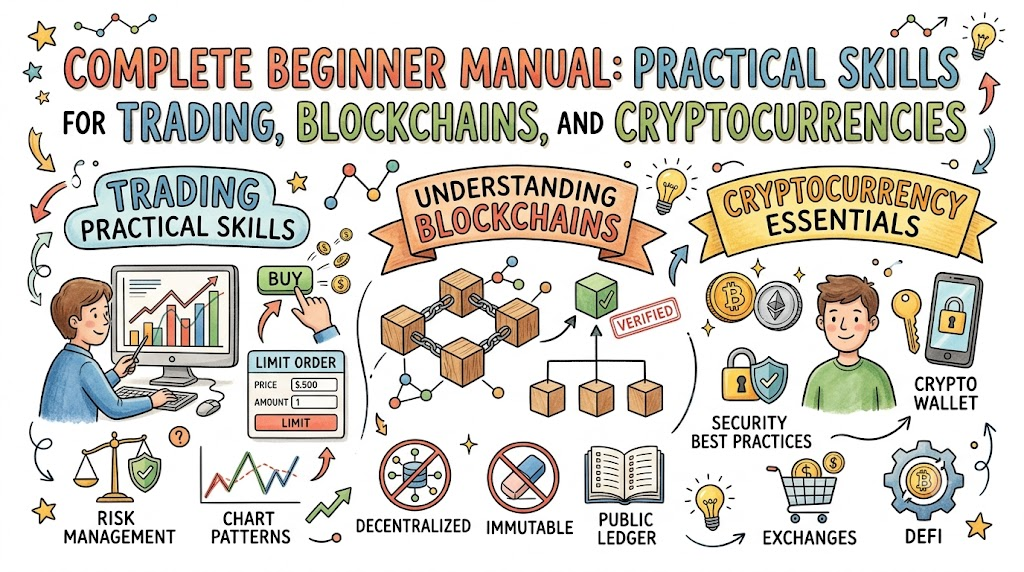
Opening the Door to Decentralized Networks
Stepping into modern digital currencies presents immediate challenges because technical jargon blinds beginners from the start. Novice users confront specialized terms like distributed consensus, cryptographic signatures, and liquidity pools without an organized curriculum to anchor their understanding. Consequently, curious newcomers risk real capital or quit before discovering how these platforms actually operate.
Overcoming these barriers requires a focused, hands-on framework instead of informal social media tips. Sound fundamentals shield personal funds while establishing verifiable operating knowledge. Through systematic, step-by-step breakdowns, CryptoBlockCoins equips participants with the exact skills needed for meaningful market progress. Taking command of financial autonomy starts by mastering verified concepts directly on this platform.
Discovering Distributed Ledger Systems
Stripped down to absolute basics, a blockchain operates as a shared, tamper-resistant digital registry that thousands of interconnected computers maintain simultaneously. Whenever an owner sends a transfer across the network, distributed nodes verify the cryptographic signature within seconds. Subsequently, automated network validators bundle these verified transfers into timestamped cryptographic packages.
Following that initial check, cryptographic hash functions lock every new block to its predecessor permanently. Therefore, altering recorded data demands dominating massive global computing clusters, a feat that remains mathematically impossible in practice. By removing legacy middlemen, blockchain technology provides trustless settlement directly to individuals worldwide.
Understanding Bitcoin Foundations
Originating as sovereign peer-to-peer digital money, Bitcoin serves as the bedrock asset of the entire decentralized landscape. The underlying mathematical code caps total issuance strictly at twenty-one million digital coins. Because programmatic consensus governs this issuance limit, genuine algorithmic scarcity preserves purchasing power against unpredictable fiat inflation.
Market data demonstrates that Bitcoin consistently outperforms conventional investment instruments over multi-year holding horizons. For instance, disciplined savers routinely survive volatile price drops by implementing continuous dollar-cost averaging campaigns. Exploring Bitcoin for beginners provides a resilient mental model for identifying legitimate scarcity across the modern economy.
Safeguarding Funds with a Crypto Wallet
Rather than storing physical assets inside a computer program, your crypto wallet holds private cryptographic authorization keys securely. The public address functions like a standard international bank routing number, while the private key operates as an unforgeable digital signature.
┌─────────────────────────────────────────────────────────────┐
│                 STORAGE ARCHITECTURE MATRIX                 │
├──────────────────────────────┬──────────────────────────────┤
│ Software Hot Systems         │ Dedicated Hardware Vaults    │
├──────────────────────────────┼──────────────────────────────┤
│ Retains internet connections │ Operates completely offline  │
│ Handles regular daily swaps  │ Safeguards core reserve funds│
│ Examples: Desktop programs   │ Examples: Cold metal units   │
└──────────────────────────────┴──────────────────────────────┘
Meanwhile, a twelve-word seed phrase serves as the master fallback key for your entire setup. Never disclose this confidential phrase to anyone. Taking full control of your crypto wallet guarantees mathematical ownership over all your holdings.
Essential Security Habits for Beginners
System vulnerabilities in digital markets almost always originate from human mistakes rather than broken encryption mathematics. Shrewd criminals use deceptive social manipulation, counterfeit smartphone programs, and fraudulent links to intercept authentication data. For example, confirming an unverified permit on an illegitimate website drains an active balance immediately.
Therefore, users must execute an uncompromised defensive plan before committing personal capital:
- Activate physical security keys on exchange profiles to defeat session interception.
- Stamp mnemonic recovery sequences onto thick stainless steel cards instead of keeping digital files.
- Save authentic web destinations directly in browser bookmarks to avoid deceptive advertising links.
- Run experimental protocol connections through separate disposable profiles containing minimal funds.
Vigilant crypto security protects personal holdings permanently against costly operational slips.
Practical Steps for First-Time Traders
Entering volatile token markets demands rigorous personal discipline alongside strict trade-sizing boundaries. Inexperienced individuals frequently place erratic bets on speculative assets without understanding order book depth or trend momentum. In contrast, veteran traders always put portfolio defense before fast windfalls.
To establish sustainable habits, implement the S.I.F.T. Execution Blueprint:
- Spot Markets First: Acquire real assets directly instead of taking risky margin debt.
- Identify Liquid Pairs: Stick to deep order books to prevent excessive slippage penalties.
- Fixed Risk Ratio: Cap position risk to one percent of total account capital per attempt.
- Targeted Stop-Loss: Establish protective exit orders the precise second you submit an entry.
Tackling crypto trading for beginners using clear, objective parameters guards your portfolio against sudden liquidation.
Inside a Cryptocurrency Exchange
A digital trading exchange links buyers and sellers through real-time matching order books. When you conduct business on a custodial exchange, the operating corporation manages your underlying account keys. Conversely, decentralized protocols clear swaps via automated self-executing software directly from your personal storage solution.
| Trading Architecture | Asset Custody | Account Verification | Settlement Pathway |
|---|---|---|---|
| Custodial Service | Company holds keys | Formal identity check | Internal off-chain ledger |
| Decentralized Hub | User keeps keys | Zero personal data | On-chain contract logic |
Choosing the right cryptocurrency exchange depends entirely on individual security goals, technical experience, and private key preferences.
Smart Contracts Across Ethereum
While Bitcoin acts as independent, unalterable digital sound money, Ethereum runs as a decentralized, programmable supercomputer. The base code executes trustless smart contracts that process commands automatically the second specific conditions occur.
Consequently, independent programmers construct non-custodial lending apps, decentralized marketplaces, and verifiable digital properties on top of this single infrastructure. As on-chain activity rises, secondary rollup protocols confirm transactions faster while slashing operational fees substantially. Investigating the Ethereum blockchain reveals the engine powering this open computational revolution.
Demystifying Decentralized Finance
Decentralized finance rebuilds traditional monetary infrastructure without corporate loan boards, manual tellers, or bureaucratic checkpoints. Transparent computer code executes peer-to-peer lending facilities, continuous borrowing markets, and automated asset exchanges around the clock.
For instance, users place matched pairs into automated pools to collect transparent network fees. However, unexpected smart contract bugs and asset divergence risks create real hazards for unwary participants. Approaching decentralized finance with caution enables users to earn transparent on-chain rewards while controlling personal risk.
Exploring the Open Web3 Frontier
The initial web era delivered static pages, whereas the subsequent phase created corporate tech platforms that monetized user data. In response to corporate silos, decentralized engineers introduced an open alternative built entirely around personal digital property.
Instead of handing private details to monopolistic corporations, users navigate Web3 platforms by authenticating with their personal cryptographic wallet. Individuals own their identities, content distribution channels, and gaming items without corporate interference. Learning Web3 for beginners shows how decentralized protocols put ownership back into the hands of internet communities.
An Orderly Roadmap for Beginners
Diving directly into complex decentralized applications without mastering underlying mechanics produces expensive, irreversible blunders. Adopting a structured educational path ensures your personal progression stays safe, manageable, and highly educational.
Execute your learning journey across these four orderly phases:
- Foundational Layer: Study Bitcoin design, distributed validation, and cryptographic hash functions.
- Custody Practice: Configure non-custodial mobile interfaces and air-gapped storage drives with physical backups.
- Platform Operations: Conduct spot trades using standard limit orders on trusted custodial venues.
- On-Chain Mastery: Explore audited decentralized exchanges, governance protocols, and digital property ecosystems.
This methodical learning structure creates genuine market competence without risking hard-earned capital.
Dangerous Traps to Avoid
Novice market participants repeatedly succumb to identical pitfalls during their first steps into this space. The most destructive mistake involves borrowing heavy leverage to chase quick speculative wealth. Market reversals trigger cascading liquidations that routinely erase aggressive trading balances overnight.
Furthermore, newcomers routinely leave entire portfolio balances inside exchange accounts rather than moving their property into private cold storage. If an exchange freezes customer withdrawals or collapses, unsecured depositors lose access to everything. Evade these traps by maintaining strict personal custody and putting persistent study ahead of hype.
Gaining the Edge with CryptoBlockCoins
Mastering fast-moving decentralized markets requires an educational partner focused on clear, transparent facts. CryptoBlockCoins publishes tested tutorials, practical safety checklists, and objective software overviews for curious learners everywhere.
Instead of chasing fleeting social trends, our curriculum emphasizes foundational skills that stand the test of time. You learn wallet custody, exchange operations, and risk mitigation using simple, everyday language. Studying with CryptoBlockCoins guarantees that you build meaningful market competence safely and steadily.
Frequently Asked Questions About CryptoBlockCoins
1. Can a beginner with zero technical background understand these materials?
Our structured courses break down difficult cryptographic theories into simple, practical guides that any learner can understand immediately.
2. Does the platform provide direct investment or trading advice?
Our mission covers technical education exclusively, so our educators never distribute personalized financial, investment, or trading recommendations.
3. Which asset should someone study first when entering the space?
Starting with Bitcoin builds a strong base because its streamlined design demonstrates the fundamental principles of decentralization and scarcity.
4. Why do industry veterans stress self-custody over exchange balances?
Holding personal private keys gives you true mathematical ownership, shielding your assets from exchange insolvencies and frozen account withdrawals.
5. How do software hot tools compare to hardware cold vaults?
Software tools run on connected computers for daily transactions, whereas physical hardware vaults disconnect entirely from the internet to stop online attacks.
6. Do I need large sums of money to start learning trading basics?
You can practice core market mechanics using minimal spot allocations or simulated paper-trading tools before risking any real money.
7. In what way does a decentralized exchange differ from a traditional brokerage?
A decentralized hub processes transactions directly between individual wallets using autonomous code, while standard brokerages hold your capital on private servers.
8. How does the architecture of Ethereum differ from Bitcoin?
Bitcoin focuses on functioning as independent, secure sound money, while Ethereum delivers a programmable computational network that executes smart contracts.
9. What daily security habits protect users against phishing attacks?
Always confirm internet addresses manually, never write down seed phrases on connected electronics, and test unknown dApps using empty burner wallets.
10. How many study hours does a beginner need to understand Web3 fundamentals?
Spending just two or three hours each week on our guided lessons builds functional operational competence within a few weeks.
Advancing Your Educational Journey
Acquiring genuine competence across modern decentralized markets demands real patience, healthy skepticism, and disciplined study habits. Focusing on verified protocol mechanics instead of emotional speculation protects your financial resources effectively. Secure your personal access keys first, apply measured execution rules to every trade, and discover decentralized protocols with care. Converting this global technology movement into an enduring personal advantage begins by taking charge of your financial education right now.

- Accelerating Modern Business Growth Through Intelligent Software Engineering And Scalable Cloud Architectures - September 5, 2026
- Building Resilient Enterprise Cloud Platforms Through Automation And Modern Reliability Engineering - September 5, 2026
- Building Resilient Software Platforms Through Modern Engineering And Enterprise Automation - September 4, 2026