Introduction
In an era of infinite choice, the “one-size-fits-all” approach to digital experiences is no longer effective. Personalization Engines are advanced software solutions that use data, machine learning, and artificial intelligence to tailor content, product recommendations, and marketing messages to individual users in real-time. By analyzing user behavior, purchase history, geographic location, and demographic data, these engines create a unique “segment of one” for every visitor. This ensures that a customer in London searching for winter coats sees a vastly different homepage than a shopper in Sydney looking for swimwear.
The importance of personalization engines lies in their ability to drive significant business growth through relevance. When users find what they need faster, engagement metrics soar and conversion rates climb. Key real-world use cases include e-commerce giants offering “frequently bought together” suggestions, streaming services curating “top picks for you,” and travel sites adjusting prices and offers based on a user’s loyalty status. When evaluating these tools, users should prioritize real-time data processing, omnichannel consistency, AI-driven automation, and the ability to perform A/B testing on personalized variations.
Best for:
E-commerce managers, growth marketers, UX designers, and digital strategists at mid-to-enterprise level companies. Industries like retail, media, travel, and financial services benefit most from the increased lifetime value (LTV) and average order value (AOV) these tools provide.
Not ideal for:
Small businesses with extremely low traffic or a very limited product catalog (e.g., a single-product landing page). In these instances, the cost of the engine and the complexity of integration may outweigh the incremental gains, and simple rule-based pop-ups might suffice.
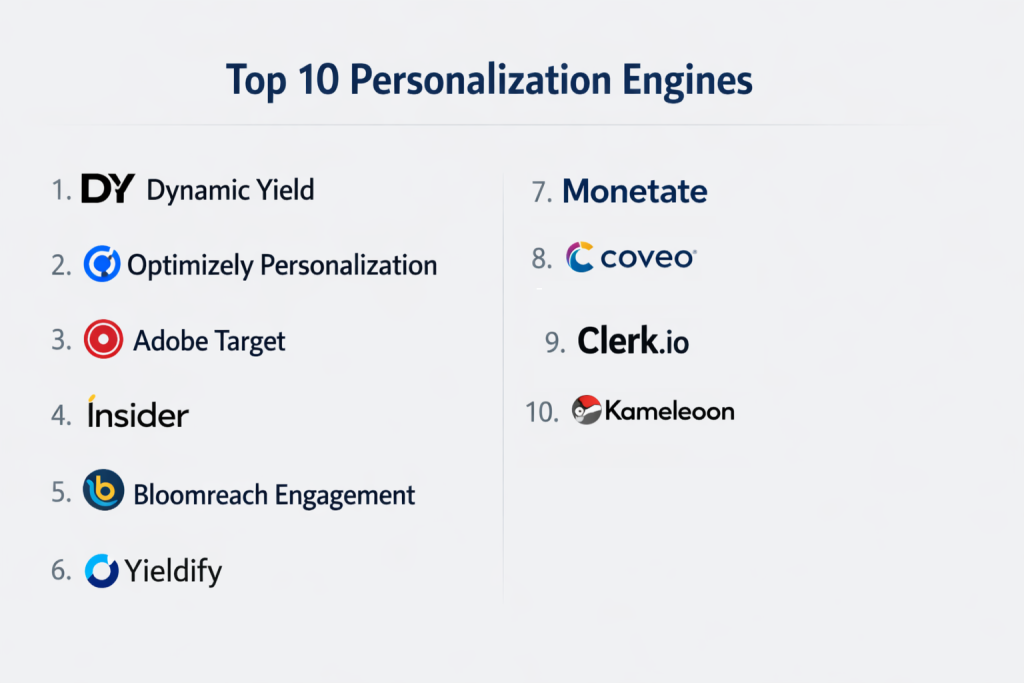
Top 10 Personalization Engines Tools
1 — Dynamic Yield
Dynamic Yield is a premium, AI-powered personalization platform that offers a unified suite for testing, optimization, and content personalization across web, mobile apps, and email.
- Key features:
- Advanced deep-learning algorithms for product recommendations.
- Omnichannel personalization that syncs user profiles across touchpoints.
- Visual editor for easy A/B testing and experience creation.
- Predictive audience targeting based on churn probability or LTV.
- Multi-layered behavioral messaging (pop-ups, banners, notifications).
- Dynamic content server-side API for high-performance apps.
- Pros:
- Exceptionally powerful AI that requires minimal manual “rule-making.”
- Excellent reporting dashboards that clearly show the revenue uplift.
- Cons:
- One of the most expensive options on the market.
- Requires a significant amount of data to “feed” the machine learning models effectively.
- Security & compliance: SOC 2 Type II, GDPR, CCPA, and ISO 27001 compliant; supports SSO and advanced encryption.
- Support & community: High-touch customer success, extensive online documentation, and “Dynamic Yield Academy” for user certification.
2 — Optimizely Personalization
Originally known for A/B testing, Optimizely has built a robust personalization engine that allows teams to deliver targeted experiences at scale without slowing down site performance.
- Key features:
- Seamless integration with Optimizely’s experimentation suite.
- “Adaptive Audience” segments that update in real-time based on behavior.
- Content recommendations powered by Natural Language Processing (NLP).
- Sophisticated visual editor for non-developers.
- Program management tools to track personalization ROI across teams.
- Pros:
- Perfect for teams that want to transition from “testing” to “personalizing” within one UI.
- Highly reliable infrastructure with minimal “flicker” on the front end.
- Cons:
- The cost is prohibitive for smaller companies.
- Can feel overly complex for teams only looking for basic product recommendations.
- Security & compliance: SOC 2 Type II, ISO 27001, HIPAA, and GDPR compliant.
- Support & community: Dedicated account managers, global user conferences, and an active developer community.
3 — Adobe Target
Part of the Adobe Experience Cloud, Adobe Target is the enterprise gold standard for AI-driven personalization and automated testing for global brands.
- Key features:
- Auto-Target: Uses machine learning to choose the best experience for each user.
- Automated Personalization: Real-time mapping of content to individuals.
- Deep integration with Adobe Analytics and Adobe Experience Manager.
- Mobile app optimization and cross-device visitor identification.
- Server-side delivery for improved SEO and performance.
- Pros:
- Unmatched scalability for organizations managing hundreds of digital properties.
- Superior AI (Adobe Sensei) for predictive modeling.
- Cons:
- Steep learning curve; often requires a dedicated specialist or agency to manage.
- Very high total cost of ownership (TCO).
- Security & compliance: FedRAMP authorized, SOC 2, ISO 27001, GDPR, and HIPAA.
- Support & community: Enterprise-grade support, professional services, and a massive ecosystem of certified partners.
4 — Insider
Insider is a “Growth Management Platform” that helps digital marketers drive growth through a highly integrated approach to personalization across web, mobile, and messaging channels like WhatsApp.
- Key features:
- Cross-channel journey orchestration (Web, App, Email, SMS, WhatsApp).
- Predictive segments powered by AI (likelihood to purchase, affinity).
- Social proof triggers (e.g., “5 people are looking at this right now”).
- Personalization for anonymous visitors using behavioral patterns.
- Category and product recommendations with high customizability.
- Pros:
- Excellent at “bridge” channels like WhatsApp and SMS personalization.
- Faster implementation time compared to traditional enterprise suites.
- Cons:
- Some users report the dashboard can be slightly laggy due to the density of features.
- Mobile app integration can be technically challenging for smaller dev teams.
- Security & compliance: ISO 27001, SOC 2 Type II, and GDPR compliant.
- Support & community: Known for highly proactive customer success teams and global localized support.
5 — Bloomreach Engagement
Bloomreach offers a specialized platform for e-commerce, combining a Customer Data Platform (CDP) with a powerful personalization and marketing automation engine.
- Key features:
- Real-time Customer Data Platform (CDP) integration.
- AI-driven search and merchandising optimization.
- Email and SMS automation based on personalized triggers.
- Web and mobile app personalization.
- Loomi AI: A proprietary e-commerce AI designed for retail intent.
- Pros:
- The most retail-focused tool on this list; understands SKU-level data deeply.
- Having the CDP and Personalization engine in one tool reduces data latency.
- Cons:
- Might be too focused on retail for companies in Finance or B2B SaaS.
- High cost of entry and complex initial data mapping.
- Security & compliance: SOC 2 Type II, GDPR, and ISO 27001 compliant.
- Support & community: Professional onboarding and a strong community of e-commerce experts.
6 — Yieldify
Yieldify is a personalization platform that focuses on “website personalization” and lead generation, specifically designed to be easy for marketers to use without deep technical help.
- Key features:
- Journey mapping to identify where users are dropping off.
- Behavioral triggers (exit intent, scroll depth, time on site).
- Simple “drag-and-drop” builder for personalized overlays and content.
- Integrated A/B and multivariate testing.
- Tiered service model providing “managed services” for teams without experts.
- Pros:
- Much more accessible and easier to set up than Adobe or Dynamic Yield.
- Their managed service is great for SMBs that don’t have a dedicated CRO team.
- Cons:
- Lacks the deep server-side and mobile app capabilities of more expensive tools.
- Personalization is more “overlay” based than deep “in-page” structural changes.
- Security & compliance: GDPR and CCPA compliant; encryption for data at rest.
- Support & community: Strong focus on account management and strategic advice.
7 — Monetate
Monetate is a long-standing leader in the space, providing a highly flexible platform for testing, segmentation, and personalized product recommendations.
- Key features:
- 1-to-1 personalization using the “Monetate Intelligent Personalization Engine.”
- Advanced segmentation that combines first-party and third-party data.
- Dynamic landing page optimization.
- “Social Proof” and urgency messaging.
- Automated discovery of new user segments through AI.
- Pros:
- Highly flexible; can be used for simple tests or complex 1-to-1 logic.
- Very reliable historical performance in the retail sector.
- Cons:
- The user interface has started to feel a bit dated compared to newer SaaS rivals.
- Some integrations with modern headless CMS platforms can be tricky.
- Security & compliance: SOC 2, PCI DSS, and GDPR compliant.
- Support & community: High-quality technical support and a wealth of retail case studies.
8 — Coveo
Coveo is an AI-powered search and recommendation engine that focuses on making every digital interaction “intelligent” by using AI to surface the most relevant content.
- Key features:
- AI-powered search that learns from user intent.
- Personalized product and content recommendations.
- Unified indexing of data from multiple sources (Salesforce, Zendesk, etc.).
- “Coveo Machine Learning” for automated query suggestions.
- Dedicated solutions for e-commerce, service, and workplace.
- Pros:
- Best-in-class for organizations where “search” is the primary way users interact.
- Excellent at B2B and technical content personalization.
- Cons:
- Not a traditional “marketing overlay” tool; it’s a deep architectural investment.
- Can be overkill if you just want to test different homepage banners.
- Security & compliance: SOC 2 Type II, HIPAA, ISO 27001, and GDPR.
- Support & community: Comprehensive “Coveo Academy” and strong developer documentation.
9 — Clerk.io
Clerk.io is an automated personalization engine specifically designed for small-to-medium-sized e-commerce businesses that want enterprise power without the complexity.
- Key features:
- “ClerkCore”: A proprietary AI that works even with limited data.
- Automated product recommendations and email marketing.
- Intelligent site search that handles typos and synonyms.
- Audience segmentation for targeted ad campaigns.
- Very fast “plug-and-play” integrations for Shopify, Magento, and WooCommerce.
- Pros:
- Incredible ease of use; can be up and running in a few hours.
- Great ROI for smaller shops that can’t afford a $5,000/month tool.
- Cons:
- Limited customizability for very complex or non-retail use cases.
- The reporting is simpler and lacks the deep “attribution” modeling of bigger players.
- Security & compliance: GDPR compliant; hosted on secure EU servers.
- Support & community: Friendly, responsive support and a helpful library of e-commerce guides.
10 — Kameleoon
Kameleoon is a powerful, AI-driven personalization and A/B testing platform that is gaining significant traction in Europe due to its strong focus on privacy and performance.
- Key features:
- Predictive Targeting: Uses AI to calculate a user’s probability of conversion in real-time.
- Advanced A/B testing for both web and full-stack (server-side).
- Flicker-free graphic editor for lightning-fast page changes.
- Consent management integration for strict GDPR compliance.
- Developer-friendly APIs and SDKs.
- Pros:
- One of the fastest engines on the market; very little impact on page speed.
- Very strong data privacy features—ideal for the EU market.
- Cons:
- Brand recognition is lower in North America compared to Adobe or Optimizely.
- AI features require a significant traffic “warm-up” period to be accurate.
- Security & compliance: HIPAA, GDPR, ISO 27001, and SOC 2 Type II.
- Support & community: Known for high-quality technical support and a transparent product roadmap.
Comparison Table
| Tool Name | Best For | Platform(s) Supported | Standout Feature | Rating (Approx.) |
| Dynamic Yield | High-Growth Retail | Web, App, Email | Deep-Learning Recommendations | 4.7 / 5 |
| Optimizely | CRO Teams | Web, App, Server | Unified Experimentation | 4.6 / 5 |
| Adobe Target | Global Enterprises | Web, App, IoT | Adobe Experience Cloud Sync | 4.4 / 5 |
| Insider | Multichannel Growth | Web, App, WhatsApp | WhatsApp/SMS Personalization | 4.7 / 5 |
| Bloomreach | E-comm Merchants | Web, Email | Retail-specific AI (Loomi) | 4.5 / 5 |
| Yieldify | SMB Marketers | Web | Managed Strategic Service | 4.3 / 5 |
| Monetate | Flexible 1-to-1 | Web, Email | Automated Segment Discovery | 4.4 / 5 |
| Coveo | Search-heavy Sites | Web, Service Portals | AI Intent-based Search | 4.5 / 5 |
| Clerk.io | Shopify/SMB E-comm | Web, Email | Plug-and-play Automation | 4.8 / 5 |
| Kameleoon | Privacy & Perf | Web, App, Server | Real-time Predictive Scoring | 4.6 / 5 |
Evaluation & Scoring of Personalization Engines
| Category | Weight | Avg. Score | Analysis |
| Core Features | 25% | 9.3 / 10 | AI-driven recommendations are now standard; the differentiator is speed. |
| Ease of Use | 15% | 7.5 / 10 | Enterprise tools are still hard to master; SMB tools have improved greatly. |
| Integrations | 15% | 8.8 / 10 | Most tools now connect natively with major CDPs and E-comm platforms. |
| Security | 10% | 9.6 / 10 | Compliance with GDPR/HIPAA is a top priority for all major vendors. |
| Performance | 10% | 8.5 / 10 | Server-side and edge delivery are solving the “flicker” issues. |
| Support | 10% | 8.2 / 10 | High-end support is expensive but generally very high quality. |
| Price / Value | 15% | 7.0 / 10 | Cost remains the biggest barrier for smaller companies to enter the space. |
Which Personalization Engines Tool Is Right for You?
Solo Users vs SMB vs Mid-market vs Enterprise
- Solo Users/Tiny Shops: Clerk.io is the way to go. It’s affordable and does the work for you, which is vital when you don’t have a data team.
- SMB: Yieldify or Clerk.io offer the best balance. Yieldify is particularly good if you want someone to help you with strategy via their managed services.
- Mid-market: Insider or Kameleoon are excellent. They offer enterprise-grade power but are more agile and often more affordable than the legacy “Big Three.”
- Enterprise: Adobe Target, Dynamic Yield, and Optimizely are the giants. They offer the security, global reach, and complex hierarchical management that massive organizations require.
Budget-conscious vs Premium Solutions
- Budget: If you are on a tight budget, look for tools that offer “pay-as-you-grow” models like Clerk.io.
- Premium: Dynamic Yield and Adobe Target are premium investments. You aren’t just paying for software; you’re paying for the most advanced AI models in the world.
Feature Depth vs Ease of Use
If you want Feature Depth (unlimited custom logic, server-side code, multi-variate everything), choose Adobe Target or Optimizely. If you want Ease of Use (drag-and-drop banners, simple recommendation blocks), choose Yieldify or Clerk.io.
Frequently Asked Questions (FAQs)
- Do personalization engines slow down my website?If implemented via client-side JavaScript, they can cause a “flicker.” However, modern tools use server-side APIs or edge computing (like Kameleoon) to eliminate this latency.
- Is personalization the same as A/B testing?No. A/B testing finds the “best version” for everyone. Personalization finds the “best version” for each person. Most engines do both.
- Does personalization work for anonymous visitors?Yes! Good engines analyze behavior (what they click, how long they stay) to build a profile even if the user hasn’t logged in.
- What is the “flicker” effect?It’s when a user briefly sees the original content before the personalized version loads. High-end tools provide technical solutions to prevent this.
- How much data do I need for AI to work?AI usually needs a few thousand visitors per month to start finding patterns. For lower-traffic sites, rule-based personalization is often better.
- Can I personalize across email and web?Yes, tools like Insider and Dynamic Yield sync user profiles so a user sees the same offer in their inbox as they do on your homepage.
- Is personalization GDPR compliant?Yes, as long as the tool supports consent management and data anonymization. European-based tools like Kameleoon are specifically built for this.
- What is “Real-time Personalization”?It means the site changes during the session. If a user adds a baby product to their cart, the homepage might change to show baby items immediately.
- Do I need a developer to use these tools?For basic setups, many offer visual editors. For deep data integration or server-side work, developer help is usually required.
- What is the typical ROI of a personalization engine?While it varies, many companies report a 10%–20% increase in revenue or conversion rates after successfully implementing a personalization strategy.
Conclusion
The selection of a Personalization Engine is a defining moment for any digital business. In , customers expect you to know them—not in a way that feels intrusive, but in a way that feels helpful. For large-scale retail and complex global operations, Dynamic Yield and Adobe Target remain the leaders. However, the rise of agile, channel-focused tools like Insider and Clerk.io has made personalization more accessible than ever before. The “best” tool is the one that aligns with your technical capabilities, your traffic volume, and your specific business goals. Start with a clear hypothesis of what your customers need, and choose the engine that can deliver that relevance with the least friction.

- Top 10 Email Deliverability Tools: Features, Pros, Cons & Comparison - September 6, 2026
- Top 10 Pharmacovigilance Software: Features, Pros, Cons & Comparison - September 6, 2026
- Top 10 Manufacturing Execution Systems (MES) - July 30, 2026