Introduction
In the world of modern software architecture, an API Gateway serves as the single point of entry for all incoming requests from clients to your backend services. Think of it as a digital traffic controller or a sophisticated concierge. Instead of a mobile app or web browser calling dozens of individual microservices directly, it makes a single call to the gateway. The gateway then handles the “plumbing”—routing the request to the correct service, verifying the user’s identity, and ensuring the backend doesn’t get overwhelmed by too much traffic.
The importance of an API Gateway lies in its ability to decouple the client interface from the backend implementation. This allows developers to update, move, or split backend services without ever breaking the frontend application. Key real-world use cases include protocol translation (like turning a web-friendly REST call into a high-speed internal gRPC call), authentication centralization, load balancing, and request rate limiting. When choosing a tool, users must evaluate latency overhead, ease of configuration, observability features, and cloud-native compatibility.
Best for:
Backend engineers, DevOps professionals, and System Architects in organizations utilizing microservices, serverless functions, or complex hybrid-cloud environments. It is a must-have for any business exposing public APIs or managing high-traffic mobile applications.
Not ideal for:
Small-scale monolithic applications where all logic resides in a single server, or simple static websites. In these cases, adding an API Gateway introduces unnecessary latency and management complexity without providing the benefits of service abstraction.
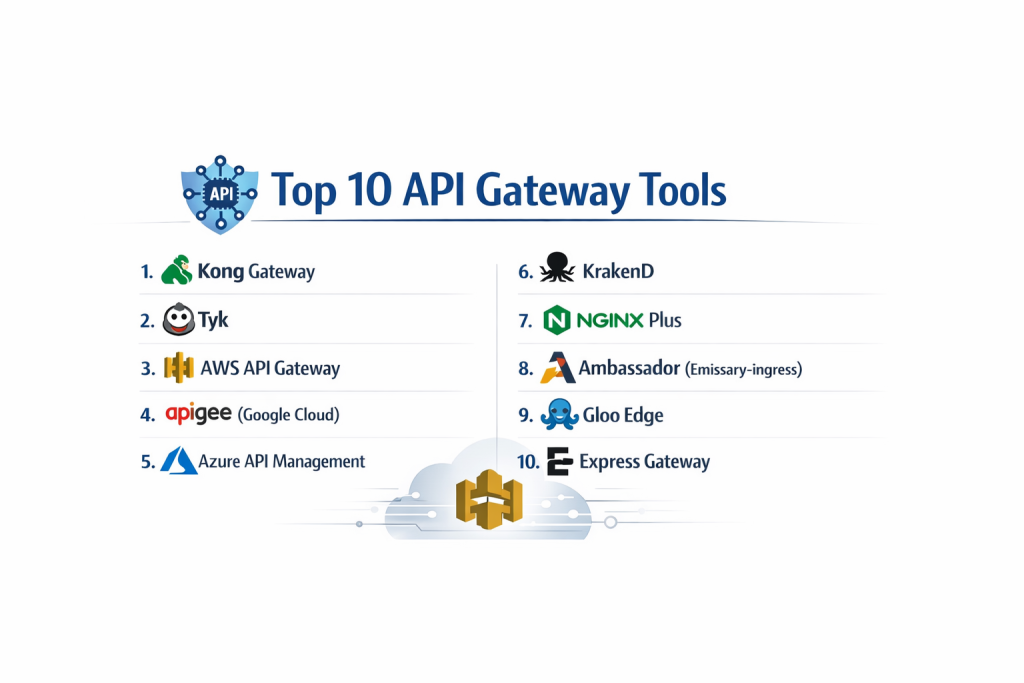
Top 10 API Gateways Tools
1 — Kong Gateway
Kong is an open-source, cloud-native API gateway built on top of NGINX, known for its incredible speed and extensibility through a modular plugin architecture.
- Key features:
- High Performance: Written in Lua, it offers sub-millisecond latency.
- Dynamic Plugin System: Add features like OAuth2, rate limiting, and logging without restarting the gateway.
- Declarative Configuration: Manage your gateway settings using YAML or JSON (decK).
- Multi-Cloud Support: Deployable on Kubernetes, AWS, Azure, or on-premise hardware.
- Service Mesh Ready: Integrates natively with Kong Mesh for internal traffic management.
- Language Extensibility: Write custom plugins in Lua, Go, Python, or JavaScript.
- Pros:
- Massive community support ensures bugs are fixed quickly and features are added often.
- Extremely lightweight compared to Java-based alternatives.
- Cons:
- The open-source version lacks a GUI, requiring CLI or API-based management.
- Advanced analytics and security features are locked behind the Enterprise paywall.
- Security & compliance: Supports SSO, OIDC, SAML, and FIPS 140-2; GDPR and SOC 2 compliant for the managed service.
- Support & community: One of the largest open-source communities in the world; extensive technical documentation and 24/7 enterprise support tiers.
2 — Amazon API Gateway
A fully managed service by AWS that allows developers to create, maintain, and secure APIs at any scale, specifically optimized for the Amazon ecosystem.
- Key features:
- Serverless Native: Perfect integration with AWS Lambda and DynamoDB.
- Canary Deployments: Safely roll out new API versions to a small subset of traffic.
- Throttling & Quotas: Prevent backend overload with granular per-client limits.
- WebSocket Support: Build real-time, two-way communication applications.
- SDK Generation: Automatically generate client SDKs for various programming languages.
- API Caching: Cache responses to improve performance and reduce backend costs.
- Pros:
- Zero infrastructure to manage; AWS handles scaling and patching automatically.
- Pay-as-you-go pricing makes it highly cost-effective for variable traffic.
- Cons:
- Can be difficult to integrate with services hosted outside of AWS.
- Latency can be slightly higher than dedicated, self-hosted gateways like Kong.
- Security & compliance: Integrates with AWS IAM and Cognito; HIPAA, PCI DSS, SOC 1/2/3, and ISO compliant.
- Support & community: Backed by AWS premium support; infinite online tutorials and a massive user base.
3 — Tyk Technologies
Tyk is a modern, Go-based open-source API gateway that emphasizes a developer-first experience and includes a full management dashboard out of the box.
- Key features:
- Go-Powered Performance: High concurrency handling with low memory overhead.
- Built-in Dashboard: A rich GUI for managing APIs, keys, and policies.
- Universal Middleware: Write custom logic for your gateway in any language.
- GraphOS: Specialized tools for managing and securing GraphQL APIs.
- Self-Healing: Automatically identifies and removes faulty backend nodes.
- Zero-Downtime Reloads: Change configurations instantly without dropping requests.
- Pros:
- The free/open-source version includes a dashboard and analytics, which many competitors charge for.
- Excellent native support for modern GraphQL architectures.
- Cons:
- Documentation can sometimes be dense and difficult for absolute beginners.
- Smaller third-party plugin ecosystem compared to NGINX-based tools.
- Security & compliance: SOC 2 Type II compliant, GDPR ready; supports OIDC, SAML, and mutual TLS (mTLS).
- Support & community: Active user forum and highly responsive direct support for paid licenses.
4 — Apigee (Google Cloud)
Google Cloud’s premium API management platform, designed for enterprises that need deep analytics, monetization, and high-level governance.
- Key features:
- AI-Powered Insights: Uses machine learning to detect traffic anomalies and security threats.
- API Monetization: Comprehensive tools for billing developers who consume your APIs.
- Advanced Developer Portal: A customizable “storefront” for your API documentation.
- Multi-Cloud Hybrid: Manage APIs across on-premise and multiple cloud providers.
- Security Reporting: Detailed dashboards on who is accessing what data.
- Traffic Shaping: Sophisticated caching and spike-arrest policies.
- Pros:
- Best-in-class analytics and business intelligence for API product managers.
- Very strong security posture for highly regulated industries.
- Cons:
- One of the most expensive options; not suitable for small projects.
- Implementation usually requires a dedicated consultant or architect.
- Security & compliance: FedRAMP, HIPAA, PCI DSS, SOC 2, and GDPR compliant.
- Support & community: Enterprise-grade support from Google Cloud; extensive training and certification programs.
5 — Azure API Management
Microsoft’s gateway solution that provides a hybrid, multi-cloud management platform for APIs across all environments.
- Key features:
- Self-Hosted Gateway: Deploy a containerized version of the gateway anywhere.
- Azure Active Directory Sync: Native security through Microsoft’s identity stack.
- Policy Expressions: Use C#-like logic to transform requests on the fly.
- Revision Management: Track changes and rollback configurations safely.
- Mocking Responses: Return sample data to frontend teams before the backend is finished.
- Virtual Network Support: Keep your API traffic completely private.
- Pros:
- Perfect for companies already using the Microsoft stack (Active Directory, Office 365).
- Excellent documentation and easy-to-use portal for developers.
- Cons:
- The high-end “Premium” tier is required for features like multi-region scaling.
- Cold-start latency can be an issue on the Consumption (serverless) tier.
- Security & compliance: ISO 27001, SOC 1/2, HIPAA, and GDPR compliant.
- Support & community: Global support network; huge presence in the enterprise sector.
6 — KrakenD
KrakenD is an ultra-high-performance open-source API Gateway that focuses strictly on speed and a stateless, “no-database” architecture.
- Key features:
- Stateless Design: No database required; configurations are loaded from simple files.
- Aggregator Pattern: Combine multiple backend calls into a single JSON response for the client.
- Response Manipulation: Filter, rename, or group data before it reaches the user.
- Declarative Config: Configuration as code, perfect for CI/CD pipelines.
- Lightweight: Can run on very small hardware or edge devices.
- Extensibility: Support for custom plugins via Lua or Go.
- Pros:
- One of the fastest gateways in the world; minimal resource footprint.
- Impossible to have a “database outage” because it doesn’t use one.
- Cons:
- Lacks a built-in UI; management is entirely through JSON files.
- Not a “full lifecycle” tool; you’ll need other tools for a developer portal.
- Security & compliance: Supports OAuth2, JWT, and SSL; GDPR compliant.
- Support & community: Solid documentation; commercial support available through KrakenD Enterprise.
7 — IBM API Connect
A heavy-duty enterprise solution that combines API gateway functionality with advanced integration and automated testing tools.
- Key features:
- Automated API Testing: Integrated tools to ensure your APIs work after every update.
- Smart Analytics: Correlate API performance with business outcomes.
- Multi-Tenant Support: Manage isolated environments for different departments.
- Micro-gateway: High-speed gateway for local execution.
- Lifecycle Governance: Clear approval workflows for publishing and retiring APIs.
- Hybrid Cloud: Consistent experience across on-premise and cloud.
- Pros:
- Unmatched for organizations with complex regulatory and audit requirements.
- Highly resilient; built for 99.999% availability.
- Cons:
- The interface is complex and can be overwhelming for developers.
- High cost of ownership and lengthy setup times.
- Security & compliance: FIPS 140-2, SOC 2, HIPAA, and ISO 27001 compliant.
- Support & community: IBM’s world-class professional services and global support network.
8 — Gloo Gateway (Solo.io)
Gloo is a next-generation API gateway built on Envoy Proxy, designed specifically for Kubernetes and microservices.
- Key features:
- Envoy-Based: Leverages the industry-standard proxy for cloud-native apps.
- Hybrid Connectivity: Connects legacy apps to Kubernetes services effortlessly.
- WebAssembly (Wasm) Support: Extend the gateway using any language that compiles to Wasm.
- Auto-Discovery: Automatically finds services running in your Kubernetes cluster.
- Sophisticated Routing: Path-based, header-based, and weighted (Blue/Green) routing.
- Istio Integration: Works perfectly as an entry point for an Istio service mesh.
- Pros:
- The most forward-looking tool for teams deep into the Kubernetes ecosystem.
- Wasm support allows for truly custom, high-performance logic.
- Cons:
- Very high learning curve; requires knowledge of Kubernetes and Envoy.
- Overkill for simple applications or non-containerized environments.
- Security & compliance: SOC 2 compliant; supports mTLS, OIDC, and JWT.
- Support & community: Very technical and responsive community; high-end support for enterprise users.
9 — Express Gateway
A minimalist, open-source API gateway built entirely on Express.js, designed specifically for JavaScript and Node.js developers.
- Key features:
- JavaScript First: Configure and extend the gateway using familiar JS code.
- Plugin System: Dozens of pre-built plugins for auth, proxying, and logging.
- CLI Tools: Easy management of users, apps, and credentials from the terminal.
- Policy-Based: Define “pipelines” to process requests through multiple steps.
- Hot-Reload: Change policies without needing to restart the Node process.
- Microservices Ready: Simple to deploy as a container.
- Pros:
- The easiest gateway for Node.js developers to understand and maintain.
- Extremely fast to set up for simple projects and MVPs.
- Cons:
- Performance is not as high as Go or C++ based gateways.
- Lacks the advanced “enterprise” features like monetization or deep analytics.
- Security & compliance: Supports standard OAuth2 and Key Auth; Varies / N/A.
- Support & community: Good community on GitHub; documentation is clear but limited.
10 — Ambassador (Emissary-ingress)
Another Envoy-based gateway, Ambassador is designed to be the “Kubernetes-native” ingress controller that developers can manage themselves.
- Key features:
- Kubernetes CRDs: Manage gateway settings using standard Kubernetes manifests.
- Self-Service: Developers can manage their own routes without waiting for IT.
- Automatic HTTPS: Integrated support for Let’s Encrypt for SSL management.
- Rate Limiting: Sophisticated per-service and per-user limits.
- Observability: Native integration with Prometheus and Grafana.
- Developer Portal: Simple, integrated portal for API discovery.
- Pros:
- Simplifies the “Ingress” problem in Kubernetes significantly.
- Empowers development teams to own their API lifecycle.
- Cons:
- Some critical features (like SSO) require the paid Edge Stack version.
- Can be resource-heavy for smaller clusters.
- Security & compliance: SOC 2 compliant; supports OAuth, OIDC, and SAML.
- Support & community: Very active Slack community and comprehensive documentation.
Comparison Table
| Tool Name | Best For | Platform(s) Supported | Standout Feature | Rating (Gartner) |
| Kong | High Performance | Hybrid, K8s, Cloud | Massive Plugin Library | 4.5 / 5 |
| AWS API GW | Serverless / AWS | AWS Native | Serverless Integration | 4.4 / 5 |
| Tyk | GraphQL / Hybrid | Cloud, On-prem | Built-in Dashboard | 4.6 / 5 |
| Apigee | Monetization / Enterprise | Hybrid, Multi-cloud | Business Analytics | 4.8 / 5 |
| Azure API MGMT | Microsoft Ecosystem | Azure, Hybrid | Policy Expressions | 4.4 / 5 |
| KrakenD | Raw Speed / Stateless | Linux, Containers | No-DB Architecture | N/A |
| IBM API Connect | Governance / Finance | On-prem, Hybrid | Automated Testing | 4.3 / 5 |
| Gloo | K8s / Service Mesh | Kubernetes | Wasm Extensibility | N/A |
| Express GW | Node.js Developers | Node.js, Linux | JavaScript Native | N/A |
| Ambassador | Kubernetes Ingress | Kubernetes | K8s Native Config | N/A |
Evaluation & Scoring of API Gateways
We evaluated these platforms based on a weighted rubric to assist in objective decision-making.
| Category | Weight | Avg. Score | Analysis |
| Core Features | 25% | 9.2 / 10 | Most tools now offer the “basics” (routing, auth, rate limiting) flawlessly. |
| Ease of Use | 15% | 7.8 / 10 | Enterprise tools are complex; AWS and Tyk lead in intuitive setup. |
| Integrations | 15% | 9.0 / 10 | Cloud-native tools (Kong, Gloo) have excellent ecosystem hooks. |
| Security & Comp. | 10% | 9.5 / 10 | A high-scoring area; this is the primary reason people buy these tools. |
| Performance | 10% | 8.8 / 10 | KrakenD and Kong are the speed leaders; Java/Node tools are slower. |
| Support & Comm. | 10% | 8.5 / 10 | Community size is vital for troubleshooting open-source issues. |
| Price / Value | 15% | 7.5 / 10 | Pricing is the biggest pain point, especially for scaling startups. |
Which API Gateways Tool Is Right for You?
Solo Users vs SMB vs Mid-market vs Enterprise
- Solo Users/Freelancers: Start with Express Gateway or AWS API Gateway (Free Tier). They are easy to set up and costs are minimal for low traffic.
- SMBs: Tyk or Kong (Open Source) provide a professional-grade gateway with a clear path to growth.
- Mid-market: Azure or Ambassador are great for teams that need to scale rapidly but want to keep management overhead low.
- Enterprise: Apigee or IBM API Connect are built for the regulatory and analytical needs of billion-dollar organizations.
Budget-conscious vs Premium Solutions
If budget is the primary driver, KrakenD and Kong (Open Source) offer incredible power for free. If you have the capital and need a “turn-key” solution with monetization and world-class analytics, Apigee is the premium choice.
Feature Depth vs Ease of Use
For Ease of Use, Glide and AWS provide the fastest “time-to-first-call.” For Feature Depth, MuleSoft (not listed, but similar to IBM) and Apigee offer complex logic that simpler gateways cannot handle.
Frequently Asked Questions (FAQs)
- What is the difference between an API Gateway and a Load Balancer?A load balancer simply distributes traffic. An API gateway understands the “content” of the request—it can check if a user is logged in, transform the data, and route based on the specific API version.
- Does an API Gateway add latency?Yes, because it is an extra “hop” in the network. However, high-performance gateways like Kong or KrakenD add less than 1-2 milliseconds, which is negligible for most apps.
- Can I build an API Gateway myself?Technically, yes (e.g., using NGINX or Node.js). However, managing security, key rotation, and rate limiting yourself is complex and error-prone compared to using a battle-tested platform.
- Why do I need an API Gateway for Kubernetes?Kubernetes “Ingress” is basic. A gateway like Ambassador or Gloo provides the advanced security and transformation features that the default Ingress lacks.
- Is Open Source safe for production?Yes. Most of the world’s largest companies (including Netflix and Uber) use open-source gateway cores like Kong or Envoy.
- What is “Rate Limiting” exactly?It prevents a single user (or an attacker) from making too many requests. For example, you can limit a user to “5 calls per second” to protect your database.
- How do I monetize my API?Enterprise tools like Apigee allow you to set up “plans” (e.g., $10/month for 1,000 calls). The gateway tracks the calls and integrates with a billing system.
- Can one gateway handle multiple cloud providers?Yes. Modern tools like Tyk and Kong Konnect are designed for multi-cloud management, allowing you to manage AWS and Azure APIs from one dashboard.
- What is “Protocol Translation”?It’s when a gateway accepts a request in one format (like HTTP) and talks to the backend in another (like SOAP or gRPC), allowing old and new systems to communicate.
- Do I need a gateway if I only have one backend?Probably not. If you only have one server, a simple Load Balancer or Reverse Proxy is usually enough. You need a gateway once you have 3+ services or a public developer ecosystem.
Conclusion
The “best” API Gateway in 2026 is the one that fits your existing environment and your team’s technical expertise. If you are a Kubernetes-first shop, Ambassador or Gloo will feel like home. If you are building a lightning-fast mobile app backend, Kong or KrakenD will provide the performance you need.
Ultimately, an API Gateway is an investment in your architecture’s security and flexibility. By centralizing the complex logic of authentication and traffic management, you free up your developers to focus on what actually matters: building features that solve your users’ problems. Choose a tool that offers an “escape hatch” (like custom plugins or code export) so you are never locked in as your business evolves.

- Top 10 Email Deliverability Tools: Features, Pros, Cons & Comparison - September 6, 2026
- Top 10 Pharmacovigilance Software: Features, Pros, Cons & Comparison - September 6, 2026
- Top 10 Manufacturing Execution Systems (MES) - July 30, 2026