Introduction
Employee engagement is no longer a corporate buzzword; it’s a measurable driver of productivity, retention, and overall business success. An Employee Engagement Platform is a specialized suite of digital tools designed to measure, analyze, and improve the connection between employees and their organization. These platforms go beyond annual surveys, offering continuous feedback channels, recognition systems, wellness tracking, and actionable analytics to foster a positive, productive, and aligned workplace culture.
The importance of these platforms cannot be overstated. In today’s hybrid and remote work environments, maintaining a cohesive, motivated workforce is a significant challenge. Disengaged employees cost organizations through higher turnover, lower quality of work, and lost innovation. Engagement platforms provide the infrastructure to listen to employees, act on their feedback, and build a culture where people feel valued and heard, directly impacting bottom-line results like profitability and customer satisfaction.
Key real-world use cases include conducting pulse surveys to gauge real-time sentiment, running peer-to-peer recognition programs to celebrate achievements, facilitating goal alignment between individual and company objectives, and providing wellbeing resources to support mental and physical health. They turn abstract concepts like “company culture” into tangible, manageable data.
When evaluating these tools, buyers should look for: Comprehensive feedback mechanisms (surveys, polls, suggestions), robust analytics and reporting to derive insights from data, seamless integrations with existing HR and communication tech stacks (like Slack, Microsoft Teams, HRIS), a user-friendly and engaging interface to drive adoption, and proven ROI through case studies or demonstrable metrics.
Best for: HR leaders, People Operations teams, and managers in mid-to-large-sized companies (typically 100+ employees) across all industries, particularly tech, finance, and professional services where talent retention is critical. They are also highly valuable for distributed or hybrid teams seeking to maintain culture.
Not ideal for: Very small startups or teams under 20 people where informal, direct communication is still highly effective. Organizations with extremely limited budgets and no capacity for cultural initiatives, or those seeking a single-point solution (like only survey software) without the broader engagement ecosystem.
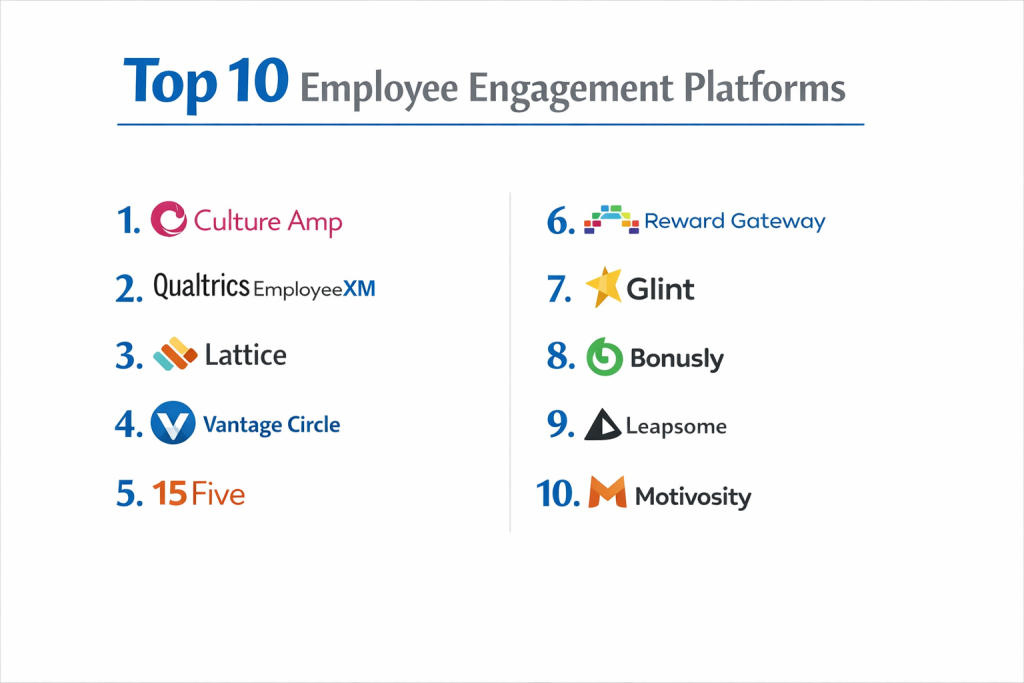
Top 10 Employee Engagement Platforms Tools
1 — Culture Amp
Culture Amp is a powerful, research-backed platform focused on empowering organizations with employee feedback, analytics, and development tools. It is designed for people-centric companies that want to make data-driven decisions to improve culture, engagement, and performance.
Key features:
- Science-backed engagement, pulse, and lifecycle surveys.
- Deep analytics with benchmarks against industry data.
- Goals and feedback (CFR) tools for performance management.
- Diversity, Equity, & Inclusion (DEI) analytics and reporting.
- Seamless integrations with HRIS, Slack, and Microsoft Teams.
- Action planning tools with recommended resources for managers.
- Advanced segmentation for drilling down into team-level data.
Pros:
- Unmatched depth in people analytics and benchmarking, trusted by top-tier companies.
- Strong focus on manager enablement with actionable insights and guides.
- Excellent customer success and strategic support for enterprise clients.
Cons:
- Premium pricing places it out of reach for many small businesses.
- Can feel overwhelming for smaller teams due to its extensive feature set and data depth.
- Configuration and getting to high-value insights requires time and commitment.
Security & compliance: SOC 2 Type II, ISO 27001 certified, GDPR compliant, offers SSO, and data encryption at rest and in transit.
Support & community: Comprehensive knowledge base, dedicated customer success managers for enterprise plans, active user community forums, and regular expert-led webinars.
2 — Qualtrics EmployeeXM
Part of the broader Qualtrics Experience Management (XM) Platform, EmployeeXM is an enterprise-grade solution for capturing and acting on employee feedback across the entire journey, from candidate to alumni.
Key features:
- Sophisticated, drag-and-drop survey builder with advanced logic.
- Predictive intelligence and iQ that identifies key drivers of engagement and attrition.
- Journey mapping across the entire employee lifecycle (e.g., onboarding, exit).
- Real-time dashboards and automated alerts for critical feedback.
- Integration with HR systems to link engagement data with operational data (like performance).
- Robust closed-loop action management to track issue resolution.
- EX benchmarks across a massive global database.
Pros:
- Extremely powerful predictive analytics and text analytics (iQ) for uncovering deep insights.
- Seamlessly connects employee experience (EX) data with customer experience (CX) and brand experience (BX) on one platform.
- Highly customizable and scalable for complex, global enterprise needs.
Cons:
- One of the most expensive solutions on the market, with a high cost of entry.
- Significant learning curve; requires trained administrators to unlock full potential.
- Can be “overkill” for companies only needing basic engagement surveying.
Security & compliance: SOC 2, SOC 3, ISO 27001, ISO 27018, GDPR, HIPAA, FedRAMP authorized. Offers extensive security controls including SSO and data residency options.
Support & community: 24/7 global support, dedicated XM success managers, extensive certification training programs (Qualtrics Academy), and a large user community.
3 — Lattice
Lattice positions itself as an all-in-one people success platform, effectively blending engagement, performance management, and growth into a single, user-friendly system. It’s popular with high-growth tech companies.
Key features:
- Integrated engagement surveys (pulse, engagement, eNPS) and goals/OKRs.
- Continuous performance management with 1-on-1s, feedback, and reviews.
- Career growth frameworks and competency matrices.
- Real-time praise and recognition feed.
- Analytics that connect engagement, performance, and growth data.
- Manager enablement tools with agenda templates and talking points.
- Deep integrations with Slack, Microsoft Teams, and Google Workspace.
Pros:
- Intuitive and aesthetically pleasing interface that drives high user adoption.
- Powerful integration of engagement, performance, and development—breaking down HR data silos.
- Strong focus on the employee and manager experience with practical, everyday tools.
Cons:
- While robust, its analytics may not be as deep or benchmark-heavy as pure-play engagement platforms like Culture Amp.
- Pricing can scale quickly as you add modules (Performance, Grow, etc.).
- Some advanced customization options may be limited compared to larger enterprise suites.
Security & compliance: SOC 2 Type II certified, GDPR compliant, data encryption, and offers SSO (SAML, Google, Okta).
Support & community: Help center, email and chat support, implementation specialists, and an active customer community with resource sharing.
4 — Vantage Circle
Vantage Circle is a comprehensive employee engagement and benefits platform with a strong focus on rewards and recognition, aiming to make appreciation easy, frequent, and global.
Key features:
- Global rewards catalog with points-based redemption (gift cards, merchandise, experiences).
- Social recognition walls with peer-to-peer and top-down recognition.
- Corporate discounts and perk programs.
- Wellness challenges and tracking to promote health.
- Milestone and service anniversary celebrations.
- Survey tools for feedback and engagement.
- Analytics dashboard to track recognition and reward spending ROI.
Pros:
- Very strong and flexible rewards engine with a vast global catalog, great for multinational teams.
- Combines recognition, rewards, wellness, and discounts into a single, engaging portal.
- Often more cost-effective than tiered-points systems, with transparent pricing.
Cons:
- The core engagement and survey analytics are less sophisticated than analytics-focused platforms.
- The platform’s look and feel can vary in modernity across different modules.
- Primarily drives value through its rewards system; other features are supplementary.
Security & compliance: GDPR compliant, uses SSL encryption, and follows standard cloud security practices. Specific enterprise compliance details vary.
Support & community: Dedicated account manager for enterprise clients, email and phone support, and online resources/documentation.
5 — 15Five
15Five is a performance and engagement platform built on the philosophy that it takes 15 minutes to write a report and 5 minutes to read it. It emphasizes continuous feedback, weekly check-ins, and strategic goal setting (OKRs).
Key features:
- Weekly check-ins and pulse surveys to maintain constant communication.
- Holistic performance reviews integrated with continuous feedback.
- OKR (Objectives and Key Results) goal setting and tracking.
- Peer recognition (“High Fives”) and manager praise.
- 1-on-1 meeting agendas and tracking.
- Engagement and performance analytics.
- “Best-Self Academy” for manager and leadership development.
Pros:
- Excellent for creating a rhythm of continuous conversation, reducing survey fatigue.
- Simple, focused interface that managers and employees actually enjoy using.
- Strong alignment between weekly priorities (Check-ins) and long-term goals (OKRs).
Cons:
- May lack the deep, research-heavy engagement analytics of some competitors.
- The “continuous” model requires strong cultural buy-in; can feel repetitive if not embraced.
- Advanced talent review or succession planning features are not its core strength.
Security & compliance: SOC 2 Type II certified, GDPR/CCPA compliant, data encryption, and offers SSO.
Support & community: Online knowledge base, email and chat support, dedicated customer success for higher tiers, and a library of managerial training content.
6 — Reward Gateway
Reward Gateway’s “SmartHub” is an employee engagement platform that combines recognition, rewards, communications, surveys, and discounts into one unified employee app, emphasizing everyday connection.
Key features:
- Employee discount and perks program with thousands of offers.
- “Cheers for Peers” social recognition with points and rewards.
- Corporate communications hub with newsletter and announcement tools.
- Engagement survey tools with benchmarking.
- Wellness challenges and resources.
- Service anniversary and milestone recognition.
- All accessible via a branded mobile app and desktop portal.
Pros:
- Creates a “one-stop-shop” employee app that drives daily logins and engagement.
- Particularly strong in the discount/rewards and internal communications segments.
- Effective for deskless and frontline workers via its accessible mobile experience.
Cons:
- The survey and analytics module is not as specialized or deep as standalone platforms.
- Can feel more like a suite of bundled tools rather than a deeply integrated system.
- Customization and complex workflow automation can be limited.
Security & compliance: ISO 27001 certified, Cyber Essentials Plus, GDPR compliant, with data encryption and secure data centers.
Support & community: Dedicated engagement consultant, 24/7 support hub, client success team, and a resource library of best practices.
7 — Glint
Now part of LinkedIn, Glint focuses on using people science and real-time analytics to help leaders understand and improve employee engagement, wellbeing, and retention.
Key features:
- AI-powered analytics that identify key engagement drivers and predict turnover risks.
- Real-time dashboard with dynamic, drillable data.
- “Always-on” feedback channels with short, frequent pulses.
- Action planning tools with guided recommendations for leaders.
- Integration with LinkedIn Talent Solutions to connect engagement data with talent insights.
- Focus on manager effectiveness with personalized insights.
- Benchmarking against a large dataset.
Pros:
- Powerful predictive analytics and a clean, intuitive dashboard for leaders.
- Strong integration with the LinkedIn ecosystem, offering unique talent insights.
- Emphasis on guiding leaders to take quick, effective action on feedback.
Cons:
- As part of a larger suite (LinkedIn Talent Solutions), it may be bundled in ways that are only cost-effective for larger enterprises.
- Less focus on the recognition/rewards or performance management features found in all-in-one platforms.
- Primarily an analytics and survey engine, requiring other tools for a full engagement suite.
Security & compliance: SOC 1, SOC 2, ISO 27001 certified. GDPR, CCPA compliant. Leverages Microsoft Azure’s security infrastructure.
Support & community: Customer success team, detailed help center, and access to LinkedIn’s learning and development resources.
8 — Bonusly
Bonusly is a peer-to-peer recognition and rewards platform designed to make employee appreciation frequent, inclusive, and values-aligned. It excels at creating a culture of gratitude through micro-bonuses.
Key features:
- Peer-to-peer recognition with monetary bonuses (small micro-bonuses).
- Integration with Slack, Microsoft Teams, and email for seamless giving.
- Customizable recognition hashtags (#Teamwork, #Innovation) to tie to company values.
- Social feed to celebrate recognitions company-wide.
- Redemption for gift cards, charitable donations, or custom experiences.
- Analytics on recognition trends, participation, and spend.
- API for custom integrations and workflows.
Pros:
- Exceptionally easy and fun to use, leading to very high participation rates.
- Effectively promotes inclusive, bottom-up recognition (not just top-down).
- Transparent, simple pricing based on active users and monthly bonus allowance.
Cons:
- Is primarily a recognition tool; lacks built-in robust survey, performance, or goals modules.
- The social-feed model may not suit all corporate cultures.
- Best when integrated into existing communication channels; as a standalone portal, engagement might drop.
Security & compliance: SOC 2 Type II certified, GDPR compliant, data encryption. Security specifics for larger enterprises vary.
Support & community: Email and chat support, help docs, and a dedicated customer success contact for business plans.
9 — Leapsome
Leapsome is a modular platform that closes the loop between engagement, performance, and learning. It is popular with European and US tech companies for its flexibility and comprehensive feature set.
Key features:
- Engagement and pulse surveys with advanced analytics.
- Goals & OKRs management with alignment views.
- Performance reviews and 360° feedback cycles.
- Learning & development course creation and tracking.
- Continuous 1-on-1s and meeting agendas.
- Integrated recognition and praise.
- All modules feed into a unified analytics suite.
Pros:
- Highly flexible and configurable modules that can be used independently or together.
- Strong European focus with excellent multilingual support and GDPR compliance.
- Clean, modern UI and a strong product roadmap responsive to user feedback.
Cons:
- As a younger company, its brand recognition and benchmark database are smaller than industry giants.
- Implementation can require more configuration due to its high flexibility.
- The learning module, while good, is not a full-fledged LMS replacement.
Security & compliance: GDPR compliant (German provider), ISO 27001 certified, data encrypted in transit and at rest, offers SSO.
Support & community: Responsive customer support, detailed help center, and implementation guidance.
10 — Motivosity
Motivosity is built on the simple idea that employees leave managers, not companies. It provides tools for managers to lead better, connect with their teams, and provide meaningful recognition.
Key features:
- “Thanks Bank” for peer-to-peer and manager-led recognition with monetary rewards.
- “Lead” module for actionable feedback, conversation guides, and manager training.
- “Connect” module for idea sharing and virtual suggestion boxes.
- “Listen” module for engagement surveys and pulse checks.
- Focus on providing tangible leadership training and resources to managers.
- Analytics on recognition, feedback, and engagement.
Pros:
- Unique and strong emphasis on practical manager training and development resources.
- Affordable and straightforward pricing, especially for SMBs.
- Combines recognition with actionable management tools effectively.
Cons:
- Brand recognition is lower compared to some larger players.
- May not have the depth of enterprise-scale analytics or global reward catalogs.
- The platform’s different “modules” can feel somewhat distinct rather than fully fused.
Security & compliance: Varies. Standard cloud security practices, data encryption. Specific enterprise compliance certifications should be confirmed.
Support & community: Customer success team, training webinars, and knowledge base.
Comparison Table
| Tool Name | Best For | Platform(s) Supported | Standout Feature | Rating |
|---|---|---|---|---|
| Culture Amp | Data-driven HR & People teams in mid-large co. | Web, Mobile App | Deep people science & industry benchmarking | 4.7/5 |
| Qualtrics EmployeeXM | Large enterprises needing predictive EX/CX insights | Web, Mobile App | Predictive Intelligence (iQ) & journey analytics | 4.8/5 |
| Lattice | High-growth tech companies wanting an all-in-one suite | Web, Mobile App, Slack, MS Teams | Seamless integration of Engagement, Perf., & Growth | 4.6/5 |
| Vantage Circle | Companies prioritizing global rewards & recognition | Web, Mobile App | Extensive global rewards catalog & discounts | 4.5/5 |
| 15Five | Organizations building a culture of continuous feedback | Web, Mobile App, Slack, MS Teams | Weekly Check-ins & OKRs for ongoing alignment | 4.6/5 |
| Reward Gateway | Frontline/deskless workforces & internal comms focus | Web, Mobile App (strong) | All-in-one employee app (SmartHub) for daily use | 4.4/5 |
| Glint | Leaders wanting predictive analytics on retention risk | Web, LinkedIn Integration | AI-powered insights & LinkedIn ecosystem integration | 4.5/5 |
| Bonusly | Creating a frequent, fun, & inclusive recognition culture | Web, Slack, MS Teams, Email | Simple, social peer-to-peer micro-bonuses | 4.7/5 |
| Leapsome | European/international companies wanting a flexible modular system | Web, Mobile App | Highly configurable modules (Engage, Perform, Learn) | 4.6/5 |
| Motivosity | SMBs focused on manager development and recognition | Web, Mobile App | Practical manager training resources (“Lead” module) | 4.5/5 |
Evaluation & Scoring of Employee Engagement Platforms
| Criteria | Weight | Description & What to Look For |
|---|---|---|
| Core Features | 25% | Breadth and depth of tools: Surveys (pulse, lifecycle), Recognition, Goals/OKRs, Feedback, Analytics, Action Planning. |
| Ease of Use | 15% | Intuitive UI for admins, managers, and employees. Low learning curve drives adoption. |
| Integrations & Ecosystem | 15% | Pre-built connectors with HRIS (Workday, BambooHR), communication (Slack, Teams), and other critical systems. API strength. |
| Security & Compliance | 10% | SOC 2, ISO 27001, GDPR, HIPAA, etc. Data encryption, SSO, and enterprise-grade controls. |
| Performance & Reliability | 10% | Platform uptime, speed, scalability for large user bases, and quality of mobile experience. |
| Support & Community | 10% | Quality of onboarding, customer support channels, knowledge base, user community, and strategic advisory. |
| Price / Value | 15% | Transparent pricing relative to features, scalability, and ROI. Total cost of ownership vs. benefits delivered. |
Which Employee Engagement Platform Tool Is Right for You?
Choosing the right platform is about matching its strengths to your specific organizational context.
- Solo Users vs. SMB vs. Mid-Market vs. Enterprise: SMBs (Under 500 employees) should prioritize ease of use, quick ROI, and affordability. 15Five, Motivosity, or Bonusly are excellent starting points. Mid-Market (500-5,000) needs scalability, better analytics, and stronger integrations. Lattice, Culture Amp, or Leapsome shine here. Large Enterprises (5,000+) require global scalability, deep security, advanced analytics, and strategic support. Qualtrics, Culture Amp, and Glint are built for this scale.
- Budget-Conscious vs. Premium Solutions: For strict budgets, Bonusly (recognition-focused) or Motivosity offer great core value. Premium solutions like Qualtrics and Culture Amp justify their cost with unmatched analytics and enterprise capabilities.
- Feature Depth vs. Ease of Use: If you need deep, scientific analytics and are willing to invest in configuration, choose Culture Amp or Qualtrics. If driving rapid, company-wide adoption with a beautiful, simple interface is key, Lattice or 15Five are better bets.
- Integration and Scalability Needs: If you rely heavily on Slack or Microsoft Teams, ensure the platform has deep, two-way integrations (Lattice, 15Five, Bonusly excel here). For scaling globally, consider tools with strong multi-currency, multi-language support and global rewards catalogs (Vantage Circle, Reward Gateway).
- Security and Compliance Requirements: Regulated industries (finance, healthcare) or any enterprise must prioritize SOC 2 Type II, ISO 27001, and specific data residency requirements. Qualtrics, Culture Amp, and Glint lead here. Confirm compliance details directly with the vendor.
Frequently Asked Questions (FAQs)
1. What is the difference between an Employee Engagement Platform and simple survey software?
An Employee Engagement Platform is a holistic ecosystem that includes surveys plus tools for recognition, goals, feedback, and analytics, all designed to drive action and improve culture. Simple survey software only collects data, leaving analysis and action planning to other, disconnected tools.
2. How much does an Employee Engagement Platform typically cost?
Pricing varies widely from ~$4-12 per user/month for basic SMB plans to custom enterprise quotes that can be $30,000+ annually. Most vendors use a tiered subscription model based on number of employees and feature modules.
3. What is the typical implementation timeline for these platforms?
For core survey and recognition modules, implementation can take 4-8 weeks. For full-suite deployments with complex integrations and customization, expect 3-6 months. Many vendors offer “quick launch” options for faster onboarding.
4. How do these platforms ensure employee feedback remains anonymous?
Reputable platforms use data aggregation thresholds (usually 5+ responses) before showing results, disable tracking of individual responses in reporting, and use secure encryption. However, anonymity depends on survey configuration.
5. Can these tools integrate with our existing HRIS (like Workday or BambooHR)?
Yes, most leading platforms offer pre-built integrations with major HRIS systems to sync employee data, though the depth of integration (one-way vs. two-way sync) varies by vendor and may require additional configuration.
6. What metrics should we track to measure the ROI of an engagement platform?
Key metrics include: Employee Net Promoter Score (eNPS), survey participation rates, voluntary turnover/retention rates, internal promotion rates, and correlations between engagement scores and business outcomes like productivity or customer satisfaction.
7. Are these platforms suitable for frontline or deskless workers?
Yes, many platforms like Reward Gateway and Vantage Circle offer mobile-first experiences. Key considerations include mobile app accessibility, offline capabilities, and integration with communication tools frontline workers already use.
8. How often should we run employee engagement surveys?
Best practice has moved from annual surveys to quarterly or monthly pulse surveys (5-10 questions) supplemented by annual deep-dive surveys. The exact frequency should match your organization’s capacity to analyze results and take action.
9. What happens to our data if we decide to switch platforms later?
Most vendors provide data export functionality, though formats and comprehensiveness vary. You should inquire about data portability and extraction fees during the sales process to avoid lock-in.
10. Can we customize the platform to match our company’s branding and culture?
Most platforms offer white-labeling options, custom color schemes, logo placement, and the ability to name features using your internal terminology (like calling recognition “Kudos” or “High Fives”).
Conclusion
Selecting the right Employee Engagement Platform is a strategic investment in your most valuable asset: your people. The landscape offers solutions for every need, from fostering daily recognition with Bonusly to powering data-driven executive decisions with Qualtrics. The key is to clearly define your primary objectives—whether it’s improving retention through predictive analytics, unifying culture with continuous feedback, or simply making appreciation a daily habit.
Remember, the “best” platform is not the one with the most features or the highest price tag. It is the one that aligns with your company size, budget, cultural maturity, and specific challenges. Success depends less on the tool itself and more on your commitment to listening to employees, empowering managers with insights, and taking consistent action. Start with a clear vision, involve stakeholders in the selection process, and choose a platform that will grow and evolve with your organization’s journey toward a more engaged and successful workforce.

- Top 10 Email Deliverability Tools: Features, Pros, Cons & Comparison - September 6, 2026
- Top 10 Pharmacovigilance Software: Features, Pros, Cons & Comparison - September 6, 2026
- Top 10 Manufacturing Execution Systems (MES) - July 30, 2026