Introduction
Interactive Voice Response (IVR) and Voice Bot platforms are the digital gatekeepers of modern customer service. IVR is an automated telephony system that interacts with callers, gathers information, and routes calls to the appropriate recipient via keypad inputs or voice recognition. Voice Bots, their more advanced successors, utilize Conversational AI, Natural Language Processing (NLP), and Machine Learning to understand spoken intent, allowing customers to engage in fluid, human-like dialogue. These platforms serve as the first point of contact, transitioning from the rigid “Press 1 for Sales” menus of the past to sophisticated virtual assistants that can resolve issues without human intervention.
The importance of these tools lies in their ability to offer 24/7 accessibility while drastically reducing operational costs. By automating routine inquiries—such as checking a bank balance or tracking a package—businesses free up their human agents to handle complex emotional or technical issues. Key real-world use cases include identity verification in banking, appointment scheduling in healthcare, and high-volume order tracking in e-commerce. When choosing a platform, users should evaluate the “naturalness” of the speech synthesis, the ease of the drag-and-drop flow designer, CRM integration capabilities, and the accuracy of intent recognition.
Best for: Customer Experience (CX) managers, IT directors, and operations leads in mid-market to enterprise-level organizations. They are essential for industries with high call volumes, such as financial services, telecommunications, travel, and public utilities.
Not ideal for: Small boutique businesses with low call volumes where a personal touch is the primary brand differentiator, or organizations that lack the technical staff to manage and optimize AI-driven conversation flows.
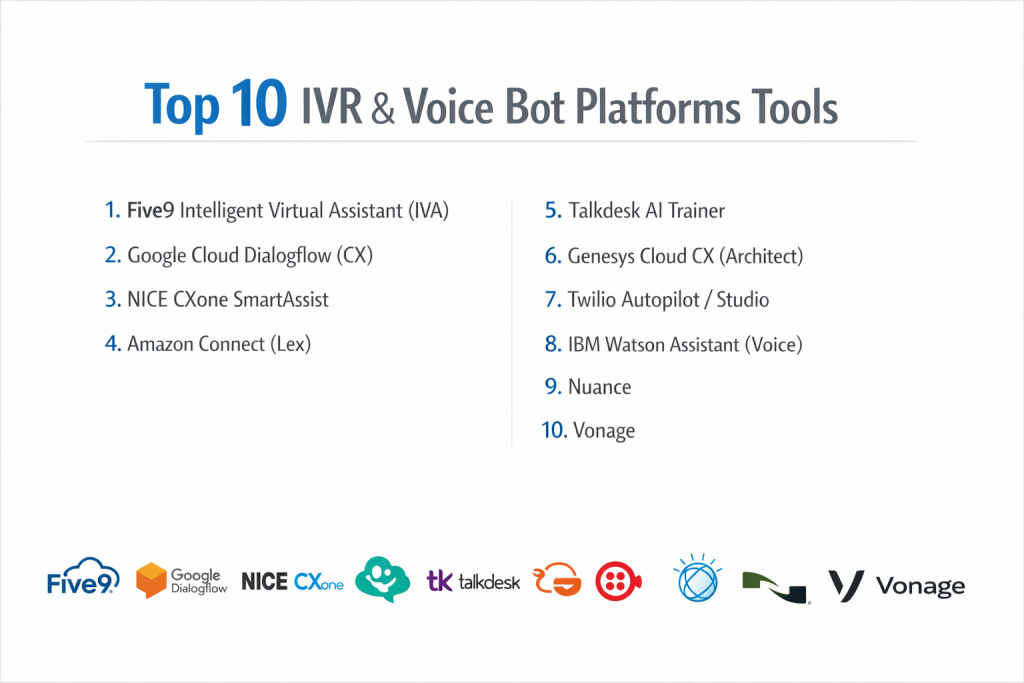
Top 10 IVR & Voice Bot Platforms Tools
1 — Five9 Intelligent Virtual Assistant (IVA)
Five9 offers a leading cloud-based IVA that moves beyond traditional IVR by using conversational AI to provide intuitive, self-service experiences for customers.
- Key features:
- Natural Language Processing (NLP) to understand complex customer intent.
- Easy-to-use visual workflow designer for building voice flows.
- Seamless “low-latency” handoff from bot to live agent with full context.
- Integration with popular CRM platforms like Salesforce and Zendesk.
- Support for over 20 languages and various regional dialects.
- Real-time analytics to track bot resolution rates and drop-off points.
- Omnichannel consistency across voice, chat, and SMS.
- Pros:
- Extremely reliable cloud infrastructure with high voice clarity.
- Reduces “caller frustration” by eliminating deep, confusing menu trees.
- Cons:
- The cost per interaction can scale quickly for high-volume users.
- Requires a focused implementation period to fine-tune intent recognition.
- Security & compliance: SOC 2 Type II, HIPAA, GDPR, PCI DSS, and FedRAMP authorized.
- Support & community: 24/7 technical support, Five9 University for self-paced learning, and a robust professional services team.
2 — Google Cloud Dialogflow (CX)
Dialogflow CX is a state-of-the-art conversational AI platform that allows developers to create advanced voice bots using Google’s world-class machine learning.
- Key features:
- State-based visual flow builder for managing complex, multi-turn conversations.
- Advanced NLU (Natural Language Understanding) for high-accuracy intent detection.
- Native integration with Google Cloud’s Speech-to-Text and Text-to-Speech.
- “Fulfillment” webhooks to connect bots to backend databases and APIs.
- Sentiment analysis to detect if a caller is becoming frustrated.
- Built-in version control for testing different bot iterations.
- Pros:
- Unmatched NLU capabilities that handle accents and “noisy” audio better than most.
- Highly scalable and cost-effective for companies already in the Google ecosystem.
- Cons:
- Requires significant technical/developer expertise to implement properly.
- Not a standalone “telephony” solution; requires integration with a carrier or PBX.
- Security & compliance: ISO 27001, SOC 2, HIPAA (with BAA), and GDPR.
- Support & community: Massive global developer community, Google Cloud premium support tiers, and extensive documentation.
3 — NICE CXone SmartAssist
Powered by Amelia, NICE CXone SmartAssist is an enterprise-grade voice bot platform designed for high-level automation and sophisticated customer journeys.
- Key features:
- Driven by Conversational AI that learns from every interaction.
- Proactive outreach capabilities (bot-initiated calls).
- Integrated workforce management to balance bot and human labor.
- Detailed interaction analytics and sentiment tracking.
- Dynamic routing based on the caller’s predicted intent.
- Ability to perform complex tasks like payment processing and account resets.
- Pros:
- One of the most “human-like” voice experiences on the market.
- Comprehensive reporting that proves the ROI of automation efforts.
- Cons:
- The setup process is extensive and usually requires professional assistance.
- Can be overly complex for businesses only needing basic IVR.
- Security & compliance: FedRAMP, SOC 2, HIPAA, GDPR, and PCI DSS Level 1.
- Support & community: Enterprise-tier 24/7 support, global user conferences, and dedicated success managers.
4 — Amazon Connect (Lex)
Amazon Connect uses Amazon Lex—the same technology behind Alexa—to build powerful, speech-enabled IVR systems within a pay-as-you-go cloud contact center.
- Key features:
- Easy drag-and-drop “Contact Flow” editor.
- High-quality Text-to-Speech via Amazon Polly.
- Pay-only-for-what-you-use pricing model.
- Built-in “Contact Lens” for AI-powered speech analytics.
- Seamless integration with AWS Lambda for real-time data lookups.
- Supports both DTMF (keypad) and natural language speech inputs.
- Pros:
- The most flexible pricing in the industry; no large upfront licensing fees.
- Scalability is virtually unlimited, making it ideal for seasonal spikes.
- Cons:
- Configuration requires a solid understanding of the AWS ecosystem.
- Support can become expensive if you require a high level of personalized help.
- Security & compliance: HIPAA, PCI, SOC 1/2/3, GDPR, and ISO standards.
- Support & community: AWS documentation, community forums, and tiered AWS Support plans.
5 — Talkdesk AI Trainer
Talkdesk focuses on making AI accessible to non-technical users, allowing CX teams to “train” their voice bots without needing data scientists.
- Key features:
- No-code interface for training intent and speech models.
- Virtual Agent for voice that offers 24/7 self-service.
- Real-time transcriptions and summaries of bot-to-human handoffs.
- Intelligent routing based on historical customer data.
- Global carrier network for high voice reliability.
- Automated quality assurance for bot interactions.
- Pros:
- One of the most user-friendly interfaces for non-developers.
- Fast deployment cycle; go from idea to live bot in weeks.
- Cons:
- Digital channel integrations (like social media) can sometimes lag behind voice.
- Proprietary nature means less flexibility for “custom” deep-tech builds.
- Security & compliance: SOC 2, HIPAA, GDPR, ISO 27001, and PCI DSS.
- Support & community: Talkdesk Academy for certification, 24/7 support, and an active customer portal.
6 — Genesys Cloud CX (Architect)
Genesys Cloud CX uses its “Architect” tool to provide a powerful, unified environment for managing both traditional IVR and modern AI voice bots.
- Key features:
- Unified designer for IVR, bots, and live agent routing.
- Integration with Google Dialogflow, Amazon Lex, and native Genesys AI.
- Predictive routing that uses AI to match callers with specific bots/agents.
- Multi-lingual support with automatic language detection.
- Visual data-mapping to connect voice flows to CRMs like Salesforce.
- High-fidelity recording and playback for bot training.
- Pros:
- Extremely robust for complex, global enterprise architectures.
- Provides a truly unified experience where bots feel like a natural part of the team.
- Cons:
- The administrative interface can be overwhelming for new users.
- High initial investment cost compared to “pay-as-you-go” rivals.
- Security & compliance: ISO 27001, SOC 2 Type II, HIPAA, and GDPR.
- Support & community: Global partner network, Genesys University, and tiered enterprise support.
7 — Twilio Autopilot / Studio
Twilio is the developer’s favorite, offering a highly customizable set of APIs for building “Programmable Voice” and sophisticated voice bots.
- Key features:
- Twilio Studio: A visual flow editor for rapid prototyping.
- Twilio Autopilot: A conversational AI engine for building bots.
- Extensive API documentation for custom telephony integrations.
- Support for “bring your own carrier” (BYOC).
- Global infrastructure with local numbers in 100+ countries.
- “TaskRouter” for intelligent distribution of bot-qualified leads.
- Pros:
- Total control over the customer experience and data flow.
- Pay-per-use pricing that is very attractive for startups.
- Cons:
- Not a “turnkey” solution; requires significant coding knowledge.
- Customer support is primarily ticket-based unless you pay for a high-tier plan.
- Security & compliance: SOC 2, ISO 27001, GDPR, and HIPAA (on specific products).
- Support & community: Industry-leading developer documentation and a massive community of builders.
8 — IBM Watson Assistant (Voice)
IBM Watson is a pioneer in AI, offering a voice bot platform that excels in complex “reasoning” and highly regulated industry requirements.
- Key features:
- Advanced AI that can clarify ambiguous customer requests.
- “Voice Gateway” for connecting Watson directly to your phone system.
- Highly secure environment designed for banking and government.
- One-click deployment to multiple voice and digital channels.
- Ability to handle “digressions” (when a caller changes the subject).
- Integration with IBM’s deep data analytics suite.
- Pros:
- Superior at handling complex, multi-step logic and compliance tasks.
- Can be deployed on-premises, in the cloud, or in a hybrid environment.
- Cons:
- The interface can feel more technical and “academic” than competitors.
- Scaling costs for enterprise features can be significant.
- Security & compliance: ISO 27001, HIPAA, GDPR, and SOC 2 Type II.
- Support & community: IBM Cloud support, professional developer forums, and enterprise success managers.
9 — Nuance (Microsoft)
Nuance, now part of Microsoft, is the technology that helped build Siri. It is the gold standard for speech recognition and biometrics in IVR.
- Key features:
- “Nuance Gatekeeper” for voice biometrics (identifying callers by their voice).
- Industry-leading speech recognition accuracy in 80+ languages.
- Intelligent IVR that shifts from touch-tone to natural language.
- Deep focus on healthcare (clinical documentation voice bots).
- Integrated with Microsoft Azure’s massive AI ecosystem.
- Predictive AI to anticipate customer needs based on history.
- Pros:
- The undisputed leader in voice biometrics and security.
- Unmatched accuracy in high-noise environments.
- Cons:
- Extremely high entry price point; built for the Fortune 500.
- Implementation is a major project that requires specialized consultants.
- Security & compliance: HIPAA, HITRUST, SOC 2, GDPR, and ISO.
- Support & community: Top-tier enterprise support and deep integration with Microsoft’s global network.
10 — Vonage (AI Studio)
Vonage AI Studio is a low-code/no-code conversation designer that makes it easy to build and deploy voice bots across global phone networks.
- Key features:
- Intuitive drag-and-drop interface for building voice conversations.
- Seamless integration with Vonage’s global communications APIs.
- Native support for Salesforce, Microsoft Dynamics, and HubSpot.
- Real-time monitoring and “live-agent” intervention.
- Automated scheduling and survey bots.
- Cross-channel support (voice, WhatsApp, SMS).
- Pros:
- Great balance between “ease of use” and “customization.”
- Excellent for global teams needing local numbers and clear voice paths.
- Cons:
- AI “intelligence” (NLU) is strong but maybe not as deep as Watson or Google.
- Reporting features are slightly more basic than enterprise legacy suites.
- Security & compliance: SOC 2, HIPAA, GDPR, and ISO 27001.
- Support & community: Vonage Developer portal, 24/7 support, and a growing user community.
Comparison Table
| Tool Name | Best For | Platform(s) Supported | Standout Feature | Rating (Gartner) |
| Five9 IVA | Mid-market CX | Cloud (Web) | Seamless Agent Handoff | 4.4 / 5 |
| Google Dialogflow | Developers | Cloud (API) | Industry-leading NLU | 4.5 / 5 |
| NICE CXone | Enterprise Scaling | Cloud (Web) | SmartAssist (Amelia) | 4.3 / 5 |
| Amazon Connect | Cost Efficiency | Cloud (Web) | Pay-as-you-go Model | 4.3 / 5 |
| Talkdesk | Non-technical Teams | Cloud (Web) | No-code AI Trainer | 4.5 / 5 |
| Genesys Cloud | Global Enterprise | Cloud (Web) | Architect Unified Flow | 4.4 / 5 |
| Twilio | Custom Builds | Cloud (API) | Developer Flexibility | 4.4 / 5 |
| IBM Watson | High Security/Gov | Hybrid/Cloud | Complex Reasoning AI | 4.2 / 5 |
| Nuance | Voice Biometrics | Hybrid/Cloud | Voice Identity Security | 4.6 / 5 |
| Vonage | SMB / Multi-channel | Cloud (Web) | No-code AI Studio | 4.2 / 5 |
Evaluation & Scoring of IVR & Voice Bot Platforms
| Category | Weight | Score (Avg) | Evaluation Notes |
| Core Features | 25% | 9.0 / 10 | Most tools now include NLU; biometrics is the “premium” differentiator. |
| Ease of Use | 15% | 8.2 / 10 | Modern “No-code” designers (Talkdesk/Vonage) are improving these scores. |
| Integrations | 15% | 8.8 / 10 | Critical for ROI; most connect to Salesforce/HubSpot easily. |
| Security & Compliance | 10% | 9.5 / 10 | Exceptionally high standards due to banking and healthcare regulations. |
| Performance | 10% | 9.2 / 10 | Cloud reliability is high; latency in speech-to-text is the main battle. |
| Support & Community | 10% | 8.5 / 10 | Developer-heavy tools (Twilio/Google) have the best self-serve info. |
| Price / Value | 15% | 7.5 / 10 | CCaaS/AI remains expensive; AWS/Twilio provide the best entry value. |
Which IVR & Voice Bot Platforms Tool Is Right for You?
Solo users vs SMB vs Mid-market vs Enterprise
- Solo Users: Generally, IVR is overkill. A simple virtual receptionist from a VoIP provider is better.
- SMBs: Vonage or Talkdesk offer the best ease-of-use. You won’t need to hire a developer to get a voice bot running.
- Mid-market: Five9 or Amazon Connect provide the best balance of sophisticated AI and manageable costs.
- Enterprise: NICE CXone, Genesys, or Nuance are the only tools capable of managing the security and complexity of thousands of concurrent calls across different global regions.
Budget-conscious vs Premium Solutions
If you want to start small and pay as you grow, Amazon Connect and Twilio are unbeatable. You only pay for the minutes your bot is actually talking. However, if you have a massive budget and need the highest possible “intelligence” and biometric security, the premium price tag of Nuance (Microsoft) or IBM Watson is a justified investment.
Feature Depth vs Ease of Use
If you have a team of developers and want to build something unique, go with Google Dialogflow or Twilio. If you want your customer service manager to be able to change the greeting and the flow without filing an IT ticket, choose Talkdesk or Vonage.
Security and Compliance Requirements
For industries like healthcare and finance, IBM Watson and Nuance lead the pack. They offer on-premises options and specialized biometrics that meet the most stringent regulatory requirements for identity verification.
Frequently Asked Questions (FAQs)
1. What is the difference between IVR and a Voice Bot?
IVR is traditional and often uses keypad tones (DTMF) or simple voice commands (e.g., “Say ‘Billing'”). A Voice Bot uses AI to understand whole sentences (e.g., “I’m calling to see why my bill was $20 higher this month”) and responds conversationally.
2. How long does it take to implement a voice bot?
A basic IVR can be set up in a few hours. A sophisticated AI voice bot typically takes 4 to 12 weeks to “train” on your specific customer data and integrate with your CRM.
3. Do customers hate IVR systems?
Customers generally dislike poor, “deep” menu trees that don’t allow them to talk to a human. However, they appreciate “intelligent” voice bots that actually solve their problems (like changing a flight) without waiting on hold for an hour.
4. Can a voice bot handle payments securely?
Yes. Platforms like NICE CXone and Genesys are PCI-compliant, allowing bots to collect credit card information securely using “dual-tone” masking or secure data vaults.
5. What is “Natural Language Understanding” (NLU)?
NLU is the AI’s ability to interpret the meaning behind words. It helps the bot understand that “I want to cancel my account” and “Close my subscription” mean the same thing.
6. Can I keep my current phone numbers?
Yes. You can “port” your numbers to these platforms, or use “SIP Trunking” to connect your existing phone system to a cloud-based voice bot.
7. Does a voice bot replace human agents?
Rarely. They “augment” teams by handling the simple, repetitive 80% of calls, allowing human agents to focus on the 20% of cases that require empathy, complex problem-solving, or high-value sales.
8. What happens if the bot doesn’t understand the caller?
A well-designed bot has a “fallback” protocol. After one or two failures to understand, it should automatically transfer the caller to a live agent with a transcript of what has happened so far.
9. Is voice recognition accurate with accents?
Modern AI from Google and Nuance is incredibly accurate with regional accents, though it still struggles with very heavy background noise or extremely poor cell connections.
10. How much does a voice bot cost?
Costs vary wildly. Pay-as-you-go models might cost $0.01 to $0.05 per minute. Enterprise licenses can cost thousands of dollars per month plus implementation fees.
Conclusion
The transition from the frustrated “Press 0 for an operator” era to the modern AI Virtual Assistant is almost complete. Whether you choose the developer-centric power of Twilio, the cost-efficiency of Amazon Connect, or the “no-code” simplicity of Talkdesk, the goal is the same: providing instant, accurate, and human-like service.
When selecting an IVR or Voice Bot platform, remember that the most “intelligent” bot is the one that knows when to stop talking and hand the call to a human. Prioritize NLU accuracy and CRM integration above all else. By automating the routine, you aren’t just saving money—you are giving your customers back their most valuable asset: their time.

- Top 10 Email Deliverability Tools: Features, Pros, Cons & Comparison - September 6, 2026
- Top 10 Pharmacovigilance Software: Features, Pros, Cons & Comparison - September 6, 2026
- Top 10 Manufacturing Execution Systems (MES) - July 30, 2026