Introduction
In the age of relentless cyber warfare, reactive security is no longer enough. To stay ahead of modern adversaries, organizations must move from merely reacting to alerts to proactively anticipating attacks. Threat Intelligence Platforms (TIPs) are the technological engine behind this transition. At its core, a TIP is a centralized solution designed to aggregate, normalize, and enrich threat data from a vast array of internal and external sources. By distilling millions of raw data points—ranging from dark web chatter and open-source research to technical indicators—into actionable insights, these platforms empower security teams to identify, investigate, and mitigate threats before they impact the business.
The importance of a TIP lies in its ability to solve the “data overload” problem. Without a centralized platform, security analysts are often buried under a mountain of disconnected logs and threat feeds. A TIP provides the necessary context—answering the “who, what, where, and why” of a threat—which is crucial for real-world use cases like proactive threat hunting, vulnerability prioritization, and accelerated incident response. When choosing a platform, evaluation criteria should prioritize the breadth of data ingestion, the quality of automation (SOAR integration), and the “actionability” of the intelligence provided.
Best for: Large enterprise Security Operations Centers (SOCs), Cyber Threat Intelligence (CTI) teams, and government agencies. Industries that are high-value targets, such as Finance, Energy, and Healthcare, benefit most from these tools to protect sensitive assets and maintain compliance.
Not ideal for: Small businesses with minimal security staff and limited data volume. For smaller teams, a TIP can become an expensive “shelf-ware” tool that adds more noise than value. These organizations are often better served by built-in threat intelligence features within their existing EDR or SIEM platforms.
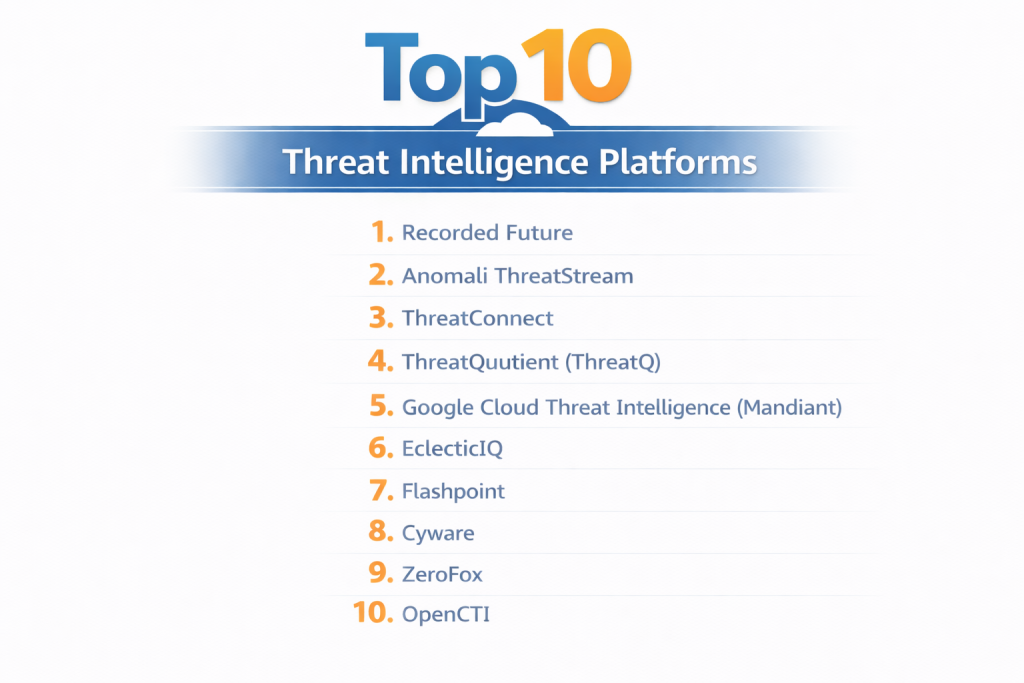
Top 10 Threat Intelligence Platforms Tools
1 — Recorded Future
Recorded Future is arguably the most recognizable name in the industry, famous for its massive “Intelligence Graph” and AI-driven insights that cover the entire web.
- Key Features:
- Intelligence Graph®: Uses patented machine learning to index and analyze data from over a million sources.
- AI Insights: Generative AI assistant that summarizes complex threat reports in seconds.
- Real-time Alerting: Instant notifications based on specific brand, domain, or executive mentions.
- Dark Web Monitoring: Specialized collection from underground forums and criminal marketplaces.
- Vulnerability Intelligence: Scores CVEs based on real-world exploitability and chatter.
- Browser Extension: Delivers intelligence directly into the analyst’s web-based workflow.
- Pros:
- The most comprehensive data coverage, including deep visibility into non-English speaking underground forums.
- Extremely intuitive user interface that reduces the learning curve for new analysts.
- Cons:
- Positioned as a premium product with a price tag to match.
- Can occasionally produce a high volume of alerts that require significant initial tuning.
- Security & Compliance: SOC 2 Type II, ISO 27001, GDPR, HIPAA, and FedRAMP authorized.
- Support & Community: Excellent enterprise support, dedicated account managers, and a thriving user community with regular training webinars.
2 — Anomali ThreatStream
Anomali is a veteran in the space, known for its ability to operationalize massive amounts of indicator data and foster collaboration through “Trusted Circles.”
- Key Features:
- Trusted Circles: Allows secure, anonymous sharing of threat data with industry peers.
- Automated Normalization: Cleanses and deduplicates indicators from hundreds of different feeds.
- Visual Link Analysis: Graphical mapping of how different threat actors, tools, and campaigns are linked.
- STAXX: A specialized client for easy ingestion of STIX/TAXII-based threat feeds.
- Precision Match: Correlates real-time threat intel with historical logs to find missed breaches.
- Pros:
- Strongest collaboration features in the market for ISACs and industry groups.
- Highly scalable architecture that handles massive volumes of IOCs without performance lag.
- Cons:
- Deployment can be complex and may require specialized professional services.
- Some advanced features are sold as separate modules, which can inflate costs.
- Security & Compliance: SOC 2 Type II, ISO 27001, HIPAA, and GDPR.
- Support & Community: Comprehensive documentation and a robust training program called “Anomali University.”
3 — ThreatConnect
ThreatConnect focuses on “TI Ops,” bridging the gap between technical threat data and business risk management to help CISOs make informed decisions.
- Key Features:
- Risk Quantification: Translates technical threats into financial risk scores for the board.
- Unified Workflow: Combines TIP, SOAR, and TIP in a single, cohesive interface.
- Collective Analytics: Benchmarks your threat landscape against other organizations in your industry.
- Custom Playbooks: Low-code automation to trigger response actions based on new intelligence.
- Intel Hub: A centralized repository for managing the entire intelligence lifecycle.
- Pros:
- Best-in-class for organizations that need to report security risk in business terms.
- Seamless integration between intelligence and automated response actions.
- Cons:
- The platform’s breadth can be overwhelming for teams strictly focused on technical indicators.
- Reporting modules can be difficult to customize for niche requirements.
- Security & Compliance: SOC 2 Type II, ISO 27001, HIPAA, and GDPR.
- Support & Community: Very responsive technical support and a marketplace for community-built playbooks.
4 — ThreatQuotient (ThreatQ)
ThreatQuotient is an analyst-centric platform designed to help teams prioritize what matters most by focusing on “relevance” rather than just “volume.”
- Key Features:
- Threat Library: A flexible database that allows analysts to customize their own data models.
- Prioritization Engine: Scores threats based on your organization’s specific environment and risk profile.
- ThreatQ Investigations: A collaborative “whiteboard” for visual incident analysis.
- Data Ingestion: Supports over 300+ integrations out of the box.
- Self-Service Exports: Easily push curated intelligence to firewalls, SIEMs, and EDRs.
- Pros:
- Extremely flexible; it doesn’t force analysts into a “one size fits all” workflow.
- Excellent at reducing “noise” by automatically aging out old or irrelevant indicators.
- Cons:
- Requires a more mature CTI team to fully leverage its customization capabilities.
- User interface is functional but lacks the modern “polish” of some competitors.
- Security & Compliance: SOC 2 Type II, ISO 27001, HIPAA, and GDPR.
- Support & Community: Strong professional services team and clear, technical documentation.
5 — Google Cloud Threat Intelligence (Mandiant)
Following the acquisition by Google, Mandiant’s legendary frontline intelligence is now integrated into the Mandiant Advantage platform, offering unmatched “incident-derived” data.
- Key Features:
- Frontline Intelligence: Data pulled directly from Mandiant’s world-class incident response engagements.
- Breach Analytics: Automatically checks your environment for signs of the latest active campaigns.
- Attack Surface Management: Identifies external-facing assets that are vulnerable to known threats.
- Actor Profiles: Deep-dive reports on APT groups, including TTPs and attribution.
- Chronicle Integration: Deep native integration with Google’s hyperscale security analytics.
- Pros:
- The quality of Mandiant’s research is widely considered the gold standard of “finished” intelligence.
- Unique “inside-out” view of threats based on actual breaches Mandiant has investigated.
- Cons:
- Historically complex pricing that can be difficult for smaller enterprises to navigate.
- The platform is increasingly becoming “Google-centric,” which may not appeal to non-GCP users.
- Security & Compliance: SOC 1/2/3, ISO 27001, HIPAA, GDPR, and FedRAMP.
- Support & Community: Elite-level support and access to the Mandiant Academy for analyst training.
6 — EclecticIQ
EclecticIQ is a European-based leader that focuses heavily on the “intelligence cycle” and the needs of government and national-level CERTs.
- Key Features:
- Intelligence Center: A workspace dedicated to the structured analysis of STIX/TAXII data.
- Fusion Center: A curated feed that merges over 50+ intelligence sources into a single delivery.
- Graph Analytics: Advanced visualization for mapping large, complex actor infrastructures.
- Collaborative Research: Built-in tools for multiple analysts to work on a single intelligence report.
- Open-Source Roots: Deeply committed to open standards and community sharing.
- Pros:
- The best choice for organizations that strictly adhere to the STIX/TAXII standard.
- Very strong privacy controls, making it popular with European government entities.
- Cons:
- The UI is highly technical and aimed at professional intelligence officers rather than generalists.
- Smaller market presence in North America compared to Recorded Future or Anomali.
- Security & Compliance: ISO 27001, SOC 2, and GDPR (EU-headquartered focus).
- Support & Community: High-touch support for government clients and active participation in OASIS standards.
7 — Flashpoint
Flashpoint is the go-to platform for organizations that need deep visibility into the “illicit underbelly” of the internet, including forums, chat apps, and marketplaces.
- Key Features:
- Illicit Community Monitoring: Real-time access to Telegram, Discord, and closed dark web forums.
- Compromised Account Detection: Identifies stolen employee or customer credentials before they are used.
- Vulnerability Management (VulnDB): Comprehensive database of over 300,000 vulnerabilities.
- Physical Security Intelligence: Tracks threats to physical locations and executive travel.
- Card Fraud Mitigation: Specialized tools for financial institutions to track stolen payment cards.
- Pros:
- Unrivaled access to hard-to-reach human intelligence (HUMINT) sources.
- Excellent for brand protection and executive protection use cases.
- Cons:
- Less focused on “technical” indicator management (IOCs) compared to specialized TIPs like Anomali.
- Can be a “siloed” tool if not properly integrated into a broader security stack.
- Security & Compliance: SOC 2 Type II, ISO 27001, GDPR, and HIPAA.
- Support & Community: Analysts-on-demand services provide custom research for high-priority incidents.
8 — Cyware
Cyware is pioneering the “Cyber Fusion” concept, emphasizing automated intelligence sharing and modular orchestration across different security silos.
- Key Features:
- Intel Exchange (CTX): An automated platform for sharing intelligence across large ecosystems.
- Cyber Fusion Center: Unifies TIP, SOAR, and Incident Response into a single workflow.
- Mobile App: Allows security leaders to receive and act on critical alerts on the go.
- Automated Playbooks: Orchestrates response actions across the entire security fabric.
- Threat Data Ingestion: Agnostic platform that connects to any open or commercial source.
- Pros:
- Highly modern architecture that is built for automation and rapid response.
- Great for MSSPs and large conglomerates that need to manage multi-tenant environments.
- Cons:
- The “Cyber Fusion” approach requires a significant cultural shift for traditional SOCs.
- Implementation can be resource-intensive due to the high level of orchestration involved.
- Security & Compliance: FedRAMP Ready, SOC 2 Type II, ISO 27001, and StateRAMP.
- Support & Community: Strong focus on customer success and 24/7 technical monitoring.
9 — ZeroFox
ZeroFox focuses on “External Cybersecurity,” protecting organizations from threats that exist outside their network perimeter, such as social media and digital brand abuse.
- Key Features:
- Digital Risk Protection: Monitors for impersonation accounts, phishing domains, and data leaks.
- Automated Takedowns: One-click service to remove malicious content from social platforms.
- Dark Web Search: Investigates threats to physical and digital assets across illicit forums.
- AI-Driven Analysis: Uses computer vision to find brand logos in malicious images and videos.
- PII Removal: Helps executives remove their personal information from data broker sites.
- Pros:
- The market leader for social media and digital brand protection.
- Managed services available to handle the “dirty work” of takedowns and reporting.
- Cons:
- Not a traditional “technical” TIP; it won’t help much with internal log correlation.
- Pricing can scale quickly based on the number of digital assets being protected.
- Security & Compliance: SOC 2 Type II, ISO 27001, HIPAA, and GDPR.
- Support & Community: Dedicated “On-Alert” services and a robust library of brand protection resources.
10 — OpenCTI (Open Source)
For organizations with strong internal engineering talent, OpenCTI is the premier open-source choice for managing and visualizing cyber threat intelligence.
- Key Features:
- Knowledge Graph: Uses a powerful graph database to map complex relationships between actors.
- STIX 2.1 Native: Built from the ground up to support the latest industry standards.
- Rule Engine: Automatically infers new relationships based on existing intelligence data.
- Vibrant Ecosystem: Hundreds of community-built connectors for major security vendors.
- Modern Interface: A clean, React-based dashboard that rivals many commercial tools.
- Pros:
- Completely free to use with zero licensing fees.
- Offers the highest level of customization and control over your own data.
- Cons:
- Requires significant infrastructure and dev-ops resources to maintain at scale.
- No “guaranteed” enterprise support unless contracted through a third-party partner.
- Security & Compliance: Varies based on self-hosting environment; natively supports RBAC and audit logs.
- Support & Community: Active Slack community and extensive documentation on GitHub.
Comparison Table
| Tool Name | Best For | Platform(s) Supported | Standout Feature | Rating (Gartner) |
| Recorded Future | Global Visibility | SaaS | Intelligence Graph® | 4.7 / 5 |
| Anomali | Collaboration (ISACs) | SaaS / On-Prem | Trusted Circles | 4.6 / 5 |
| ThreatConnect | Risk Quantification | SaaS / Hybrid | TI Ops (Risk Scoring) | 4.5 / 5 |
| ThreatQ | Prioritization | On-Prem / Cloud | Custom Threat Library | 4.4 / 5 |
| Mandiant | Expert Insights | SaaS | Frontline Intel | 4.6 / 5 |
| EclecticIQ | Gov / CERTs | On-Prem / Cloud | STIX/TAXII Native | 4.3 / 5 |
| Flashpoint | Dark Web / Fraud | SaaS | Illicit Chat Access | 4.5 / 5 |
| Cyware | Cyber Fusion / MSSP | Cloud / Hybrid | Mobile Alerting | 4.4 / 5 |
| ZeroFox | Brand Protection | SaaS | Automated Takedowns | 4.5 / 5 |
| OpenCTI | Advanced Customization | Self-Hosted | Open Source Graph | N/A |
Evaluation & Scoring of Threat Intelligence Platforms
Selecting a TIP is a major investment. We have evaluated these tools using a weighted scoring rubric that emphasizes the most critical factors for modern security teams.
| Category | Weight | Evaluation Rationale |
| Core Features | 25% | Quality of data normalization, enrichment, and deduplication. |
| Ease of Use | 15% | How quickly an analyst can go from “raw data” to “actionable insight.” |
| Integrations | 15% | Breadth of API support and “out of the box” connectors. |
| Security & Compliance | 10% | Internal hardening, encryption, and regulatory certifications. |
| Performance | 10% | Speed of search and stability during high-volume data ingest. |
| Support & Community | 10% | Documentation, training, and 24/7 expert availability. |
| Price / Value | 15% | Transparency of costs and overall return on investment. |
Which Threat Intelligence Platform Tool Is Right for You?
Solo Users vs SMB vs Mid-Market vs Enterprise
- Small Business / Solo Users: Avoid heavy commercial TIPs. Start with OpenCTI if you have the skills, or leverage the free community versions of Recorded Future or Anomali.
- Mid-Market: Look for a platform that balances features with manageability. Recorded Future or ZeroFox are excellent choices that provide high value without requiring a 5-person engineering team.
- Enterprise: You need a platform that can handle complexity. Anomali, ThreatConnect, or Mandiant Advantage are the industry heavyweights capable of supporting massive, global SOC operations.
Budget-Conscious vs Premium Solutions
If budget is the primary concern, OpenCTI is unbeatable, provided you can host it. For those with a “security-first” budget who need the absolute best data available, Recorded Future and Mandiant are the premium gold standards.
Feature Depth vs Ease of Use
- Depth: ThreatQ and OpenCTI are the winners. They allow you to build custom models and data structures.
- Ease of Use: Recorded Future and ZeroFox win here. Their dashboards are clean, and their alerts are easy for even junior analysts to understand.
Integration and Scalability Needs
If you are an MSSP or a massive conglomerate, Cyware and Anomali offer the best multi-tenant and cross-org sharing capabilities. If you are a Google Cloud shop, the native integration of Mandiant with Chronicle is a major scalability win.
Frequently Asked Questions (FAQs)
Q1: What is the difference between a Threat Feed and a TIP?
Answer: A threat feed is just a list of data (like malicious IPs). A TIP is the software that takes those feeds, combines them with other data, removes the junk, and shows you how they relate to your business.
Q2: Does a TIP replace my SIEM?
Answer: No. They work together. The TIP provides the “intelligence” (what to look for), and the SIEM provides the “visibility” (looking through your logs to see if that thing is happening).
Q3: What is “Indicator Aging”?
Answer: This is a crucial TIP feature. An IP address might be malicious today but clean next week. “Aging” ensures your security tools aren’t blocking legitimate traffic because of outdated data.
Q4: Can a TIP help with “Alert Fatigue”?
Answer: Yes, by prioritizing threats. Instead of looking at 1,000 alerts, a TIP can tell you which 10 are actually relevant to your specific industry and geography.
Q5: Is dark web monitoring really necessary?
Answer: For most enterprises, yes. It allows you to find leaked credentials or “planned” attacks before they ever reach your network perimeter.
Q6: What is STIX/TAXII?
Answer: These are the industry-standard languages for sharing threat intelligence. A good TIP must support these to “talk” to other security tools and government feeds.
Q7: How long does it take to implement a TIP?
Answer: A SaaS platform can be up in a day, but “operationalizing” it—connecting your feeds and tuning your alerts—usually takes 3 to 6 months.
Q8: What are “Finished Intelligence” reports?
Answer: These are human-written reports (like those from Mandiant or Recorded Future) that provide strategic context on threat actors, rather than just technical indicators.
Q9: Can a TIP help with Brand Protection?
Answer: Yes. Tools like ZeroFox or Recorded Future can find fake social media profiles or “typosquatted” domains (like https://www.google.com/search?q=g00gle.com) that are being used for phishing.
Q10: Is open-source threat intelligence (OSINT) enough?
Answer: It’s a great start, but it often lacks the “speed” and “validation” of commercial feeds. Most mature organizations use a mix of both.
Conclusion
The “best” Threat Intelligence Platform isn’t necessarily the one with the most data—it’s the one that gives your team the most time back. Whether you choose the high-speed AI of Recorded Future, the expert-led insights of Mandiant, or the open-source flexibility of OpenCTI, the goal remains the same: transforming raw data into a shield for your organization.
Ultimately, choosing a TIP is about matching the platform’s strengths to your team’s maturity. Don’t buy a Ferrari if you only need a daily commuter; start with what you can realistically manage and scale as your intelligence capabilities grow.

- Top 10 Email Deliverability Tools: Features, Pros, Cons & Comparison - September 6, 2026
- Top 10 Pharmacovigilance Software: Features, Pros, Cons & Comparison - September 6, 2026
- Top 10 Manufacturing Execution Systems (MES) - July 30, 2026