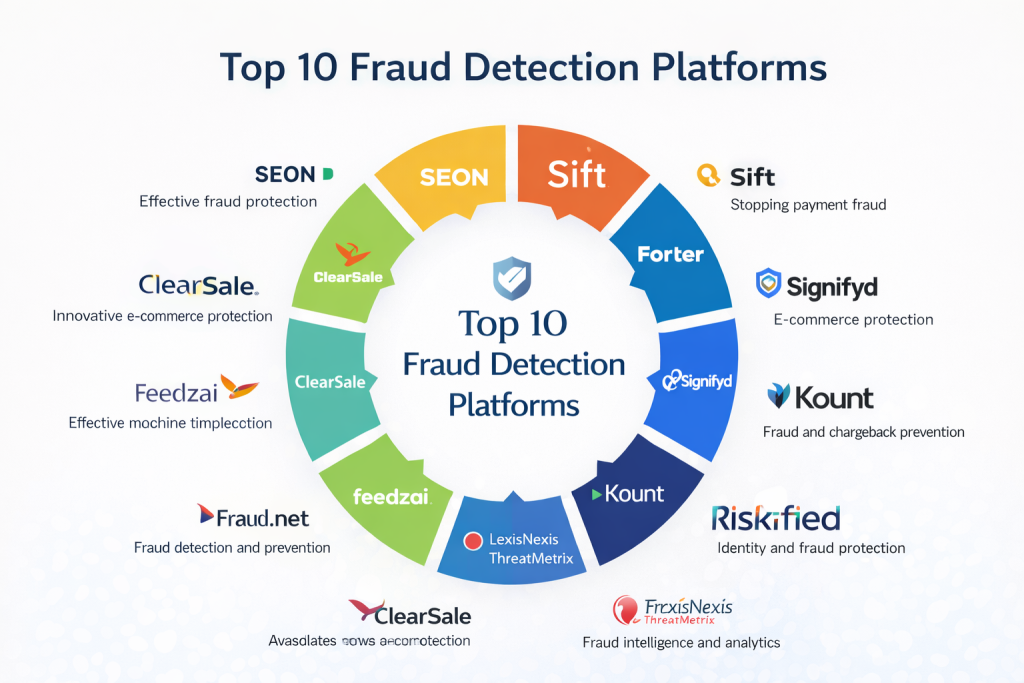
Introduction
In an era where digital transactions occur in milliseconds, the battle against cybercrime has moved from physical vaults to sophisticated data streams. Fraud Detection Platforms are comprehensive software ecosystems designed to identify, block, and manage fraudulent activities in real-time. These platforms leverage artificial intelligence (AI), machine learning (ML), and behavioral analytics to distinguish between legitimate customers and malicious actors. Unlike basic security filters, modern fraud detection platforms analyze thousands of data points—from device fingerprints and IP locations to typing speed and mouse movements—to assign a risk score to every interaction.
The importance of these platforms is paramount for business survival in 2026. As fraudsters adopt generative AI to create “synthetic identities” and execute complex social engineering attacks, businesses must deploy equally advanced defenses to prevent multi-million dollar losses. Key real-world use cases include preventing payment fraud at e-commerce checkouts, stopping account takeovers (ATO) in banking apps, and detecting promo abuse in marketing campaigns. When evaluating these tools, users should prioritize decision latency (how fast it works), false positive rates (how often it blocks good customers), and integration flexibility with existing payment gateways.
Best for: Risk officers, IT security leads, and e-commerce managers in finance, retail, and travel. These tools are essential for any organization processing online payments, managing user accounts, or handling sensitive personal data at scale.
Not ideal for: Brick-and-mortar businesses with no online presence or micro-merchants whose transaction volume is low enough that standard payment processor filters (like those built into Stripe or PayPal) are sufficient.
Top 10 Fraud Detection Platforms
1 — SEON (Fraud Fighters)
SEON is a modern, data-rich platform that focuses on “digital footprinting.” It is designed for businesses that want deep visibility into a user’s online presence to verify their identity without adding friction.
- Key Features:
- Social Media Lookup: Checks 50+ social signals based on email or phone.
- Device Fingerprinting: Identifies users based on hardware and software configurations.
- Whitebox Machine Learning: Provides human-readable “explanations” for every risk score.
- IP Intelligence: Detects VPNs, Tor usage, and proxy high-risk locations.
- Browser Extension: Allows manual investigators to check data instantly in-browser.
- Custom Rules Engine: Offers pre-set and bespoke rules for specific industry risks.
- Pros:
- The most transparent AI in the industry; you always know why a transaction was flagged.
- Extremely fast “Go-Live” time (often within two weeks).
- Cons:
- Heavy focus on digital signals might miss sophisticated “mule” accounts that look legitimate.
- Reporting dashboards can be complex for non-technical users.
- Security & Compliance: SOC 2 Type II, GDPR compliant, SSO, and 256-bit encryption.
- Support & Community: 24/7 technical support, extensive API documentation, and a robust “Fraud Academy” for user education.
2 — Sift
Sift is an industry giant that uses a global data network to protect the entire “customer journey,” from account creation and login to final payment.
- Key Features:
- Digital Trust & Safety Suite: Covers payment fraud, account defense, and content integrity.
- Global Data Network: Learns from 1 trillion annual events across thousands of brands.
- Dynamic Friction: Triggers 2FA only when risk thresholds are met.
- Workflows: Visual automation builder for handling high-risk cases.
- Content Integrity: Detects spam and scam posts in marketplaces.
- Pros:
- Unrivaled “network effect”—if a fraudster hits one Sift client, they are flagged for all.
- Excellent UI/UX for manual review teams.
- Cons:
- “Blackbox” elements in their ML can make it hard to understand certain decisions.
- Higher price point, making it more suitable for mid-market and enterprise.
- Security & Compliance: ISO 27001, SOC 2, HIPAA, and GDPR.
- Support & Community: Dedicated account managers for enterprise, large knowledge base, and annual user summits.
3 — Forter
Forter specializes in “fully automated” fraud prevention for e-commerce, offering a chargeback guarantee that shifts the financial risk away from the merchant.
- Key Features:
- Decision-as-a-Service: Provides instant “Approve/Decline” decisions for every order.
- Chargeback Guarantee: Forter pays for any fraud-related chargebacks they approve.
- Identity Exchange: Bridges data across different retailers to recognize return customers.
- Smart Claims: Automates the dispute process for “friendly fraud” (claims made by legitimate users).
- Abuse Prevention: Stops promo/referral abuse and policy violations.
- Pros:
- Eliminates the need for an in-house manual review team.
- Very high approval rates for legitimate international orders.
- Cons:
- Merchants lose granular control over individual transaction decisions.
- The “guarantee” model can be more expensive than SaaS-only models.
- Security & Compliance: PCI DSS Level 1, GDPR, and SOC 2.
- Support & Community: High-touch enterprise support and proactive performance reviews.
4 — Signifyd
Signifyd is a leading commerce protection platform that blends AI with a massive commerce network to provide guaranteed fraud protection for retailers.
- Key Features:
- Revenue Protection: Focuses on minimizing false positives to maximize sales.
- Agent Console: Provides detailed insights for the rare cases that need human eyes.
- Return Abuse Prevention: Identifies “serial returners” who hurt merchant margins.
- Account Protection: Guards against account takeovers and unauthorized access.
- Seamless Integration: Pre-built connectors for Shopify, BigCommerce, and Magento.
- Pros:
- Deep specialization in the retail and e-commerce sector.
- Excellent at recovering revenue that would otherwise be lost to “over-conservative” filters.
- Cons:
- Less versatile for non-retail industries (like iGaming or Fintech).
- The pricing model is closely tied to transaction volume, which can scale quickly.
- Security & Compliance: SOC 2 Type II, GDPR, and PCI compliance.
- Support & Community: Strong partnership with e-commerce platforms and proactive success management.
5 — Kount (by Equifax)
Kount leverages Equifax’s massive identity data to provide a multi-layered approach to fraud prevention and identity verification.
- Key Features:
- Identity Trust Global Network: Analyzes 32 billion interactions annually.
- Kount Control: Specifically designed to stop bot attacks and account takeovers.
- Case Management: Robust tools for teams that prefer manual oversight of high-value transactions.
- Omnichannel Protection: Protects web, mobile, and in-person transactions.
- Near Real-time Analytics: Provides visual heatmaps of where fraud is originating.
- Pros:
- Access to Equifax’s unique credit and identity data sets.
- Very strong at identifying bot-driven credential stuffing attacks.
- Cons:
- The interface can feel “legacy” compared to newer SaaS competitors like SEON.
- Implementation can be more involved than “plug-and-play” tools.
- Security & Compliance: PCI DSS, GDPR, ISO 27001, and SOC 2.
- Support & Community: Enterprise-grade support and extensive training resources for fraud analysts.
6 — Riskified
Riskified uses high-scale machine learning to turn “declines into approvals,” primarily catering to high-volume global retailers.
- Key Features:
- Chargeback Guarantee Model: Similar to Forter, they assume the liability for fraud.
- Deco: A specialized tool to recover sales lost during the 3D Secure (3DS) process.
- Policy Protect: Stops shoppers from abusing “item not received” claims or returns.
- Identity Link: Connects disparate data points to form a single view of the customer.
- Payment Optimization: Routes transactions through the most likely path for approval.
- Pros:
- Outstanding results for high-ticket items (luxury goods, electronics).
- Helps businesses expand into “high-risk” geographic markets with confidence.
- Cons:
- Can be a “black box” regarding why certain orders are declined.
- Not ideal for low-margin businesses due to the percentage-based fee structure.
- Security & Compliance: GDPR, SOC 2, and PCI Level 1.
- Support & Community: Technical account managers and annual fraud performance reports.
7 — LexisNexis ThreatMetrix
ThreatMetrix is an enterprise-grade solution that focuses on “Digital Identity Intelligence,” making it a favorite for global banks and financial institutions.
- Key Features:
- Digital Identity Network: Analyzes billions of transactions to identify “true” personas.
- Behavioral Biometrics: Monitors how users hold their phones or type to detect bots/impersonators.
- Smart ID: Creates a persistent identifier for users that survives clearing cookies.
- Case Management: High-end forensic tools for deep fraud investigations.
- Policy Engine: Highly granular rules that can be adjusted for different regions.
- Pros:
- The gold standard for high-security financial services.
- Incredible depth in identifying sophisticated technical “spoofing” attempts.
- Cons:
- Extremely high learning curve for the administrative console.
- Implementation usually requires significant professional services and time.
- Security & Compliance: FedRAMP, HIPAA, SOC 2, GDPR, and ISO 27001.
- Support & Community: 24/7 global enterprise support and specialized consulting.
8 — Feedzai
Feedzai is an “AI-first” platform used by some of the world’s largest banks to handle both Anti-Money Laundering (AML) and fraud detection in one place.
- Key Features:
- Pulse: Real-time stream processing for immediate risk decisioning.
- Genome: A visual link-analysis tool to find hidden connections between accounts.
- Fairness AI: Audits the AI to ensure it isn’t biased against specific demographics.
- Omnichannel Coverage: Unified view of risk across retail and digital banking.
- Automated Machine Learning: Helps data scientists build better models faster.
- Pros:
- Best-in-class for combining Fraud and AML into a “Single Pane of Glass.”
- Extremely scalable for processing thousands of transactions per second.
- Cons:
- Pricing and complexity are out of reach for most small-to-midsize e-commerce stores.
- Requires a dedicated data science team to fully leverage the platform.
- Security & Compliance: ISO 27001, SOC 2, GDPR, and local banking regulations.
- Support & Community: High-touch engineering support and executive advisory services.
9 — ClearSale
ClearSale offers a “hybrid” approach, combining advanced machine learning with a massive team of human fraud analysts for high-accuracy manual reviews.
- Key Features:
- Hybrid Detection: AI screens everything; humans review the “gray area” cases.
- No False Positives Guarantee: They claim to never decline a legitimate customer.
- Custom SDKs: Easy integration for mobile apps (iOS/Android).
- Comprehensive Analytics: Real-time dashboards on approval rates and ROI.
- Chargeback Management: Full-service handling of the chargeback lifecycle.
- Pros:
- The “human touch” significantly reduces the chance of insulting a VIP customer.
- Very flexible; they can act as an extension of your existing team or replace it.
- Cons:
- Manual review can sometimes introduce slight delays (latency) in decisioning.
- Scaling human reviews can be more costly than pure-AI solutions.
- Security & Compliance: PCI DSS, GDPR, and SOC 2.
- Support & Community: Very responsive customer service and a strong presence in the e-commerce community.
10 — Fraud.net
Fraud.net is a cloud-native platform that uses a “collective intelligence” approach, allowing companies to share anonymized data to stay ahead of fraud rings.
- Key Features:
- App Store for Fraud: Integrated third-party tools (like email or phone lookups) in one place.
- Entity Resolution: Groups different actions together into a single “bad actor” profile.
- Anomaly Detection: Uses unsupervised learning to find new fraud patterns.
- Graph Database: Visualizes complex relationships between data points.
- Mining for Insights: Tools to find historical fraud that was previously missed.
- Pros:
- Highly modular; you only pay for the specific data “checks” you need.
- Excellent for businesses that want a “DIY” approach to building their risk stack.
- Cons:
- Integrating multiple “app” modules can make the setup complex.
- The user community is smaller than industry giants like Sift or Kount.
- Security & Compliance: SOC 2 Type II, GDPR, and HIPAA.
- Support & Community: Dedicated success managers and a highly technical support team.
Comparison Table
| Tool Name | Best For | Platform(s) Supported | Standout Feature | Rating (Gartner) |
| SEON | Digital Footprinting | Web, API, Chrome | Social Media Lookup | 4.8 / 5 |
| Sift | Global Network Effect | Web, Mobile SDK | 1T+ Event Network | 4.6 / 5 |
| Forter | Automated Approval | Web, API | Chargeback Guarantee | 4.5 / 5 |
| Signifyd | Retail Optimization | Web, Shopify/etc. | Revenue Protection | 4.6 / 5 |
| Kount | Identity Trust | Web, Mobile | Equifax Data Access | 4.4 / 5 |
| Riskified | High-Ticket Retail | Web, API | Deco (3DS Recovery) | 4.5 / 5 |
| ThreatMetrix | High-End Finance | Web, SDK | Behavioral Biometrics | 4.7 / 5 |
| Feedzai | Fraud + AML | Cloud, On-Premise | Fairness AI | 4.4 / 5 |
| ClearSale | Manual Accuracy | Web, API | Human Review Team | 4.8 / 5 |
| Fraud.net | Modular Stacks | Cloud | App-style Ecosystem | N/A |
Evaluation & Scoring of [Fraud Detection Platforms]
To help you choose the right partner, we have scored the general “Fraud Detection” category based on a weighted rubric that reflects the priorities of a 2026 Risk Management team.
| Category | Weight | Evaluation Rationale |
| Core Features | 25% | Capacity for device fingerprinting, ML scoring, and behavioral analysis. |
| Ease of Use | 15% | Intuitiveness of the dashboard and speed of manual reviews. |
| Integrations | 15% | Availability of SDKs and pre-built connectors for major platforms. |
| Security & Compliance | 10% | Platform’s own data handling and regulatory certifications. |
| Performance | 10% | Decision latency (must be <200ms) and platform uptime. |
| Support & Community | 10% | Quality of documentation and availability of specialist analysts. |
| Price / Value | 15% | Transparency and the “Chargeback/ROI” impact on the bottom line. |
Which [Fraud Detection Platforms] Tool Is Right for You?
Solo Users vs SMB vs Mid-Market vs Enterprise
- SMB (Small to Midsize): If you are a team of 5-50, SEON or Signifyd are excellent. They offer simple integrations and immediate value without needing a dedicated data science team.
- Mid-Market: Sift and ClearSale provide the scalability and reporting depth needed for growing companies that are starting to see targeted fraud attacks.
- Enterprise: For global banks and massive retailers, LexisNexis ThreatMetrix or Feedzai are the industry standards, providing the highest level of technical depth and regulatory support.
Budget-Conscious vs Premium Solutions
- Budget: SEON offers a transparent per-check pricing model that is very friendly to smaller budgets.
- Premium: Forter and Riskified are premium “guarantee” models. You pay more, but you also eliminate the financial risk and the need for an internal fraud team.
Feature Depth vs Ease of Use
- Feature Depth: LexisNexis and Feedzai are the most powerful but require technical experts to operate.
- Ease of Use: Forter is the ultimate “easy button”—it just works in the background. Sift also offers a very clean, modern interface for analysts.
Integration and Scalability Needs
If your stack is built on Shopify, BigCommerce, or Magento, Signifyd or ClearSale have the best “one-click” integrations. If you are building a custom mobile app, ensure the tool you pick has a robust Mobile SDK (like Sift or Kount).
Frequently Asked Questions (FAQs)
Q1: What is a “False Positive” in fraud detection?
Answer: A false positive (or “insult”) is when a legitimate customer’s transaction is incorrectly flagged as fraud and blocked. This is often more expensive than fraud itself because it ruins customer loyalty.
Q2: How does a “Chargeback Guarantee” work?
Answer: If the fraud tool approves a transaction that later turns out to be fraudulent, the software provider (like Forter or Riskified) pays the merchant back for the lost funds and fees.
Q3: Can these tools detect “Account Takeover” (ATO)?
Answer: Yes. Most top-tier platforms monitor login behavior (location, device, typing speed) and will flag a login if it deviates from the user’s historical pattern.
Q4: Do I still need a manual review team?
Answer: It depends. “Fully automated” platforms aim to eliminate manual review. However, many businesses prefer a “hybrid” model where a small team reviews the most ambiguous cases.
Q5: Is data privacy an issue with these tools?
Answer: These tools are built with GDPR and CCPA in mind. They typically anonymize data and use “hashing” to ensure that sensitive personal information isn’t exposed during the risk assessment.
Q6: What is “Device Fingerprinting”?
Answer: It is a technique that collects technical data about a user’s device (screen resolution, OS, fonts, plugins) to create a unique ID, helping to identify fraudsters even if they change their IP.
Q7: How fast are these fraud decisions made?
Answer: Professional platforms make decisions in under 200 milliseconds. This ensures there is zero noticeable delay for the customer during the checkout process.
Q8: Can these tools stop “Friendly Fraud”?
Answer: Friendly fraud (a legitimate customer claiming they didn’t receive an item) is harder to stop, but tools like Signifyd and Riskified use historical behavior to flag “serial claimers.”
Q9: Do I need a fraud platform if I use Stripe?
Answer: Stripe Radar is good for basics, but specialized platforms like SEON or Sift offer much deeper data (like social media lookups) that can catch sophisticated fraud Stripe might miss.
Q10: What is “Whitebox AI”?
Answer: Whitebox AI provides a clear, human-readable reason for its score (e.g., “Flagged because IP is 2000 miles from shipping address”). Blackbox AI just gives a score without explaining why.
Conclusion
The “best” fraud detection platform is not the one with the most data, but the one that provides the most actionable insight for your specific business model. In 2026, fraud is no longer just about stolen credit cards; it’s about identity, bot behavior, and account integrity.
If you are a high-volume retailer, the security of a Chargeback Guarantee from Forter or Riskified might be your best bet. If you are a nimble fintech startup, the transparency and digital footprinting of SEON will give you the control you need. Regardless of your choice, the goal is to build a “frictionless” experience for your honest customers while making your site an impossible target for fraudsters.

- Top 10 Email Deliverability Tools: Features, Pros, Cons & Comparison - September 6, 2026
- Top 10 Pharmacovigilance Software: Features, Pros, Cons & Comparison - September 6, 2026
- Top 10 Manufacturing Execution Systems (MES) - July 30, 2026