Introduction
KYC/AML compliance tools are digital platforms that help organizations verify the identity of their clients (KYC) and monitor their financial activities for suspicious behavior (AML). These tools use advanced technologies—such as Artificial Intelligence (AI), Machine Learning (ML), and biometric liveness detection—to cross-reference user data against global sanctions lists, politically exposed persons (PEP) databases, and adverse media.
Why It Matters
The stakes for non-compliance have never been higher. Regulatory bodies such as FinCEN in the United States and the EBA in Europe issue billions of dollars in fines annually. Beyond the financial penalties, a single compliance failure can lead to irreparable reputational damage, loss of banking licenses, and even criminal charges for executives.
Real-World Use Cases
- Neobanking Onboarding: Instantly verifying a new user’s passport and face to open a bank account in minutes.
- Crypto Exchange Compliance: Screening wallet addresses against “Travel Rule” requirements and blacklisted entities.
- Real Estate Transactions: Identifying the Ultimate Beneficial Owner (UBO) to prevent the use of property for money laundering.
- Gaming & Gambling: Ensuring users are of legal age and are not using the platform to move illicit funds.
What to Look For
When evaluating these tools, users should prioritize accuracy (low false positives), global coverage (support for various document types), integration ease (API/SDK quality), and regulatory agility (the ability to update rules as laws change).
Best for: Compliance officers, Risk Managers, and CTOs at fintech startups, mid-sized banks, and large financial enterprises. These tools are essential for any business handling high-volume transactions or regulated financial services.
Not ideal for: Small local businesses with low-risk profiles, such as a neighborhood coffee shop or a boutique retail store, where manual verification of a few local IDs is sufficient and the cost of automated software would outweigh the benefits.
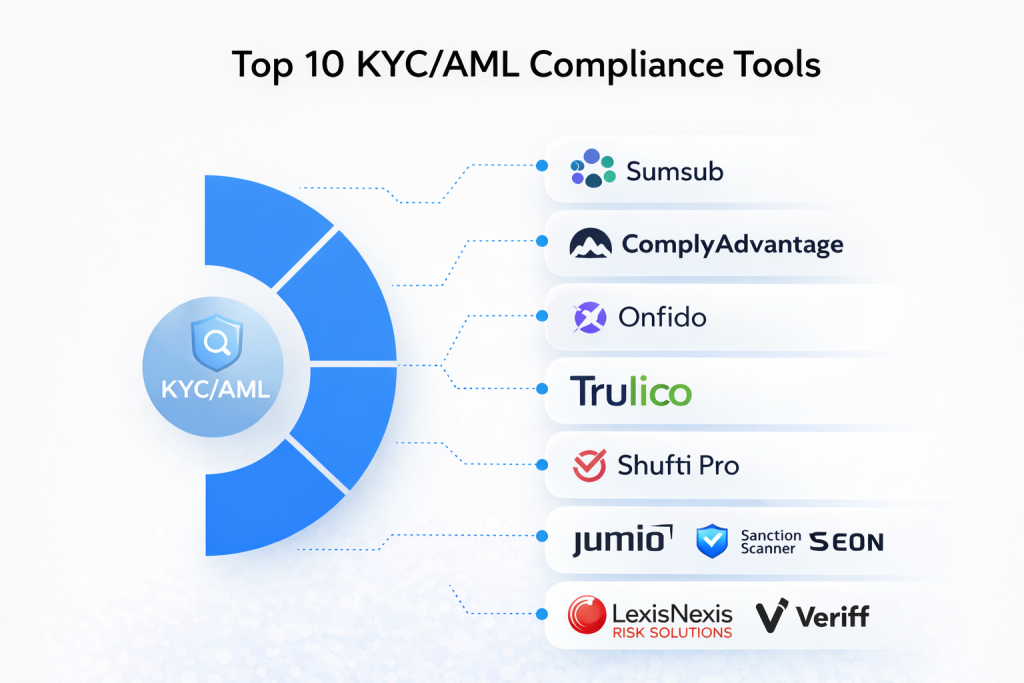
Top 10 KYC/AML Compliance Tools
1 — Sumsub
Sumsub is an “all-in-one” verification platform that aims to orchestrate the entire user journey, from initial onboarding to ongoing transaction monitoring. It is particularly popular among crypto and fintech firms due to its highly customizable “Workflow Builder.”
- Key features:
- AI-powered identity verification with liveness detection.
- Automated KYB (Know Your Business) and UBO screening.
- Real-time transaction monitoring and “Travel Rule” compliance.
- No-code workflow orchestration for different jurisdictions.
- Global database access for Sanctions, PEP, and Adverse Media.
- Pros:
- Excellent user experience with a very low drop-off rate during onboarding.
- Modular pricing that scales well with business growth.
- Cons:
- The breadth of features can make the initial dashboard setup overwhelming.
- Document processing for rare jurisdictions can occasionally take longer.
- Security & compliance: SOC 2 Type II, GDPR, ISO 27001, and HIPAA compliant.
- Support & community: Extensive documentation, 24/7 technical support for enterprise, and a very active compliance blog community.
2 — ComplyAdvantage
ComplyAdvantage provides real-time risk intelligence. It is best known for its proprietary database that uses AI to “read” the news and update risk profiles faster than traditional manual databases.
- Key features:
- Real-time AML risk screening against thousands of global lists.
- Adverse media monitoring using natural language processing (NLP).
- Automated transaction screening and monitoring.
- Configurable risk-scoring engine.
- API-first architecture for seamless backend integration.
- Pros:
- Proprietary data means fewer “ghost” alerts and lower false positives.
- Extremely fast search results even for massive datasets.
- Cons:
- Focuses more on screening data than the “front-end” document capture.
- Enterprise-leaning pricing can be steep for early-stage startups.
- Security & compliance: ISO 27001, SOC 2, and fully GDPR aligned.
- Support & community: Dedicated account managers for most tiers and high-quality API documentation.
3 — Onfido
Onfido, now part of Entrust, is a pioneer in AI-driven document and facial biometrics. It is designed for businesses that want a balance between high-security liveness checks and a frictionless mobile experience.
- Key features:
- Advanced biometric liveness detection (video and photo).
- Support for over 2,500 document types across 195 countries.
- AI-powered fraud detection for synthetic identities and deepfakes.
- Automated data extraction (OCR) with high accuracy.
- Smart Capture SDKs for iOS, Android, and Web.
- Pros:
- Exceptional mobile SDK that guides users to take the perfect photo.
- Strong reputation and trust among Tier 1 financial institutions.
- Cons:
- Support response times can vary depending on the contract level.
- Limited native “Transaction Monitoring” compared to Sumsub.
- Security & compliance: SOC 2, ISO 27001, GDPR, and UK DIATF certified.
- Support & community: Robust developer portal and global enterprise support teams.
4 — Trulioo
Trulioo is a “Global Identity Network” that provides access to over 400 data sources to verify 5 billion people and 330 million business entities worldwide. It is the go-to for massive global scalability.
- Key features:
- Identity Verification (IDV) via government and utility data.
- Global Business Verification (KYB) for identifying UBOs.
- Watchlist screening and ongoing monitoring.
- Address verification via reliable global databases.
- A single API to connect to hundreds of local data providers.
- Pros:
- Unmatched global reach for non-document-based verification.
- High reliability for verifying users in emerging markets.
- Cons:
- The “per-check” cost can add up for high-volume, low-margin businesses.
- Platform complexity requires a learning curve for new compliance officers.
- Security & compliance: SOC 2 Type II and GDPR compliant.
- Support & community: Strong professional services team for large-scale implementation.
5 — Shufti Pro
Shufti Pro is recognized for its “Hybrid Intelligence” approach, combining AI with human oversight to achieve 99% accuracy. It offers one of the most cost-effective “Pay-as-you-go” models.
- Key features:
- Real-time identity verification in under 60 seconds.
- NFC-based document verification for biometric passports.
- Multilingual support for over 150 languages.
- AML screening against 1,700+ watchlists.
- Video KYC for high-risk customer onboarding.
- Pros:
- Offers a free trial, which is rare in the high-end KYC space.
- Flexible pricing makes it very accessible for small businesses and startups.
- Cons:
- The UI/UX of the back-office dashboard feels slightly dated compared to peers.
- Human-in-the-loop verification can occasionally introduce slight latency.
- Security & compliance: PCI DSS, GDPR, ISO 27001, and SOC 2.
- Support & community: 24/7 customer support and a helpful developer sandbox.
6 — Jumio
Jumio is an industry veteran focusing heavily on “End-to-End” identity orchestration. It leverages advanced automation to detect sophisticated fraud like “injection attacks” on mobile cameras.
- Key features:
- Jumio KYX Platform for unified identity and risk assessment.
- Automated document verification with 3D liveness.
- Identity proofing using a “risk engine” that analyzes device signals.
- Advanced screening for PEP and Sanctions.
- Case management tools for manual review teams.
- Pros:
- Extremely robust fraud detection that catches 99.9% of spoofing attempts.
- Very strong integrations with existing banking core systems.
- Cons:
- High-end pricing is tailored for enterprise, not small businesses.
- Implementation can be complex, often requiring professional services.
- Security & compliance: PCI DSS, ISO 27001, SOC 2, and GDPR.
- Support & community: Global 24/7 support with dedicated technical account managers.
7 — Sanction Scanner
A specialized AML tool from Europe, Sanction Scanner focuses on affordability and real-time monitoring of sanctions and PEP lists.
- Key features:
- Global Sanctions & PEP screening updated every few minutes.
- Transaction monitoring with a flexible rules engine.
- Adverse media screening across 200+ countries.
- Batch screening for existing customer databases.
- Social Media and Web risk assessment.
- Pros:
- One of the most user-friendly interfaces in the AML market.
- Very competitive pricing for the level of data provided.
- Cons:
- Does not offer its own “Document Verification” hardware/SDKs (focuses on data).
- The feature set is narrower than “all-in-one” platforms.
- Security & compliance: GDPR compliant and ISO 27001 certified.
- Support & community: Responsive live chat and personalized onboarding.
8 — SEON
SEON takes a unique “Digital Footprint” approach. Instead of just looking at IDs, it analyzes a user’s email, phone number, and IP address to build a risk profile before the KYC process even starts.
- Key features:
- Email and Phone profiling (social media account lookup).
- Device fingerprinting and IP analysis.
- Real-time AML screening for transactions.
- Browser extension for manual fraud investigations.
- Machine learning-based risk scoring.
- Pros:
- Catches fraudsters at the “top of the funnel” before you spend money on KYC.
- No-code rule editor is very intuitive for fraud managers.
- Cons:
- The digital footprint data can sometimes be sparse in certain regions.
- Best used alongside a document verification tool, not as a replacement.
- Security & compliance: GDPR compliant; SOC 2 Type II.
- Support & community: Excellent documentation and transparent “Product Roadmap.”
9 — LexisNexis Risk Solutions
The “Titan” of the industry, LexisNexis offers massive datasets and deep investigative tools. It is the standard for global banks and government agencies.
- Key features:
- Bridger Insight XG for massive-scale watchlist screening.
- RiskNarrative for total compliance orchestration.
- World-class physical and digital identity data.
- TotalCheck for comprehensive customer due diligence (CDD).
- Advanced link analysis to find hidden connections between entities.
- Pros:
- Data depth that no other provider can match.
- Widely recognized and “auditor-approved” across the globe.
- Cons:
- Very long sales cycles and implementation times.
- Complex pricing structure that is difficult for smaller firms to navigate.
- Security & compliance: Meets all major global banking and government standards.
- Support & community: Enterprise-grade 24/7 support and professional training.
10 — Veriff
Veriff is a tech-forward platform that focuses on “Video-First” verification. They use the camera’s video stream to detect liveness and document authenticity in real-time.
- Key features:
- Automated video-based identity verification.
- Proof of address and background checks.
- Cross-device verification (start on PC, finish on phone).
- AI-powered liveness with motion analysis.
- Biometric authentication for returning users.
- Pros:
- Extremely high conversion rate for mobile users.
- Fast verification times, often under 10 seconds for standard IDs.
- Cons:
- The video requirement can be high-bandwidth for users in poor signal areas.
- Customization options are more limited than Sumsub.
- Security & compliance: SOC 2 Type II, GDPR, and ISO 27001.
- Support & community: Strong developer support via Slack and comprehensive API docs.
Comparison Table
| Tool Name | Best For | Platform(s) Supported | Standout Feature | Rating (G2/Gartner) |
| Sumsub | Crypto & Fintech | Web, iOS, Android | No-code Workflow Builder | 4.6 / 4.7 |
| ComplyAdvantage | Real-time Risk Data | API-only | AI-driven Adverse Media | 4.6 / 4.5 |
| Onfido | Mobile Onboarding | Web, iOS, Android | Smart Capture SDK | 4.5 / 4.4 |
| Trulioo | Global Scaling | Web, API | 400+ Global Data Sources | 4.5 / 4.5 |
| Shufti Pro | Startups & SMBs | Web, iOS, Android | Hybrid AI + Human Review | 4.7 / N/A |
| Jumio | Large Enterprises | Web, iOS, Android | 3D Liveness Detection | 4.3 / 4.2 |
| Sanction Scanner | AML Monitoring | Web, API | Affordable Real-time AML | 4.9 / 4.8 |
| SEON | Fraud Prevention | Web, API, Chrome | Digital Footprint Analysis | 4.8 / N/A |
| LexisNexis | Tier 1 Banks | Desktop, Web, API | Massive Proprietary Data | 4.5 / 4.4 |
| Veriff | Video Verification | Web, iOS, Android | Sub-10s Video Onboarding | 4.3 / 4.4 |
Evaluation & Scoring of KYC/AML Tools
To help you choose, we have evaluated these tools using a weighted scoring rubric that reflects the priorities of modern compliance teams.
| Metric | Weight | Evaluation Criteria |
| Core Features | 25% | IDV accuracy, global coverage, KYB support, and liveness quality. |
| Ease of Use | 15% | Dashboard intuitiveness, user onboarding flow, and mobile SDK quality. |
| Integrations | 15% | Quality of API/SDK, available plugins (Salesforce, etc.), and documentation. |
| Security | 10% | Certifications (SOC2, ISO), encryption, and jurisdictional compliance. |
| Performance | 10% | Verification speed, uptime, and handling of “edge case” document types. |
| Support | 10% | Response times, dedicated AM availability, and community resources. |
| Price / Value | 15% | Transparency, scalability, and “total cost of ownership.” |
Which KYC/AML Tool Is Right for You?
Choosing the right tool is a strategic decision that depends on your company’s stage and risk appetite.
1. Solo Users & Small Startups
If you are just launching, focus on Shufti Pro or iDenfy. Their “Pay-as-you-go” or low-entry pricing allows you to maintain compliance without massive upfront costs. Look for tools that offer a free trial to test your integration first.
2. Fast-Growing Fintech & Crypto
Speed and flexibility are key here. Sumsub and Veriff offer the best combination of “all-in-one” features and developer-friendly APIs. Their ability to handle the “Travel Rule” and global jurisdictions makes them ideal for the crypto space.
3. Mid-Market & Global Operations
When you reach a scale where you are verifying thousands of users daily across multiple continents, Trulioo or Onfido become essential. Their access to global government databases (Trulioo) and superior mobile UX (Onfido) helps maintain high conversion rates at scale.
4. Enterprise & Tier 1 Financial Institutions
Large banks require “auditor-proof” solutions with deep data lineages. LexisNexis or Jumio are the market leaders here. These tools offer the complex case management and deep investigative data required for high-risk, high-volume environments.
Frequently Asked Questions (FAQs)
1. What is the difference between KYC and AML?
KYC (Know Your Customer) is the process of verifying a person’s identity at onboarding. AML (Anti-Money Laundering) is a broader set of procedures, including transaction monitoring and risk screening, designed to prevent the movement of illicit funds.
2. Are these tools GDPR compliant?
Most top-tier tools like Sumsub, Onfido, and ComplyAdvantage are fully GDPR compliant. They act as data processors and offer features like automated data deletion to help you meet your privacy obligations.
3. How long does a typical implementation take?
Implementation can range from a few days for a simple API integration (like SEON) to several months for complex enterprise systems (like LexisNexis). Most mid-market tools take 2–4 weeks to go live.
4. Can these tools detect deepfakes?
Yes, modern tools use “Biometric Liveness Detection” (like 3D face mapping or motion analysis) to distinguish between a real human and a digital injection, photo, or deepfake video.
5. How much do these tools cost?
Pricing is usually based on volume. Some charge a flat monthly fee, but most use a “per-check” model ranging from $0.50 to $3.00 depending on the complexity of the check and your annual volume.
6. Do I need an internet connection for these tools?
Generally, yes, as they need to query cloud-based databases. However, some providers like EnQualify offer “Edge AI” that can perform certain verification steps locally on a mobile device without a stable connection.
7. Can these tools verify businesses (KYB) as well as individuals?
Yes, tools like Trulioo, Sumsub, and Shufti Pro have dedicated KYB modules that pull data from corporate registries to identify beneficial owners and company structures.
8. What is a “False Positive” in AML?
A false positive occurs when the system flags a legitimate customer as a “match” for a criminal or sanctioned person. Reducing these is a key goal of AI-driven tools to save compliance teams time.
9. Can I use multiple tools together?
Absolutely. Many firms use one tool for “front-end” ID verification (like Onfido) and another for “back-end” transaction monitoring and data screening (like ComplyAdvantage).
10. What is the “Travel Rule” in crypto?
It is a requirement that virtual asset service providers (VASPs) share sender and receiver information for transactions above a certain threshold. Tools like Sumsub and ComplyCube offer specific modules for this.
Conclusion
The “best” KYC/AML tool isn’t the one with the most features; it’s the one that aligns most closely with your specific regulatory requirements, user demographic, and technical stack. While Sumsub and ComplyAdvantage are excellent general-purpose leaders for the modern fintech age, an enterprise bank may still find the data depth of LexisNexis irreplaceable.
When choosing, prioritize a tool that reduces friction for your honest users while building a “high wall” for bad actors. Compliance should be an enabler of growth, not a bottleneck.

- Top 10 Email Deliverability Tools: Features, Pros, Cons & Comparison - September 6, 2026
- Top 10 Pharmacovigilance Software: Features, Pros, Cons & Comparison - September 6, 2026
- Top 10 Manufacturing Execution Systems (MES) - July 30, 2026