Introduction
Identity Verification (IDV) tools are software-as-a-service (SaaS) platforms that use artificial intelligence (AI), machine learning, and biometric analysis to authenticate individuals. These tools typically work by analyzing government-issued documents—such as passports or driver’s licenses—and matching them against a “live” selfie or video of the user. Beyond document checks, modern IDV platforms cross-reference global databases, monitor for AML (Anti-Money Laundering) risks, and detect “liveness” to ensure a person is physically present rather than using a static photo or a digital mask.
Why It Matters
The importance of IDV cannot be overstated. For regulated industries, it is the key to achieving KYC (Know Your Customer) compliance. For e-commerce and gaming, it is a tool to prevent costly chargebacks and account takeovers. Without robust IDV, businesses are vulnerable to massive regulatory fines and the devastating reputational damage that follows a security breach.
Real-World Use Cases
- Financial Services: Securely onboarding new bank account holders in minutes without a physical branch visit.
- Gig Economy: Verifying the identities of drivers and couriers to ensure platform safety.
- Healthcare: Authenticating patients for telehealth services to prevent medical identity theft.
- Age-Restricted Commerce: Ensuring buyers of alcohol, tobacco, or gaming services meet legal age requirements.
What to Look For
When evaluating IDV tools, companies should prioritize verification speed, global document coverage, liveness detection quality, and integration flexibility. A tool that is too slow will cause user “drop-off,” while a tool that is too lax will invite fraud.
Best for: Compliance officers, product managers, and security leads at fintechs, crypto exchanges, marketplaces, and large-scale enterprises that require high-trust onboarding.
Not ideal for: Hyper-local small businesses with very low transaction risks or organizations that only require simple email/password authentication without a legal mandate for identity proofing.
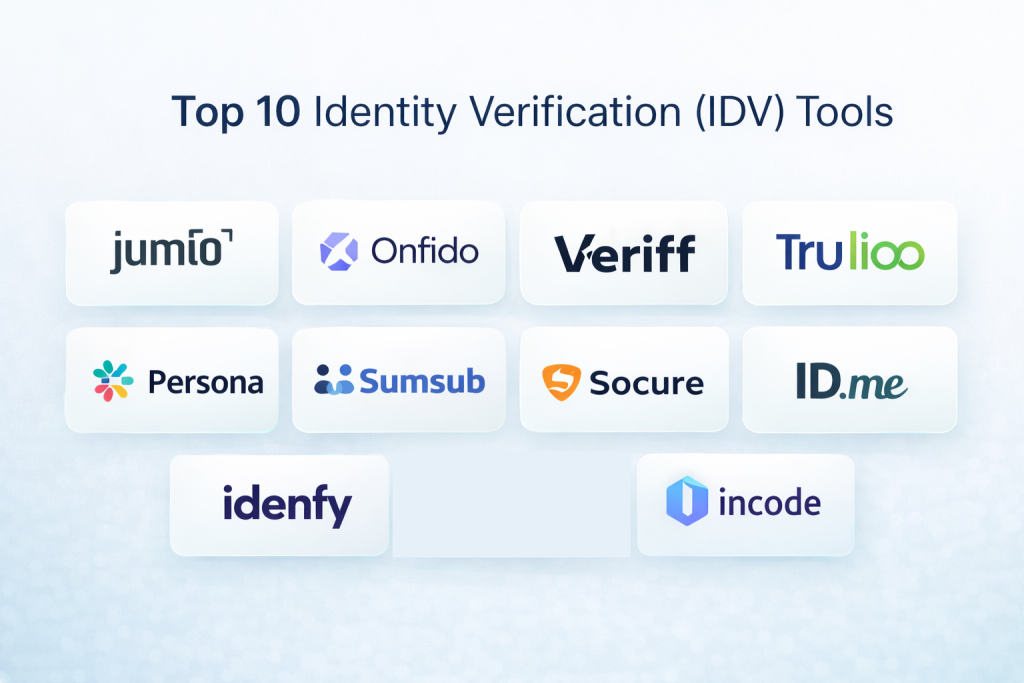
Top 10 Identity Verification (IDV) Tools
1 — Jumio
Jumio is a pioneer in the IDV space, widely recognized for its AI-powered “KYX” platform. It provides an end-to-end orchestration layer that handles everything from initial ID capture to ongoing risk monitoring.
- Key features:
- AI-driven document and biometric authentication.
- Advanced “liveness” detection to prevent deepfake attacks.
- Automated KYB (Know Your Business) and UBO screening.
- Unified dashboard for manual case reviews.
- Transaction monitoring and AML screening against global watchlists.
- Pros:
- Unparalleled global reach with support for over 3,500 ID types.
- Very strong reputation among Tier 1 financial institutions.
- Cons:
- Implementation can be complex and resource-heavy.
- Pricing is at the premium end of the market.
- Security & compliance: SOC 2 Type II, PCI DSS, GDPR, and ISO 27001 compliant.
- Support & community: High-quality enterprise support with dedicated account managers and extensive developer documentation.
2 — Onfido
Onfido, now an Entrust company, focuses on “Atlas AI,” a proprietary machine-learning engine designed to automate the verification process with high precision and low bias.
- Key features:
- Atlas AI for high-speed automated document checks.
- Motion liveness (users perform a simple head movement).
- Privacy-first design with modular verification flows.
- Extensive “Smart Capture” SDKs for mobile and web.
- Real-time fraud reporting and analytics.
- Pros:
- Exceptional mobile user experience that minimizes friction.
- Proven track record with high-growth fintechs like Revolut and Bitstamp.
- Cons:
- Automated decisions can sometimes require manual overrides for blurry photos.
- Less focus on the “digital footprint” side compared to competitors like SEON.
- Security & compliance: ISO 27001, SOC 2, and GDPR compliant.
- Support & community: Robust developer portal and active participation in global compliance forums.
3 — Veriff
Veriff is known for its “video-first” approach to verification, capturing more data points than static photo systems to identify fraudulent intent more effectively.
- Key features:
- Video-based identity verification for 11,500+ document types.
- Cross-device linking (start on desktop, finish on mobile).
- Automated liveness and background environment analysis.
- NFC-based chip reading for e-passports.
- Near-instant decisioning (average 6 seconds).
- Pros:
- One of the fastest verification speeds in the industry.
- Highly accurate at detecting sophisticated fraud in real-time.
- Cons:
- Video capture requires higher bandwidth, which can be a hurdle in emerging markets.
- Customization options for the UI are somewhat more restricted.
- Security & compliance: SOC 2 Type II, ISO 27001, and GDPR compliant.
- Support & community: Excellent technical support and a very modern, easy-to-use API.
4 — Trulioo
Trulioo positions itself as a “Global Identity Network,” focusing on providing access to thousands of independent data sources to verify users without requiring a document upload.
- Key features:
- Access to 400+ authoritative data sources (credit, government, etc.).
- Identity verification for 5 billion people globally.
- Global Business Verification (KYB) for identifying business owners.
- AML screening for PEP and Sanctions.
- Workflow orchestration through a single API.
- Pros:
- Best-in-class for non-document-based verification (voter rolls, utility bills).
- Vast coverage of emerging markets where digital IDs are less common.
- Cons:
- Relies heavily on third-party data quality, which can vary by country.
- The platform can feel disjointed due to the sheer number of data modules.
- Security & compliance: SOC 2 Type II and GDPR compliant.
- Support & community: Extensive professional services and global enterprise support teams.
5 — Persona
Persona offers a highly customizable identity infrastructure that allows businesses to “pick and choose” verification components to build a bespoke user journey.
- Key features:
- Dynamic flow builder with conditional logic.
- Native support for government ID, selfie, and database lookups.
- Passive liveness detection (no head movements required).
- Case management tool for investigating suspicious users.
- In-depth link analysis to find fraud rings.
- Pros:
- Extremely flexible; you only build (and pay for) what you need.
- Clean, modern interface that developers love.
- Cons:
- Configuring complex flows requires a solid understanding of logic and risk.
- Primarily focused on the North American and European markets.
- Security & compliance: SOC 2 Type II, GDPR, and HIPAA compliant.
- Support & community: High-quality documentation and a growing community of startup founders.
6 — Sumsub
Sumsub is an “all-in-one” platform that leans heavily into regulatory compliance, offering a “legal-as-a-service” approach alongside its technical tools.
- Key features:
- Automated KYC, KYB, and AML in one dashboard.
- No-code workflow builder for compliance teams.
- Travel Rule compliance specifically for crypto exchanges.
- Deepfake detection and biometric liveness.
- Proof of address verification via geolocation and document analysis.
- Pros:
- Transparent pricing and a very quick setup process.
- Strong legal support and guidance for navigating local regulations.
- Cons:
- The interface can be cluttered due to the high volume of compliance data.
- Support response times can be slower for lower-tier customers.
- Security & compliance: SOC 2, ISO 27001, and GDPR.
- Support & community: Active blog, webinars, and 24/7 technical support for enterprise.
7 — Socure
Socure is a leader in “predictive” identity, moving beyond simple ID matching to use big data and graph analytics to predict the likelihood that an identity is fraudulent.
- Key features:
- Sigma Identity Fraud engine for predictive risk scoring.
- Direct access to massive US-based datasets.
- Best-in-class detection of synthetic identity fraud.
- Automated document and selfie verification.
- Inclusive identity verification for “thin-file” individuals (Gen Z, immigrants).
- Pros:
- Drastically reduces manual reviews through high-confidence AI scoring.
- Exceptional performance in the North American financial market.
- Cons:
- Limited effectiveness outside of the United States compared to global players.
- Can be difficult to “explain” AI decisions to traditional auditors.
- Security & compliance: SOC 2 Type II and PCI DSS compliant.
- Support & community: Strong presence in the US banking and fintech ecosystem.
8 — ID.me
ID.me has built a “digital wallet” ecosystem where users verify their identity once and can then use that verified status across thousands of government and commercial sites.
- Key features:
- Portable identity (users don’t have to re-verify for every site).
- Live video chat verification for users who fail automated checks.
- Specialized verification for military, students, and first responders.
- NIST 800-63-3 compliant (IAL2 and AAL2).
- High-security multi-factor authentication.
- Pros:
- Massive pre-verified user base (nearly 100 million users).
- Only provider with a robust human-led video backup for accessibility.
- Cons:
- Some users find the “wallet” model intrusive or complicated.
- Heavy focus on US-based government and retail sectors.
- Security & compliance: FedRAMP High, SOC 2, and NIST 800-63-3.
- Support & community: Strong consumer-facing support and high enterprise reliability.
9 — iDenfy
iDenfy is a “hybrid” verification provider that uses AI but keeps human experts in the loop to double-check every verification, aiming for near-zero error rates.
- Key features:
- 24/7 human oversight for every automated check.
- Real-time liveness and document authentication.
- Integrated AML and PEP screening.
- Age verification and digital signature modules.
- “Pay-per-success” pricing model.
- Pros:
- High accuracy because a human eye reviews edge cases.
- Very affordable for smaller businesses with lower volumes.
- Cons:
- The human review can slightly increase verification time (up to 2 minutes).
- Smaller global infrastructure compared to giants like Jumio.
- Security & compliance: ISO 27001, GDPR, and SOC 2.
- Support & community: Responsive customer success team and a clear, simple API.
10 — Incode
Incode is an “AI-first” platform that prides itself on being fully automated, claiming to remove the “human-in-the-loop” entirely to increase privacy and speed.
- Key features:
- Passive liveness detection with proprietary “One-to-Many” matching.
- Fully automated, non-custodial identity platform.
- Advanced deepfake and mask detection.
- Frictionless web and mobile SDKs.
- On-premise deployment options for high-security firms.
- Pros:
- Extremely fast and private (data doesn’t necessarily need to leave the premise).
- High conversion rates due to the “passive” nature of the checks.
- Cons:
- Lack of human fallback can be an issue for users with damaged physical IDs.
- Newer player with less “legacy” trust than some competitors.
- Security & compliance: iBeta Level 2 liveness, SOC 2, and GDPR.
- Support & community: Growing developer ecosystem and high-touch enterprise support.
Comparison Table
| Tool Name | Best For | Platform(s) Supported | Standout Feature | Rating (Gartner/TrueReview) |
| Jumio | Large Enterprise | Web, iOS, Android | KYX Orchestration | 4.4 / 4.2 |
| Onfido | High-Growth Fintech | Web, iOS, Android | Atlas AI Logic | 4.4 / 4.4 |
| Veriff | Rapid Onboarding | Web, iOS, Android | Video-First Analysis | 4.7 / 4.6 |
| Trulioo | Global Data Coverage | Web, API | 400+ Data Sources | 4.5 / 4.5 |
| Persona | Custom Workflows | Web, iOS, Android | Logic-Based Flow Builder | 4.7 / 4.9 |
| Sumsub | Compliance Automation | Web, iOS, Android | Travel Rule Support | 4.7 / 4.8 |
| Socure | US Fraud Prevention | Web, API | Predictive Risk Scoring | 4.6 / N/A |
| ID.me | Gov & Retail Wallet | Web, iOS, Android | Portable Identity Wallet | 4.5 / 4.1 |
| iDenfy | SMB / Affordability | Web, iOS, Android | 24/7 Human Oversight | 4.7 / 4.8 |
| Incode | Privacy & Speed | Web, iOS, Android | 100% Automated AI | 4.8 / N/A |
Evaluation & Scoring of Identity Verification Tools
To provide an objective overview, we have scored these tools based on a weighted rubric that reflects the real-world needs of compliance and product teams.
| Metric | Weight | Evaluation Criteria |
| Core Features | 25% | Document accuracy, biometric liveness, and global ID support. |
| Ease of Use | 15% | End-user friction, dashboard intuitiveness, and mobile UX. |
| Integrations | 15% | API/SDK quality, documentation, and existing CRM/platform plugins. |
| Security | 10% | Certifications (SOC 2, ISO, HIPAA), encryption, and data privacy. |
| Performance | 10% | Verification speed, uptime, and false-positive/negative rates. |
| Support | 10% | Customer service quality, onboarding, and community resources. |
| Price / Value | 15% | Transparency, scalability, and “total cost of ownership.” |
Which Identity Verification (IDV) Tool Is Right for You?
Selecting the right IDV tool isn’t about finding the “best” software on paper; it’s about matching the tool to your specific operational constraints.
Solo Users vs SMB vs Enterprise
- SMBs: If you are a small business, iDenfy or Sumsub are excellent choices. They offer transparent pricing and “out-of-the-box” features that don’t require a dedicated engineering team to maintain.
- Enterprise: For large-scale banking or global retail, Jumio or LexisNexis (though not in the top 10, they are a huge enterprise player) provide the massive data depth and “auditor-friendly” reporting you need.
Budget-Conscious vs Premium
- Budget: iDenfy offers a unique “pay-per-success” model, meaning you don’t pay for users who fail the check or drop off.
- Premium: Onfido and Socure command a premium because of their industry-leading accuracy and the brand trust they provide to your end users.
Feature Depth vs Ease of Use
- Feature-Rich: Persona is the winner if you need to build complex, branching logic (e.g., “If user is from Germany, ask for X; if they are from the US, ask for Y”).
- Ease of Use: Veriff and Incode offer the smoothest paths for users, often completing the entire process in under 15 seconds.
Frequently Asked Questions (FAQs)
1. How long does a typical identity verification take?
Most modern automated tools like Veriff or Incode take between 6 and 30 seconds. Tools that include a “human-in-the-loop” review, like iDenfy, may take 1–2 minutes but offer higher accuracy.
2. Are IDV tools legal under GDPR?
Yes, but they must be implemented correctly. These tools act as “data processors.” You must ensure your chosen vendor has a Data Processing Agreement (DPA) and provides features for “the right to be forgotten.”
3. What is “liveness detection”?
Liveness detection is a security feature that ensures the person performing the check is a real, live human. It prevents fraud where criminals hold up a photo, use a video recording, or employ high-tech “deepfakes.”
4. Can IDV tools verify documents in different languages?
Most global tools like Jumio and Trulioo support Latin and non-Latin scripts, including Cyrillic, Arabic, Chinese, and Kanji, covering over 190 countries.
5. How much do these tools cost?
Pricing is typically “per check.” High-volume enterprises may pay as little as $0.50 per check, while low-volume startups might pay $1.50 to $3.00 per successful verification.
6. Do I need a developer to install these?
Most tools offer “No-Code” versions (like a hosted link), but for a seamless experience inside your own app, you will need a developer to integrate their API or SDK.
7. What is a “False Positive” in IDV?
A false positive occurs when a legitimate, honest user is flagged as a fraudster. High false-positive rates can kill your conversion and overwhelm your support team.
8. Can I verify a business (KYB) with these tools?
Yes, many platforms like Sumsub and Trulioo have specialized “Know Your Business” modules that look up corporate registries and identify the Ultimate Beneficial Owners (UBO).
9. What happens if a user’s ID is expired?
Most IDV tools will automatically reject an expired ID. However, some platforms allow you to set custom rules to “warn” the user or allow a manual override in specific circumstances.
10. What is the difference between KYC and IDV?
IDV (Identity Verification) is the technical act of proving a person is who they say they are. KYC (Know Your Customer) is the broader legal regulatory process that includes IDV but also includes ongoing monitoring and risk assessment.
Conclusion
The “best” Identity Verification tool is the one that disappears. From a user’s perspective, the ideal onboarding experience is so fast and intuitive that they barely notice it’s happening. From a business perspective, the ideal tool is a silent sentinel that blocks 99.9% of fraud without ever bothering your legitimate customers.
While Veriff leads the pack in pure speed and Persona in flexibility, your choice ultimately comes down to your jurisdiction, your budget, and the specific fraud threats you face. In 2026 and beyond, as AI-generated fraud continues to evolve, staying with a reputable, AI-forward vendor is no longer just a compliance requirement—it is a survival necessity.

- Top 10 Email Deliverability Tools: Features, Pros, Cons & Comparison - September 6, 2026
- Top 10 Pharmacovigilance Software: Features, Pros, Cons & Comparison - September 6, 2026
- Top 10 Manufacturing Execution Systems (MES) - July 30, 2026