Introduction
Data Governance Platforms are comprehensive software suites designed to manage the availability, usability, integrity, and security of an organization’s data assets. Unlike a single tool that might only track data quality or catalog file names, a governance platform provides a holistic environment where business policies meet technical execution. It allows organizations to define who owns a piece of data, what its business definition is, who is allowed to see it, and how long it should be retained before being deleted.
Why It Matters
Data governance is the bedrock of Data Trust. Without it, AI models are built on biased or incorrect information, executive reports contradict each other, and companies risk multi-million dollar fines for privacy violations. A robust platform automates the tedious work of finding sensitive information and mapping data lineage, allowing the organization to move faster while remaining compliant with global laws like GDPR and CCPA.
Key Real-World Use Cases
- Privacy Compliance: Automatically identifying PII (Personally Identifiable Information) across thousands of databases to ensure “Right to be Forgotten” requests are fulfilled.
- Standardizing Business Logic: Ensuring that the definition of “Net Revenue” is identical across the sales, finance, and marketing departments.
- Data Democratization: Creating a “Data Shop” where analysts can find high-quality, approved datasets without needing to ask a DBA for permission.
- Risk Management: Monitoring who has access to sensitive financial data and alerting the security team to unusual access patterns.
What to Look For
Evaluation criteria should include automation capabilities (how much can it do without manual entry?), ease of adoption (will business users actually use it?), connector depth, and metadata intelligence (AI-driven tagging).
Best for: Chief Data Officers (CDOs), Data Stewards, and Compliance Officers in mid-sized to large enterprises. It is particularly vital for sectors like Fintech, Healthcare, and Government where data accuracy and privacy are legally mandated.
Not ideal for: Early-stage startups with very small, localized datasets or companies that do not yet have a centralized data strategy. For these groups, a simple shared document and basic database permissions are often sufficient until they scale.
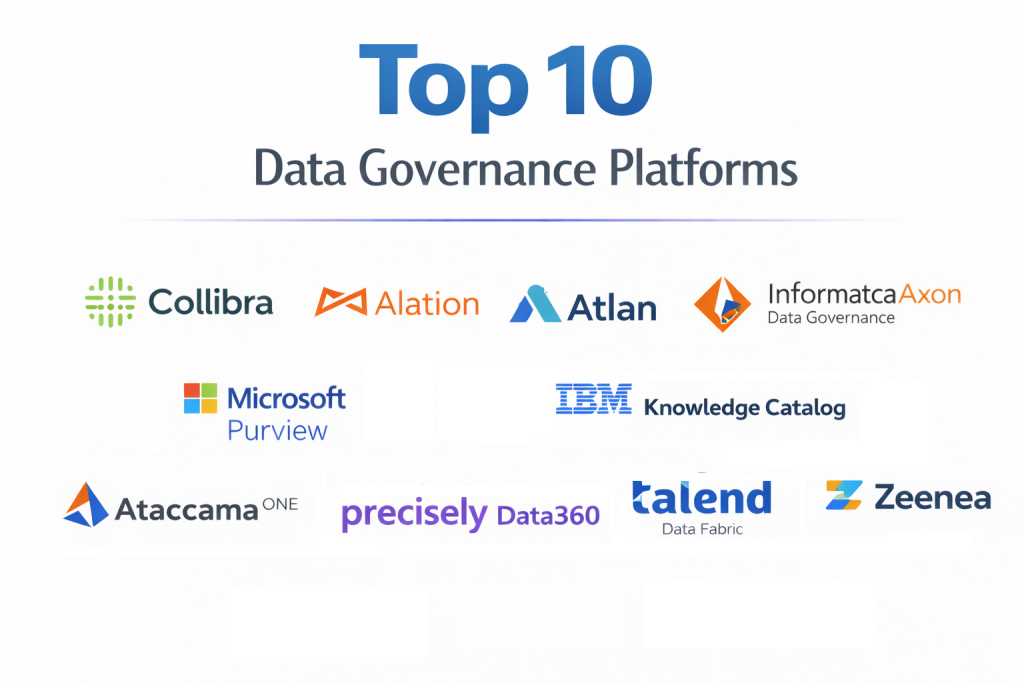
Top 10 Data Governance Platforms Tools
1 — Collibra
Collibra is widely considered the industry standard for enterprise data governance. It offers a sophisticated, “System of Record” approach that unifies data cataloging, quality, and governance into a single, highly structured environment.
- Key features:
- Data Stewardship Workbench: A centralized hub for managing tasks, approvals, and roles for data owners.
- Business Glossary: A robust engine for defining and linking business terminology to technical assets.
- Policy Manager: Tools to digitize and enforce data policies across the organization.
- Privacy App: Specific workflows designed to automate CCPA and GDPR compliance.
- Assessments: Automated surveys to evaluate the impact of data use on privacy and risk.
- Pros:
- The most comprehensive feature set in the market for complex, global organizations.
- Excellent for building a formal culture of data accountability and stewardship.
- Cons:
- Extremely high cost and a long implementation cycle that often requires consultants.
- The user interface can feel “heavy” and technical for non-power users.
- Security & compliance: FedRAMP, SOC 2 Type II, ISO 27001, HIPAA, and GDPR. Offers deep encryption and audit logs.
- Support & community: “Collibra University” provides extensive training, alongside a massive global partner network and 24/7 enterprise support.
2 — Alation
Alation focuses on “Data Intelligence” by combining governance with a user-friendly, social-media-like interface. It is famous for being the first to advocate for a “human-centric” approach to metadata management.
- Key features:
- Behavioral Analysis Engine: Learns from how people actually use data to suggest the most trusted sources.
- Trust Flags: Allows users to endorse datasets or warn others about potential quality issues.
- Alation Compose: An intelligent SQL editor that provides governance warnings while a user is writing code.
- Data Governance App: Simplifies the creation of stewardship workflows and business glossaries.
- Automated Lineage: Visualizes the journey of data from source to dashboard.
- Pros:
- High user adoption rates because it feels more like a search engine than a corporate tool.
- Bridges the gap between technical data engineers and business analysts effectively.
- Cons:
- The “social” aspect requires a highly active team to be effective; otherwise, descriptions stay blank.
- Advanced governance automation features can be complex to configure initially.
- Security & compliance: SOC 2 Type II, GDPR, and SSO integration (SAML/Okta).
- Support & community: Very active user community (“Alationites”) and a strong library of webinars and technical documentation.
3 — Atlan
Atlan is a “Modern Data Workspace” built for teams that move fast. It is cloud-native and integrates deeply with the modern data stack (Snowflake, dbt, Looker).
- Key features:
- Active Metadata: Metadata that “paints” itself into other tools (e.g., seeing data health inside a BI tool).
- Playbooks: Automated bots that can tag PII or document columns across thousands of tables in seconds.
- Open Lineage: Built on open standards to ensure visibility across the entire pipeline.
- Persona-Based UX: Customizes the interface based on whether the user is an engineer or a manager.
- Personalized Glossaries: Allows different departments to have their own specific definitions.
- Pros:
- One of the fastest implementation times in the industry (can show value in days).
- Highly intuitive, “SaaS-feeling” UI that requires very little training.
- Cons:
- Primarily focused on cloud-native tools; less support for legacy on-premise mainframes.
- Pricing can scale quickly as you add more connectors and users.
- Security & compliance: SOC 2 Type II, HIPAA, GDPR, ISO 27001, and fine-grained access control.
- Support & community: Known for high-velocity product updates and a very responsive, modern customer success team.
4 — Informatica Axon Data Governance
Informatica is a legacy giant that has successfully moved to the cloud. Axon is their governance layer, designed to work seamlessly with their massive ecosystem of data integration and quality tools.
- Key features:
- Unison Search: A unified view that shows the relationship between business, technical, and quality metadata.
- CLAIRE AI: An AI engine that automatically discovers and classifies data across the enterprise.
- Process Mapping: Connects data assets to actual business processes (e.g., “Monthly Billing”).
- Regulatory Accelerators: Pre-built content for specific regulations like BCBS 239 or GDPR.
- Change Impact Analysis: Shows how a change in a source system will ripple through the company.
- Pros:
- Unrivaled for breadth; if you have a massive, messy hybrid environment, Informatica can map it.
- Strongest “one-stop-shop” for teams already using Informatica’s PowerCenter or Cloud Data Integration.
- Cons:
- Licensing and modules can be confusing and very expensive.
- Often requires significant professional services to get a full deployment running.
- Security & compliance: FedRAMP, SOC 2, HIPAA, GDPR, and ISO 27001.
- Support & community: Decades of experience, a massive global knowledge base, and 24/7 global support.
5 — Microsoft Purview
Microsoft Purview is a unified data governance solution that helps manage and govern your on-premises, multi-cloud, and SaaS data. It is the natural choice for organizations heavily invested in Azure and Office 365.
- Key features:
- Data Map: Automatically discovers and catalogs data across Azure, AWS, and on-prem.
- Sensitivity Labels: Leverages the same labels used in M365 (Secret, Confidential) to protect data.
- Data Insights: High-level dashboards showing where sensitive data is stored and who has access.
- Managed Workflows: Simple drag-and-drop tool for creating governance approvals.
- Integration with M365: Can govern data within Excel, Word, and Teams.
- Pros:
- Unbeatable value for organizations already on the Microsoft E5 license tier.
- Deep, native integration with Power BI and SQL Server.
- Cons:
- Navigating the Microsoft interface can be confusing for non-Azure users.
- Customizing connectors for non-Microsoft sources can be more difficult than competitors.
- Security & compliance: Fully integrated with Microsoft Entra ID (SSO); SOC, HIPAA, and ISO compliant.
- Support & community: Backed by the global Microsoft support ecosystem and a massive network of Azure consultants.
6 — IBM Knowledge Catalog
IBM Knowledge Catalog is part of the Cloud Pak for Data ecosystem. It focuses on using AI to make data governance “invisible” by automating the heavy lifting of classification and protection.
- Key features:
- Automated Data Discovery: Uses ML to identify and classify over 160 types of sensitive data.
- Active Metadata: Dynamically updates data policies based on the context of the user.
- Data Virtualization: Allows users to query data without moving it, maintaining strict governance.
- Privacy Workflows: Built-in tools for managing data consent and deletion.
- Collaboration Tools: Integrated chat and notes for data stewards.
- Pros:
- Excellent for highly regulated industries (banking/government) needing deep audit trails.
- Very strong AI capabilities for automated data tagging.
- Cons:
- Implementation can be complex and requires a strong understanding of the IBM ecosystem.
- The platform feels geared toward very large, traditional enterprises.
- Security & compliance: FIPS 140-2, HIPAA, GDPR, ISO 27001, and SOC 2.
- Support & community: World-class global support and a massive library of academic-grade documentation.
7 — Ataccama ONE
Ataccama ONE is an AI-powered platform that unifies data governance, quality, and master data management (MDM) into a single “Fabric.”
- Key features:
- Self-Driving Data Governance: AI suggests rules and identifies anomalies without manual input.
- Automated Data Profiling: Instantly analyzes any connected source to determine its health.
- Integrated MDM: Cleans and merges data while governing it.
- Data Stories: Visual reports that make data governance progress easy to explain to executives.
- One-Click Cataloging: Adds metadata with minimal configuration.
- Pros:
- One of the best user interfaces on the market; very clean and modern.
- Great “all-in-one” value for teams that need both governance and data quality.
- Cons:
- If you only need a catalog and not quality/MDM, the platform may feel like “too much.”
- The community-driven support resources are smaller than Informatica or Microsoft.
- Security & compliance: ISO 27001, SOC 2, GDPR, and HIPAA compliant.
- Support & community: High-quality professional services and a dedicated customer success manager for enterprise clients.
8 — Precisely (Data360)
Precisely is a specialist in “Data Integrity,” and its Data360 platform provides a powerful suite for data governance, focusing on the accuracy and context of information.
- Key features:
- Visual Data Lineage: Provides some of the most detailed lineage mapping for impact analysis.
- Contextual Governance: Links technical assets to business value drivers.
- Flexible Metamodel: Allows you to customize exactly how your organization defines data relationships.
- Scorecards: Automated dashboards showing data health and policy compliance.
- Workflow Orchestration: Manages data stewardship tasks through a visual builder.
- Pros:
- Excellent for “Impact Analysis”—knowing exactly what will break if a table is changed.
- Strong history in managing complex data for retail and financial sectors.
- Cons:
- The interface can feel a bit more dated than “modern” tools like Atlan.
- Requires a significant amount of configuration to get the most out of the metamodel.
- Security & compliance: SOC 2, GDPR, and ISO 27001.
- Support & community: Strong enterprise support and a professional services wing with deep industry knowledge.
9 — Talend Data Fabric
Talend (now part of Qlik) provides a governance solution that is deeply embedded in its data integration suite. It is designed to govern data as it moves through the pipeline.
- Key features:
- Talend Trust Score: Automatically calculates a health score for every dataset based on quality and metadata.
- Self-Service Data Stewardship: A dedicated app for business users to fix data errors manually.
- Unified Catalog: Combines data from cloud warehouses, on-prem, and streaming sources.
- Data Masking: Protects sensitive data in real-time as it is being processed.
- API-First Design: Allows for easy integration with other internal tools.
- Pros:
- Ideal for data engineers who want to govern data “at the source” during ETL.
- Very flexible pricing model that scales with usage.
- Cons:
- The governance features are sometimes secondary to the integration (ETL) features.
- Can be resource-heavy for on-premise installations.
- Security & compliance: SOC 2, HIPAA, GDPR, and ISO 27001.
- Support & community: Massive user base, robust knowledge base, and tiered support options.
10 — Zeenea
Zeenea is a European-based “Data Discovery Platform” that prides itself on being agile, simple, and incredibly fast to deploy.
- Key features:
- Zeenea Explorer: A simplified interface designed for non-technical business users.
- Zeenea Studio: A more powerful view for data stewards and engineers.
- Smart Connectors: Lightweight connectors for a wide range of cloud and legacy systems.
- Knowledge Graph: Visualizes complex relationships between data, people, and processes.
- API-First: Everything in the platform can be automated via API.
- Pros:
- Extremely strong focus on European privacy standards (GDPR) and data residency.
- One of the cleanest, most minimalist designs in the governance market.
- Cons:
- Smaller presence and ecosystem in North America compared to the “Big Three.”
- Fewer built-in “Data Quality” features compared to Ataccama or Talend.
- Security & compliance: SOC 2 Type II, ISO 27001, and GDPR.
- Support & community: High-touch personalized support for enterprise clients.
Comparison Table
| Tool Name | Best For | Platform(s) Supported | Standout Feature | Rating (Gartner) |
| Collibra | Global Enterprise | Multi-cloud, On-prem | Stewardship Workflows | 4.5 / 5.0 |
| Alation | Data Intelligence | Multi-cloud, On-prem | Behavioral AI Engine | 4.6 / 5.0 |
| Atlan | Modern Data Stack | Cloud-Native | Active Metadata Sync | 4.7 / 5.0 |
| Informatica | Complex Hybrid | All Platforms | CLAIRE AI Intelligence | 4.4 / 5.0 |
| MS Purview | Microsoft Shops | Azure, AWS, M365 | M365 Sensitivity Labels | 4.3 / 5.0 |
| IBM Catalog | AI Automation | Hybrid Cloud | Auto-Data Protection | 4.2 / 5.0 |
| Ataccama ONE | Integrated Quality | Cloud & Hybrid | Unified Data Fabric | 4.6 / 5.0 |
| Precisely | Impact Analysis | Multi-cloud, On-prem | Business Value Mapping | 4.5 / 5.0 |
| Talend | Data Engineers | Multi-cloud, Hybrid | Talend Trust Score | 4.4 / 5.0 |
| Zeenea | Agile Governance | Cloud-Native | Minimalist UX | N/A |
Evaluation & Scoring of Data Governance Platforms
We evaluate these platforms based on a weighted scoring rubric that prioritizes both technical capability and the likelihood of successful organizational adoption.
| Category | Weight | Evaluation Criteria |
| Core Features | 25% | Cataloging, lineage, PII discovery, and stewardship tools. |
| Ease of Use | 15% | Time to value, UI design, and non-technical accessibility. |
| Integrations | 15% | Breadth of connectors (modern & legacy) and API quality. |
| Security & Comp. | 10% | Encryption, audit trails, and compliance certifications. |
| Perf. & Reliability | 10% | Scalability with large metadata volumes and platform uptime. |
| Support & Comm. | 10% | Documentation, training academy, and user community vibrancy. |
| Price / Value | 15% | Predictability of cost and Total Cost of Ownership (TCO). |
Which Data Governance Platform Tool Is Right for You?
Solo Users vs SMB vs Mid-Market vs Enterprise
- Solo Users/Small SMB: Generally, you do not need a full platform. Focus on building a “Data Dictionary” in a tool like Notion or a shared spreadsheet until your data team exceeds 5 people.
- Mid-Market: Atlan, Alation, and Zeenea are excellent choices. They provide the structure you need to scale without requiring a specialized “Platform Engineer” just to keep the lights on.
- Enterprise: Collibra, Informatica, and IBM are the standard. They can handle the political and technical complexity of tens of thousands of users across global regions.
Budget-Conscious vs Premium Solutions
- Budget: If you are already an Azure customer, Microsoft Purview is almost always the most cost-effective path. For open-source enthusiasts, a combination of DataHub and custom scripts can work, though maintenance costs are high.
- Premium: Collibra and Alation are premium investments. You are paying for the “best-in-class” user experience and the most advanced automation available.
Feature Depth vs Ease of Use
If you prioritize Ease of Use (essential for getting business buy-in), Atlan and CastorDoc are leaders. If you need Feature Depth for complex regulatory audits and master data management, Ataccama and Informatica provide more control.
Integration and Scalability Needs
If your data lives in mainframes and 20-year-old databases, Informatica and IBM have the legacy connectors you need. If you are starting fresh in the cloud, Atlan and Alation will integrate more seamlessly with your stack.
Frequently Asked Questions (FAQs)
1. Is a Data Catalog the same as a Data Governance Platform?
No. A catalog is just a component. A Data Governance Platform includes the catalog plus the rules, policies, stewardship workflows, and compliance tools needed to manage the data.
2. How long does it take to implement data governance?
The software can be installed in days, but the “program” takes months or years. Most companies start with one domain (like “Customer Data”) and roll it out over 3–6 months.
3. Does these tools store my actual data?
Usually, no. They store “metadata” (data about the data). Your actual customer records stay in your database; the platform just stores the table names, descriptions, and owners.
4. Can I build my own data governance tool?
You can, but it is rarely cost-effective. Building a tool that handles automated lineage, PII discovery, and business workflows across different databases is a massive engineering undertaking.
5. How much do these platforms cost?
Pricing varies wildly. Microsoft Purview can start at a few hundred dollars a month for small usage, while Collibra or Informatica can easily exceed $100,000 per year for enterprise licensing.
6. Do I need a Data Steward to run this?
Yes. A platform is only as good as the people who define the policies. You will need “Stewards” (people who understand the data) and “Owners” (people responsible for the data) to make it work.
7. How does this help with GDPR?
Governance platforms help you find every place a customer’s email address is stored. Without one, finding every instance of a specific user’s data across a company is nearly impossible.
8. What is “Active Metadata”?
Active metadata means the governance information “travels” to where the user is. For example, when a user is in a BI tool, a pop-up might tell them, “Warning: This dataset is not approved for external use.”
9. Can governance platforms handle unstructured data (PDFs/Images)?
Some can (like Informatica and IBM), but most are specialized for structured data (SQL databases/Warehouses). Always check the connector list if you have a large “Data Lake” of files.
10. What is the biggest mistake in buying a platform?
Buying a tool before you have a strategy. If you buy a complex tool like Collibra but don’t have anyone assigned to be a “Data Steward,” the platform will become a “shelf-ware” ghost town.
Conclusion
Data Governance is no longer a “back-office” IT project; it is a critical business capability. The right Data Governance Platform acts as the glue that holds your data strategy together, turning a confusing mess of tables into a trusted asset that everyone in the company can use safely.
If you are a modern, cloud-first company, Atlan and Alation provide the easiest path to success. If you are a global giant with legacy complexity, Collibra and Informatica offer the power you need to stay compliant. Ultimately, the best tool is the one that fits your company’s culture—because data governance only works if your people actually use it.

- Top 10 Email Deliverability Tools: Features, Pros, Cons & Comparison - September 6, 2026
- Top 10 Pharmacovigilance Software: Features, Pros, Cons & Comparison - September 6, 2026
- Top 10 Manufacturing Execution Systems (MES) - July 30, 2026