Introduction
Deep Learning Frameworks are specialized software libraries that provide the building blocks for designing, training, and deploying artificial neural networks. Think of them as the “operating systems” for AI. They handle the complex underlying mathematics—such as backpropagation and gradient descent—allowing developers to focus on the architecture of their models rather than the calculus of high-dimensional tensors. These frameworks abstract away the hardware-level complexities of GPUs and TPUs, making it possible for researchers to scale their ideas from a single laptop to a massive data center.
Why It Matters
Deep learning is computationally expensive and mathematically dense. Frameworks provide “automatic differentiation” and pre-built layers (like convolutional or recurrent layers) that save thousands of hours of development time. They ensure that AI models are efficient, portable, and reproducible across different environments.
Key Real-World Use Cases
- Computer Vision: Powering facial recognition, medical imaging diagnostics, and autonomous vehicle navigation.
- Natural Language Processing (NLP): Enabling real-time translation, sentiment analysis, and the generation of human-like text.
- Recommendation Engines: Driving the personalized content seen on platforms like Netflix, TikTok, and Amazon.
- Generative AI: Creating high-fidelity images, music, and synthetic data for research.
What to Look For
When evaluating a framework, you should look for computational performance, community support, ease of debugging, and deployment flexibility (can it run on a mobile phone as easily as a server?).
Best for: AI researchers, data scientists, and machine learning engineers in tech-forward enterprises and academic institutions. It is essential for industries like Healthcare, Automotive, Finance, and Cybersecurity.
Not ideal for: Organizations with limited data or those solving simple linear problems. If your problem can be solved with a basic Excel formula or a simple regression model, the complexity and hardware requirements of deep learning frameworks will be a hindrance rather than a help.
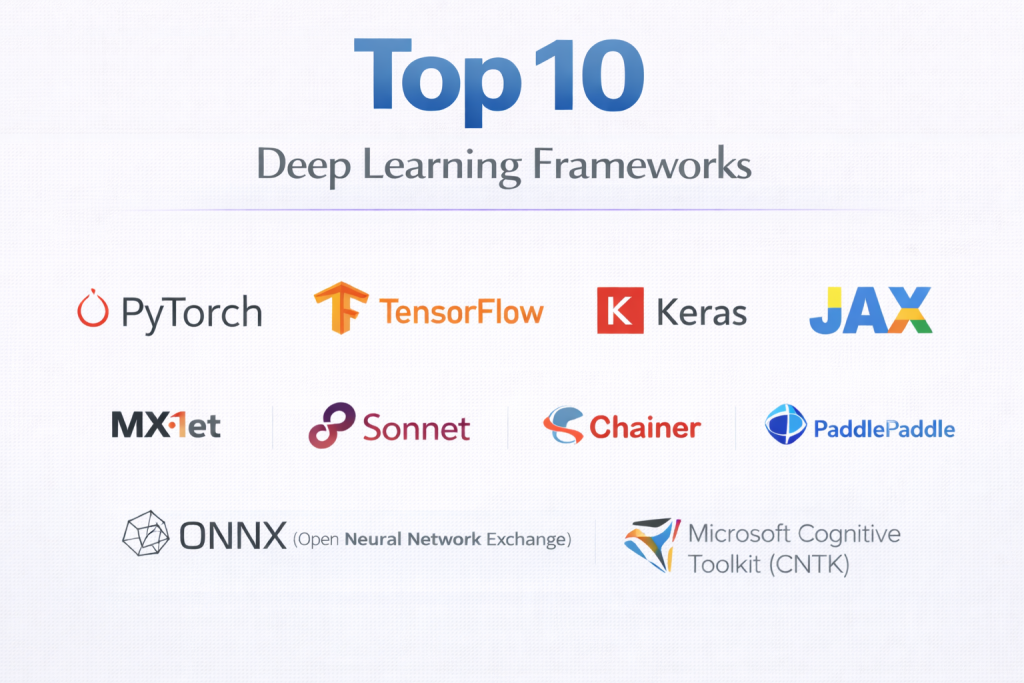
Top 10 Deep Learning Frameworks Tools
1 — PyTorch
Created by Meta’s AI Research lab, PyTorch has become the favorite of the academic community and is rapidly dominating the enterprise space due to its “Pythonic” nature and flexibility.
- Key features:
- Dynamic Computational Graphs: Allows users to change the network behavior on the fly during runtime.
- TorchScript: Transition smoothly between “eager mode” for research and “script mode” for production.
- Distributed Training: Native support for splitting workloads across multiple GPUs and nodes.
- Strong Ecosystem: Includes libraries like TorchVision, TorchText, and TorchAudio.
- Python-First: Designed to feel like a native Python library, making it intuitive for developers.
- Pros:
- Exceptionally easy to debug using standard Python debugging tools.
- Currently the most popular framework for cutting-edge AI research and LLM development.
- Cons:
- Historically considered less efficient for mobile deployment than TensorFlow (though this is narrowing).
- Smaller set of pre-built “ready-to-go” production monitoring tools compared to older competitors.
- Security & compliance: Supports encrypted tensors and secure model serving. Compliance is typically handled via the hosting platform (AWS/GCP/Azure).
- Support & community: Massive, vibrant community; world-class documentation; extensive tutorials and third-party courses.
2 — TensorFlow
Developed by Google Brain, TensorFlow is the “industrial-strength” framework. It was designed from the beginning to handle massive production workloads across heterogeneous hardware.
- Key features:
- TensorFlow Serving: A high-performance system for deploying models in production environments.
- TF Lite: Specialized for mobile, embedded, and IoT device deployment.
- TF Extended (TFX): An end-to-end platform for deploying production ML pipelines.
- Keras Integration: High-level API that makes model building fast and simple.
- TensorBoard: A powerful visualization toolkit for tracking metrics and model graphs.
- Pros:
- The most robust toolset for moving models from a lab into a global, high-scale application.
- Exceptional support for specialized hardware like Google’s TPUs (Tensor Processing Units).
- Cons:
- The “static graph” approach (in older versions) can be harder to learn and debug.
- Can feel overly “verbose” and complex for simple research experiments.
- Security & compliance: Strongest enterprise security features, including TensorFlow Privacy for differential privacy.
- Support & community: Backed by Google; massive enterprise adoption; widely available professional certifications.
3 — Keras
Keras is a high-level API that acts as an interface for other frameworks (primarily TensorFlow). It focuses on enabling fast experimentation by being as “human-centric” as possible.
- Key features:
- User-Friendly API: Minimizes the number of user actions required for common use cases.
- Modularity: Neural network layers, cost functions, and optimizers are all standalone modules.
- Multi-Backend Support: Can run on top of TensorFlow, JAX, or PyTorch (in Keras 3.0).
- Built-in Preprocessing: Tools for image, text, and numerical data preparation.
- Easy Prototyping: Go from idea to result in just a few lines of code.
- Pros:
- The best framework for beginners and those who need to prototype an idea in minutes.
- Clear and actionable error messages that make troubleshooting simple.
- Cons:
- Might feel restrictive for researchers who need to invent brand-new, low-level mathematical operations.
- Performance is tied to the efficiency of the underlying backend it is running on.
- Security & compliance: Inherits the security and compliance of the backend (e.g., TensorFlow).
- Support & community: Excellent documentation; huge presence on Stack Overflow; very beginner-friendly community.
4 — JAX
JAX is Google’s newer high-performance library for numerical computing and machine learning. It is designed for researchers who want to push the boundaries of performance.
- Key features:
- Autograd: Can automatically differentiate native Python and NumPy functions.
- XLA (Accelerated Linear Algebra): Compiles Python code into highly optimized kernels for GPUs and TPUs.
- Vectorization (vmap): Easily write code for a single example and apply it to a batch.
- Purely Functional: Encourages a functional programming style, which is great for mathematical clarity.
- Pytree System: Handles complex data structures (like dictionaries of arrays) effortlessly.
- Pros:
- Incredible speed; often outperforms PyTorch and TensorFlow in specialized research tasks.
- Very clean mathematical syntax that maps closely to research papers.
- Cons:
- Steep learning curve due to its functional programming paradigm (no “state” in objects).
- Ecosystem is still growing; fewer “off-the-shelf” deployment tools for mobile or web.
- Security & compliance: Varies / N/A.
- Support & community: Rapidly growing in the research world (especially at DeepMind and Google Research).
5 — MXNet
Apache MXNet is a flexible and efficient deep learning library designed for high-scalability, which led to its adoption as the deep learning framework of choice for AWS.
- Key features:
- Hybrid Frontend: Switch between imperative and symbolic programming modes.
- Efficient Scaling: Designed to scale linearly across multiple GPUs and many machines.
- Polyglot Support: Deep support for Python, R, Scala, C++, Julia, and Perl.
- Gluon API: A high-level interface that simplifies model definition.
- Low Memory Footprint: Very efficient at running on hardware with limited resources.
- Pros:
- Excellent for multi-language teams (e.g., those using R and Python together).
- Highly optimized for cloud environments, particularly Amazon Web Services.
- Cons:
- Community momentum is significantly lower than PyTorch or TensorFlow.
- Documentation can sometimes lag behind the latest features.
- Security & compliance: Supports enterprise-grade security within the Apache Software Foundation guidelines.
- Support & community: Strong backing from AWS; active but smaller community than the “Big Two.”
6 — Sonnet
Developed by DeepMind, Sonnet is a library built on top of TensorFlow designed to provide simple, composable abstractions for machine learning research.
- Key features:
- Object-Oriented: Focused on creating “modules” that can be easily reused.
- Clarity: Specifically designed to avoid the “hidden state” problems in early TensorFlow versions.
- Flexible: Allows for the construction of complex architectures with minimal boilerplate.
- Research-Focused: Optimized for the types of models built at DeepMind (Reinforcement Learning).
- Composable: Modules can be nested to create hierarchical models.
- Pros:
- Extremely clean code architecture that is easy to read and maintain.
- Highly reliable, as it powers many of the most famous AI breakthroughs of the last decade.
- Cons:
- Very closely tied to the TensorFlow ecosystem; if you don’t like TF, you won’t like Sonnet.
- Not intended as a general-purpose production deployment tool.
- Security & compliance: Inherits TensorFlow’s security features.
- Support & community: Documentation is excellent but the user base is primarily high-level researchers.
7 — Chainer
Chainer was one of the first frameworks to introduce the “Define-by-Run” (dynamic graph) approach, which heavily influenced the design of PyTorch.
- Key features:
- Dynamic Graph Construction: The graph is built as the code is executed.
- Python-Native: Highly intuitive for Python developers.
- CuPy Integration: Uses CuPy for high-speed GPU-accelerated NumPy operations.
- Flexibility: Easy to implement complex logic like loops inside neural networks.
- Lightweight: Very few dependencies compared to TensorFlow.
- Pros:
- Very easy to understand for developers who want to see exactly how data flows through a network.
- Great for innovative research involving non-standard network architectures.
- Cons:
- The main developers (Preferred Networks) have transitioned their focus to PyTorch, so Chainer is mostly in maintenance mode.
- Limited support for modern deployment pipelines.
- Security & compliance: N/A.
- Support & community: Mature community, but activity has declined significantly in recent years.
8 — PaddlePaddle
Developed by Baidu, PaddlePaddle (Parallel Distributed Deep Learning) is the leading framework in China, designed for industrial applications and massive scale.
- Key features:
- Industrial-Grade Models: Huge library of pre-trained models optimized for manufacturing and finance.
- Paddle Serving: High-performance model deployment system.
- Paddle Mobile: Highly optimized for mobile and IoT devices.
- VisualDL: Visualization tool similar to TensorBoard.
- Massive Distributed Training: Native support for training on thousands of GPUs.
- Pros:
- Exceptional performance for large-scale Chinese language (NLP) tasks.
- Very efficient at handling massive datasets in a production environment.
- Cons:
- English-language documentation and community support are not as robust as the US-based frameworks.
- Less adoption in Western markets, which can make hiring experienced developers harder.
- Security & compliance: High standards for industrial security and data privacy.
- Support & community: Massive in Asia; strong corporate backing from Baidu; extensive technical support for enterprise.
9 — ONNX (Open Neural Network Exchange)
While not a “training framework” in the traditional sense, ONNX is a critical ecosystem tool that allows models to be moved between different frameworks.
- Key features:
- Framework Interoperability: Train in PyTorch, deploy in TensorFlow, or vice versa.
- Hardware Optimization: Allows models to run on a wide variety of hardware (Intel, NVIDIA, ARM).
- Standardized Format: A common file format for neural network graphs.
- ONNX Runtime: A high-performance engine for executing ONNX models.
- Broad Support: Supported by almost every major tech player (Microsoft, AWS, Meta).
- Pros:
- Eliminates “vendor lock-in”—you aren’t stuck with one framework for the life of your product.
- Dramatically improves the performance of models on specific edge hardware.
- Cons:
- Conversion between frameworks can sometimes be finicky for very custom or new layers.
- It is a deployment tool, not a place to design or train a new model from scratch.
- Security & compliance: Varies by implementation; the ONNX runtime is highly secure.
- Support & community: Industry-wide support; excellent documentation and conversion tools.
10 — Microsoft Cognitive Toolkit (CNTK)
CNTK is Microsoft’s legacy deep learning framework. While it is no longer being actively developed with new features, it remains a powerful tool in many existing enterprise pipelines.
- Key features:
- Massive Scalability: Designed to handle huge datasets across multiple GPUs.
- Efficiency: Known for having very high performance for Speech and NLP tasks.
- C++ and Python APIs: Can be easily integrated into C++ applications.
- Model Compression: Tools for making models smaller for faster inference.
- Built-in Components: Includes a wide range of standard neural network layers.
- Pros:
- Still one of the fastest engines for specific types of RNNs (Recurrent Neural Networks).
- Deeply integrated with the Microsoft development ecosystem.
- Cons:
- It is a “sunset” product; no new major features are being added.
- The community has largely moved to PyTorch or TensorFlow.
- Security & compliance: Built to Microsoft’s enterprise security standards.
- Support & community: Legacy documentation is available, but active community support is low.
Comparison Table
| Tool Name | Best For | Platform(s) Supported | Standout Feature | Rating (Gartner) |
| PyTorch | Research & LLMs | K8s, Cloud, Mobile | Dynamic Graphs | 4.8 / 5.0 |
| TensorFlow | Production Scale | K8s, Edge, Cloud | TF Serving / Ecosystem | 4.6 / 5.0 |
| Keras | Beginners / Speed | Cloud, Mobile | Human-centric API | 4.7 / 5.0 |
| JAX | High-perf Research | Cloud (TPU/GPU) | XLA Compilation | N/A |
| MXNet | Multi-language Teams | Cloud (AWS focus) | Scaling Efficiency | 4.3 / 5.0 |
| Sonnet | Modular Research | TensorFlow based | Object-oriented Logic | N/A |
| Chainer | Innovators (Legacy) | Local / Cloud | Define-by-Run | N/A |
| PaddlePaddle | Industrial / Asia | Cloud, Mobile, Edge | Industrial Model Library | N/A |
| ONNX | Portability | Cross-platform | Framework Switching | N/A |
| CNTK | Legacy Enterprise | Windows / Linux | Efficiency for Speech | 4.1 / 5.0 |
Evaluation & Scoring of Deep Learning Frameworks
Choosing a framework is a long-term commitment. We evaluate these tools using a weighted rubric that prioritizes the needs of both the developer and the enterprise.
| Category | Weight | Evaluation Criteria |
| Core Features | 25% | Automatic differentiation, GPU/TPU support, and layer variety. |
| Ease of Use | 15% | API clarity, Pythonic feel, and quality of error messages. |
| Integrations | 15% | Support for data warehouses, MLOps tools, and cloud providers. |
| Security & Comp. | 10% | Encryption, differential privacy, and regulatory audit logs. |
| Performance | 10% | Training throughput, inference latency, and memory usage. |
| Support & Comm. | 10% | Documentation, Stack Overflow presence, and enterprise support. |
| Price / Value | 15% | Open-source availability vs. costs of managed cloud services. |
Which Deep Learning Frameworks Tool Is Right for You?
Solo Users vs SMB vs Mid-Market vs Enterprise
- Solo Users/Students: Start with Keras or PyTorch. The learning curve is gentle, and the community help is endless.
- SMBs: PyTorch is usually the sweet spot. It allows you to move fast and hire from a pool of researchers who likely used it in school.
- Mid-Market: TensorFlow is often preferred for teams that have a dedicated DevOps or MLOps function and need a more “rigid” production pipeline.
- Enterprise: TensorFlow or MXNet (if on AWS) provide the governance and scaling that massive organizations require.
Budget-conscious vs Premium Solutions
- Budget-conscious: All these tools are open-source. However, the “real” cost is hardware. Using Google Colab (Free TensorFlow/PyTorch) is the best way to save on GPU costs.
- Premium: Managed platforms like Amazon SageMaker or Google Vertex AI (which run these frameworks) are the “premium” route, trading money for engineering time.
Feature Depth vs Ease of Use
If you want to build a standard image classifier in an hour, Keras is the winner. If you are trying to invent a new type of “Neural Architecture Search” or a custom transformer for a scientific breakthrough, JAX or PyTorch are necessary.
Frequently Asked Questions (FAQs)
1. Is PyTorch better than TensorFlow?
There is no “better.” PyTorch is generally easier for research and debugging, while TensorFlow has traditionally had more robust tools for industrial-scale deployment.
2. Can I use these frameworks for traditional machine learning (like linear regression)?
You can, but it is often overkill. For non-neural network tasks, libraries like Scikit-learn or XGBoost are much simpler and more efficient.
3. Do I need a GPU to use a Deep Learning Framework?
You can run them on a CPU, but training will be significantly slower (often 10x to 100x slower). For meaningful deep learning, a GPU (preferably NVIDIA) is essential.
4. What programming language should I learn first?
Python. While some frameworks support C++ or R, Python is the universal language of the deep learning ecosystem.
5. How much data do I need for deep learning?
Generally, a lot. Deep learning thrives on large datasets (thousands to millions of examples). For smaller datasets, you should look at “Transfer Learning” or traditional machine learning.
6. Is Keras a framework or an API?
Technically, it is an API that sits on top of a framework. However, it is so comprehensive that many people treat it as a standalone tool.
7. Can I move my model from one cloud to another?
Yes, especially if you use the ONNX format. This allows you to train on AWS and deploy on a specialized edge device or a different cloud provider.
8. Is JAX replacing TensorFlow?
Not necessarily. JAX is a research-focused tool for high performance. TensorFlow remains the primary “enterprise” platform for Google Cloud users.
9. What is “Automatic Differentiation”?
It is the “magic” of these frameworks. It allows the computer to automatically calculate the mathematical derivatives needed to “teach” the neural network how to correct its mistakes.
10. Are these frameworks secure?
The frameworks themselves are open-source and widely audited. However, “Model Security” (protecting your model from being stolen or manipulated) requires additional layers of defense like encryption and access control.
Conclusion
The selection of a Deep Learning Framework is a decision that will define your team’s workflow for years. If you are in the business of discovery and rapid iteration, PyTorch and JAX offer the freedom you need to innovate. If you are building a global-scale product that must run flawlessly on millions of mobile devices, the maturity of TensorFlow and PaddlePaddle is hard to ignore.
Ultimately, the “best” framework is the one that your team feels most productive using. Because these tools are open-source, the barrier to experimentation is zero. Start with a simple project in Keras, move to PyTorch as your needs grow, and look toward JAX when you are ready to push the limits of performance.

- Top 10 Email Deliverability Tools: Features, Pros, Cons & Comparison - September 6, 2026
- Top 10 Pharmacovigilance Software: Features, Pros, Cons & Comparison - September 6, 2026
- Top 10 Manufacturing Execution Systems (MES) - July 30, 2026