Introduction
Contract Lifecycle Management (CLM) is the systematic, technology-driven process of managing an organization’s contracts from their initial request and authoring, through negotiation and approval, to signing, execution, and renewal or termination. Think of it as a central command center for every agreement your company enters into, whether with vendors, customers, or partners. It moves contract management beyond scattered files and chaotic email threads into a structured, automated, and auditable workflow.
Its importance cannot be overstated. Ineffective contract management leads to revenue leakage from missed renewals, compliance risks from unenforced terms, operational delays from slow approvals, and strategic blind spots from inaccessible data. A robust CLM system transforms contracts from static documents into dynamic sources of business intelligence and value. Key real-world use cases include: accelerating sales cycles by quickly generating standard agreements, ensuring procurement compliance with approved vendors and terms, mitigating risk through automated obligation tracking, and unlocking insights by analyzing contract data to improve future deals.
When choosing a CLM tool, key evaluation criteria should include: user adoption ease (intuitive interface), workflow automation capabilities, AI-powered analytics for clause extraction and risk assessment, deep integration with core systems like CRM, ERP, and e-signature, and enterprise-grade security to protect sensitive information. The goal is to find a platform that balances powerful functionality with the flexibility to adapt to your unique business processes.
Best for: CLM tools deliver the most value to legal, sales, procurement, and finance teams within mid-to-large-sized organizations that handle a high volume or complexity of contracts. Industries with stringent regulatory needs—like life sciences, healthcare, financial services, technology, and manufacturing—are prime beneficiaries. Companies experiencing rapid growth or those with decentralized operations also see significant ROI from centralizing contract control.
Not ideal for: Very small businesses or solo entrepreneurs who execute only a handful of simple contracts per year may find the cost and complexity of a full CLM suite unnecessary. For basic storage and e-signature needs, a combination of a secure cloud drive and a standalone e-sign tool might suffice. Organizations with extremely standardized, non-negotiable contracts (like some click-wrap SaaS agreements) may also not require the full negotiation and approval workflow automation.
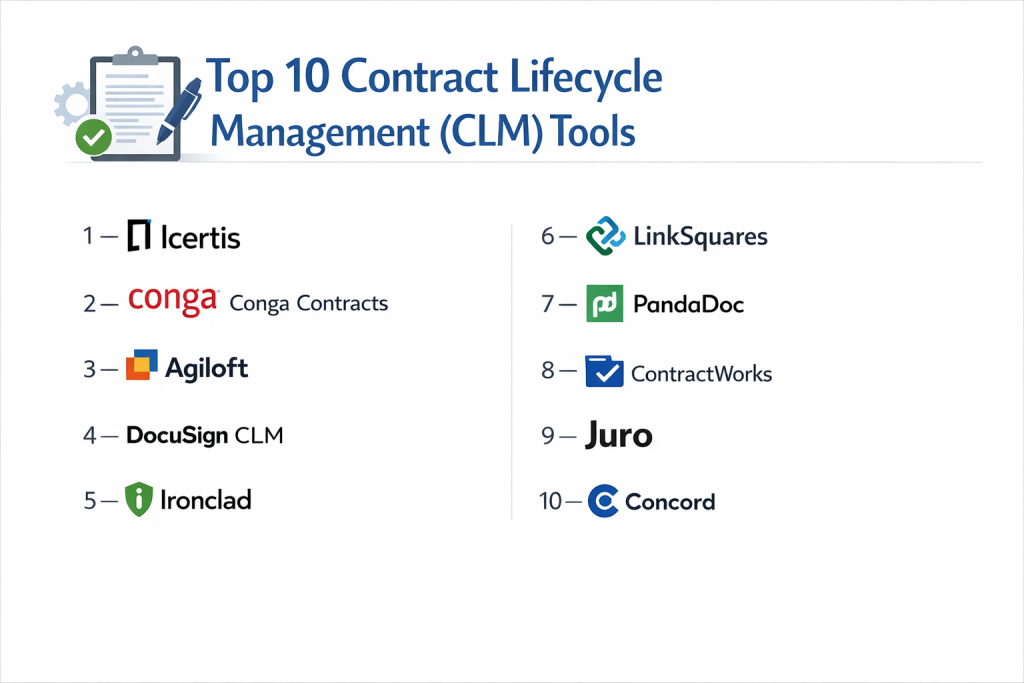
Top 10 Contract Lifecycle Management (CLM) Tools
1 — Icertis Contract Intelligence
Icertis is an enterprise-focused CLM platform that uses AI to transform contracts into strategic assets, emphasizing compliance, risk management, and insight generation for large, complex organizations.
Key features:
- AI-driven contract intelligence for deep clause-level analysis, risk scoring, and obligation extraction.
- Extensible platform with a powerful data repository that structures all contract metadata.
- Advanced governance and compliance workflows, especially for highly regulated industries.
- Robotic Process Automation (RPA) and bidirectional integrations with major ERP and CRM systems.
- Sophisticated scenario modeling for negotiation and “what-if” analysis.
- Global template management with robust clause libraries and approval chains.
Pros:
- Unmatched depth in AI analytics and data structuring for global enterprises.
- Strong focus on turning contract data into actionable business intelligence and ensuring regulatory adherence.
Cons:
- Premium enterprise pricing places it out of reach for small and mid-market businesses.
- Implementation can be lengthy and resource-intensive, requiring a significant change management effort.
Security & compliance: SOC 1, 2, and 3, ISO 27001, GDPR, HIPAA capable. Features include SSO, granular access controls, data encryption at rest and in transit, and detailed audit trails.
Support & community: Enterprise-grade support with dedicated customer success managers, 24/7 global support options, comprehensive online resources, and an annual user conference.
2 — Conga Contracts (formerly Apttus)
Conga Contracts is a comprehensive, Salesforce-native CLM solution designed to streamline the entire agreement process from quote-to-cash, deeply embedded within the Salesforce ecosystem.
Key features:
- Native Salesforce integration providing a seamless experience within the CRM interface.
- Automated document generation from Salesforce data, with dynamic clause selection.
- Collaborative negotiation tools with redlining, commenting, and version control.
- Obligation and milestone management with automated alerts for key dates.
- Centralized repository with powerful search, reporting, and dashboard capabilities.
- Approval workflow automation with configurable rules and routing.
Pros:
- The gold standard for Salesforce-centric organizations, offering unparalleled workflow continuity.
- Excellent for automating sales contracts and accelerating deal cycles directly from the CRM.
Cons:
- Less optimal for companies not heavily invested in the Salesforce platform.
- Can become complex and costly as needs scale, with various add-on modules.
Security & compliance: SOC 2 Type II, GDPR compliant. Leverages Salesforce’s security infrastructure, including SSO, field-level security, and data encryption.
Support & community: Support through Conga’s customer portals, knowledge base, and implementation partners. Strong ecosystem of Salesforce administrators and consultants.
3 — Agiloft
Agiloft is a highly flexible, no-code CLM platform built on a powerful rules engine, allowing businesses to deeply customize workflows and processes without developer resources.
Key features:
- Fully configurable, no-code platform enabling deep customization of fields, workflows, and dashboards.
- Powerful AI for data extraction and classification from uploaded contracts during migration.
- Integrated workflow, service desk, and document management in a single suite.
- Strong reporting engine with ad-hoc and scheduled report capabilities.
- Advanced clause and template library with conditional logic.
- Scalable architecture suitable for departments or global enterprises.
Pros:
- Exceptional flexibility allows it to adapt to almost any business process, not just standard contract flows.
- Strong total cost of ownership (TCO) due to reduced need for custom coding over time.
Cons:
- The no-code configuration power requires internal expertise or consulting to set up optimally.
- The user interface is functional but less modern and polished than some cloud-native competitors.
Security & compliance: SOC 2 Type II, ISO 27001, GDPR compliant. Offers SSO, data encryption, detailed audit logs, and role-based access.
Support & community: Provides 24/5 phone and email support, an extensive knowledge base, and active user community forums. Professional services available.
4 — DocuSign CLM
DocuSign CLM (originally SpringCM) integrates tightly with the DocuSign e-signature empire to provide an end-to-end system for agreement management, from generation through signing to post-signature tracking.
Key features:
- Deep, seamless integration with DocuSign eSignature for a unified experience.
- Smart document generation from pre-approved templates and clause libraries.
- Automated workflow routing with conditional logic for approvals and negotiations.
- Centralized repository with powerful OCR and full-text search capabilities.
- Basic obligation management for tracking key dates and deliverables.
- Mobile-responsive design for reviewing and approving contracts on the go.
Pros:
- Ideal for companies already standardized on DocuSign, creating a frictionless “click-to-sign” ecosystem.
- Rapid deployment for core use cases like automated agreement generation and signing.
Cons:
- May lack the deep AI analytics and extreme customization of pure-play CLM leaders.
- Often viewed as an extension of the e-signature product rather than a standalone CLM powerhouse.
Security & compliance: SOC 2 Type II, ISO 27001, GDPR, HIPAA. Utilizes DocuSign’s security cloud with SSO, encryption, and compliance certifications.
Support & community: Access to DocuSign’s broad support network, knowledge base, and university training. Enterprise support plans are available.
5 — Ironclad
Ironclad is a modern, digital-native CLM platform focused on streamlining contract workflow for dynamic companies, with a strong emphasis on user experience and a connected ecosystem of tools.
Key features:
- Digital Workspace for collaborative negotiation with real-time editing and commenting.
- Workflow Designer with a visual, drag-and-drop interface to build automated processes.
- AI-powered analytics (Ironclad Analytics) for tracking cycle times and bottlenecks.
- Deep integrations with common business tools like Slack, Salesforce, and Workday.
- Smart Repository that automatically organizes and tags executed contracts.
- Clickwrap functionality for managing high-volume online agreements.
Pros:
- Excellent, intuitive user interface drives high adoption among business teams, not just legal.
- Strong API-first architecture makes it highly adaptable and easy to connect to a modern tech stack.
Cons:
- Historically strong in mid-market; enterprise-scale features for highly complex global governance are still maturing.
- Pricing can be high for smaller teams with basic needs.
Security & compliance: SOC 2 Type II, GDPR, CCPA compliant. Features include SSO, audit trails, and enterprise-grade security practices.
Support & community: Known for responsive customer success, with detailed help center, webinars, and an active user community.
6 — LinkSquares
LinkSquares is an AI-powered CLM solution that emphasizes post-signature value, using its strength in data extraction and analytics to help businesses understand what’s in their existing contract portfolio.
Key features:
- Powerful AI for post-signature analysis (Summarize) to extract key data from legacy contracts.
- Strategic repository focused on searchability, reporting, and dashboarding on contract metadata.
- Built-in workflow automation for contract creation, review, and approval.
- Risk and obligation tracking with automated alerts for deadlines.
- Custom reporting on virtually any data point extracted from contracts.
- Native e-signature integration (with DocuSign and Adobe Sign).
Pros:
- Superior for companies that need to analyze and derive insights from a large backlog of existing contracts.
- AI is a core strength, particularly for data extraction and portfolio-wide reporting.
Cons:
- The pre-signature workflow and authoring capabilities, while present, are not as deep as some process-focused competitors.
- Best suited for companies ready to leverage data, not just automate a process.
Security & compliance: SOC 2 Type II, GDPR compliant. Offers SSO, encryption, and role-based access controls.
Support & community: Provides dedicated customer success management, training, and 24/5 support for enterprise customers.
7 — PandaDoc
PandaDoc began as a document automation and e-signature tool and has evolved into a full-featured CLM, particularly strong for sales teams needing to create, send, track, and sign proposals and contracts quickly.
Key features:
- Excellent document builder with drag-and-drop editing, dynamic content, and rich media.
- Real-time document tracking showing when a proposal is opened, viewed, and signed.
- Integrated payment processing to collect deposits or payments within the document.
- Approval workflows and content library for controlled document creation.
- CRM integrations with deep bi-directional sync for Salesforce, HubSpot, and others.
- Basic contract repository and reporting.
Pros:
- Unbeatable for sales velocity, turning quotes and proposals into signed agreements faster.
- User-friendly and intuitive, with a low learning curve for business users.
Cons:
- Less focused on complex legal negotiation workflows, deep clause libraries, or post-signature obligation management.
- The CLM functionality may feel lightweight for large, complex legal departments.
Security & compliance: SOC 2 Type II, GDPR, HIPAA capable. Features SSO, data encryption, and compliance certifications.
Support & community: 24/7 chat and email support, extensive knowledge base, free webinars, and a community forum.
8 — ContractWorks (by SecureDocs)
ContractWorks is a straightforward, cost-effective CLM solution focused on core functionality: a secure repository, powerful search, and basic workflow, ideal for SMBs getting started with contract management.
Key features:
- Fast, easy-to-set-up repository with OCR and full-text search across all documents.
- Customizable reporting and dashboarding on key contract dates and metadata.
- Task and deadline alerts for renewals and other important obligations.
- Simple approval workflow and electronic signature integration.
- Role-based permissions to control access to sensitive documents.
- Affordable, predictable pricing model.
Pros:
- One of the most cost-effective entry points into organized CLM, with rapid implementation.
- Remarkably easy to use and administer, with a clean, intuitive interface.
Cons:
- Lacks advanced AI, deep customization, and complex automation features of enterprise platforms.
- Not designed for intricate, multi-stage contract authoring and negotiation workflows.
Security & compliance: SOC 2 Type II certified, with 256-bit encryption, SSO, and detailed audit logs.
Support & community: U.S.-based customer support via phone and email, helpful knowledge base, and simple onboarding.
9 — Juro
Juro is a all-in-one CLM platform designed specifically to enable legal and business teams to collaborate on contracts in a unified, browser-based environment, reducing dependency on Word and email.
Key features:
- Native, collaborative editor that lives in the browser, allowing real-time negotiation.
- Powerful automation builder to create self-serve contract workflows for business teams.
- Smart data extraction and tagging upon contract completion.
- Full API ecosystem for integrating with HR, finance, and productivity tools.
- Built-in e-signature and approval workflows.
- Design-focused interface that prioritizes user experience.
Pros:
- Brilliantly eliminates the friction of toggling between Word, PDF, and email for negotiation.
- Highly effective for standardizing and scaling high-volume contracts like NDAs and employment offers.
Cons:
- Less suited for extremely complex, high-value contracts that require heavy, line-by-line legal drafting outside a template.
- A newer player, so may lack some of the deep enterprise governance features of established vendors.
Security & compliance: SOC 2 Type II, GDPR, CCPA compliant. Data encrypted in transit and at rest, with SSO and audit trails.
Support & community: Responsive customer success team, comprehensive help center, and regular product training sessions.
10 — Concord
Concord is a cloud-based CLM that simplifies the contracting process with an emphasis on collaboration, speed, and a clean user experience for drafting, signing, and managing contracts.
Key features:
- Collaborative online redlining and commenting in a unified workspace.
- Automated template and workflow builder for common agreement types.
- Centralized repository with smart organization and search.
- Synchronized negotiation showing changes in real-time.
- Integration with e-signature providers and CRM systems.
- Dashboard for tracking contract status and key metrics.
Pros:
- Streamlines negotiation by keeping all discussions and versions in one accessible place.
- Fast and intuitive to learn, helping to accelerate initial contract cycles quickly.
Cons:
- May not offer the depth of reporting, AI, or backend customization required by large legal departments.
- Competes in a crowded mid-market space with strong, feature-rich alternatives.
Security & compliance: SOC 2 compliant, GDPR ready. Uses enterprise-grade security with encryption, SSO, and permission controls.
Support & community: Provides email and in-app support, a knowledge base, and onboarding assistance.
Comparison Table
| Tool Name | Best For | Platform(s) Supported | Standout Feature | Rating |
|---|---|---|---|---|
| Icertis | Large global enterprises needing AI-driven insights & compliance | Cloud, Web | AI for strategic contract intelligence & risk | 4.6/5 |
| Conga Contracts | Salesforce-centric sales & legal teams | Cloud, Web (Salesforce Native) | Deep, native Salesforce CRM integration | 4.5/5 |
| Agiloft | Organizations needing a highly customizable, no-code platform | Cloud, On-Premise, Web | Unmatched no-code configuration flexibility | 4.4/5 |
| DocuSign CLM | Companies standardized on DocuSign eSignature | Cloud, Web, Mobile | Seamless end-to-end process with e-signature | 4.3/5 |
| Ironclad | Modern, mid-market to enterprise companies valuing UX & integration | Cloud, Web | Excellent user adoption & connected workflow design | 4.5/5 |
| LinkSquares | Companies prioritizing AI analysis of existing contract portfolios | Cloud, Web | Post-signature AI analytics & data extraction | 4.4/5 |
| PandaDoc | Sales teams needing fast proposal-to-contract cycles | Cloud, Web, Mobile | Document tracking & payment for sales velocity | 4.6/5 |
| ContractWorks | SMBs seeking an affordable, easy-to-use repository | Cloud, Web | Simplicity, fast setup & cost-effectiveness | 4.2/5 |
| Juro | Legal & business teams collaborating on high-volume contracts | Cloud, Web | Native browser-based editor for collaboration | 4.5/5 |
| Concord | Teams wanting streamlined, collaborative negotiation | Cloud, Web | Unified workspace for negotiation & commenting | 4.3/5 |
Evaluation & Scoring of Contract Lifecycle Management (CLM)
| Evaluation Criteria | Weight | Icertis | Conga | Agiloft | Ironclad | ContractWorks |
|---|---|---|---|---|---|---|
| Core Features | 25% | 98 | 92 | 94 | 90 | 78 |
| Ease of Use | 15% | 82 | 88 | 83 | 96 | 95 |
| Integrations & Ecosystem | 15% | 93 | 97* | 88 | 94 | 80 |
| Security & Compliance | 10% | 99 | 95 | 96 | 92 | 90 |
| Performance & Reliability | 10% | 97 | 94 | 95 | 93 | 92 |
| Support & Community | 10% | 96 | 90 | 92 | 91 | 85 |
| Price / Value | 15% | 80 | 82 | 90 | 85 | 96 |
| Weighted Total Score | 100% | 92.1 | 90.6 | 90.9 | 90.9 | 86.9 |
Note: Conga scores exceptionally high for Salesforce integrations but may be less broad outside that ecosystem.
Which Contract Lifecycle Management (CLM) Tool Is Right for You?
- Solo Users vs. SMB vs. Mid-Market vs. Enterprise: Solo users likely need only e-signature. SMBs should start with ContractWorks or PandaDoc for core functionality. Growing Mid-Market firms need scalability and better UX, making Ironclad, Juro, or Concord strong choices. Large Enterprises require the power, AI, and global compliance of Icertis, Conga, or Agiloft.
- Budget-Conscious vs. Premium Solutions: For tight budgets, ContractWorks offers immense value. PandaDoc provides great sales-focused features at a mid-tier price. Premium solutions like Icertis and Ironclad justify cost with advanced AI, automation, and enterprise support that reduce legal risk and operational cost.
- Feature Depth vs. Ease of Use: If you have complex, varied processes, prioritize feature depth and customization (Agiloft, Icertis). If driving company-wide adoption is critical, prioritize ease of use (Ironclad, PandaDoc, Juro).
- Integration and Scalability Needs: Audit your tech stack. If Salesforce is your core, Conga is a top contender. For a modern API-first stack, Ironclad or Juro excel. Ask vendors about API limits, data volume, and adding new business units or contract types.
- Security and Compliance Requirements: In regulated industries (pharma, finance), SOC 2, ISO 27001, and specific certifications (HIPAA) are mandatory. For global operations, ensure the tool supports data residency laws (GDPR) and has robust audit trails.
Frequently Asked Questions (FAQs)
- What’s the difference between an e-signature tool and a full CLM?
An e-signature tool focuses solely on obtaining a signature electronically. A CLM manages the entire lifecycle—creation, negotiation, approval, signing, post-execution obligations, and renewal—often with integrated e-signature as one feature. - How long does a typical CLM implementation take?
It varies widely: 2-4 weeks for a basic SMB repository setup, 3-6 months for a mid-market workflow automation project, and 6+ months for a large-scale enterprise deployment with complex integrations and customization. - Can CLM software handle contracts in multiple languages?
Most enterprise-grade platforms (Icertis, Agiloft) support multi-language contracts, including template management and sometimes AI analysis. Mid-market tools may have more limited multilingual support. - How does AI actually help with contracts?
AI in CLM can: Extract data (dates, parties, clauses) from scanned contracts, suggest riskier clauses based on pre-defined rules, automate clause selection during drafting, and analyze portfolio trends (e.g., finding all contracts with auto-renewal). - Is our contract data safe in a cloud-based CLM?
Reputable vendors invest more in security than most individual companies can. Look for SOC 2 Type II certification as a baseline, which validates their security, availability, and confidentiality controls. - What’s the biggest hurdle to CLM success?
Poor user adoption is the number one failure point. Choosing an overly complex system that teams avoid, or failing to train users, undermines the investment. Involving end-users in selection is crucial. - Can we start with just a repository and add features later?
Yes, many platforms like Agiloft, Ironclad, and ContractWorks are modular. You can begin by solving the immediate “contract chaos” problem with a central repository and later activate workflow, AI, and analytics modules. - How do CLM systems integrate with other software?
They use APIs, pre-built connectors, and native integrations. Common connections are to CRM (Salesforce), ERP (SAP, NetSuite), e-signature (DocuSign), HR systems, and communication tools like Slack or Microsoft Teams. - What is a fair price for a CLM system?
Pricing models differ: per-user per-month ($50-$150+), per-contract, or tiered enterprise. An SMB might spend a few thousand dollars annually, while a global enterprise investment can reach six or seven figures. - What’s the first step in choosing a CLM?
Audit your current process. Identify key pain points (e.g., slow approvals, missed renewals), key users (legal, sales, procurement), and must-have integrations. This creates a requirements list to evaluate vendors against.
Conclusion
Choosing the right Contract Lifecycle Management software is a strategic investment in operational efficiency, risk reduction, and business intelligence. The landscape offers tailored solutions, from the streamlined collaboration of Juro to the enterprise-scale AI of Icertis and the Salesforce-native power of Conga.
The “best” CLM is not the one with the most features, but the one that best fits your organization’s size, process complexity, and technological ecosystem. Prioritize user adoption, clear ROI on automating your biggest pain points, and a platform that can scale with your growth. By taking a strategic, needs-based approach, you can transform your contract management from a necessary chore into a demonstrable source of competitive advantage and value.

- Top 10 Email Deliverability Tools: Features, Pros, Cons & Comparison - September 6, 2026
- Top 10 Pharmacovigilance Software: Features, Pros, Cons & Comparison - September 6, 2026
- Top 10 Manufacturing Execution Systems (MES) - July 30, 2026
This is a great and comprehensive overview of today’s Contract Lifecycle Management (CLM) solutions. CLM platforms are essential for modern enterprises because they automate and streamline every stage of a contract’s life — from creation and workflow automation to negotiation, execution, renewal, and compliance tracking. By centralizing all contracts in one secure repository, these tools reduce manual errors, shorten contract cycle times, improve compliance and risk management, and give teams real‑time visibility into contractual obligations and deadlines. In practical terms, CLM software helps legal, procurement, sales, and operations teams work more efficiently while reducing risk and administrative overhead — critical for scaling business operations and improving contract governance.