Introduction
Food Safety Compliance (HACCP) Software is a specialized digital platform designed to help food businesses systematically manage, document, and automate their Hazard Analysis and Critical Control Points (HACCP) plans and broader food safety programs. It moves food safety from paper checklists and manual logs into a centralized, real-time, and data-driven system. In today’s global supply chain and under intense regulatory scrutiny, this software is critical not just for compliance, but for brand protection, operational efficiency, and consumer trust. It transforms food safety from a reactive, audit-driven burden into a proactive, value-adding component of daily operations.
Key real-world use cases include a multi-site food manufacturer automating temperature checks and corrective actions across all facilities, a restaurant chain ensuring consistent daily food safety checks and allergen management at every location, and a food distributor tracing ingredients through the supply chain for rapid recall execution. When choosing a HACCP software, users should prioritize core compliance capabilities (digital monitoring, corrective actions, audit trails), ease of use for frontline staff, mobile accessibility for real-time data capture, robust reporting for management and audits, and strong integrations with existing ERP, IoT sensors, and laboratory systems.
Best for: These tools are essential for Food Safety & Quality Assurance (FSQA) Managers, Operations Directors, and Compliance Officers in industries including food & beverage manufacturing, processing, packaging, distribution, retail, and hospitality. They benefit businesses of all sizes, from a single-site processor to a global brand.
Not ideal for: Very small, low-risk operations (e.g., a small-scale farmer selling directly at a local market) may rely on manual, paper-based HACCP plans as required by local regulators. Non-food businesses have no application for this specific compliance software.
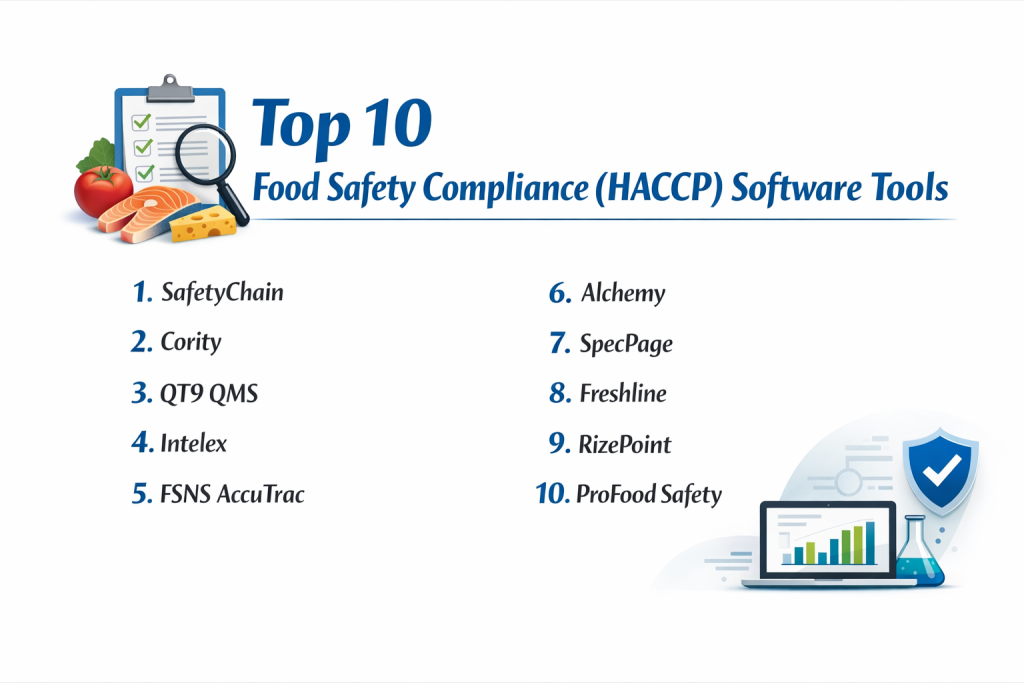
Top 10 Food Safety Compliance (HACCP) Software Tools
1 — SafetyChain
SafetyChain is a comprehensive, cloud-based Quality Management System (QMS) and Supplier Quality Management platform built specifically for the food and beverage industry, with HACCP as a core module.
- Key features
- End-to-end platform for HACCP, SQF, BRC, and FSMA compliance management.
- Real-time production and quality data collection via mobile apps and IIoT (Industrial Internet of Things) integration.
- Advanced analytics and dashboards for tracking KPIs like CAPA effectiveness and quality costs.
- Integrated supplier compliance and raw material quality management.
- Automated workflows for deviations, non-conformances, and corrective/preventive actions (CAPA).
- Pros
- Industry-specific depth that goes beyond HACCP to cover the full spectrum of food safety and quality management.
- Powerful data aggregation and analytics that turn compliance data into operational intelligence.
- Cons
- Can be a significant investment, both in cost and implementation resources, better suited for mid-market and enterprise.
- The breadth of features requires thorough configuration and staff training to realize full value.
- Security & compliance: Enterprise-grade cloud security with SOC 2 Type II certification, data encryption, and robust access controls. Designed to meet stringent audit requirements.
- Support & community: Dedicated customer success managers, implementation consultants, and 24/7 support. Active user community and regular industry-specific webinars.
2 — Cority (EtQ Reliance)
Cority (which acquired EtQ) offers the EtQ Reliance platform, a highly flexible and configurable enterprise Quality, Environmental, Health, and Safety (QEHS) solution that is widely used for complex HACCP and food safety management.
- Key features
- Highly configurable workflow engine to model any HACCP plan or food safety process without coding.
- Integrated modules for document control, audit management, training, and supplier quality.
- Strong risk management tools for hazard analysis, FMEA (Failure Mode and Effects Analysis), and control plan management.
- Comprehensive reporting and dashboarding for management review and regulatory reporting.
- Scalable architecture for global, multi-site deployments.
- Pros
- Unmatched flexibility and configurability to adapt to unique, complex, or evolving food safety processes.
- True enterprise scalability for large, multinational organizations with diverse needs.
- Cons
- The high degree of configurability can lead to longer, more complex implementation cycles.
- May be over-engineered and costly for smaller or simpler operations.
- Security & compliance: Offers both cloud (SaaS) and on-premise deployments. Cloud version includes high-level security certifications (SOC 2, ISO 27001), encryption, and audit trails.
- Support & community: Enterprise-level support with dedicated account management. Large user community and partner network for implementation and training.
3 — QT9 QMS
QT9 QMS is a modern, all-in-one, cloud-based Quality Management System known for its user-friendly interface, rapid implementation, and affordability, making it accessible for SMBs in the food sector.
- Key features
- Intuitive, modern interface with modules for HACCP, document control, audits, training, and CAPA.
- Mobile app for real-time data logging, inspections, and non-conformance reporting on the production floor.
- Automated workflows and email alerts for task assignments and escalations.
- Built-in analytics and customizable dashboard for real-time quality oversight.
- API for integrations with ERP, LIMS, and other business systems.
- Pros
- Excellent ease of use and quick time-to-value, reducing training time and accelerating adoption.
- Strong value proposition with a comprehensive feature set at a competitive price point.
- Cons
- While highly capable, it may lack some of the ultra-deep, industry-specific functionality of larger platforms.
- Primarily a SaaS model; less flexibility for heavy on-premise customization.
- Security & compliance: Cloud-based with robust security including SSL encryption, secure data centers, and role-based access. Compliant with major data privacy standards.
- Support & community: Responsive US-based support, extensive online knowledge base, video tutorials, and live training webinars.
4 — Intelex
Intelex, a part of Industrial Scientific, is a leading EHSQ (Environment, Health, Safety, and Quality) platform with powerful applications for managing HACCP, food safety audits, and compliance across large, distributed organizations.
- Key features
- Comprehensive EHSQ platform with specific applications for food safety plan management and monitoring.
- Strong mobile capabilities for inspections, data collection, and issue reporting from anywhere.
- Advanced analytics and predictive insights to identify food safety risks before they become incidents.
- Integrated learning management system (LMS) for food safety training and competency tracking.
- Global capability with multi-language and multi-currency support.
- Pros
- Powerful platform for organizations wanting to manage food safety within a broader EHSQ framework.
- Leading-edge analytics and reporting capabilities for data-driven decision making.
- Cons
- As a large, multi-purpose EHSQ platform, it can be complex to configure specifically for food safety without expert guidance.
- Pricing and implementation are geared towards mid-to-large enterprises.
- Security & compliance: Enterprise-grade security with certifications including ISO 27001, SOC 2, and adherence to global data protection regulations. Offers both cloud and on-premise.
- Support & community: Global customer support, professional services, and a large partner network. Active user community groups and annual conference.
5 — FSNS AccuTrac
FSNS AccuTrac (from Food Safety Net Services) is a food safety and quality software developed by a leading food testing lab, offering tight integration between lab results, compliance monitoring, and corrective actions.
- Key features
- Direct integration with FSNS laboratory results for automatic import and alerting on COAs (Certificates of Analysis) and pathogen tests.
- Digital monitoring and verification for HACCP, SSOPs, and GMPs with customizable checklists.
- Traceability and recall management module for lot tracking and simulated recalls.
- Customer/supplier portal for sharing specifications, COAs, and audit reports.
- Built specifically to support SQF, BRC, FSMA, and other GFSI benchmarked standards.
- Pros
- Unique, powerful integration with laboratory data, creating a closed-loop system from test to corrective action.
- Built by food safety experts, ensuring the workflows and terminology align with auditor expectations.
- Cons
- The tight lab integration is most valuable for clients of FSNS or those who prioritize lab-data connectivity.
- May have a stronger focus on manufacturing vs. other segments like retail or distribution.
- Security & compliance: High-level security for protecting sensitive lab and production data. Specific certifications are part of FSNS’s accredited lab protocols.
- Support & community: Support from food safety professionals and technical experts. Part of the larger FSNS educational and consulting ecosystem.
6 — Alchemy
Alchemy (now part of Vector Solutions) focuses on the human side of food safety, combining training, coaching, and compliance monitoring into a single platform designed to drive behavioral change on the production floor.
- Key features
- Integrated learning management system (LMS) with a large library of food safety and GMP courses.
- Mobile tools for daily food safety checks, audits, and observations.
- “Coach & Train” tools to document real-time coaching moments and reinforce training.
- Task management and accountability tracking to ensure follow-through on food safety duties.
- Analytics on training effectiveness linked to compliance metrics.
- Pros
- Exceptional focus on training, coaching, and human performance as the foundation of food safety culture.
- Designed for frontline usability, increasing engagement and compliance at the operator level.
- Cons
- Less focused on deep, automated data collection from IoT sensors or complex supply chain traceability.
- Its strength is in human performance; may need augmentation for highly automated facilities.
- Security & compliance: Secure, cloud-based platform. Data encryption and standard enterprise security protocols. Compliance features support audit readiness.
- Support & community: Dedicated support and customer success teams. Access to Vector Solutions’ vast training and EHS content library.
7 — SpecPage
SpecPage provides a specialized Product Lifecycle Management (PLM) platform for food and beverage, with deep functionality for managing product specifications, which is the critical foundation for any HACCP plan.
- Key features
- Centralized, digital specification management for raw materials, packaging, finished goods, and recipes.
- Integrated HACCP and food safety plan builder, linking hazards directly to product specs and process steps.
- Automated label generation and regulatory compliance checking (allergens, nutrition, claims).
- Supplier collaboration portal for managing and approving raw material specs.
- Formula management and costing integrated with safety data.
- Pros
- Unmatched for managing the product specification data that underpins HACCP plans.
- Streamlines the link between R&D, safety, and compliance, ensuring consistency from formulation to label.
- Cons
- Core strength is in specs and PLM; broader operational monitoring (e.g., temperature logs) may require integration.
- Best value is realized when managing complex product portfolios and frequent innovation.
- Security & compliance: Enterprise data security with role-based access, audit trails, and data encryption. Supports compliance with global food labeling regulations.
- Support & community: Industry-focused support and implementation services. User community of food and beverage R&D and QA professionals.
8 — Freshline
Freshline (by Compac) is a traceability and quality management platform focused on the fresh produce, protein, and perishable goods sectors, emphasizing real-time quality data and chain-of-custody tracking.
- Key features
- Real-time quality inspection data capture (defects, brix, temperature, weight) at receiving, in-process, and shipping.
- Powerful lot-based traceability from farm/grower through processing to customer.
- Digital HACCP and food safety monitoring tailored for perishable operations.
- Advanced yield and quality reporting for operational and financial insights.
- Integration with packing lines, scales, and IoT sensors.
- Pros
- Sector-specific expertise for fresh and perishable supply chains, with tailored workflows and metrics.
- Strong focus on real-time quality data and traceability, crucial for recall speed and customer satisfaction.
- Cons
- Niche focus means it is less applicable for dry goods, packaged goods, or non-perishable manufacturing.
- May be less known outside of its core fresh produce and protein verticals.
- Security & compliance: Data security appropriate for protecting sensitive supply chain and customer data. Supports compliance with the Produce Safety Rule and other fresh commodity standards.
- Support & community: Support from teams with fresh produce/commodity expertise. Part of Compac’s broader ecosystem in fresh food technology.
9 — RizePoint
RizePoint is a mobile-first audit and compliance management platform widely used by large restaurant chains, foodservice distributors, and retail food operators to manage brand standards and food safety audits.
- Key features
- Mobile audit and inspection platform for conducting internal, third-party, and supplier audits.
- Centralized dashboard for tracking audit scores, corrective actions, and trends across all locations.
- Automated corrective action workflows and task assignment to managers.
- Benchmarking and reporting against industry standards or custom brand standards.
- Strong integrations with major POS and back-office systems in the hospitality sector.
- Pros
- Best-in-class for managing a standardized audit program across hundreds or thousands of locations.
- Excellent mobile user experience for auditors, streamlining the data collection process.
- Cons
- Focused more on the audit and verification side rather than real-time, continuous operational monitoring.
- Its sweet spot is multi-unit operations; may be less tailored for a single manufacturing plant.
- Security & compliance: Enterprise-grade security with features like SSO and data encryption. SOC 2 Type II certified. Designed to protect sensitive audit and location data.
- Support & community: Dedicated customer success and support teams. User community for large multi-unit brands.
10 — ProFood Safety
ProFood Safety offers a straightforward, affordable digital HACCP and food safety management solution designed for small to mid-sized food businesses, including processors, packers, and warehouses.
- Key features
- Step-by-step digital HACCP plan builder with templates and guidance.
- Digital monitoring logs for temperatures, sanitizer concentrations, and other CCPs/OPs.
- Document control for SOPs, work instructions, and training records.
- Basic corrective action tracking and management review reporting.
- Cloud-based and mobile-friendly for access from any device.
- Pros
- Accessibility and affordability for businesses taking their first step from paper to digital.
- Simple, focused design that covers the essentials without overwhelming complexity.
- Cons
- Lacks the advanced analytics, extensive integrations, and scalability of enterprise platforms.
- May not support the most complex multi-site or highly automated operations.
- Security & compliance: Cloud security with standard data protection measures. Provides the necessary audit trails and electronic records for compliance.
- Support & community: Direct support from the software team. Targeted towards SMBs without dedicated IT staff.
Comparison Table
| Tool Name | Best For (Target User or Scenario) | Platform(s) Supported | Standout Feature | Rating |
|---|---|---|---|---|
| SafetyChain | Mid-market to enterprise food manufacturers wanting a full QMS with deep analytics. | Cloud | End-to-end quality and safety platform with powerful production data aggregation. | N/A |
| Cority (EtQ Reliance) | Large, complex enterprises needing a highly configurable EHSQ platform for global deployment. | Cloud, On-Premise | Unmatched workflow flexibility and configuration without coding. | N/A |
| QT9 QMS | SMBs and mid-market companies seeking a modern, user-friendly, and fast-to-implement QMS. | Cloud | Excellent ease of use and value for a comprehensive feature set. | N/A |
| Intelex | Large organizations managing food safety as part of a broader EHSQ (Environment, Health, Safety, Quality) program. | Cloud, On-Premise | Powerful analytics within a leading enterprise EHSQ platform. | N/A |
| FSNS AccuTrac | Food processors who prioritize tight integration with laboratory testing data and results. | Cloud | Direct integration with a major food testing lab network for closed-loop quality. | N/A |
| Alchemy | Operations focused on human performance, training, and building a frontline food safety culture. | Cloud | Integrated training, coaching, and compliance tools to drive behavioral change. | N/A |
| SpecPage | Food & Bev companies with complex product portfolios needing PLM and spec management as the HACCP foundation. | Cloud | Deep product lifecycle and specification management integrated with safety plans. | N/A |
| Freshline | Fresh produce, protein, and perishable goods suppliers needing real-time quality data and traceability. | Cloud | Sector-specific traceability and quality management for perishable supply chains. | N/A |
| RizePoint | Multi-unit restaurant chains, foodservice, and retail managing brand standards and audit programs. | Cloud | Mobile-first audit management and corrective action tracking across distributed locations. | N/A |
| ProFood Safety | Small to mid-sized food businesses taking the first step from paper to digital HACCP management. | Cloud | Affordable, straightforward digital HACCP plan builder and monitoring tools. | N/A |
Evaluation & Scoring of Food Safety Compliance (HACCP) Software
| Evaluation Criteria | Weight | Score (1-5) | Weighted Score | Notes on What to Look For |
|---|---|---|---|---|
| Core Features | 25% | HACCP/Plan builder, digital monitoring, CAPA, audit trails, reporting. | ||
| Ease of Use | 15% | Intuitive for frontline staff, reduces training time, mobile-friendly. | ||
| Integrations & Ecosystem | 15% | Connects to ERP, IoT sensors, LIMS, lab data, supply chain partners. | ||
| Security & Compliance | 10% | Data security, audit trail integrity, compliance with electronic record regulations (21 CFR Part 11). | ||
| Performance & Reliability | 10% | Uptime, mobile app performance in low-connectivity areas, data sync speed. | ||
| Support & Community | 10% | Quality of onboarding, regulatory expertise of support team, user forums. | ||
| Price / Value | 15% | Total cost relative to features, scalability, and ROI in reduced risk and efficiency. | ||
| TOTAL SCORE | 100% | /5 |
Which Food Safety Compliance (HACCP) Software Tool Is Right for You?
- Solo Users vs. SMB vs. Mid-Market vs. Enterprise: A very small processor might start with ProFood Safety. A typical SMB should evaluate QT9 QMS or Alchemy for balance and value. Growing mid-market companies need the robustness of SafetyChain or FSNS AccuTrac. Large multinational enterprises require the scalability and configurability of Cority (EtQ) or Intelex.
- Budget-Conscious vs. Premium Solutions: For constrained budgets, ProFood Safety and QT9 QMS offer core digital compliance. Premium solutions like SafetyChain and Cority justify cost with deep analytics, extensive integrations, and enterprise support that reduce systemic risk.
- Feature Depth vs. Ease of Use: Cority (EtQ) and SpecPage offer immense depth for complex needs. Alchemy and QT9 QMS prioritize user-friendly design for faster adoption. Your choice hinges on operational complexity and staff tech-savviness.
- Integration and Scalability Needs: If you have IoT sensors on ovens or freezers, ensure the platform can ingest that data. If you rely on a specific ERP (SAP, Oracle) or lab, prioritize integration. For scaling across regions, look for multi-language/currency support and centralized governance features.
- Security and Compliance Requirements: In highly regulated sectors (infant formula, pharmaceuticals), electronic record signatures (21 CFR Part 11 compliance) are critical—ensure the platform is validated. For global operations, data residency laws (GDPR) must be supported.
Frequently Asked Questions (FAQs)
- What is the difference between HACCP software and a general QMS?
HACCP software focuses specifically on the 7 principles of HACCP (hazard analysis, CCPs, etc.). A comprehensive Food Safety QMS (like SafetyChain) includes HACCP but also manages supplier quality, customer complaints, audits, and non-conformance across the entire quality system. - How does this software help during a food safety audit or regulatory inspection?
It provides instant, organized access to all records (monitoring logs, corrective actions, training certificates). Strong search functions and audit trails demonstrate control and due diligence, turning a stressful audit into a streamlined review of digital records. - Can it integrate with our temperature sensors and other IoT devices?
Leading platforms (SafetyChain, Intelex) offer APIs and pre-built connectors for common IoT devices. This enables automated data capture, eliminating manual log errors and providing real-time alerts for deviations. - Is cloud-based software secure enough for our sensitive food safety data?
Reputable providers invest more in security (SOC 2, encryption) than most companies can on their own. Cloud security is generally superior to on-premise for SMBs. The key is to review the vendor’s security certifications and data policies. - What is the typical implementation timeline?
For a focused HACCP module at a single site, it can be 4-8 weeks. For a full QMS rollout across multiple facilities, expect 6-18 months. Tools like QT9 QMS are known for faster deployment, while Cority implementations are longer due to customization. - How do we ensure our frontline staff will actually use it?
Choose a tool with an excellent mobile experience (Alchemy, RizePoint). Involve them in the selection demo. Design simple, clear workflows. Use training and coaching features (Alchemy) to reinforce use. Ease of use is the biggest adoption driver. - Does this replace our need for paper records entirely?
In most jurisdictions, digital records with proper audit trails are legally equivalent or superior to paper. The software should eliminate paper, but you must have a defined process for electronic record signing and archiving to meet regulations. - What’s the biggest mistake companies make when implementing?
Treating it as an IT project instead of an operational transformation. Success requires strong leadership from QA/Operations, clear process redesign, and ongoing change management to shift culture from paper-based to data-driven habits. - Can it manage allergen controls and labeling compliance?
Yes, advanced platforms (SpecPage, SafetyChain) include allergen management modules to track allergens through formulation, scheduling, sanitation, and automate label generation against FDA/USDA or global regulations. - How do we calculate the ROI of this software?
ROI comes from: Labor Savings (automating manual logs/reports), Reduced Waste (faster corrective actions), Fewer Audit Non-Conformances (saving consultant fees), Faster Recalls (minimizing brand damage), and Avoided Cost of a Major Recall or Shutdown.
Conclusion
Selecting the right Food Safety Compliance software is a strategic decision that impacts risk, efficiency, and brand integrity. From the full-spectrum QMS power of SafetyChain and the unparalleled configurability of Cority to the frontline focus of Alchemy and the fresh supply chain expertise of Freshline, each platform serves a distinct mission.
The central insight is that the “best” system aligns with your primary operational reality and strategic goal. Are you a manufacturer needing deep data integration? A multi-unit operator standardizing audits? Or an SMB taking the first digital step? Use the evaluation framework to match a tool’s core strengths—be it analytics, configurability, usability, or sector-specificity—to your most critical needs. The right investment will not only ensure compliance but will build a culture of safety, empower your team with data, and provide the documentation fortress needed to protect your business in an ever-more demanding global marketplace.

- Top 10 Email Deliverability Tools: Features, Pros, Cons & Comparison - September 6, 2026
- Top 10 Pharmacovigilance Software: Features, Pros, Cons & Comparison - September 6, 2026
- Top 10 Manufacturing Execution Systems (MES) - July 30, 2026