Introduction
A Hospitality Property Management System (PMS) is the central nervous system of any hotel, resort, or accommodation business. It is a comprehensive software platform that manages all front-desk and back-office operations, including reservations, guest check-ins/check-outs, room assignments, billing, and housekeeping. More than just a digital ledger, a modern PMS is an integrated hub that connects every aspect of the guest journey and property operations.
In the competitive hospitality industry, a robust PMS is not a luxury; it’s a necessity for survival and growth. It is critically important because it streamlines complex operations, maximizes revenue through rate and occupancy management, centralizes guest data for personalized service, and provides real-time business intelligence. It replaces error-prone manual processes, allowing staff to focus on guests rather than paperwork. Key real-world use cases include: a boutique hotel managing direct bookings and third-party channel reservations from a single calendar; a large resort coordinating room cleaning schedules, maintenance requests, and spa bookings across multiple buildings; or a hostel handling group bookings, automated online check-ins, and integrated point-of-sale (POS) for the bar.
When choosing a PMS, hoteliers must evaluate: core functionality depth for their property type, ease of use for staff training, the breadth and quality of third-party integrations (channel managers, payment processors, CRM), cloud-based accessibility vs. on-premise installation, and the quality of reporting and analytics for decision-making.
Best for: PMS tools are essential for hotel general managers, revenue managers, front-desk supervisors, and property owners. They deliver immense value for hotels of all sizes (from 10-room boutiques to 1,000-room resorts), hostels, vacation rental managers, and aparthotels. Any business that manages daily inventory (rooms) and guest stays benefits.
Not ideal for: A very small homestay or a single vacation rental property listed on one platform (like Airbnb) might manage with that platform’s built-in tools. Private homeowners renting occasionally are better served by vacation rental marketplace tools. Businesses without dynamic pricing or complex guest servicing needs may find a simple booking calendar sufficient.
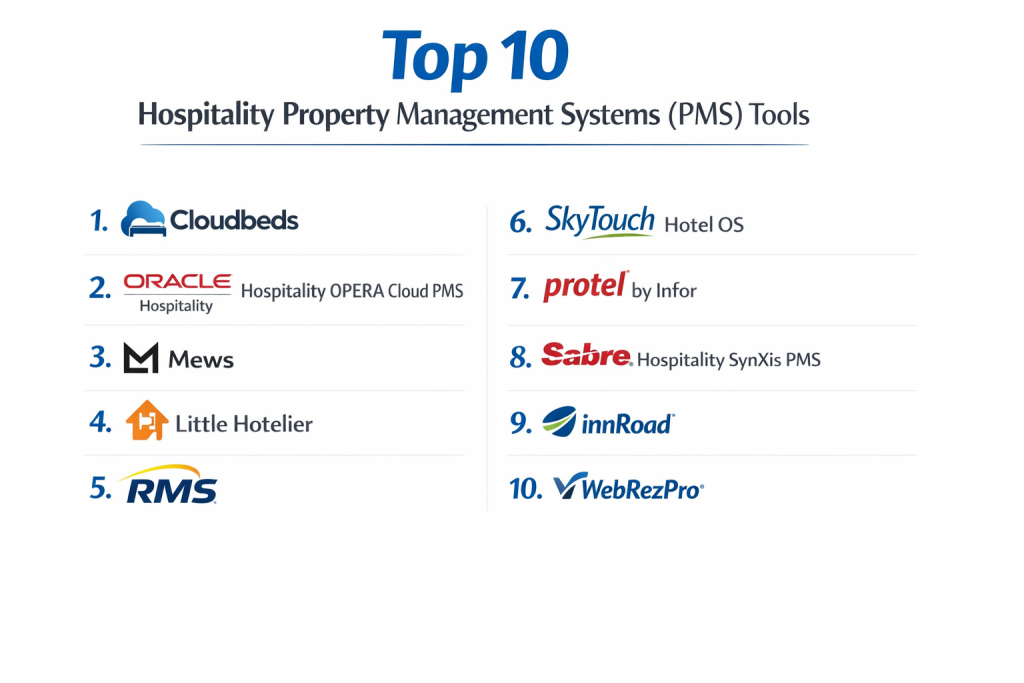
Top 10 Hospitality Property Management Systems (PMS) Tools
1 — Cloudbeds
A fully integrated, cloud-based hospitality operations suite designed specifically for independent hotels, hostels, and vacation rental operators seeking an all-in-one solution.
- Key Features
- Unified platform combining PMS, Channel Manager, Booking Engine, and Revenue Management tools.
- Built-in payment processing with automated reconciliation.
- Direct two-way integrations with 300+ distribution and software partners.
- Customizable housekeeping and maintenance management modules.
- Detailed reporting dashboards and a mobile app for managers.
- Multi-property management capabilities.
- Pros
- Exceptional value as an “all-in-one” suite, eliminating the need to purchase and integrate multiple separate systems.
- User-friendly interface and strong customer support tailored to independent operators.
- Cons
- Can become expensive for very small properties as pricing is often per-room, per-month.
- The breadth of features can be overwhelming for properties with extremely simple needs.
- Security & Compliance: Cloud-based with data encryption, PCI DSS Level 1 compliance (highest level for payment security), SOC 2 Type II certification, and GDPR-ready tools.
- Support & Community: 24/7 multilingual phone, chat, and email support. Extensive “Cloudbeds University” training academy, active user community forums, and annual customer conference.
2 — Oracle Hospitality OPERA Cloud PMS
The industry-leading enterprise-grade PMS, now fully cloud-based, designed for large hotel groups, luxury resorts, and casinos requiring utmost scalability and deep functionality.
- Key Features
- Comprehensive front office, back office, and revenue management in a single cloud platform.
- Advanced group and event booking management with complex billing.
- Deep integration with the broader Oracle ecosystem (MICROS POS, Symphony).
- Configurable workflows and robust user permission controls.
- Advanced reporting and analytics with Oracle business intelligence.
- Global capabilities supporting multiple languages, currencies, and tax regimes.
- Pros
- Unmatched depth of features and scalability for complex, high-volume operations.
- Gold standard for enterprise-level stability, security, and global support.
- Cons
- Very high cost, with pricing typically accessible only to large enterprises.
- Implementation can be lengthy and complex, often requiring dedicated consultants.
- Security & Compliance: Enterprise-grade security with global data centers, SOC 1/2/3 reports, ISO 27001 certification, and comprehensive data privacy compliance (GDPR, CCPA).
- Support & Community: 24/7 global enterprise support, dedicated account management, a vast network of certified implementation partners, and large user groups.
3 — Mews
A modern, cloud-native, API-first PMS that emphasizes automation and guest experience, popular with trendy hotels, hostels, and aparthotels.
- Key Features
- API-centric architecture allowing for deep, custom integrations.
- Emphasis on contactless operations: online check-in/out, digital keys, and guest apps.
- Unified inbox for all guest communication (email, chat, reviews).
- Open payment platform that connects to multiple processors.
- Automated task management for housekeeping and maintenance.
- Vibrant marketplace of pre-built “Mews Connectors.”
- Pros
- Highly automated, reducing front-desk administrative tasks and empowering guests.
- Extremely flexible and developer-friendly, ideal for properties wanting a tailored tech stack.
- Cons
- The modern, automated approach may require a significant shift in operational mindset for traditional hotels.
- Some advanced features may rely on integrating additional apps from the marketplace.
- Security & Compliance: Cloud security with encryption, PCI DSS compliance, GDPR tools, and regular security audits. Specific certifications like SOC 2 are offered.
- Support & Community: 24/7 support, detailed developer documentation, an active community of partners, and regular product webinars.
4 — Little Hotelier
An all-in-one cloud solution built specifically for small hotels, B&Bs, and inns (typically under 30 rooms) that need simplicity and essential tools at an affordable price.
- Key Features
- Simplified PMS with easy front-desk calendar and booking management.
- Integrated channel manager and commission-free direct booking engine.
- Simple rate management and promotional tools.
- Basic housekeeping status board.
- Direct connectivity to major OTAs like Booking.com and Expedia.
- Mobile-friendly for owners/managers on the go.
- Pros
- Extremely user-friendly and intuitive, with a short learning curve for small business owners.
- Excellent value, bundling critical tools (PMS, channel manager, booking engine) into one affordable package.
- Cons
- Lacks the advanced reporting, group booking, and customization features needed by larger hotels.
- May feel restrictive for properties that wish to grow beyond a certain size or complexity.
- Security & Compliance: Provides secure cloud hosting, PCI compliance through partners, and adheres to data protection principles. Specific enterprise certifications are less common.
- Support & Community: 24/7 phone and email support specifically geared toward small business owners, with a help center and setup assistance.
5 — RMS (HotelKey)
A modern, cloud-based platform that combines a powerful PMS with a built-in contactless guest journey platform, focusing on mid-market and boutique hotels.
- Key Features
- Integrated guest engagement tools (digital check-in, messaging, mobile key).
- Robust group and corporate account management.
- Built-in CRM for tracking guest preferences and history.
- Customizable reporting suite and revenue analytics.
- Open API for integrations and a curated marketplace of partners.
- Contactless POS and activities booking.
- Pros
- Strong focus on enhancing the guest experience directly through the PMS interface.
- Offers a good balance of advanced features (like group management) with a modern, clean user interface.
- Cons
- While scalable, its sweet spot is the mid-market; may not have the sheer depth of OPERA for giant resorts.
- The brand is growing, so global support footprint may not be as extensive as legacy providers.
- Security & Compliance: Cloud-based with data encryption, SOC 2 Type II compliance, PCI DSS standards, and tools for GDPR/CCPA compliance.
- Support & Community: 24/7/365 support, dedicated customer success managers, online knowledge base, and user training programs.
6 — SkyTouch Hotel OS
A cloud-based PMS from the makers of OPERA, designed with a focus on operational efficiency and actionable insights for hoteliers of various sizes.
- Key Features
- “Insights-Driven” dashboard with predictive analytics and performance alerts.
- Labor management tools integrated with housekeeping and maintenance.
- Streamlined group sales and catering modules.
- Built-in tools for managing upselling and packages.
- Strong reporting with visual data representations.
- Mobile manager app for remote oversight.
- Pros
- Data-driven approach helps managers make quicker, more informed decisions.
- Offers a robust feature set that bridges the gap between simple and overly complex systems.
- Cons
- The interface, while functional, can feel less modern than some newer cloud-native competitors.
- Some users note a learning curve to fully utilize the advanced analytical features.
- Security & Compliance: Hosted on secure AWS infrastructure, with data encryption, access controls, and compliance with industry standards. Specific certifications should be confirmed.
- Support & Community: 24/7 phone and online support, training and certification programs, and access to a user community.
7 — Protel by Infor
A powerful on-premise and cloud PMS with a very strong presence in the European market, known for its robustness and deep functionality for mid to large-sized hotels.
- Key Features
- Comprehensive modules for front office, back office, revenue, and event management.
- Strong focus on travel agent and tour operator connectivity.
- Detailed guest profile and history management.
- Advanced rate and inventory controls.
- Can be deployed on-premise for properties with specific data governance needs.
- Integration with Infor’s broader ERP suite.
- Pros
- Extremely reliable and feature-rich, with a long-standing reputation for stability.
- Offers deployment flexibility (cloud or on-premise), which is valued by certain markets and property types.
- Cons
- The on-premise model can involve higher upfront hardware costs and IT maintenance.
- The user interface is functional but can appear dated compared to newer cloud-only platforms.
- Security & Compliance: High-level security for both cloud and on-premise. Complies with strict European data protection laws (GDPR) and offers various international standards.
- Support & Community: Global support network, extensive partner channel for implementation, and regional user groups, particularly strong in Europe.
8 — Sabre Hospitality SynXis PMS
A cloud-based platform from the global travel technology giant Sabre, focused on central reservations, distribution, and property management for chain hotels and groups.
- Key Features
- Deep integration with the Sabre SynXis Central Reservation System (CRS) for global distribution.
- Robust chain management tools for corporate offices.
- Comprehensive group and business transient management.
- Advanced business intelligence and reporting tools.
- Designed for seamless multi-property management.
- Pros
- Ideal for hotel chains needing tight synchronization between their PMS and global distribution/CRS.
- Powerful corporate-level controls and reporting for managing a brand portfolio.
- Cons
- Its architecture is heavily geared towards chains; may be overly complex for a single independent property.
- Part of a large corporate ecosystem, which can sometimes slow down the pace of innovation.
- Security & Compliance: Enterprise-level security aligned with global travel industry standards, PCI DSS compliance, and data privacy controls.
- Support & Community: Enterprise-grade support structure, access to Sabre’s vast travel technology resources, and dedicated account teams for large clients.
9 — innRoad
A straightforward, cloud-based PMS and channel manager combo aimed at small to mid-sized independent hotels and resorts seeking reliability and ease of use.
- Key Features
- Integrated PMS and channel manager with real-time inventory updates.
- Simple drag-and-drop reservation management on a visual calendar.
- Built-in reporting for occupancy, ADR, and RevPAR.
- Direct connections to major OTAs and GDS.
- Guest communication tools for pre-arrival emails and confirmations.
- Pros
- Known for its reliability and straightforward, no-fuss approach to core PMS functions.
- Easy to set up and learn, making it a good choice for properties without dedicated IT staff.
- Cons
- Lacks the depth of features for complex group business, events, or advanced revenue management.
- The interface, while clean, is more utilitarian than modern.
- Security & Compliance: Cloud-based security with data encryption. Compliant with PCI DSS standards and follows data protection best practices.
- Support & Community: U.S.-based 24/7 phone and email support, online training videos, and a knowledge base.
10 — WebRezPro
A mature and reliable cloud-based PMS known for its excellent customer service and strong fit for vacation rentals, B&Bs, and small hotels, particularly in North America.
- Key Features
- Flexible setup for hotels, B&Bs, and vacation rentals (multiple units per property).
- Integrated channel manager and commission-free booking engine.
- Housekeeping and maintenance scheduling.
- Customizable reporting and guest database.
- Built-in email marketing tools.
- Long-standing reputation for reliable, consistent service.
- Pros
- Praised for having one of the most responsive and helpful support teams in the industry.
- Highly adaptable to different lodging types, especially hybrid models like inns with cottage rentals.
- Cons
- The platform’s age can show in its user interface, which lacks some modern design elements.
- May not have the same pace of feature innovation as some venture-backed newcomers.
- Security & Compliance: Utilizes secure data centers, encryption, and is PCI compliant. Specific audit certifications should be confirmed.
- Support & Community: Legendary 24/7 phone support, comprehensive online help, and a loyal, long-term customer base.
Comparison Table
| Tool Name | Best For (Target User/Scenario) | Platform(s) Supported | Standout Feature | Rating |
|---|---|---|---|---|
| Cloudbeds | Independent hotels, hostels & vacation rentals wanting an all-in-one suite. | Cloud, Web, Mobile | Fully integrated operations suite (PMS, channel manager, booking engine). | N/A |
| Oracle OPERA Cloud | Large enterprise hotels, luxury resorts, global chains & casinos. | Cloud, Web | Unmatched enterprise depth, scalability, and global ecosystem integration. | N/A |
| Mews | Modern hotels, hostels, and aparthotels focused on automation & guest tech. | Cloud, Web, API-first | API-centric design and strong emphasis on contactless guest journeys. | N/A |
| Little Hotelier | Small hotels, B&Bs, and inns (under ~30 rooms) needing simplicity & value. | Cloud, Web, Mobile | User-friendly, all-in-one package perfectly scaled for very small properties. | N/A |
| RMS (HotelKey) | Mid-market & boutique hotels seeking a balance of power and guest experience tools. | Cloud, Web, Mobile | Integrated contactless guest journey platform within the PMS. | N/A |
| SkyTouch Hotel OS | Hoteliers of various sizes who prioritize data-driven operational insights. | Cloud, Web, Mobile | “Insights-Driven” dashboard with predictive analytics and performance alerts. | N/A |
| Protel by Infor | Mid-to-large hotels, especially in Europe, wanting deployment flexibility. | Cloud or On-Premise | Robust functionality with a choice of cloud or on-premise installation. | N/A |
| Sabre SynXis PMS | Hotel chains and groups requiring deep PMS-CRS integration for distribution. | Cloud, Web | Tight, native integration with the Sabre SynXis Central Reservation System. | N/A |
| innRoad | Small to mid-sized independent hotels wanting straightforward, reliable core tools. | Cloud, Web | Reliability and ease of use for core reservation and channel management. | N/A |
| WebRezPro | Vacation rentals, B&Bs, and small hotels valuing exceptional customer support. | Cloud, Web | Renowned, highly responsive customer support and flexibility for lodging types. | N/A |
Evaluation & Scoring of Hospitality Property Management Systems (PMS)
| Criteria | Weight | What to Look For (Evaluation Guidelines) |
|---|---|---|
| Core Features | 25% | Depth of reservation management, front-desk operations, housekeeping, billing, group/event booking, and rate management. |
| Ease of Use | 15% | Intuitive interface for front-desk staff, speed of common tasks (check-in), quality of training materials, and overall user adoption. |
| Integrations & Ecosystem | 15% | Quality of native integrations with key systems: Channel Manager, Booking Engine, Payment Processor, POS, CRM, and Door Lock systems. |
| Security & Compliance | 10% | Data encryption, PCI DSS compliance for payments, SOC 2/ISO 27001 certifications, and tools for GDPR/CCPA guest data privacy. |
| Performance & Reliability | 10% | System uptime (99.9%+), speed during peak check-in/out times, cloud infrastructure quality, and disaster recovery provisions. |
| Support & Community | 10% | 24/7 support availability, quality of onboarding/training, access to a knowledge base or user community, and vendor responsiveness. |
| Price / Value | 15% | Transparent pricing model (per room/per month vs. flat fee), total cost of ownership (including integrations), and demonstrable ROI. |
Which Hospitality Property Management System (PMS) Tool Is Right for You?
- Solo Users vs SMB vs Mid-Market vs Enterprise: Small B&Bs and inns should start with Little Hotelier or WebRezPro. Independent hotels and hostels (SMB/Mid-Market) are the core audience for Cloudbeds, Mews, and innRoad. Large independent resorts and boutique chains should evaluate RMS and SkyTouch. Global hotel chains and large enterprises require Oracle OPERA Cloud or Sabre SynXis.
- Budget-Conscious vs Premium Solutions: For maximizing value on a tight budget, Little Hotelier and innRoad are strong. Mid-range investments with more features include Cloudbeds, Mews, and RMS. Premium enterprise solutions like Oracle OPERA Cloud involve significant investment for unparalleled depth and support.
- Feature Depth vs Ease of Use: If you need maximum control, complex group management, and detailed reporting and have trained staff, prioritize Oracle OPERA Cloud or Protel. If staff adoption and streamlined operations are paramount, choose Cloudbeds, Little Hotelier, or Mews.
- Integration and Scalability Needs: If you want an all-in-one suite, Cloudbeds is a top choice. If you need to build a custom tech stack, Mews and its API-first approach excel. For global chain distribution, Sabre SynXis is purpose-built. For on-premise requirements, Protel offers that flexibility.
- Security and Compliance Requirements: All vendors must provide PCI DSS compliance. Enterprises and those in strict regulatory environments (EU) must prioritize vendors with SOC 2 Type II, ISO 27001, and proven GDPR tools.
Frequently Asked Questions (FAQs)
1. What is the difference between a PMS and a Channel Manager?
A PMS manages internal operations (reservations, front desk, housekeeping). A Channel Manager distributes your room inventory and rates outward to online travel agencies (OTAs) like Booking.com. They must integrate seamlessly. Many modern systems like Cloudbeds include both.
2. Is a cloud-based or on-premise PMS better?
Cloud-based PMS (like most listed) is the modern standard: lower upfront cost, automatic updates, remote access, and included security. On-premise (server in your office) offers full control but has high IT costs and is becoming outdated.
3. How much does a hotel PMS cost?
Pricing is typically per room, per month for cloud systems, ranging from $1 – $5+ per room. Enterprise systems have custom quotes. Consider setup fees, transaction costs, and fees for integrated services like payment processing.
4. How long does it take to implement a new PMS?
A cloud system for a single independent hotel can take 2-6 weeks. A large enterprise rollout can take 6-18 months. Key factors are data migration from the old system, staff training, and integrating third-party tools.
5. Can a PMS help increase my hotel’s revenue?
Absolutely. A PMS with integrated revenue management tools can analyze demand and suggest optimal pricing. It also helps maximize direct bookings (saving OTA commissions) and facilitates upselling (room upgrades, late check-out).
6. What is a “two-way” integration and why is it critical?
A “two-way” integration means data syncs automatically in both directions. For example, when a booking comes from Expedia, it instantly appears in your PMS, and when you mark a room as dirty in your PMS, it updates the housekeeping app. One-way syncs cause errors.
7. What should I do with my old guest data when switching systems?
A professional PMS vendor will offer data migration services. Ensure historical guest data (stays, preferences, notes) is transferred. This preserves your guest history for marketing and personalized service.
8. How important is mobile access for a PMS?
Crucial for modern management. A mobile-friendly PMS or dedicated app allows managers to view reports, approve requests, and manage operations off-site, and empowers staff like housekeeping supervisors to update room statuses in real-time.
9. Can a PMS handle vacation rentals or mixed-use properties?
Yes. Systems like Cloudbeds, WebRezPro, and Mews are designed with flexibility for different property types, managing multiple units within a single “property” or handling different rental terms (nightly vs. weekly).
10. What is the biggest mistake hotels make when choosing a PMS?
Choosing based on price or a flashy demo alone without ensuring it fits their specific operational workflow. Always insist on a hands-on trial and speak to references with a similar property type and size.
Conclusion
Choosing the right Property Management System is one of the most critical technology decisions a hotelier will make. From the all-in-one simplicity of Cloudbeds for independents to the unparalleled power of Oracle OPERA Cloud for global giants, the ideal platform aligns perfectly with your property’s size, complexity, and ambition. The “best” PMS is not the most famous or expensive one, but the one that becomes an invisible, reliable backbone—empowering your staff, delighting your guests, and providing the insights you need to grow.
Prioritize seamless integration capability and ease of use for your team above all else. A system that creates friction will cost you more in lost efficiency and errors than you save. Take the time for thorough demos, speak to peer references, and plan your implementation meticulously. By investing in the right central nervous system for your property, you’re not just buying software; you’re building a stronger foundation for exceptional hospitality and long-term profitability.

- Top 10 Email Deliverability Tools: Features, Pros, Cons & Comparison - September 6, 2026
- Top 10 Pharmacovigilance Software: Features, Pros, Cons & Comparison - September 6, 2026
- Top 10 Manufacturing Execution Systems (MES) - July 30, 2026