Introduction
A Hospitality Channel Manager is a specialized software platform that acts as the central hub connecting a hotel’s or property’s Property Management System (PMS) to dozens of online distribution channels like Booking.com, Expedia, Airbnb, and Google. It automatically synchronizes room availability, rates, and restrictions in real-time across all connected sales outlets. In the digital age of travel, this tool is not a luxury but the critical infrastructure required to maximize occupancy, optimize pricing, and prevent costly overbookings.
The importance of a robust channel manager cannot be overstated. Manual management of even a handful of channels is error-prone, time-consuming, and leads to “rate parity” violations and double bookings. A channel manager automates this process, ensuring real-time inventory sync, centralized rate management, and data-driven distribution decisions. Real-world use cases include a boutique hotel pushing last-minute room discounts to a mobile app channel; a vacation rental manager synchronizing calendars for the same property listed on Airbnb and Vrbo; and a hotel group enforcing consistent pricing rules across 50 properties from a single dashboard.
When evaluating channel managers, key criteria include: breadth and depth of channel connections (OTA, GDS, metasearch, direct), two-way real-time sync reliability, integration with your core PMS, quality of rate and availability management tools, reporting and analytics capabilities, and the overall total cost of ownership.
Best for: Channel managers are essential for any accommodation provider selling rooms online through multiple websites. This includes hotels, motels, hostels, vacation rentals, B&Bs, and aparthotels. Key users are Revenue Managers, Hotel General Managers, Property Owners, and Front Desk Managers across independent properties, small chains, and large management groups.
Not ideal for: A property that rents exclusively through a single platform (e.g., only on Airbnb) and uses that platform’s built-in calendar may not need a separate channel manager. A very small hostel or B&B with permanently static rates and manual phone booking might manage without one, but it severely limits growth potential.
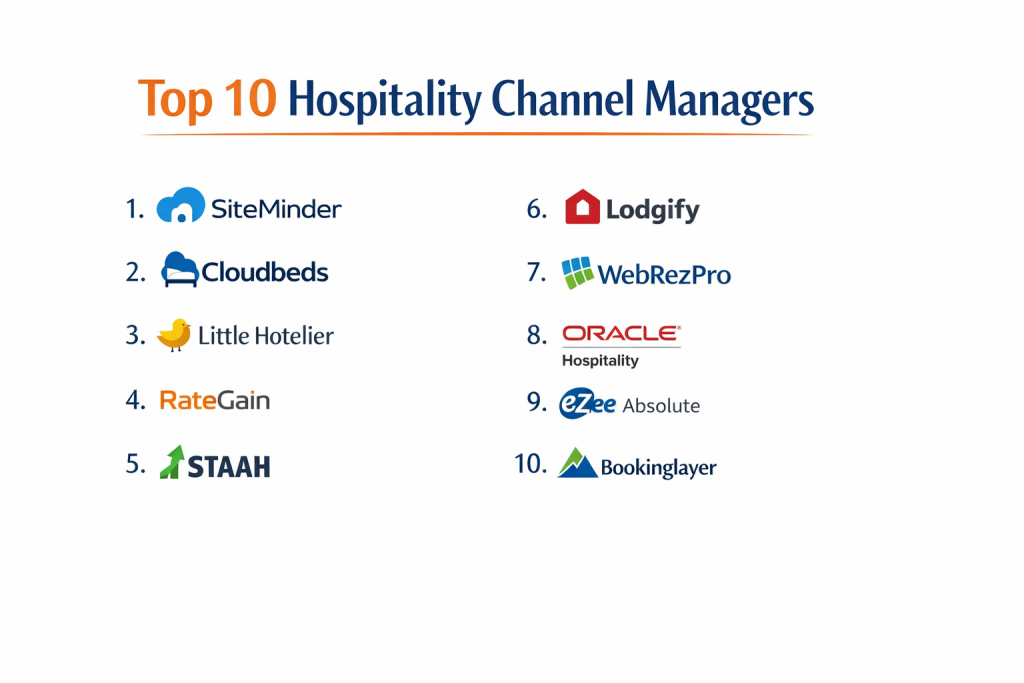
Top 10 Hospitality Channel Managers
1 — SiteMinder
SiteMinder is the world’s largest and most established channel manager, known for its vast global distribution network, reliability, and comprehensive feature set for properties of all sizes, from independents to large chains.
- Key Features
- Extensive Channel Marketplace: Connects to over 400 global distribution channels, including all major OTAs, GDS, and metasearch sites.
- The World’s Leading Hotel Commerce Platform: Offers additional tools like a booking engine, guest messaging, and revenue management intelligence.
- Powerful Rate & Inventory Management: Advanced tools for setting restrictions, stop-sells, and managing multi-room types.
- Open API & Deep PMS Integrations: Widely integrated with hundreds of PMS systems for seamless two-way sync.
- Robust Reporting & Analytics: Detailed performance reports on channel production, pickup, and revenue.
- Global Scale & Reliability: Enterprise-grade infrastructure with 24/7 monitoring and support.
- Pros
- Unmatched channel connectivity and industry trust, making it a safe, scalable choice.
- A true all-in-one commerce suite beyond just channel management.
- Cons
- Can be more expensive than some competitors, especially for smaller properties.
- The platform’s breadth can feel overwhelming for very small operations seeking simplicity.
- Security & Compliance: ISO 27001 certified, PCI DSS compliant, GDPR compliant. Enterprise-grade data security.
- Support & Community: 24/7 global customer support in multiple languages. Extensive knowledge base, webinars, and a large user community.
2 — Cloudbeds
Cloudbours is an award-winning, all-in-one hospitality management suite. Its channel manager is natively integrated with its own PMS, booking engine, and other tools, providing a seamless experience for growing and multi-property operations.
- Key Features
- Native All-in-One Platform: Deeply integrated channel manager, PMS, booking engine, and reporting in a single interface.
- Commission-Free Direct Bookings: A strong, customizable booking engine to drive revenue away from high-commission OTAs.
- Unified Calendar & Rate Management: Manage all availability, rates, and restrictions from one master calendar.
- Strong for Alternative Lodging: Excellent features for hostels, vacation rentals, and boutique hotels.
- Payouts & Financial Reporting: Integrated payment processing and automated financial reporting.
- Mobile-First Management: Fully functional mobile app for managers on the go.
- Pros
- Seamless, user-friendly experience with no integration headaches between core systems.
- Exceptional value and powerful tools for independent properties and small to mid-sized groups.
- Cons
- As an all-in-one, it’s a platform commitment; less ideal if you are deeply invested in and satisfied with a separate, specialized PMS.
- While it connects to major channels, its pure channel count is smaller than SiteMinder’s vast marketplace.
- Security & Compliance: PCI DSS Level 1 certified, data encryption, GDPR compliant. Trusted by thousands of properties globally.
- Support & Community: 24/7 multilingual support via chat, phone, and email. Extensive Academy with training and an active user community.
3 — Little Hotelier
Little Hotelier, powered by SiteMinder, is a simplified, all-in-one solution built specifically for small hotels, B&Bs, and guesthouses. It combines an easy-to-use channel manager with a front-desk PMS and a direct booking website.
- Key Features
- Designed for Small Properties: Intuitive interface with a focus on ease of use for owners and managers with limited tech experience.
- Built-in Front Desk PMS: Handles guest profiles, check-ins/outs, and basic operations.
- Free Direct Booking Website: Includes a mobile-optimized, commission-free booking website.
- Essential Channel Connections: Pre-connected to major global OTAs (Booking.com, Expedia) for immediate distribution.
- Automated Guest Communications: Sends pre-stay and post-stay emails automatically.
- Affordable, Simple Pricing: Straightforward monthly pricing often based on room count.
- Pros
- The most accessible and tailored solution for small, owner-operated properties getting started with digital distribution.
- Provides a complete tech stack (PMS, channel manager, website) in one affordable package.
- Cons
- Lacks the advanced features, customization, and extensive channel options required by larger or more complex properties.
- The simplified design may feel limiting as a business grows.
- Security & Compliance: Leverages SiteMinder’s security infrastructure. PCI compliant and follows data protection standards.
- Support & Community: Dedicated 24/7 support for small businesses. Help center and onboarding guidance.
4 — RateGain (via various products like DHISCO, TravelClick)
RateGain is a leading distribution and revenue management technology company serving large hotel chains, groups, and enterprises. Its solutions power complex connectivity, rate shopping, and channel management at scale.
- Key Features
- Enterprise-Grade Distribution: High-volume, high-speed connectivity solutions for chains with complex IT environments.
- Advanced Rate Shopping & Parity: Powerful tools to monitor competitor rates and enforce rate parity across thousands of channels.
- API-First Connectivity: Focus on deep, two-way API integrations with legacy PMS, CRS, and revenue management systems.
- Business Intelligence & Analytics: Sophisticated data aggregation and reporting for corporate-level decision-making.
- Group & Chain Management: Centralized controls for distributing rates and inventory across a brand’s portfolio.
- Acquisition of Key Platforms: Integrates technology from acquisitions like DHISCO, TravelClick, and MyCheckout.
- Pros
- The industry standard for large hotel enterprises with demanding performance, integration, and data needs.
- Unmatched depth in rate shopping, parity monitoring, and competitive intelligence.
- Cons
- Not a product for independent or small hotels; pricing and implementation are enterprise-scale.
- Can be less intuitive and require dedicated IT or revenue management resources to operate.
- Security & Compliance: Enterprise-level security certifications (SOC 2, ISO 27001). Compliant with global data standards.
- Support & Community: Enterprise support with dedicated account managers and technical teams. Industry conferences and partnerships.
5 — STAAH
STAAH is a global channel manager known for its reliability, competitive pricing, and strong presence in the Asia-Pacific and European markets. It offers a robust core channel management solution with a wide range of integrations.
- Key Features
- Extensive Direct Channel Integrations: Connects to a wide array of global and regional OTAs, including many in Asia.
- Full Two-Way XML Integration: Ensures real-time, reliable synchronization with channels and PMS.
- Advanced Stop-Sell & Yield Management: Tools to tightly control inventory distribution based on pick-up.
- Multi-Property Management: Dashboard for managing several properties from a single login.
- Competitive Pricing: Often positioned as a cost-effective alternative to the largest players.
- Booking Engine & Extranet Integration: Offers a booking engine and tools to manage channel extranets from one place.
- Pros
- Strong, reliable core channel management at a competitive price point.
- Excellent connectivity, especially for properties targeting guests in the Asia-Pacific region.
- Cons
- The user interface can feel less modern and polished than some cloud-native competitors.
- While feature-rich, it may not offer the same breadth of ancillary tools (like deep guest messaging) as full suites.
- Security & Compliance: Industry-standard security protocols. Compliant with data protection regulations in its operating regions.
- Support & Community: 24/7 support. Active in regional hospitality trade shows and communities.
6 — Lodgify
Lodgify is a complete business management solution designed specifically for vacation rental owners and property managers. Its channel manager is built to sync calendars across top short-term rental platforms.
- Key Features
- Vacation Rental Focus: Built from the ground up for the workflows of vacation rentals (cleaning schedules, guest guides, multi-stay discounts).
- Direct Booking Website Builder: A powerful, drag-and-drop website builder to create a professional, direct-booking site.
- Unified Inbox & Guest Communication: Manages messages from all channels (Airbnb, Vrbo, booking inquiries) in a single inbox.
- Automated Task & Team Coordination: Assigns cleaning and maintenance tasks triggered by bookings.
- Sync with Airbnb, Vrbo, Booking.com: Deep integration with leading short-term rental platforms.
- Contract & Payment Management: Handles rental agreements and secure online payments.
- Pros
- The best all-in-one platform for professionalizing and scaling a vacation rental business.
- Exceptional tools for driving and managing direct bookings to save on OTA commissions.
- Cons
- Specialized for vacation rentals; not suitable for traditional hotels or hostels.
- The breadth of features requires a learning curve and process adoption.
- Security & Compliance: PCI DSS compliant, SSL encryption. Trusted by thousands of property managers.
- Support & Community: Email, chat, and phone support. Extensive help center, blog, and community of vacation rental professionals.
7 — WebRezPro
WebRezPro is a cloud-based property management system with a fully integrated, powerful channel manager. It’s a popular choice for small to mid-sized hotels, inns, and B&Bs in North America looking for a unified system.
- Key Features
- True Native Integration: Channel manager is built into the PMS, not just connected, ensuring flawless sync.
- Commission-Free Booking Engine: A customizable, mobile-friendly direct booking engine included.
- Group & Package Management: Strong features for managing group blocks and creating sellable packages.
- Housekeeping & Maintenance Management: Integrated operational modules.
- Detailed Reporting Suite: Over 200 standard reports for operations, marketing, and finance.
- GDS Connectivity: Provides access to the global travel agent network.
- Pros
- Rock-solid reliability and ease of use due to its truly unified, cloud-native architecture.
- Excellent for properties that want a capable PMS and channel manager from a single vendor.
- Cons
- Primarily focused on the North American market and its most relevant channels.
- As a packaged system, there’s less flexibility to swap out components for best-of-breed alternatives.
- Security & Compliance: PCI compliant, daily data backups, secure cloud hosting. Meets industry standards.
- Support & Community: 24/7 North America-based phone and email support. Training webinars and user guides.
8 — Oracle Hospitality (OPERA Cloud Distribution)
Oracle Hospitality OPERA Cloud Distribution is the channel management component of the industry-leading OPERA Cloud suite. It’s designed for enterprise hotel chains and large independent properties that use or require the OPERA ecosystem.
- Key Features
- Native OPERA Cloud Integration: Seamlessly connects with the OPERA Cloud PMS, Sales & Catering, and other modules.
- Enterprise-Grade Architecture: Built for high transaction volumes, global scalability, and complex hotel group structures.
- Centralized Rate Management: Manage rates, inventory, and restrictions across an entire portfolio from a single point.
- Advanced Business Rules: Sophisticated controls for distribution based on market segment, channel, and date.
- Comprehensive Reporting: Deep analytics integrated with the broader OPERA business intelligence framework.
- Part of a Full Tech Stack: Integrates with Oracle’s revenue management, point-of-sale, and payment solutions.
- Pros
- The gold standard for large enterprises already invested in or standardizing on the Oracle/OPERA platform.
- Unmatched power and control for complex, multi-property management structures.
- Cons
- Extremely high cost and implementation complexity. Not accessible to SMBs.
- Can be rigid and require significant internal IT or consultant resources.
- Security & Compliance: Oracle’s global enterprise security standards, including SOC reports, data encryption, and compliance certifications.
- Support & Community: Enterprise-level global support. User groups and conferences for large enterprise clients.
9 — eZee Absolute
eZee Absolute is a comprehensive, cloud-based hotel management software suite that includes a channel manager, PMS, booking engine, and more. It’s known for its affordability and strong presence in emerging markets.
- Key Features
- All-in-One Cloud Suite: Integrated PMS, channel manager, booking engine, and front-desk operations.
- Wide Range of Integrations: Connects with numerous OTAs, payment gateways, and third-party tools.
- Affordable Pricing Model: Competitive pricing, making it attractive for budget-conscious small hotels.
- Multi-Property View: Allows management of several properties from a centralized dashboard.
- Offline Capability: Can process bookings and check-ins even with a temporary internet outage.
- Global Support Network: Offices and support in multiple regions worldwide.
- Pros
- Very cost-effective way to get a full suite of hotel management tools.
- Good global support coverage, particularly in Asia, the Middle East, and Africa.
- Cons
- User interface and experience can feel dated compared to modern competitors.
- Some users report that advanced features or complex setups can require back-end support.
- Security & Compliance: Standard cloud security measures. Compliance varies by region of operation.
- Support & Community: 24/7 global support via phone, chat, and email. Knowledge base and training videos.
10 — Bookinglayer
Bookinglayer is a modern, API-first channel manager and booking system built for flexibility. It caters to a wide range of accommodation types, from hotels to unique lodgings, and is popular for its customization options.
- Key Features
- API-First & Highly Customizable: Designed for developers and tech-savvy managers to build custom workflows and integrations.
- Wide Accommodation Type Support: Handles hotels, villas, glamping sites, tour packages, and more.
- Advanced Resource Management: Manages more than just rooms—ideal for properties selling add-ons like transfers, activities, or equipment.
- Direct Booking Focus: Provides powerful tools to create a custom, brand-aligned direct booking website.
- Two-Way Sync: Reliable real-time synchronization with major channels.
- Transparent Pricing: Simple, monthly subscription based on resources managed.
- Pros
- Unparalleled flexibility for non-standard accommodation businesses or those with unique technical needs.
- Strong focus on building a profitable direct booking strategy.
- Cons
- The flexibility comes with complexity; it requires more setup and technical understanding than out-of-the-box solutions.
- Smaller brand name and community compared to the industry giants.
- Security & Compliance: Data encryption, secure APIs. GDPR compliant.
- Support & Community: Technical support via email and tickets. Documentation aimed at developers.
Comparison Table
| Tool Name | Best For | Platform(s) Supported | Standout Feature | Rating |
|---|---|---|---|---|
| SiteMinder | Hotels of all sizes needing maximum global distribution | Cloud | Largest channel marketplace & industry-leading scale | N/A |
| Cloudbeds | Growing hotels, hostels & vacation rentals wanting an all-in-one suite | Cloud (Native Suite) | Seamlessly integrated PMS, channel manager & booking engine | N/A |
| Little Hotelier | Small hotels, B&Bs & guesthouses seeking simple, all-in-one tech | Cloud | Simplified, complete package for small property owners | N/A |
| RateGain | Large hotel chains & enterprises needing advanced distribution & rate intelligence | Cloud/API | Enterprise-grade rate shopping, parity & distribution power | N/A |
| STAAH | Properties seeking reliable, cost-effective core channel management | Cloud | Strong reliability & competitive pricing, especially in APAC | N/A |
| Lodgify | Vacation rental owners & professional property managers | Cloud | Complete vacation rental business management suite | N/A |
| WebRezPro | Small/mid-sized North American hotels wanting a unified PMS+CM | Cloud | True native integration of channel manager within a capable PMS | N/A |
| Oracle OPERA Cloud | Enterprise chains using the Oracle OPERA ecosystem | Cloud | Deep native integration within the leading enterprise PMS platform | N/A |
| eZee Absolute | Budget-conscious hotels globally, especially in emerging markets | Cloud | Affordable all-in-one suite with wide global support | N/A |
| Bookinglayer | Tech-savvy managers or unique lodgings needing customization | Cloud/API | High flexibility & API-first design for custom workflows | N/A |
Evaluation & Scoring of Hospitality Channel Managers
Use this rubric to objectively compare platforms. Weight the criteria based on your property’s size, technical resources, and distribution strategy.
| Evaluation Criteria | Weight | What to Look For | Scoring Guide (1-5) |
|---|---|---|---|
| Core Features | 25% | Real-time two-way sync, rate/restriction management, channel count, reporting. | 5: Exceeds all needs; 3: Meets core needs; 1: Lacks critical features. |
| Ease of Use | 15% | Dashboard intuitiveness, setup process, daily management complexity. | 5: Intuitive for daily users; 3: Requires some training; 1: Cumbersome. |
| Integrations & Ecosystem | 15% | PMS integration depth, booking engine, payment gateways, other hotel software. | 5: Seamless with your stack; 3: Key integrations exist; 1: Poor integration. |
| Security & Compliance | 10% | Data encryption, uptime SLAs, PCI DSS, GDPR compliance, audit logs. | 5: Enterprise-grade certs & guarantees; 3: Standard security; 1: Concerns. |
| Performance & Reliability | 10% | Sync speed/accuracy, system uptime, handling of peak booking volumes. | 5: 99.9%+ uptime, flawless sync; 3: Generally reliable; 1: Sync issues. |
| Support & Community | 10% | 24/7 availability, support quality, training resources, user community. | 5: Proactive, expert global support; 3: Adequate support; 1: Poor support. |
| Price / Value | 15% | Monthly cost, setup fees, per-booking charges, ROI from features. | 5: Exceptional value for price; 3: Price aligns with market; 1: Poor value. |
How to Use: Shortlist 2-3 tools that match your property type and size. Score each 1-5 for every criterion. Multiply the score by the weight (as a decimal) to get a weighted score. Sum the weighted scores for each vendor to see which aligns best with your priorities.
Which Hospitality Channel Manager Tool Is Right for You?
The right choice depends on your property type, scale, existing tech stack, and growth ambitions.
- Property Type & Size: Small B&Bs/Guesthouses should prioritize simplicity: Little Hotelier or Cloudbeds. Vacation Rentals must choose Lodgify. Independent/Mid-size Hotels have great options in Cloudbeds, SiteMinder, or WebRezPro. Hotel Chains & Large Groups need enterprise power: RateGain, Oracle OPERA Cloud, or SiteMinder Enterprise.
- Tech Stack Philosophy: If you want a single, unified system, choose an all-in-one suite (Cloudbeds, WebRezPro, eZee). If you prefer “best-of-breed” and have a PMS you love, choose a standalone channel manager (SiteMinder, STAAH) that integrates with it.
- Primary Distribution Goals: For maximizing global OTA reach, SiteMinder’s vast marketplace is key. For driving direct bookings to save on commissions, prioritize tools with strong booking engines (Cloudbeds, Lodgify, Bookinglayer). For vacation rentals, focus on Airbnb/Vrbo sync (Lodgify).
- Budget-Conscious vs. Premium Solutions: For affordability, eZee Absolute, STAAH, and Little Hotelier are strong. Cloudbeds and SiteMinder offer mid-market value. RateGain and Oracle are premium enterprise investments.
- Geographic Market Focus: In North America, WebRezPro and major global players work well. In Asia-Pacific, STAAH and eZee have strong regional connections. Ensure your chosen tool connects to the OTAs most popular in your target markets.
- Integration and Scalability Needs: If you use a common cloud PMS, check for a pre-built, two-way integration. If you have a legacy system, you may need an API-centric tool like Bookinglayer or an enterprise solution. Ensure the tool can scale with your room count and channel connections.
Frequently Asked Questions (FAQs)
1. What is “two-way sync” and why is it critical?
Two-way synchronization means that when a booking comes in from any connected channel (e.g., Expedia), it instantly reduces availability in your channel manager and PMS, and that update is pushed out to all other channels. This prevents double bookings. Conversely, if you close out a room type in your PMS, it instantly closes on all channels. One-way sync is risky and inadequate.
2. How many channels should I connect to?
Start with the major players for your region (e.g., Booking.com, Expedia, Airbnb). Then, strategically add 2-3 niche channels that match your property type (e.g., Hostelworld for hostels, Vrbo for vacation homes). Quality over quantity—manage channels that actually produce bookings.
3. Can a channel manager help me get onto the GDS (Global Distribution System)?
Yes, but not directly. Most channel managers partner with a GDS Gateway company (like SiteMinder via its partners or RateGain). The channel manager feeds your rates/availability to the gateway, which then distributes it to the GDS (Amadeus, Sabre, etc.) for travel agents to see. There is usually an additional fee for this service.
4. What’s the difference between a channel manager and a booking engine?
A Channel Manager distributes your inventory outward to third-party sales sites (OTAs). A Booking Engine is the widget on your own website that allows guests to book directly with you. They work together: the channel manager should sync with your booking engine so direct reservations also update all channel availability.
5. How do channel managers handle rate parity?
They provide the tools to maintain parity. You set a base rate in the channel manager, and it can distribute that rate (or a configured markup/down) to each channel. However, maintaining parity is ultimately your responsibility. Some, like RateGain, offer active rate shopping tools to monitor and alert you of parity violations.
6. What happens during an internet outage?
A robust channel manager operates in the cloud, so if your hotel’s internet goes down, the distribution continues (channels can still sell, and bookings will queue). A good PMS will have an offline mode to check guests in/out locally. Once internet is restored, the systems sync automatically. Ask vendors about their outage protocols.
7. Are there long-term contracts?
It varies. Many modern cloud providers (Cloudbeds, SiteMinder) offer month-to-month subscriptions, providing flexibility. Some enterprise solutions or those with heavy onboarding may require annual contracts. Always clarify the terms before signing.
8. How is pricing typically structured?
Common models include: Monthly Subscription (based on room count or number of channels), Per-Booking Fee (a small charge for each reservation that comes through the system), or a Hybrid of both. There may also be one-time setup fees.
9. Can I manage multiple properties under one account?
Yes, all serious channel managers offer a Multi-Property Dashboard or Group Management feature. This allows centralized control over rates and inventory while also providing individual property views. This is essential for management companies and hotel groups.
10. What’s the single biggest mistake when choosing?
Selecting based on price alone or the flashiest demo. The #1 priority must be reliable, real-time two-way integration with your PMS. A cheap or pretty tool that causes double bookings or fails to sync will cost far more in lost revenue, guest frustration, and manual work than you’ll ever save.
Conclusion
Selecting a hospitality channel manager is a foundational decision that directly controls your most valuable asset: your inventory. The market offers tailored solutions, from the accessible simplicity of Little Hotelier for starters to the all-in-one power of Cloudbeds for growing independents, the specialized focus of Lodgify for vacation rentals, and the enterprise muscle of RateGain and Oracle. The “best” tool is not the one with the most connections, but the one that provides rock-solid reliability, integrates seamlessly with your operations, and aligns with your distribution strategy.
Success hinges on prioritizing synchronization accuracy over all else. A double booking is the fastest way to destroy guest trust and revenue. Use the evaluation framework to find a platform that is not just a marketing dashboard but a reliable central nervous system for your distribution. By investing in the right channel manager, you free yourself from manual calendar hell, unlock global reach, and gain the control needed to strategically sell every room, every night, at the best possible price.

- Top 10 Email Deliverability Tools: Features, Pros, Cons & Comparison - September 6, 2026
- Top 10 Pharmacovigilance Software: Features, Pros, Cons & Comparison - September 6, 2026
- Top 10 Manufacturing Execution Systems (MES) - July 30, 2026