Introduction
Car Rental Management Software (CRMS) is a specialized digital platform that serves as the operational backbone for any vehicle rental business. It integrates and automates the entire rental lifecycle—from online booking and customer management to fleet tracking, maintenance scheduling, billing, and reporting. Think of it as a central nervous system that replaces manual ledgers, paper contracts, and chaotic spreadsheets with a streamlined, data-driven process.
Its importance is fundamental to profitability and growth in a competitive industry. A robust CRMS directly increases revenue by maximizing fleet utilization through real-time availability calendars and dynamic pricing. It drastically reduces administrative costs by automating contracts, invoices, and payment processing. Furthermore, it enhances customer satisfaction with smooth online bookings, digital check-in/out, and transparent communication, while also safeguarding assets through meticulous maintenance logs and compliance tracking.
Key real-world use cases include: Independent rental agencies managing a local fleet, Franchise locations of major brands needing consistent operations, Specialty rental businesses (luxury, classic cars, commercial vans), and Ride-sharing or car-sharing platforms managing peer-to-peer or corporate fleets.
When evaluating a CRMS, key criteria include: Core rental management features (reservations, contracts, payments), Fleet management capabilities (maintenance, damage tracking, vehicle location), Channel management for distributing inventory on OTAs (Online Travel Agencies), Customer relationship management (CRM) tools, and the quality of reporting and analytics for business insights.
Best for: This software is essential for car rental business owners, fleet managers, and operations managers. It delivers the most value to small-to-medium independent rental companies, franchisees, and specialty rental operators. It is also critical for entrepreneurs launching new rental ventures or shifting from manual processes.
Not ideal for: Individuals renting out a single personal vehicle occasionally; for them, peer-to-peer platforms like Turo provide the necessary tools. Large car-sharing corporations (e.g., Zipcar, major OEM programs) often require fully custom-built enterprise solutions. Businesses that only need basic scheduling for a small pool of company vehicles might find a simpler vehicle scheduling software sufficient.
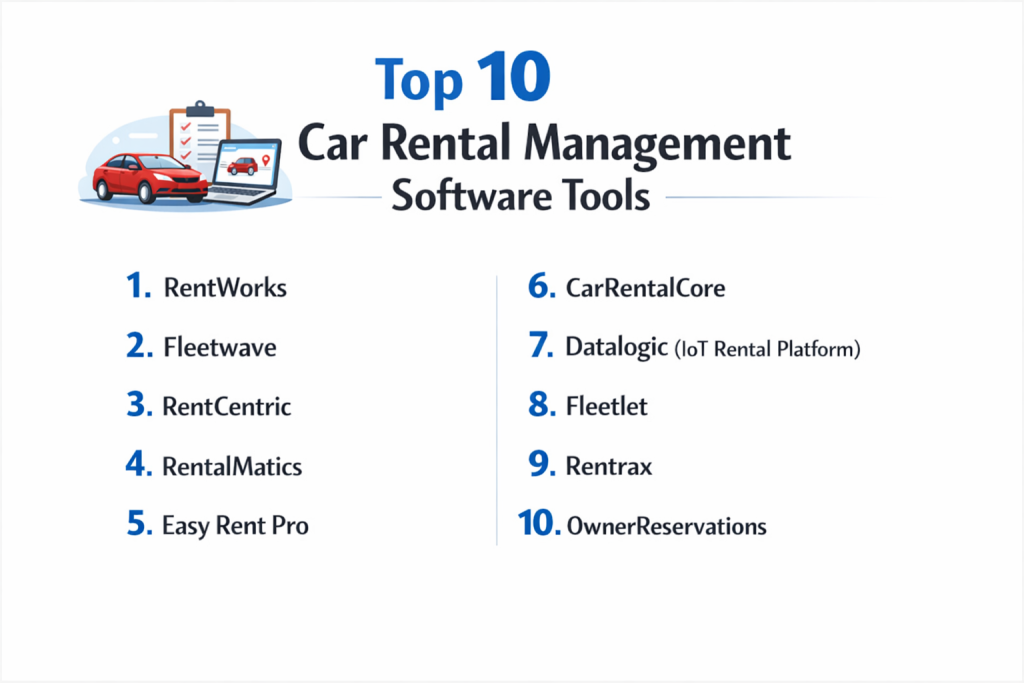
Top 10 Car Rental Management Software Tools
1 — RentWorks
A comprehensive, all-in-one cloud platform designed as a modern alternative to legacy systems, known for its user-friendly interface and robust automation.
- Short description: A fully integrated solution that handles everything from online bookings and dynamic pricing to fleet maintenance and detailed analytics. Ideal for growing independent companies and small chains seeking efficiency.
- Key features:
- End-to-end rental process automation: quote-to-contract-to-invoice.
- Integrated channel manager for distributing rates/availability to major OTAs (Expedia, Booking.com).
- Real-time fleet availability calendar with drag-and-drop scheduling.
- Automated customer communication (confirmations, reminders, follow-ups).
- Built-in maintenance scheduling and cost tracking module.
- Advanced reporting dashboard with profitability and fleet performance metrics.
- Pros:
- Excellent balance of powerful features and an intuitive, modern user interface.
- Strong automation reduces manual data entry and minimizes errors.
- Cons:
- May have limitations for very large, enterprise-scale operations with highly complex needs.
- Some niche features for specific rental verticals (e.g., heavy equipment) may require customization.
- Security & compliance: Cloud-based with data encryption, secure payment processing (PCI DSS compliant), and adherence to data protection standards like GDPR.
- Support & community: Responsive support via email, chat, and phone. Growing knowledge base and user community.
2 — Fleetwave (by Chevin)
A veteran fleet management solution with deep car rental functionality, favored by larger operations, municipalities, and organizations with mixed fleets (rental, leased, and owned).
- Short description: A powerful, configurable system built for complex fleet operations beyond pure rental. Suited for companies that need to manage rentals alongside company-owned assets and require deep operational control.
- Key features:
- Comprehensive rental management integrated with full lifecycle fleet asset management.
- Advanced maintenance management with predictive scheduling and parts inventory.
- Strong compliance tracking for safety inspections, licenses, and regulations.
- Detailed financial tracking and cost allocation across the fleet.
- Highly customizable reporting and business intelligence tools.
- Mobile applications for field inspections and data capture.
- Pros:
- Unmatched depth in asset lifecycle management and maintenance control.
- Highly scalable and configurable for large or complex organizational structures.
- Cons:
- Can be complex and expensive to implement, with a steeper learning curve.
- User interface can feel less modern compared to newer cloud-native platforms.
- Security & compliance: Enterprise-grade security, often deployed on-premise or private cloud. Complies with various industry and governmental standards.
- Support & community: Professional support and implementation services through Chevin’s global network. Established user base in government and enterprise sectors.
3 — RentCentric
A widely adopted, robust platform specifically built for the car and truck rental industry, offering a strong mix of core features and hardware integrations.
- Short description: A reliable workhorse in the industry, known for its stability and extensive feature set. A popular choice for mid-sized independent rental companies and franchisees needing a proven, dedicated rental solution.
- Key features:
- Full-featured reservation and rental management system.
- Integrated POS (Point of Sale) for counter transactions.
- Hardware integrations for key cabinets, barcode scanners, and vehicle tracking.
- Customer portal for online bookings and account management.
- Built-in accounting integrations (QuickBooks) and reporting suite.
- Options for GPS fleet tracking integration.
- Pros:
- Very stable and reliable system with a long track record in the industry.
- Excellent out-of-the-box functionality for standard car rental operations.
- Cons:
- The user interface, while functional, is not as sleek as some modern competitors.
- Some users report that customizations or complex workflows can be challenging.
- Security & compliance: Offers standard data security and PCI compliance for payments. Specific certifications may vary by deployment.
- Support & community: Well-regarded customer support. Large installed base means many consultants and developers are familiar with the platform.
4 — RentalMatics
A unique platform that combines traditional rental management with integrated telematics and GPS fleet tracking, focusing on security, utilization, and automation.
- Short description: Ideal for rental companies where vehicle security, real-time location tracking, and automated check-in/out are priorities. Blends software with IoT (Internet of Things) hardware.
- Key features:
- Native integration of GPS tracking hardware for real-time fleet visibility.
- Geofencing, speed alerts, and trip history for security and monitoring.
- Automated rental agreements based on actual vehicle use (mileage/time).
- Digital vehicle inspection apps with photo capture for damage reporting.
- Theft recovery tools and driver behavior monitoring.
- Pros:
- Powerful combination of management software and telematics for enhanced control.
- Significantly reduces disputes and fraud through automated data collection.
- Cons:
- Requires investment in and installation of hardware (GPS devices) in each vehicle.
- The focus on tracking may be overkill for small, low-risk local fleets.
- Security & compliance: High focus on data security for location information. Complies with relevant data privacy regulations for tracking data.
- Support & community: Support for both software and hardware components. Niche community focused on telematics-enabled rental operations.
5 — Easy Rent Pro
A cloud-based software known for its simplicity and affordability, making it a strong entry point for startups and very small rental operations.
- Short description: A straightforward, easy-to-learn system designed to get small rental businesses digital quickly. Focuses on core reservation, customer, and vehicle management without overwhelming complexity.
- Key features:
- Simple reservation management and calendar view.
- Basic customer and vehicle database management.
- Contract and invoice generation.
- Essential reporting on rentals and revenue.
- Affordable monthly subscription with a clear pricing structure.
- Pros:
- Low cost and very quick to set up and start using.
- Intuitive for users with minimal technical or industry software experience.
- Cons:
- Lacks advanced features like channel management, deep maintenance, or complex pricing engines.
- May not scale well for businesses that grow beyond a certain size or complexity.
- Security & compliance: Standard cloud application security. Best for basic data protection needs.
- Support & community: Basic customer support. Relies on its simplicity to minimize support needs.
6 — CarRentalCore
An open-source car rental management software that provides full control and customization for businesses with technical resources.
- Short description: A self-hosted solution where you own the code. Perfect for tech-savvy rental businesses or developers who need to build a fully customized, branded platform without recurring SaaS fees.
- Key features:
- Full access to source code for unlimited customization.
- Core modules for reservations, fleet, customers, and payments.
- Multi-language and multi-currency support.
- API for building custom integrations.
- One-time license fee model (plus optional support).
- Pros:
- Ultimate flexibility and control over the software’s features and design.
- No ongoing monthly subscription fees after the initial license purchase.
- Cons:
- Requires significant technical expertise or budget for a developer to host, maintain, and customize.
- User support and updates depend on your own team or hired developers.
- Security & compliance: Security is the responsibility of the hosting organization. No inherent compliance certifications.
- Support & community: Community-based support forums. Professional support packages are available for purchase from the vendor.
7 — Datalogic (IoT Rental Platform)
A forward-thinking platform designed for the future of rental, focusing on contactless, keyless operations via smartphones and IoT sensors.
- Short description: Specializes in enabling a fully digital customer journey—book, unlock, and drive using a smartphone app. Targets car-sharing, peer-to-peer, and forward-thinking traditional rental companies.
- Key features:
- Mobile app for customers to locate, unlock, and start rental vehicles.
- IoT hardware integration for keyless entry and ignition.
- Dynamic pricing engines and membership/subscription models.
- Automated insurance and damage assessment tools.
- Platform designed for scale in shared mobility models.
- Pros:
- Enables the most modern, convenient, and low-overhead rental experience.
- Ideal for building a branded car-sharing or subscription service.
- Cons:
- High dependency on hardware (smart locks, etc.) and mobile network connectivity.
- Less optimized for traditional counter-based rental operations.
- Security & compliance: High-security standards for mobile access and vehicle control. Compliance with evolving mobility service regulations.
- Support & community: Specialized support for IoT and mobility operations. Part of a newer ecosystem of shared-economy technology providers.
8 — Fleetlet
A mobile-first, streamlined solution designed for small to medium fleets, emphasizing simplicity in scheduling, maintenance, and customer management on the go.
- Short description: A clean, intuitive app-focused platform for rental businesses whose managers and staff are often away from a desktop. Prioritizes ease of use and core task management.
- Key features:
- Mobile-optimized interface for checking vehicles in/out and managing reservations.
- Simple maintenance tracking and reminder system.
- Customer communication tools (SMS/email) within the app.
- Digital inspection checklists.
- Basic reporting accessible from mobile devices.
- Pros:
- Excellent for businesses that operate primarily from a lot or garage without a fixed office terminal.
- Very low training time due to its intuitive, app-based design.
- Cons:
- Lacks the depth of features and administrative control found in full desktop systems.
- Not suited for complex pricing, multi-channel distribution, or large-scale operations.
- Security & compliance: Standard mobile app security protocols. Best for smaller operations without complex compliance needs.
- Support & community: Support via in-app messaging and email. Community is less formal.
9 — Rentrax
A UK-based software provider with a strong presence in Europe, offering a solid suite of rental management features with good support for local tax and regulatory requirements.
- Short description: A reliable choice for rental businesses in the UK and Europe, providing robust core functionality and an understanding of regional operational nuances.
- Key features:
- Comprehensive rental and reservation management.
- Integrated accounting and VAT (Value Added Tax) handling.
- Fleet management with service and maintenance history.
- Customer portal and online booking engine.
- Reporting tailored for European business analysis.
- Pros:
- Strong regional fit with localized compliance and tax features.
- Solid, dependable system for standard rental operations.
- Cons:
- Less global brand recognition outside of Europe.
- May not be the best fit for businesses needing highly advanced or niche features.
- Security & compliance: Adheres to European data protection standards (GDPR) and financial regulations.
- Support & community: Localized support in English and other European languages. Established user base in its core regions.
10 — OwnerReservations
A platform initially designed for vacation rental property management (PMS) that has been effectively adapted for small-scale, specialty, or luxury car rental fleets.
- Short description: A versatile system for businesses that manage a diverse “fleet” of unique assets. Great for renting high-value, distinct vehicles (luxury, classic, exotic) where presentation and individual asset details are key.
- Key features:
- Visually rich presentation of vehicles with extensive photo galleries and descriptions.
- Channel management for distributing to various specialty websites.
- Integrated payment processing and secure online bookings.
- Cleaning/maintenance scheduling tailored for high-turnover assets.
- Customer communication and review management tools.
- Pros:
- Excellent for marketing and showcasing unique vehicles online.
- Leverages powerful PMS features adapted for vehicle rentals.
- Cons:
- Not built from the ground up for traditional high-volume car rental (e.g., managing 100 identical sedans).
- Some auto-industry specific features (like detailed maintenance logs) may be less robust.
- Security & compliance: Standard e-commerce and data security for online bookings and payments. GDPR compliant.
- Support & community: Support from the vacation rental software world, which is generally strong. User community focused on hospitality.
Comparison Table
| Tool Name | Best For (Target User or Scenario) | Platform(s) Supported | Standout Feature | Rating |
|---|---|---|---|---|
| RentWorks | Growing independents & small chains wanting modern automation | Web, Cloud-native | User-Friendly Design & Strong Process Automation | N/A |
| Fleetwave | Large ops/mixed fleets needing deep asset lifecycle management | Web, On-Premise, Cloud | Enterprise-Grade Fleet Maintenance & Asset Control | N/A |
| RentCentric | Established mid-sized companies needing a reliable industry staple | Windows, Web, Mobile | Proven Stability & Extensive Hardware Integrations | N/A |
| RentalMatics | Security-focused companies wanting integrated GPS/telematics | Web, Mobile, IoT Hardware | Native Telematics for Tracking & Automated Check-in/out | N/A |
| Easy Rent Pro | Startups & very small ops prioritizing simplicity & low cost | Web, Cloud | Extreme Simplicity & Affordability | N/A |
| CarRentalCore | Tech-savvy businesses needing full customization & code access | Self-Hosted (PHP/MySQL) | Open-Source Code for Unlimited Customization | N/A |
| Datalogic | Car-sharing, subscription, & keyless/contactless rental models | Web, Mobile App, IoT | Mobile-First, Keyless Rental Experience | N/A |
| Fleetlet | Mobile-first small businesses managing rentals from a phone/tablet | iOS, Android, Web | Streamlined Mobile App for On-the-Go Management | N/A |
| Rentrax | Rental businesses in the UK/Europe needing regional compliance | Web, Cloud | Strong Regional Fit for European Regulations & VAT | N/A |
| OwnerReservations | Specialty/luxury fleets where online presentation is critical | Web, Cloud | Vacation-Rental Style Presentation & Channel Mgmt for Unique Assets | N/A |
Evaluation & Scoring of Car Rental Management Software
| Criteria | Weight | What to Look For (Excellent Performance) |
|---|---|---|
| Core Features | 25% | Reservation/booking management, contract generation, rate management, fleet availability calendar, customer database, integrated payment processing. |
| Ease of Use | 15% | Intuitive interface for staff and customers, clear navigation, minimal training required, quality of mobile experience, simplicity of daily tasks (check-in/out). |
| Integrations & Ecosystem | 15% | Channel managers for OTAs, accounting software links (QuickBooks, Xero), payment gateways, hardware (key cabinets, scanners), telematics/GPS, API availability. |
| Security & Compliance | 10% | Data encryption, secure payment handling (PCI DSS), access controls, audit trails, compliance with regional data privacy laws (e.g., GDPR), fraud prevention tools. |
| Performance & Reliability | 10% | System uptime, speed for peak booking periods, data backup/disaster recovery, scalability to handle fleet growth, stability of cloud/on-premise hosting. |
| Support & Community | 10% | Quality of onboarding/training, responsiveness of support (phone/chat), comprehensiveness of help docs/knowledge base, active user community or partner network. |
| Price / Value | 15% | Transparent pricing model (monthly, per vehicle, one-time), total cost of ownership (including setup/hardware), ROI through time savings and increased revenue, contract flexibility. |
Which Car Rental Management Software Tool Is Right for You?
- Solo Users/Startups vs. SMB vs. Mid-Market vs. Enterprise: Startups and very small ops should begin with Easy Rent Pro or Fleetlet. Growing SMBs will find the best balance in RentWorks or RentCentric. Mid-market and small chains should evaluate RentCentric, RentalMatics, or Fleetwave. Large enterprises with complex asset management needs require the power of Fleetwave.
- Budget-Conscious vs. Premium Solutions: Easy Rent Pro and the open-source CarRentalCore (if you have tech skills) offer low-cost entry. RentWorks and RentCentric represent the mid-market value tier. Fleetwave and fully custom IoT platforms like Datalogic are premium investments.
- Feature Depth vs. Ease of Use: Easy Rent Pro and Fleetlet prioritize simplicity. RentWorks offers a great balance. Fleetwave and RentCentric provide immense depth for those who need complex configurations and controls.
- Integration and Scalability Needs: For connecting to OTA websites, ensure the software has a strong channel manager (RentWorks, OwnerReservations). For scaling fleet size and business complexity, Fleetwave and RentCentric are built to scale. For IoT and hardware integration, RentalMatics and Datalogic specialize in this.
- Security and Compliance Requirements: All businesses need PCI compliance for payments. Those in Europe (GDPR) or handling sensitive data should prioritize vendors like Rentrax or Fleetwave with clear compliance frameworks. Telematics solutions like RentalMatics add a physical security layer.
Frequently Asked Questions (FAQs)
What’s the difference between fleet management software and car rental software?
Fleet Management Software (FMS) focuses on the lifecycle cost, maintenance, and compliance of a company’s owned or leased vehicles. Car Rental Software (CRMS) is specialized for the commercial rental transaction—managing short-term rentals, customer billing, availability, and distribution. Many tools, like Fleetwave, blend both.
Do I need to use the software’s payment processing, or can I use my own?
Most CRMS offers integrated payment gateways (like Stripe, Square) for convenience and automated reconciliation. Many also allow you to use your own merchant account through an API, though this may require additional setup.
Can this software help me list my cars on websites like Expedia or Turo?
Yes, through a channel manager. Software like RentWorks or OwnerReservations can push your fleet’s availability and rates to multiple Online Travel Agencies (OTAs) and peer-to-peer platforms simultaneously, updating calendars in real-time to prevent double-bookings.
How does software help with vehicle maintenance?
A good CRMS includes a maintenance module where you can schedule services (oil changes, inspections) based on time or mileage. It automatically flags vehicles due for service, tracks repair history and costs, and prevents them from being rented out during maintenance.
Is cloud-based or on-premise software better?
Cloud-based (SaaS) offers lower upfront cost, automatic updates, and access from anywhere, which is ideal for most modern businesses. On-premise software is installed on your own servers, offering more control and customization but requiring IT expertise and higher initial investment. Fleetwave offers both.
What hardware do I typically need?
Common hardware includes tablets/kiosks for check-in, barcode scanners for inventory, printers for contracts, and possibly key management systems. Specialized solutions like RentalMatics require GPS devices.
How long does it take to implement new software?
A simple cloud system like Easy Rent Pro can be live in days. A comprehensive system like RentCentric or Fleetwave, with data migration and training, can take 4-12 weeks. Open-source or highly customized setups take the longest.
Can the software handle different rental types (hourly, daily, weekly, monthly)?
Absolutely. Configurable rate tables for different time periods and vehicle classes are a standard core feature of any credible CRMS.
What’s the biggest mistake rental businesses make when choosing software?
Choosing based on price alone without considering scalability, or selecting a system that is too complex for their team, leading to poor adoption and wasted investment. Always request a live demo and involve your staff in the testing.
How do I ensure customer data is safe?
Choose vendors that are transparent about their security practices. Look for mentions of data encryption (in transit and at rest), secure cloud infrastructure (like AWS or Google Cloud), PCI DSS compliance for payments, and adherence to privacy laws like GDPR.
Conclusion
Choosing the right Car Rental Management Software is a pivotal decision that directly shapes your operational efficiency, customer satisfaction, and profitability. The market offers specialized solutions: the modern automation of RentWorks, the industrial strength of Fleetwave, the proven reliability of RentCentric, and the innovative edge of Datalogic.
The “best” software isn’t defined by its feature count, but by how seamlessly it fits your specific business model, fleet size, and growth ambitions. Use the evaluation framework to weigh your priorities: Are you a startup needing simplicity, a growing company seeking automation, or an established player requiring deep asset control?
By investing time in a thorough selection process—involving demos, talking to references, and calculating true ROI—you can implement a system that does more than manage rentals. It becomes a strategic partner that helps you optimize your fleet, delight your customers, and drive your business forward. The right digital foundation turns operational challenges into competitive advantages.

- Top 10 Email Deliverability Tools: Features, Pros, Cons & Comparison - September 6, 2026
- Top 10 Pharmacovigilance Software: Features, Pros, Cons & Comparison - September 6, 2026
- Top 10 Manufacturing Execution Systems (MES) - July 30, 2026