Introduction
Airport Operations Management Software (AOMS) is the integrated digital nervous system for modern airports. It is a comprehensive suite of tools that centralizes, automates, and optimizes the myriad of real-time activities required to run an airport safely and efficiently. This software moves far beyond basic scheduling to provide a Single Source of Truth (SSoT) that synchronizes airline schedules, gate and stand assignments, baggage handling, security operations, maintenance, and passenger flow management.
Implementing an effective AOMS is critical for airport viability and growth. It is the backbone that maximizes operational efficiency, enhances safety and security, improves the passenger experience, and ensures regulatory compliance. By providing real-time situational awareness, it enables data-driven decisions that reduce delays, optimize resource utilization, and increase overall airport throughput. In practice, it allows an operations controller to reassign a gate within seconds when a flight is delayed, helps a maintenance team prioritize runway repairs based on live traffic, enables security to manage checkpoint queues dynamically, and gives airline handlers precise data on baggage carousel availability.
When evaluating an AOMS, key criteria include: Real-time data integration and visualization across all operational areas, robust Resource Management for gates, stands, check-in counters, and baggage belts, advanced Collaborative Decision Making (CDM) tools for airlines and ground handlers, comprehensive reporting and analytics for performance benchmarking, and scalability and flexibility to adapt to an airport’s unique processes and future growth.
Best for: This software is essential for airport operators, air traffic service providers, fixed-base operators (FBOs), and ground handling companies. Key users include airport operations managers, airside and landside coordinators, apron controllers, airline station managers, and maintenance directors at airports of all sizes, from regional general aviation fields to major international hubs.
Not ideal for: Very small private airstrips or flying clubs with minimal scheduled traffic and basic operational needs. For these entities, a combination of standalone scheduling calendars, basic resource booking tools, and manual processes may suffice until complexity and traffic volumes demand a more integrated solution.
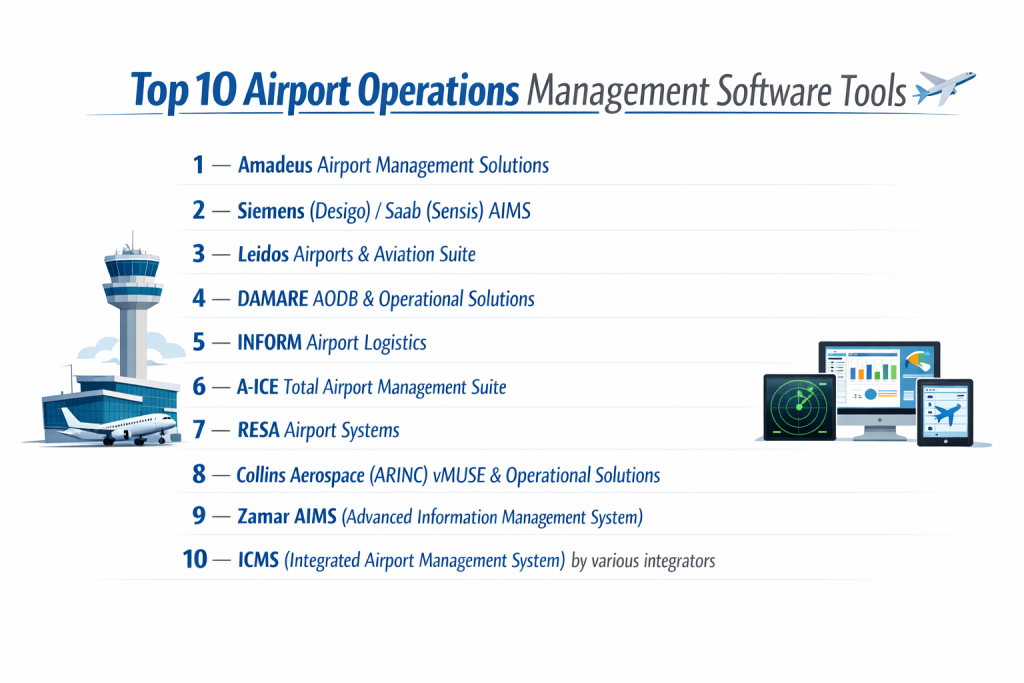
Top 10 Airport Operations Management Software Tools
The right AOMS platform is foundational to an airport’s performance. Here is a detailed analysis of ten leading enterprise-grade solutions that power airports worldwide.
1 — Amadeus Airport Management Solutions
A comprehensive, cloud-native suite from a travel tech giant, designed to streamline passenger processing and airport operations with a strong focus on common-use and self-service.
Key features:
- Amadeus Flow: Real-time passenger flow management and predictive analytics for queue times.
- Common Use Passenger Processing System (CUPPS): Enables multiple airlines to share check-in counters, gates, and self-service kiosks.
- Airport Operational Database (AODB): Centralized data hub integrating flight schedules, resources, and operational events.
- Resource Management System (RMS): For dynamic allocation of gates, stands, check-in desks, and baggage belts.
- Integrations: Deep connectivity with Amadeus’ global distribution system (GDS) and other airline/airport systems.
- Cloud-based platform offering scalability and reduced on-premise infrastructure.
Pros:
- Unmatched strength in passenger processing and common-use technology, backed by global travel industry expertise.
- Cloud delivery model allows for faster updates, scalability, and potentially lower IT overhead.
Cons:
- As part of a massive corporate ecosystem, can be perceived as less flexible for highly customized, unique airport needs.
- Total cost of ownership for the full suite can be significant for smaller airports.
Security & compliance: ISO 27001 certified, GDPR compliant, and adheres to stringent aviation industry data security standards. Cloud infrastructure meets high availability and resilience benchmarks.
Support & community: Global 24/7 support network. Extensive documentation and professional services. Large, established user base across major airports.
2 — Siemens (Desigo) / Saab (Sensis) AIMS
A powerful, integrated platform combining Siemens’ building automation with Saab’s Sensis air traffic solutions for holistic airport management.
Key features:
- Integrated AODB and RMS: Centralized control for flight information, gate/stand planning, and baggage handling.
- Apron and Airside Management: Advanced surface surveillance and vehicle tracking integration.
- Building Management System (BMS) Integration: Unifies operational control with terminal HVAC, lighting, and energy management.
- Predictive analytics for delay propagation and resource conflict resolution.
- Collaborative Decision Making (CDM) tools for all airport partners.
- Highly modular architecture allowing airports to build their ideal ecosystem.
Pros:
- Unique value proposition in linking traditional operations with intelligent building management for total facility optimization.
- Extremely robust and scalable, trusted by some of the world’s most complex and high-traffic airports.
Cons:
- The integrated system can involve a complex and lengthy implementation and customization process.
- May represent a substantial capital investment, more suited for large-scale greenfield or major upgrade projects.
Security & compliance: Meets critical infrastructure protection standards. Systems are designed for high security and redundancy, with compliance certifications specific to each module (e.g., aviation, building tech).
Support & community: Enterprise-level support with dedicated account and engineering teams. Strong presence in the global airport consultancy and integration community.
3 — Leidos Airports & Aviation Suite
A mission-critical software suite from a defense and aviation specialist, focused on security, resilience, and large-scale enterprise operations.
Key features:
- i3 AODB: A highly configurable and scalable operational database forming the system core.
- Intelligent Resource Management (IRM): AI and rules-based optimization for gate, stand, and counter assignments.
- Baggage Management: Integrated tracking and reconciliation (BRS).
- Massive data integration capabilities with air traffic control, airlines, ground handlers, and security systems.
- Advanced reporting and business intelligence with customizable dashboards.
- Strong focus on business continuity and disaster recovery architectures.
Pros:
- Proven in the most demanding, high-security, and large-scale airport environments globally.
- Exceptional depth in data integration, making it ideal for airports acting as a true data hub for all stakeholders.
Cons:
- Can be resource-intensive to implement and maintain, requiring significant internal or partner IT expertise.
- The user interface in some legacy modules may be less modern than newer cloud-native competitors.
Security & compliance: Designed to meet and exceed stringent government and aviation security standards (e.g., TSA, ICAO). Often deployed in sensitive national security contexts.
Support & community: Provides top-tier, mission-critical support. Often involves deep, long-term partnerships with airport IT and operations teams.
4 — DAMARE AODB & Operational Solutions
A specialized provider known for its powerful, flexible, and user-friendly AODB and resource management systems, popular with mid-sized and growing airports.
Key features:
- Core AODB: Highly reliable and intuitive database for managing all flight and operational data.
- Visual Resource Manager (VRM): Drag-and-drop interface for planning and managing gates, stands, check-in zones, and baggage carousels.
- Flight Information Display System (FIDS) management.
- Automated messaging (Type B, AIDX) with airlines and handling agents.
- Web-based and mobile access for operational staff.
- Strong configurability to adapt to unique airport workflows without deep coding.
Pros:
- Excellent balance of powerful functionality and user-friendly design, leading to high user adoption.
- Flexible and scalable, making it a favorite for airports undergoing expansion or modernizing from legacy systems.
Cons:
- While comprehensive, may not have the same breadth of integrated niche modules (like full BMS) as some mega-vendors.
- Market presence is strongest in certain regions (Europe, Middle East, Asia-Pacific).
Security & compliance: Implements robust cybersecurity measures. Compliant with relevant data protection regulations (GDPR). Systems are designed for high availability.
Support & community: Renowned for responsive and knowledgeable customer support. Active user group conferences and collaboration.
5 — INFORM Airport Logistics
A leader in applying advanced optimization and artificial intelligence to solve complex airport logistics puzzles, particularly for ground handling and turnaround management.
Key features:
- Syncontrol® Turnaround Management: AI-driven optimization of aircraft turnaround processes (cleaning, catering, fueling, boarding).
- GroundStar®: Resource scheduling and optimization for ground handling staff and equipment (buses, loaders, stairs).
- Inventory Management: For ground support equipment (GSE) and warehouse logistics.
- Predictive analytics to foresee bottlenecks and propose mitigation actions.
- “Digital Twin” simulation capabilities to test scenarios and optimize processes.
Pros:
- Unmatched in using AI to solve specific, high-value operational inefficiencies that directly impact on-time performance.
- Delivers rapid and measurable ROI by reducing turnaround times, optimizing labor, and minimizing equipment costs.
Cons:
- Focused primarily on airside and ground handling logistics; may need to be integrated with a broader AODB for full airport coverage.
- The advanced optimization models require high-quality input data to function effectively.
Security & compliance: German engineering standards with strong data security. Complies with European and international data protection and operational regulations.
Support & community: Specialized support from optimization experts. Strong reputation in the ground handling and cargo sectors.
6 — A-ICE Total Airport Management Suite
A modern, modular suite built on a next-generation AODB, emphasizing data sovereignty, open APIs, and a future-ready architecture.
Key features:
- AGORA AODB: A cutting-edge operational database built with real-time, event-driven architecture.
- Full suite of modules: RMS, BRS, FIDS, CDM, and non-aeronautical revenue management.
- Open API-first design facilitates easy integration with third-party systems and innovation.
- Advanced data analytics and visualization platform.
- Flexible deployment: Cloud, on-premise, or hybrid models.
- Strong focus on the passenger journey and non-aeronautical revenue opportunities.
Pros:
- Modern, agile technology stack that avoids the legacy constraints of some older systems, enabling faster innovation.
- Open architecture empowers airports to build best-of-breed technology ecosystems tailored to their needs.
Cons:
- As a newer challenger in a conservative industry, it may have a shorter track record at the very largest global hubs compared to incumbents.
- Requires airports to have a clear vision for system integration to fully leverage the open API benefits.
Security & compliance: Adheres to highest cybersecurity frameworks. GDPR compliant. Cloud offerings meet enterprise security standards.
Support & community: Growing global support network. Focuses on collaborative partnerships with airport clients.
7 — RESA Airport Systems
A long-standing specialist in passenger processing and operational systems, known for reliability and strong customer relationships, particularly in the European market.
Key features:
- Comprehensive AODB and RMS.
- Passenger processing solutions: Common Use, Self-Service (CUSS), and Bag Drop.
- Baggage Reconciliation System (BRS).
- Airport Collaborative Decision Making (A-CDM) solutions.
- Operations Control Center (OCC) dashboards.
- Proven, stable technology with a focus on operational continuity.
Pros:
- High reliability and stability, a critical factor for 24/7 airport operations.
- Deep domain expertise and a partnership-oriented approach, often working closely with airport teams.
Cons:
- Product development and roadmap may be perceived as more incremental than disruptive compared to cloud-native AI-driven newcomers.
- Global brand recognition outside its core markets may be less pronounced than the largest players.
Security & compliance: Implements industry-standard security protocols. Systems are designed for resilience and uptime.
Support & community: Provides dependable, localized support. Has a loyal, long-term customer base.
8 — Collins Aerospace (ARINC) vMUSE & Operational Solutions
A leader in common-use passenger technology, expanding into broader operational management with a trusted brand in aviation communications and infrastructure.
Key features:
- vMUSE (Virtual Multi-Use Self Service): The industry-standard common-use platform for check-in and bag drop, now in a virtualized/cloud format.
- Airport Operational Database (AODB) solutions.
- Integrated resource management.
- Deep integration with global airline systems via the ARINC network.
- Strong focus on flight information display and passenger communication.
Pros:
- Dominant position in common-use passenger processing, with unparalleled airline system connectivity.
- Leverages the immense trust and installed base of the Collins Aerospace/ARINC brand in aviation infrastructure.
Cons:
- The broader AOMS suite may be less historically prominent than its passenger processing flagship, vMUSE.
- As part of a large aerospace and defense corporation, the pace of software innovation can vary.
Security & compliance: Meets the highest aviation and defense industry security standards. Critical infrastructure focus.
Support & community: Global support network through Collins Aerospace’s extensive service footprint. Trusted by major airlines and airports worldwide.
9 — Zamar AIMS (Advanced Information Management System)
A comprehensive, integrated suite popular in the Middle East, Asia, and Africa, known for its configurability and all-in-one approach.
Key features:
- Fully integrated modules: AODB, RMS, BRS, FIDS, CUPPS, and A-CDM in a single, cohesive system.
- Visual planning tools for resources with conflict detection.
- Business Intelligence and reporting suite.
- Airport financials and billing integration.
- Web-based and mobile operational views.
Pros:
- Offers a truly unified system from a single vendor, reducing integration complexity.
- Highly configurable to suit varied operational procedures and regional requirements.
Cons:
- May present a higher degree of vendor lock-in compared to a best-of-breed, API-centric approach.
- Market presence is regional, though expanding.
Security & compliance: Implements international cybersecurity standards. Data protection compliant with relevant jurisdictions.
Support & community: Provides strong regional implementation and support services.
10 — ICMS (Integrated Airport Management System) by various integrators
A category representing highly customized systems often built by major system integrators (like SITA, NEC, local champions) for specific airports or regions.
Key features:
- Tailored to specific airport needs, often during major expansions or greenfield projects.
- Deep integration with local ATC, government systems, and unique operational processes.
- May combine best-of-breed commercial components with custom-developed modules.
- Often includes significant local content and technology transfer.
Pros:
- Can be the perfect fit for an airport with highly unique requirements not met by off-the-shelf products.
- Supports national industrial and technological development goals.
Cons:
- Long-term maintenance, upgrades, and vendor support risk can be higher than with established product vendors.
- Upfront development cost and timeline can be substantial and carry project risk.
Security & compliance: Highly variable, dependent on the integrator’s standards and local regulations. Must be scrutinized on a case-by-case basis.
Support & community: Support model is defined by the contract with the integrator; can be excellent or problematic.
Comparison Table
| Tool Name | Best For (Target User or Scenario) | Platform(s) Supported | Standout Feature | Rating |
|---|---|---|---|---|
| Amadeus | Airports prioritizing cloud, passenger processing, and common-use technology. | Cloud, Web, Mobile | Cloud-native suite with strong CUPPS & passenger flow analytics. | N/A |
| Siemens/Saab | Large, complex hubs wanting integration of operations with building/facility management. | Windows, Web, Client-Server | Holistic integration of AOMS with Building Management Systems (BMS). | N/A |
| Leidos | Major international airports and high-security environments needing mission-critical resilience. | Various, often On-Prem | Proven scalability, security, and deep data integration capabilities. | N/A |
| DAMARE | Mid-sized and growing airports seeking a powerful yet user-friendly core AODB & RMS. | Web, Mobile, Windows | Intuitive Visual Resource Manager (VRM) and strong configurability. | N/A |
| INFORM | Airports and ground handlers focused on optimizing turnaround logistics with AI. | Windows, Web | AI-driven optimization for turnaround management & ground resource scheduling. | N/A |
| A-ICE | Technologically progressive airports wanting an open-architecture, API-driven modern platform. | Cloud, On-Prem, Hybrid | Next-gen “AGORA” AODB and open API-first design for ecosystem building. | N/A |
| RESA | Airports valuing stability, reliability, and strong partner relationships, especially in Europe. | Various | Reliable, stable core systems with deep passenger processing expertise. | N/A |
| Collins Aerospace | Airports where common-use passenger processing (CUPPS) and airline connectivity are paramount. | Virtualized, Cloud, On-Prem | Industry-leading vMUSE CUPPS platform & global ARINC network integration. | N/A |
| Zamar AIMS | Airports seeking a single-vendor, fully integrated suite for all operational modules. | Web, Client-Server | Unified, all-in-one system from AODB to billing in a single package. | N/A |
| Custom ICMS | Airports with highly unique needs or national strategic projects requiring bespoke solutions. | Highly Variable | Complete customization to fit exact operational and national requirements. | N/A |
Evaluation & Scoring of Airport Operations Management Software
Selecting an AOMS is a strategic, decade-long decision. Use this weighted framework to evaluate options against your airport’s master plan.
| Evaluation Category | Weight | What to Look For |
|---|---|---|
| Core Features | 25% | Robustness of AODB, sophistication of Resource Management, quality of collaborative tools (CDM), baggage management, and reporting/BI. |
| Ease of Use & Adoption | 15% | Intuitiveness of the interface for controllers, flexibility of workflow configuration, quality of training, and mobile access. |
| Integrations & Ecosystem | 20% | Native connectors to key systems (ATC, Airlines, BMS, FIDS, Security), support for standard messaging (AIDX), and openness of API. |
| Security & Compliance | 15% | Cybersecurity certification (e.g., ISO 27001), adherence to aviation regulations (ICAO, local CAA), data sovereignty, and disaster recovery. |
| Performance & Reliability | 15% | System uptime (99.99%+), real-time data processing speed, scalability to handle peak traffic, and proven track record. |
| Support & Partnership | 5% | Quality of implementation services, availability of 24/7 support, vendor’s financial stability, and roadmap alignment. |
| Price / Value & TCO | 5% | Total Cost of Ownership (license, implementation, customization, maintenance, cloud fees) vs. operational benefits (efficiency, delay reduction). |
Which Airport Operations Management Software Is Right for You?
The choice depends on your airport’s size, complexity, strategic goals, and existing technology landscape.
- Airport Size & Complexity: Large International Hubs require the proven scalability and resilience of Leidos, Siemens/Saab, or Amadeus. Mid-sized/Growing Airports often find the best value in DAMARE, A-ICE, or RESA. Small Regional Airports might utilize streamlined modules from these vendors or focused solutions from niche providers.
- Strategic Focus & Pain Points: If passenger experience and processing is key, prioritize Amadeus or Collins Aerospace. For airside and turnaround efficiency, INFORM is a specialist. To integrate with smart building systems, consider Siemens/Saab. For a modern, open tech stack to foster innovation, evaluate A-ICE.
- Budget-Conscious vs. Strategic Investment: Consider Total Cost of Ownership (TCO) over decades. A lower upfront cost for a less flexible system may lead to higher customization and integration costs later. Cloud-based solutions (Amadeus, A-ICE Cloud) may shift CAPEX to OPEX. Custom ICMS projects have high initial cost and risk but can deliver a perfect fit.
- Integration and Legacy System Needs: An open API architecture (A-ICE) is crucial if you wish to maintain or gradually replace best-of-breed subsystems. If replacing an entire legacy ecosystem, a comprehensive integrated suite (Zamar, Leidos) may simplify the transition. Ensure the vendor has experience integrating with your specific Air Traffic Control (ATC) and airline systems.
- Security and Compliance Requirements: All vendors must meet high standards, but scrutiny is vital for government-owned airports or those in sensitive regions. Verify cybersecurity certifications, data localization policies, and audit trails. Mission-critical systems from Leidos or Collins Aerospace are built for high-security environments.
Frequently Asked Questions (FAQs)
1. What is an AODB and why is it the “heart” of an AOMS?
The Airport Operational Database (AODB) is the central repository for all flight and resource data. It is the “Single Source of Truth” that receives schedules from airlines, updates flight statuses in real-time, and feeds information to every other system (FIDS, RMS, BRS, etc.). No integrated operations are possible without a robust, reliable AODB.
2. How does AOMS improve an airport’s on-time performance (OTP)?
It enables Collaborative Decision Making (CDM). By giving airlines, ground handlers, and ATC a shared view of operations and predictive tools, they can jointly anticipate delays (e.g., due to late inbound aircraft), proactively reassign gates or resources, and optimize turnaround sequences, minimizing knock-on effects.
3. What is the difference between on-premise and cloud-based AOMS?
On-premise systems are installed on the airport’s own servers, offering full control but requiring significant IT capital and expertise. Cloud-based (SaaS) systems are hosted by the vendor, offering easier scalability, automatic updates, and reduced local IT burden, but require robust internet connectivity and trust in the vendor’s security.
4. How long does a typical AOMS implementation take?
For a comprehensive suite at a major airport, implementation can take 18 to 36 months or more. It involves complex data migration, deep workflow analysis, extensive customization, integration with dozens of systems, and training hundreds of users. Phased rollouts are common.
5. Can we integrate a new AOMS with our legacy systems?
Yes, but it’s a primary project challenge. A modern AOMS should support standard aviation data protocols (AIDX, IATA) and offer robust APIs. A detailed integration plan, often involving middleware, is essential. Vendors with experience in similar legacy environments are preferable.
6. What role does AI play in modern AOMS?
AI and machine learning are increasingly used for predictive analytics (forecasting delays, passenger flow), resource optimization (dynamically assigning gates and stands for maximum efficiency), and turnaround management (sequencing ground handling tasks).
7. How is data security managed, especially for cloud systems?
Reputable vendors hold certifications like ISO 27001. Contracts specify data sovereignty (where data is stored). Security involves encryption (in transit and at rest), strict access controls, and comprehensive audit logs. Airports must perform due diligence on the vendor’s security posture.
8. What are the hidden costs of an AOMS project?
Beyond software licenses, budget for implementation services, customization, data migration, integration work, training, ongoing maintenance/support fees, hardware upgrades, and internal project management resources. Underestimating these is a common mistake.
9. How do we ensure staff adopt the new system?
Involve key operational users from the start in design and testing. Invest in comprehensive, role-based training. Choose a system with an intuitive user interface. Strong change management and leadership buy-in are critical to move from old processes.
10. What’s the biggest mistake airports make when selecting an AOMS?
Choosing based on a feature checklist or price alone, without a deep understanding of their own future-state operational processes and technology ecosystem strategy. The selection must align with the airport’s 10-20 year master plan, not just solve today’s problems.
Conclusion
Selecting an Airport Operations Management Software is one of the most consequential technology decisions an airport authority will make. It is not merely a purchase but a strategic partnership that will define operational excellence for decades. The landscape offers solutions ranging from the integrated might of Siemens/Saab and Leidos to the cloud-native agility of Amadeus and A-ICE, the user-friendly power of DAMARE, and the specialized AI of INFORM.
The paramount insight is that there is no universal “best” system. The right choice is the platform that most seamlessly aligns with your airport’s unique operational DNA, growth trajectory, and technological vision. It must be a catalyst for your strategic goals, whether that’s maximizing passenger satisfaction, achieving top-tier on-time performance, or integrating with a smart city ecosystem.
This decision demands rigorous self-assessment, clear long-term vision, and meticulous evaluation. By focusing on core architecture, ecosystem openness, and vendor partnership—not just features—airports can implement a system that not only manages today’s chaos but also intelligently orchestrates the sustainable, efficient, and passenger-centric airports of the future.

- Top 10 Email Deliverability Tools: Features, Pros, Cons & Comparison - September 6, 2026
- Top 10 Pharmacovigilance Software: Features, Pros, Cons & Comparison - September 6, 2026
- Top 10 Manufacturing Execution Systems (MES) - July 30, 2026