Introduction
In the complex world of global trade, a port is more than just a place where ships dock. It’s a bustling ecosystem of dozens of independent actors—shipping lines, terminal operators, freight forwarders, trucking companies, customs authorities, and rail operators—all needing to exchange critical information seamlessly and securely. A Port Community System (PCS) is the central digital nervous system that makes this possible. It is a neutral, electronic platform that facilitates the standardized and integrated exchange of information between all public and private stakeholders involved in a port’s logistics chain. Think of it as a shared digital marketplace and communication hub that replaces paper, phone calls, and isolated digital systems with a single, cohesive workflow.
The importance of a modern PCS cannot be overstated. It is the key driver for turning a port from a potential bottleneck into a competitive advantage. Key real-world use cases include enabling electronic submission of customs declarations and other official documents, coordinating truck and rail slot bookings to reduce congestion at terminal gates, sharing real-time vessel arrival and departure times (Estimated Time of Arrival/ETA), automating cargo release and invoicing processes, and providing a unified cargo tracking portal for all stakeholders. When evaluating these systems, ports and authorities should look for: breadth of stakeholder integration, support for international data standards (like IFTM, UN/EDIFACT), depth of functionality modules (from customs to dangerous goods), platform neutrality and governance model, robust API framework for third-party connections, and scalability to handle growing trade volumes.
Best for: Port Community Systems are essential infrastructure for Port Authorities, Terminal Operators, Government Customs Agencies, Shipping Lines, Freight Forwarders, and Transport Companies. They are critical for medium to large ports with significant container, bulk, or Ro-Ro traffic, and for national governments seeking to create a National Single Window for trade facilitation. Regions with multiple ports often implement a regional PCS.
Not ideal for: A full-scale PCS is not relevant for very small, privately-owned marinas or fishing ports with simple, infrequent commercial traffic. In these cases, basic scheduling software or direct communication suffices. Individual shipping companies or logistics firms should not seek to build their own “PCS”; they instead connect to the existing neutral PCS of the ports they operate in.
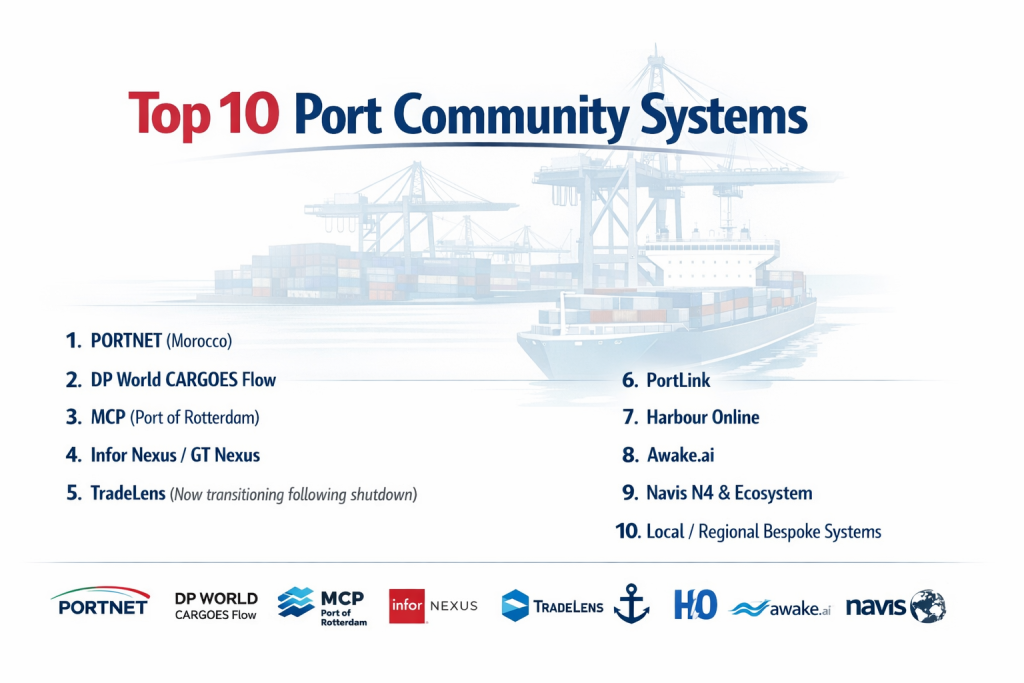
Top 10 Port Community Systems
The PCS landscape features specialized software vendors, large logistics IT providers, and bespoke solutions developed for specific port communities. Here is an analysis of ten significant platforms and models.
1 — PORTNET (Morocco)
PORTNET is often cited as a global benchmark for a successful, nationwide single window and PCS. Operated by a public-private partnership, it digitally integrates all Moroccan ports with trade and government entities, serving as a model for developing regions.
- Key Features:
- National Single Window: A single point of submission for all import/export/transit declarations to all government agencies.
- End-to-End Process Coverage: Manages the entire logistics chain from pre-arrival to post-clearance, including customs, health, and agricultural inspections.
- Integrated Payment Gateway: Handles collection of port dues, customs duties, and other fees electronically.
- Cargo & Vessel Tracking: Provides real-time visibility on shipment status and vessel movements across all Moroccan ports.
- Paperless Trade: Drives the dematerialization of over 200 trade documents.
- Stakeholder Portals: Tailored interfaces for shippers, carriers, forwarders, banks, and government agencies.
- Pros:
- Dramatically reduces cargo clearance times and administrative costs for businesses, boosting national competitiveness.
- High mandatory usage rates ensure critical mass and data richness, maximizing efficiency gains for the entire trade ecosystem.
- Cons:
- As a nationally mandated system, it offers less flexibility for individual ports to customize processes outside the national framework.
- Its success is heavily tied to strong government policy and enforcement, which can be difficult to replicate elsewhere.
- Security & Compliance: High-level security with role-based access, digital certificates, and full audit trails. Compliant with international trade data standards and national regulations.
- Support & Community: Extensive training programs and help desks for all user types. Strong governance body with representation from key public and private stakeholders.
2 — DP World CARGOES Flow
CARGOES Flow is a cloud-based, software-as-a-service (SaaS) PCS offered by global port and logistics giant DP World. It represents a modern, vendor-backed approach to port community digitization, designed for quick deployment and scalability.
- Key Features:
- Cloud-Native SaaS Platform: No on-premise hardware required; accessible globally via web browser with rapid implementation.
- Modular, Configurable Suite: Offers modules for vessel clearances, gate appointments, document management, and track & trace.
- Focus on Gate & Yard Efficiency: Advanced tools for managing truck appointments, container pick-up/drop-off, and reducing terminal turn times.
- DP World Ecosystem Integration: Can connect with other DP World digital logistics services across its global network.
- API-First Architecture: Built for easy integration with existing Terminal Operating Systems (TOS), ERP, and other third-party software.
- Data Analytics Dashboard: Provides insights into port performance, congestion points, and cargo flows.
- Pros:
- Reduces the traditional high cost and long timeline associated with bespoke PCS development and maintenance.
- Benefits from the operational expertise and global perspective of a major terminal operator.
- Cons:
- Some ports may perceive a potential conflict of interest in using a system provided by a competing terminal operator (DP World).
- While configurable, it may not capture the unique, deep intricacies of every local port process as well as a bespoke system.
- Security & Compliance: Hosted on secure, compliant cloud infrastructure (e.g., AWS). Features data encryption, SSO, and adherence to international data protection standards.
- Support & Community: Supported by DP World’s dedicated digital team. Onboarding and continuous support are part of the service model.
3 — MCP (Port of Rotterdam)
The Maasvlakte Container Terminal (MCP) system and the broader digital ecosystem of the Port of Rotterdam represent a world-leading, highly integrated “smart port” model. Its approach is characterized by deep collaboration and data sharing underpinned by a neutral platform.
- Key Features:
- Port Optimizer & Pronto: A shared platform where shipping lines and terminals exchange precise berthing plans and data, optimizing quay and resource planning.
- Container 42 & IoT Integration: Pioneering use of smart containers and IoT sensors to share real-time data on location, temperature, and shocks.
- Truck Appointment System: A widely used system to manage truck flows and reduce waiting times at all deep-sea terminals.
- Port Community System (Portbase): The underlying neutral data utility that facilitates secure data exchange between hundreds of companies.
- Digital Twin of the Port: An evolving virtual model of the entire port used for simulation, planning, and predictive analytics.
- Focus on Standards: Heavy investment in developing and adopting open data standards to ensure interoperability.
- Pros:
- Delivers tangible efficiency gains (like reduced waiting times) and sets the global standard for port collaboration and innovation.
- The neutral, community-governed model fosters high levels of trust and participation from all stakeholders.
- Cons:
- The ecosystem is complex and has evolved over decades; replicating it fully elsewhere requires massive investment and cultural change.
- Some cutting-edge components (like the full digital twin) are still in development and not all features are available as a standard product.
- Security & Compliance: State-of-the-art cybersecurity for critical infrastructure. Full compliance with EU regulations (GDPR, Customs Code). Operates under strict governance rules.
- Support & Community: Robust support through Portbase. Active innovation programs (PortXL, Rotterdam Port Fund) foster a strong community of tech startups and partners.
4 — GT Nexus (an Infor Company) / Infor Nexus
While not a traditional PCS, Infor Nexus is a leading cloud-based global supply chain and logistics platform. It functions as a multi-enterprise business network that can perform PCS-like functions by connecting all parties in a trade lane, including port stakeholders.
- Key Features:
- Multi-Enterprise Collaboration Platform: Connects shippers, carriers, forwarders, terminals, and customs on a single global network.
- End-to-End Shipment Visibility: Provides real-time tracking and milestone monitoring from purchase order to final delivery.
- Document Management & Compliance: Centralizes all shipping documents (BOL, certificates) and helps ensure regulatory compliance.
- Logistics Process Orchestration: Automates workflows and exception management across the supply chain.
- Advanced Analytics & Benchmarking: Leverages network data to provide insights on performance, costs, and carbon emissions.
- Strong Ocean Carrier Integration: Deep electronic connections with most major ocean shipping lines.
- Pros:
- Provides visibility and control that extends far beyond the port, covering the entire international supply chain.
- Powerful for large multinational shippers (BCOs) who need to manage complex global logistics across multiple trade lanes and ports.
- Cons:
- It is a private business network, not a neutral, port-wide public utility. Its adoption at a specific port is driven by its shipper/carrier users, not port mandate.
- May not replace the need for a local PCS to handle highly specific port authority or customs procedures.
- Security & Compliance: Enterprise-grade, multi-tenant cloud security. SOC 1, 2, and 3 certified. Compliant with global data privacy and security standards.
- Support & Community: Dedicated customer success management. Large, global user network of leading retailers and manufacturers.
5 — Tradelens (Now transitioning following shutdown announcement)
*Note: IBM and Maersk announced the wind-down of the Tradelens platform in late 2022. It is included here for historical context and because its model influenced the industry.* Tradelens was a blockchain-enabled global trade platform founded by Maersk and IBM, aiming to digitize and secure the global supply chain.
- Key Features:
- Blockchain-Based Data Sharing: Provided an immutable, shared record of shipment events, aiming to create a single source of truth.
- Permissioned Network: Participants controlled what data they shared and with whom.
- Document Digitization & Security: Focused on reducing fraud and errors with secure, digital documents like Bills of Lading.
- Global Network Ambition: Sought to connect carriers, ports, customs, and shippers worldwide on a single standard.
- Real-Time Event Publishing: Automated sharing of milestones like vessel departures, arrivals, and customs releases.
- Pros:
- Pioneered the application of blockchain to maritime logistics, highlighting the value of secure, transparent data sharing.
- Demonstrated strong potential for reducing documentary fraud and administrative delays.
- Cons:
- Ultimately struggled to achieve the critical mass of ecosystem participants needed to become self-sustaining.
- The business case for a fully global, carrier-led platform proved challenging against regional and port-specific PCS solutions.
- Platform is no longer operational.
- Security & Compliance: Was built on highly secure IBM cloud and blockchain technology, with a focus on data integrity and privacy.
6 — PortLink
PortLink is a comprehensive PCS provider with a strong presence in Asia and the Middle East. It offers a suite of integrated solutions covering port operations, logistics, and community services, often implemented as a government-backed national project.
- Key Features:
- Integrated Port & Logistics Suite: Modules for vessel traffic management, terminal operations, gate automation, and warehouse management.
- National Single Window Solutions: A core specialty, implementing digital trade facilitation platforms for governments.
- Community Portal & Messaging: A central platform for all port users to submit documents, track cargo, and communicate.
- Mobile Applications: Provides drivers and field agents with mobile tools for appointments, document submission, and status checks.
- Cargo & Equipment Tracking: Manages the movement and status of containers, bulk cargo, and port equipment.
- Billing & Invoicing: Automated generation and settlement of port dues and other charges.
- Pros:
- Offers a full-stack solution that can modernize both port operations and the wider community from a single vendor.
- Proven experience in delivering large-scale, transformative national trade digitization projects.
- Cons:
- As a full-suite provider, there is a risk of vendor lock-in for the port community.
- May be a heavier, more complex solution than a port community with modern existing systems needs.
- Security & Compliance: Implements robust security measures for critical national infrastructure. Complies with international standards like ISO 27001 and relevant customs data protocols.
- Support & Community: Provides full lifecycle support from implementation to training and ongoing maintenance. Establates user groups for its client communities.
7 — Harbour Online
Harbour Online is a PCS developed in collaboration with the Port of Antwerp-Bruges, one of Europe’s largest ports. It represents a modern, user-centric platform focused on simplifying and digitizing processes for port users, especially SMEs.
- Key Features:
- Declarations & Permits: Electronic submission of all required port calls, dangerous goods, and waste declarations.
- Resource Planning: Tools for booking pilots, tugboats, mooring men, and other port services.
- Unified Dashboard: A personalized overview for each user showing all their ongoing processes, tasks, and documents.
- Digital Document Wallet: Secure storage and management of all port-related certificates and documents.
- API Integration: Allows forwarders and agents to connect their own internal systems directly to the PCS.
- Multi-Port Functionality: Designed to be used across multiple ports within a region.
- Pros:
- Intuitive design lowers the barrier to digital adoption for smaller companies like freight forwarders and agents.
- Developed in close partnership with a major port, ensuring it solves real-world user problems effectively.
- Cons:
- Its feature set is closely aligned with European port processes; may require adaptation for other regions.
- Brand recognition is currently strongest in the Benelux and surrounding regions.
- Security & Compliance: High security standards with electronic identity (eID) login. Fully compliant with European and Belgian regulations, including GDPR.
- Support & Community: Supported by the Port of Antwerp-Bruges team and the software developer. Active user feedback channels and training sessions.
8 — Awake.ai
Awake.ai represents the next generation of “smart port” platforms. It is an AI and data-focused SaaS platform that connects to existing port systems (TOS, PCS) to optimize maritime logistics through predictive analytics and automation.
- Key Features:
- Predictive ETA Engine: Uses AI and massive datasets (AIS, weather, port congestion) to generate highly accurate ETAs for vessels.
- Just-In-Time Port Call Optimization: Helps coordinate vessel speed and port resource scheduling to reduce waiting times and emissions.
- API-First Data Integration Layer: Easily ingests and harmonizes data from disparate port systems to create a unified data lake.
- Stakeholder Collaboration Tools: Provides shared situational awareness and communication channels for port calls.
- Sustainability Analytics: Tracks and reports on CO2 emissions from shipping and port operations.
- Cloud-Native Microservices: Modular architecture allows ports to adopt specific capabilities (like ETA prediction) without full system replacement.
- Pros:
- Delivers immediate operational and environmental benefits (fuel savings, reduced congestion) by making port calls smarter.
- Complements and enhances existing PCS investments rather than seeking to replace them entirely.
- Cons:
- It is an optimization layer, not a full-service PCS for document management or customs processing.
- The value proposition requires a certain level of existing digital maturity and data availability from the port.
- Security & Compliance: Built on secure cloud infrastructure. Data processing agreements and security protocols align with industry best practices.
- Support & Community: Supported by the vendor’s product and data science teams. Engaging with a community of forward-thinking ports and startups.
9 — Cargotec Navis N4 & Ecosystem
While Navis N4 is a premier Terminal Operating System (TOS), its extensive ecosystem and integration capabilities make it a central pillar in many port communities. The Navis Ecosystem facilitates data exchange between the TOS and carriers, truckers, and other partners.
- Key Features:
- Industry-Standard TOS: N4 is the operational brain for container terminals worldwide, managing yard planning, equipment dispatch, and vessel operations.
- Carrier & Partner Integration: Via APIs and standard protocols, it shares real-time data on container location, gate moves, and vessel operations with shipping lines.
- XVELA Platform: A multi-enterprise collaboration platform (born from Navis and DECA) that facilitates berth collaboration and other shared processes between carriers and terminals.
- Truck Appointment Integration: N4 can integrate with or provide data to external PCS gate appointment systems.
- Advanced Terminal Analytics: Provides deep operational data that can be shared with port authorities for planning and optimization.
- Pros:
- For ports where the terminal is the dominant actor, a best-in-class TOS with strong integration is the de facto core of the digital community.
- Provides the granular, real-time operational data that is critical for higher-level PCS functions like track-and-trace.
- Cons:
- It is a terminal-centric system, not a neutral community platform. It does not inherently manage customs, broader port authority functions, or non-containerized cargo.
- A full port community requires systems beyond the TOS to integrate all stakeholders.
- Security & Compliance: Enterprise-grade security for critical operational technology. Compliance frameworks are tailored to terminal operator needs and customer contracts.
- Support & Community: Global 24/7 support from Kalmar (part of Cargotec). Large, active user community of terminal operators through events and user groups.
10 — Local/Regional Bespoke Systems (e.g., Port ICSS, Da Nang PCS)
Many ports, especially large ones with unique needs, operate on custom-developed, bespoke PCS platforms. Examples include Port of Singapore’s (PSA) own systems, or regionally developed systems like those in Vietnam (Da Nang). These are built by or for a specific port community.
- Key Features:
- Tailored to Local Needs: Perfectly mirrors the specific legal, operational, and business processes of that port or country.
- Deep Process Integration: Can achieve very deep automation of niche local procedures that off-the-shelf software might handle generically.
- Direct Stakeholder Control: The port authority or community owns the roadmap and development priorities.
- Often Evolved Over Decades: Represents institutional knowledge codified into software.
- Pros:
- Offers the best possible fit for the unique requirements of that specific port community.
- Can foster a strong sense of local ownership and control over a critical piece of digital infrastructure.
- Cons:
- Extremely high development and long-term maintenance costs. Can become technologically outdated if not continuously reinvested in.
- Risk of “vendor lock-in” with the specific development partner. Integration with global systems can be more challenging if built on proprietary standards.
- Security & Compliance: Varies widely depending on the resources and expertise of the developing port/authority. Can range from excellent to inadequate.
- Support & Community: Support is provided by the internal IT team or the specific systems integrator. Community is the local port user base.
Comparison Table
| Tool Name | Best For | Platform(s) Supported | Standout Feature | Rating |
|---|---|---|---|---|
| PORTNET | National governments seeking a transformative single window | Web, Enterprise Integrations | Nationwide mandatory single window driving high adoption & efficiency | N/A |
| DP World CARGOES Flow | Ports wanting a modern, cloud SaaS PCS from an operator | Cloud (Web), Mobile, API | Cloud-native, modular SaaS platform for faster deployment | N/A |
| Port of Rotterdam Ecosystem | Large ports aiming to be a collaborative “smart port” leader | Various (APIs, Web, IoT) | Holistic, data-driven collaboration model & digital twin vision | N/A |
| Infor Nexus | Global shippers & carriers needing multi-port supply chain visibility | Cloud (Web), API | Global multi-enterprise network for end-to-end supply chain visibility | N/A |
| PortLink | Governments/ports needing a full integrated port & community suite | Web, Mobile, On-Premise/Cloud | Comprehensive single-window and port operations suite | N/A |
| Harbour Online | European ports & their users (especially SMEs) seeking simplicity | Web, API | User-centric design developed with Port of Antwerp-Bruges | N/A |
| Awake.ai | Ports looking to add AI-powered optimization to existing systems | Cloud (API-first), Web | AI-driven predictive ETAs & just-in-time port call optimization | N/A |
| Navis Ecosystem | Container terminals as the anchor of their digital community | Various (On-prem/Cloud TOS, APIs) | Terminal operating system as the core data hub for container flows | N/A |
| Bespoke Systems | Ports with unique, complex processes and significant IT resources | Varies | Perfect, tailored fit for specific local port community needs | N/A |
Evaluation & Scoring of Port Community Systems
To compare these diverse solutions, use this weighted scoring rubric. Score each system from 1 (Poor) to 5 (Excellent), multiply by the weight, and sum for a total score out of 100.
| Evaluation Category | Weight | What to Look For (5 = Excellent) | System A Score | System B Score |
|---|---|---|---|---|
| Core Features | 25% | Breadth of modules (customs, bookings, visibility), process coverage, standardization. | ||
| Ease of Use & Adoption | 15% | UI intuitiveness for diverse users, onboarding support, mobile access, training. | ||
| Integrations & Ecosystem | 15% | API strength, pre-built connectors (TOS, carriers, customs), adoption of open standards. | ||
| Security & Compliance | 10% | Data protection, user authentication, audit logs, compliance with int’l trade/security regs. | ||
| Performance & Reliability | 10% | System uptime, scalability for peak volumes, speed of data processing. | ||
| Support & Community Governance | 10% | Quality of support, stakeholder management, governance model (neutral vs. vendor-led). | ||
| Price / Value | 15% | Total cost of ownership (license, implementation, support) vs. efficiency gains for community. | ||
| TOTAL SCORE | 100% | /100 | /100 |
Which Port Community System Is Right For You?
The choice is less about picking a software product and more about selecting a strategic model for digital community development.
- Port Size & Ambition: Local vs. National vs. Global Hub:
- Regional/Smaller Ports: Prioritize cost-effectiveness and simplicity. A cloud SaaS model (CARGOES Flow) or partnering with a neighboring large port’s system are smart choices. Avoid expensive bespoke builds.
- Major National Ports: Prioritize comprehensive functionality and local fit. A bespoke system or a configurable suite from a major vendor (PortLink) may be necessary. Strong governance is key.
- Global Hub Ports/National Governments: Prioritize innovation and ecosystem leadership. Investing in a collaborative smart port model (Rotterdam) or a mandatory national single window (PORTNET) can transform competitiveness.
- Governance Model: Neutral Utility vs. Vendor-Led:
- Neutral, Community-Owned: Best for fostering trust and widespread adoption among competing private companies. Requires strong governance (e.g., a Port Authority-led non-profit).
- Vendor-Led (SaaS): Faster to deploy and update, with clear accountability. Potential concerns about neutrality if the vendor is also a port competitor (like a terminal operator).
- Build vs. Buy vs. Partner:
- Build (Bespoke): Maximum control and fit, but high cost, risk, and long timeline. Only for ports with major resources.
- Buy (COTS/SaaS): Faster, often more feature-rich out-of-the-box, but may require adapting processes. Models like CARGOES Flow or PortLink.
- Partner/Replicate: Collaborating with a leading “smart port” (Rotterdam) to adopt their practices and platforms can be a powerful shortcut.
- Integration and Data Strategy:
- “System of Record” vs. “System of Innovation”: Your core PCS handles transactions. Consider an AI layer like Awake.ai to optimize using the data. Don’t expect one system to do everything.
- API-First is Non-Negotiable: Any modern PCS must expose data and services via robust APIs to connect with carriers’ systems, forwarders’ ERPs, and IoT devices.
- Security and Compliance Requirements:
- Critical National Infrastructure: Security must be paramount, with certified data centers and robust cyber-defense. This favors established vendors or heavily resourced bespoke projects.
- International Trade Compliance: The system must support evolving customs regulations (e.g., ICS2 in EU), electronic cargo manifests, and other mandatory data exchanges.
Frequently Asked Questions (FAQs)
1. What’s the difference between a PCS and a Terminal Operating System (TOS)?
A TOS manages the internal operations of a single terminal (yard planning, crane dispatch, stowage). A PCS facilitates information exchange between all external stakeholders (carriers, forwarders, truckers, customs) and the terminal(s). They are complementary: the TOS feeds real-time container data into the PCS.
2. How long does it take to implement a PCS?
A cloud SaaS solution can go live in 6-12 months for core modules. A comprehensive national single window or bespoke system can take 2-5 years for full rollout, involving legal changes, stakeholder training, and complex integrations.
3. How is a PCS funded?
Models vary: Transaction fees (per declaration, per container), Annual subscription fees for business users, Government funding as critical trade infrastructure, or a hybrid model. The key is that fees must be low enough to encourage universal adoption.
4. What is a “National Single Window”?
It is a PCS at the national level, allowing traders to submit all regulatory documents (for customs, health, agriculture, etc.) through a single electronic entry point. The system then distributes the data to all relevant government agencies. PORTNET is a prime example.
5. How do you ensure all stakeholders actually use the system?
Mandate is the most effective driver (e.g., government requiring e-declarations). Carrot-and-stick: Provide clear benefits (faster clearance, less waiting) while phasing out manual alternatives. Ease of use is critical for SMEs.
6. What happened to blockchain platforms like Tradelens?
They proved the technology’s value for trust and transparency but struggled with the business model and achieving universal scale against entrenched regional systems. The concept lives on in more focused applications (e.g., electronic Bills of Lading).
7. Can a PCS help with port congestion?
Absolutely. Truck Appointment Systems (a core PCS module) smooth truck arrivals. Vessel ETA sharing and berth collaboration tools optimize terminal resource planning. Real-time visibility helps all parties plan better, reducing unexpected delays.
8. What are the biggest barriers to PCS success?
Political and organizational challenges, not technical ones. These include: lack of trust/cooperation between competing companies, resistance to change from legacy processes, lack of strong governance, and insufficient funding for long-term maintenance.
9. Is a PCS only for container shipping?
No. Modern PCS handle bulk cargo (e.g., grain, coal), Ro-Ro (vehicles), and general cargo. The data and processes differ, but the principle of a shared information platform remains the same.
10. What’s the first step a port should take?
Conduct a comprehensive stakeholder analysis and needs assessment. Form a joint governance committee with representatives from port authority, terminals, shipping lines, forwarders, and truckers. Define the shared problems you are trying to solve before discussing software.
Conclusion
Choosing and implementing a Port Community System is a strategic endeavor that reshapes the very fabric of a port’s operations and competitiveness. The landscape offers multiple paths: the transformative national model of PORTNET, the cloud-based agility of CARGOES Flow, the collaborative “smart port” vision of Rotterdam, and the user-focused design of Harbour Online.
The critical insight is that the “best” system is the one that achieves critical mass and delivers tangible value to its entire community. Technology is an enabler, but success is determined by governance, stakeholder buy-in, and a relentless focus on solving real-world inefficiencies. A port must choose a model—be it a neutral utility, a vendor partnership, or a bespoke build—that aligns with its culture, resources, and ambition. In an era where supply chain resilience and visibility are paramount, a modern, effective PCS is no longer a luxury; it is the essential digital foundation for any port that aims to thrive in the future of global trade.

- Top 10 Email Deliverability Tools: Features, Pros, Cons & Comparison - September 6, 2026
- Top 10 Pharmacovigilance Software: Features, Pros, Cons & Comparison - September 6, 2026
- Top 10 Manufacturing Execution Systems (MES) - July 30, 2026