Introduction
In today’s globalized and volatile world, supply chains have become incredibly complex and vulnerable to disruption. A Supply Chain Control Tower Platform is a centralized, technology-enabled solution that provides end-to-end visibility, analytics, and proactive control over the entire supply chain ecosystem. Think of it as an air traffic control center, but for your logistics network. It aggregates real-time data from multiple internal and external sources—like ERP systems, warehouse management, transportation carriers, IoT sensors, and suppliers—to create a single, coherent picture of your operations from sourcing to delivery.
The importance of a control tower has never been greater. It transforms supply chain management from a reactive, siloed function into a proactive, intelligent, and collaborative capability. Key real-world use cases include monitoring shipments in real-time and predicting delays before they happen, automatically detecting and alerting teams to critical exceptions (like a missed port departure), simulating “what-if” scenarios to assess the impact of a natural disaster or demand surge, orchestrating optimal responses to disruptions by re-routing shipments or reallocating inventory, and providing performance dashboards that track key metrics like on-time-in-full (OTIF) delivery and carbon footprint across all partners. When evaluating these platforms, look for: data aggregation and harmonization capabilities, depth and configurability of analytics and AI/ML, quality of alerting and exception management, collaboration tools for partners, scalability and cloud architecture, and strength of pre-built integrations with common enterprise and logistics systems.
Best for: Supply Chain Control Tower Platforms deliver immense value for Supply Chain Directors, Chief Operating Officers, Logistics Managers, and Demand Planners in organizations with complex, multi-tier, and global supply chains. They are critical for large enterprises and fast-growing mid-market companies in manufacturing, retail, consumer packaged goods, life sciences, and high-tech electronics. Businesses that rely on just-in-time inventory or have experienced costly disruptions benefit the most.
Not ideal for: A full-scale control tower platform is typically overkill for very small businesses with simple, local, and stable supply chains involving only a few partners. For these organizations, the visibility features within a robust ERP or a standalone Transportation Management System (TMS) may be sufficient. Companies unwilling to invest in the necessary data connectivity or process change management will also not realize the platform’s full value.
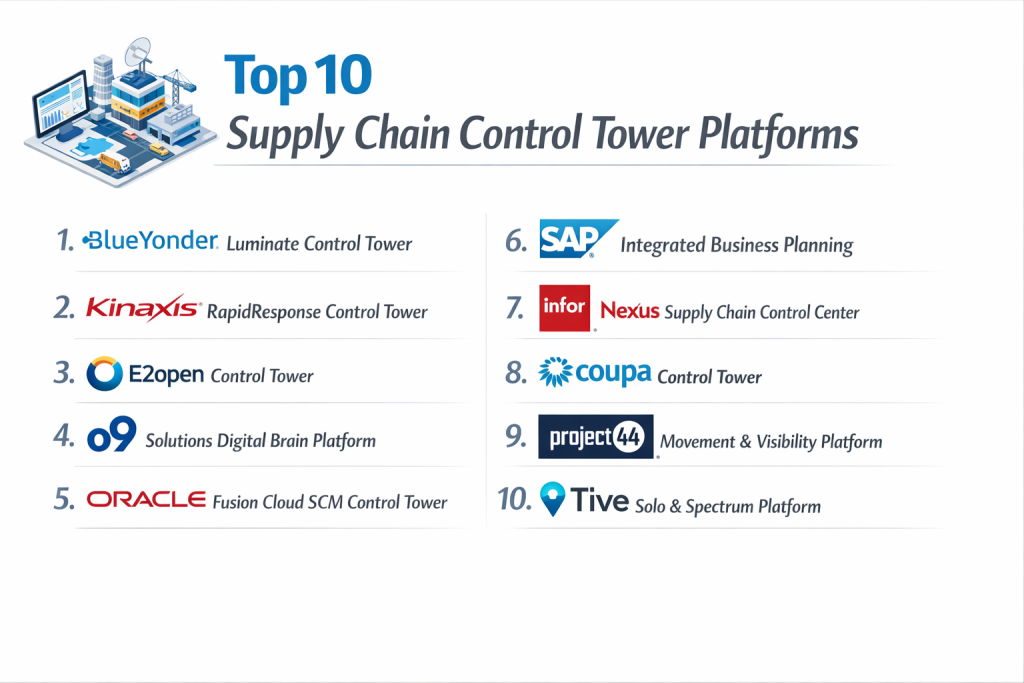
Top 10 Supply Chain Control Tower Platforms
The control tower market includes specialized best-of-breed vendors and expansive suites from large enterprise software providers. Here is a detailed analysis of ten leading platforms.
1 — Blue Yonder (formerly JDA) Luminate Control Tower
Blue Yonder’s Luminate Control Tower is a core component of its extensive supply chain execution suite. It’s an AI and ML-powered platform designed for large, complex enterprises seeking to move beyond visibility to autonomous, prescriptive decision-making.
- Key Features:
- Autonomous Supply Chain: Uses machine learning to not only predict disruptions but also recommend and, with approval, execute automated corrective actions.
- Deep Blue Yonder Ecosystem Integration: Native, seamless connectivity with Blue Yonder’s TMS, WMS, and planning solutions for a closed-loop system.
- Multi-Enterprise Collaboration: Connects and orchestrates actions across a network of suppliers, carriers, and customers.
- Digital Twin Capability: Can create a living, digital simulation of the physical supply chain for scenario modeling.
- Contextual Intelligence: Correlates supply chain events with external data (weather, news, social sentiment) to understand root causes.
- Role-Based dashboards: Highly customizable views and alerts for planners, logistics managers, and executives.
- Pros:
- Industry-leading AI/ML capabilities that enable a shift from descriptive analytics to prescriptive and autonomous action.
- Unmatched depth for companies committed to the full Blue Yonder ecosystem for end-to-end supply chain management.
- Cons:
- Can be extremely complex and costly to implement, requiring significant internal expertise or consultancy.
- The full value is best realized within the Blue Yonder ecosystem; integrating with a heterogeneous best-of-breed tech stack can be challenging.
- Security & Compliance: Enterprise-grade security with role-based access, data encryption, and comprehensive audit logs. SOC 1, 2, and 3 reports available. Compliant with global data privacy regulations.
- Support & Community: Tiered support plans, including premium 24/7 options. Extensive knowledge base, Blue Yonder University for training, and a large, active user community with annual conferences.
2 — Kinaxis RapidResponse Control Tower
Kinaxis RapidResponse is unique for its concurrent planning capability, and its Control Tower is built on this same engine. It’s designed for demand-driven companies that need to sense, analyze, and respond to changes across their supply chain in a single, unified environment.
- Key Features:
- Concurrent Planning Engine: Allows planners in sales, operations, and logistics to collaborate on a single, always-current version of the truth and see the impact of changes in real-time.
- Sense and Respond: Monitors performance against plan and external triggers, instantly calculating the ripple effect of any deviation.
- “What-If” Scenario Analysis: Enables rapid modeling of countless scenarios (e.g., supplier failure, demand spike) to evaluate trade-offs and choose the best response.
- Multi-Tier Visibility: Extends visibility and collaboration beyond tier-one suppliers and customers.
- Strong Performance Management: Robust KPI tracking and benchmarking capabilities.
- No-Black-Box AI: Provides explainable AI insights, showing the “why” behind recommendations.
- Pros:
- The concurrent planning model breaks down organizational silos, enabling unprecedented cross-functional agility and alignment.
- Powerful scenario modeling tools that are deeply integrated with core planning data, not bolted on as an afterthought.
- Cons:
- The concurrent planning paradigm represents a significant shift in business processes, requiring strong change management.
- Like other enterprise platforms, it is a substantial investment best suited for mid-to-large sized companies.
- Security & Compliance: Kinaxis is a public company with stringent security protocols. Features include SSO, data encryption, and compliance with ISO 27001, SOC 2, and GDPR.
- Support & Community: Offers dedicated customer success managers and 24/7 support. Kinaxis has a passionate user community and hosts annual user events.
3 — E2open Control Tower
E2open offers a unified network-based platform that connects supply chain planning with execution through its control tower. It is particularly strong in global trade and logistics orchestration, serving large, network-centric enterprises.
- Key Features:
- Network-Based Architecture: All partners (suppliers, manufacturers, logistics providers, customers) are connected on a single, multi-tenant network, facilitating natural data exchange and collaboration.
- Global Trade Management Integration: Deep, native integration with E2open’s trade compliance and logistics solutions provides unique visibility into customs, duties, and cross-border complexities.
- Logistics & Transportation Orchestration: Strong capabilities to monitor and optimize global shipments across all modes (ocean, air, truck, rail).
- Demand-Sensing: Uses downstream data (point-of-sale, syndicated data) to improve forecast accuracy and detect demand shifts early.
- Application Suite: The control tower is part of a broad suite covering planning, logistics, channel, and global trade.
- Pros:
- The network effect provides inherent value as more trading partners join, improving data liquidity and collaboration.
- Exceptional for managing the complexities of international supply chains, including trade compliance and multi-modal logistics.
- Cons:
- The breadth of the suite can be overwhelming for a company seeking only a focused control tower solution.
- Implementation can be extensive due to the network-based model and wide scope.
- Security & Compliance: Provides enterprise-grade security on its network platform. Compliant with major standards including SOC 1, SOC 2, ISO 27001, and GDPR.
- Support & Community: Global support organization. E2open hosts user conferences and facilitates special interest groups for its large network of clients.
4 — o9 Solutions Digital Brain Platform
The o9 Digital Brain Platform is an AI-powered platform that combines supply chain control tower functionality with integrated business planning. It is known for its intuitive, user-friendly interface and rapid configuration using a “platform-as-a-service” model.
- Key Features:
- Knowledge Graph Foundation: Built on a graph-based model that intuitively connects all supply chain entities, relationships, and data, making it highly flexible.
- Integrated Business Planning: Unifies financial, commercial, and supply chain planning within the same environment as execution control.
- Consumer-Grade UI: Features a modern, intuitive, and highly visual interface that promotes adoption across business users.
- Rapid Configuration & Scalability: The platform’s meta-data driven architecture allows for faster implementation and easier model changes than traditional code-heavy platforms.
- Advanced Scenario Planning: Enables collaborative, drag-and-drop modeling of complex scenarios.
- AI/ML-Driven Insights: Provides predictive and prescriptive analytics layered on top of the unified data model.
- Pros:
- The modern UI and rapid configuration capabilities significantly reduce time-to-value and improve user adoption rates.
- Strong integration of planning and execution in one platform breaks down traditional functional barriers.
- Cons:
- As a younger company compared to some legacy giants, it may have a less extensive track record of multi-decade implementations in the largest global enterprises.
- The platform’s flexibility requires thoughtful design to avoid over-complexity.
- Security & Compliance: o9 employs robust cloud security measures and is compliant with standards such as SOC 2 and ISO 27001. GDPR-ready.
- Support & Community: Provides implementation services and ongoing customer success support. Building a growing user community through events and forums.
5 — Oracle Fusion Cloud SCM Control Tower
Oracle Control Tower is the visibility and orchestration layer within the comprehensive Oracle Fusion Cloud Supply Chain & Manufacturing (SCM) suite. It is the natural choice for enterprises heavily invested in the Oracle ecosystem.
- Key Features:
- Native Oracle Fusion Cloud Integration: Pre-built, seamless connectivity with Oracle Fusion Cloud applications for Inventory, Manufacturing, Logistics, and Procurement.
- End-to-End Process Monitoring: Monitors key order-to-cash and procure-to-pay processes across the Oracle suite.
- Intelligent Performance Management: Tracks KPIs, identifies anomalies, and provides root-cause analysis.
- Oracle Integration Cloud: Leverages a powerful middleware platform to connect to non-Oracle systems and external data sources.
- Built on Oracle Cloud Infrastructure (OCI): Benefits from the security, performance, and global scale of OCI.
- Adaptive Intelligent Apps: Incorporates Oracle’s AI services for predictive insights.
- Pros:
- For companies running Oracle Fusion Cloud SCM, it offers the fastest, most integrated path to a control tower with minimal integration overhead.
- Backed by the full strength, security, and global support of Oracle.
- Cons:
- Its primary design center is for unifying Oracle applications; companies with a highly heterogeneous application landscape may find it less optimized.
- Can be part of a large, complex Oracle Cloud implementation.
- Security & Compliance: Enterprise-grade security inherent to Oracle Cloud. Complies with a vast array of global standards including SOC 1/2, ISO, GDPR, and HIPAA.
- Support & Community: Access to Oracle’s massive global support organization, extensive documentation, and user communities (Oracle Customer Connect).
6 — SAP Integrated Business Planning (IBP) with Supply Chain Control Tower
SAP’s control tower is a core component of its SAP Integrated Business Planning (IBP) solution, which itself is part of the intelligent suite built on SAP Business Technology Platform (BTP). It is the strategic choice for the global SAP-centric enterprise.
- Key Features:
- Deep SAP S/4HANA Integration: Provides native, real-time visibility into processes running on SAP’s core ERP, offering unparalleled insight into financial and material flows.
- Embedded in SAP IBP: Control tower alerts and insights are directly linked to the planning environment, enabling closed-loop planning and execution.
- SAP Business Network Integration: Can connect and pull data from the SAP Business Network (for logistics, asset intelligence, etc.).
- Built on SAP BTP: Leverages the platform’s analytics, AI (SAP AI Core), and integration services.
- Focus on Responsive Supply Chains: Designed to sense deviations from the IBP plan and trigger orchestrated responses.
- Pros:
- For companies with SAP S/4HANA at their core, it provides the deepest possible operational and financial supply chain insight with minimal data latency.
- Tight integration with SAP IBP creates a powerful planning-execution feedback loop.
- Cons:
- The value proposition is strongest in a predominantly SAP environment; integrating with non-SAP best-of-breed systems requires more effort.
- Part of a broad and complex SAP landscape that requires specialized skills to implement and maintain.
- Security & Compliance: Leverages SAP’s enterprise-grade cloud security and compliance, which meets rigorous global standards for data protection and privacy.
- Support & Community: Supported by SAP’s extensive global services network and partner ecosystem. Huge, active user community through SAP User Groups and events.
7 — Infor Nexus Supply Chain Control Center
Infor Nexus (formerly GT Nexus) is a cloud-based multi-enterprise business network with a strong control tower. It excels at providing visibility and orchestration across global, multi-tier supply chains, especially for asset-light companies like retailers and brands.
- Key Features:
- Multi-Enterprise Business Network: Pre-connected network of carriers, suppliers, and logistics providers, reducing the time and cost to achieve visibility.
- Global Order & Shipment Management: Tracks purchase orders and shipments from origin to final destination, providing milestone-based visibility.
- Logistics Process Orchestration: Automates workflows and document exchange between buyers, suppliers, and logistics partners.
- Inventory & In-Transit Visibility: Provides a unified view of inventory across warehouses and in transit globally.
- Strong Ocean & International Focus: Deep integration with ocean carriers and capabilities for managing international trade complexities.
- Network Analytics: Benchmarking and performance analytics derived from the aggregated data of all network participants.
- Pros:
- The network model accelerates time-to-value, as key partners may already be connected or are easier to onboard.
- Exceptional for managing complex global sourcing and logistics networks with a focus on order and shipment execution.
- Cons:
- Less focused on deep integration with internal manufacturing or production planning processes compared to some ERP-embedded towers.
- The network’s value is tied to the participation of your specific trading partners.
- Security & Compliance: Enterprise-grade, multi-tenant cloud security. SOC 1, 2, and 3 certified. Compliant with global data privacy standards.
- Support & Community: Dedicated customer success management. Benefits from being part of a large, established network with a community of users.
8 — Coupa Control Tower
Coupa Control Tower is part of the Coupa Business Spend Management (BSM) platform. It provides visibility that is intrinsically linked to spend, procurement, and working capital, making it ideal for CFOs and Chief Procurement Officers seeking supply chain resilience.
- Key Features:
- Spend-Centric Visibility: Correlates supply chain events (delays, disruptions) directly with financial impact (POs, invoices, payments).
- Unified with Procurement Processes: Insights are tied directly to the requisition, sourcing, and contract management lifecycle within Coupa.
- Supplier Risk & Performance Monitoring: Aggregates data from various sources to provide a holistic view of supplier health, risk, and performance.
- Working Capital Insights: Highlights opportunities to optimize cash flow through dynamic discounting or improved payment terms linked to supply chain performance.
- Community Intelligence: Leverages anonymized data from the vast Coupa community to benchmark supplier performance and pricing.
- Pros:
- Uniquely bridges the gap between supply chain operations and financial performance, speaking directly to the office of the CFO.
- Powerful for organizations where procurement is a key driver of supply chain strategy and risk management.
- Cons:
- Its core strength is in the upstream supply chain (suppliers, procurement); it may have less depth in downstream logistics and transportation orchestration.
- Most valuable when used as part of the broader Coupa BSM suite.
- Security & Compliance: Coupa is a publicly traded company with a strong security posture. SOC 1 and 2 certified, ISO 27001 compliant, and adheres to GDPR.
- Support & Community: Comprehensive support and a large, active community of procurement and supply chain professionals.
9 — project44 Movement & Visibility Platform
project44 is a best-of-breed visibility platform that has evolved into a robust control tower. It is the leader in real-time transportation visibility, built on the deepest direct API integrations with carriers (truckload, LTL, ocean, air, rail) globally.
- Key Features:
- Carrier-Native Integrations: Connects via APIs directly to carrier telematics and operational systems, providing highly accurate, real-time location and status data (not just scanned milestones).
- Advanced Transportation Visibility: The gold standard for tracking over-the-road, ocean, and rail shipments with predictive ETAs.
- Freight Intelligence Market: A unique capability that provides benchmark data on lane performance, rates, and carrier reliability.
- Supply Chain Health Modules: Offers specific applications for high-tech, retail, manufacturing, and life sciences industries.
- Collaborative Workspaces: Allows shippers, carriers, and customers to collaborate on exceptions within the platform.
- Open API Architecture: Designed to feed high-fidelity data into any other system (ERP, TMS, WMS, control towers).
- Pros:
- Provides the most accurate and granular real-time visibility data in the market, especially for transportation.
- The platform-agnostic model allows it to be the preferred visibility engine for companies regardless of their core ERP or planning system.
- Cons:
- Primarily focused on the transportation/logistics leg; may have less native functionality for deep supplier collaboration or production monitoring.
- As a visibility-focused tool, advanced orchestration and autonomous response features are evolving but may not match the depth of broader suites.
- Security & Compliance: Enterprise-grade security. SOC 2 Type II certified, ISO 27001 compliant, and adheres to data privacy regulations like GDPR and CCPA.
- Support & Community: Industry-recognized support. A large network of connected carriers and shippers creates a de facto community.
10 — Tive Solo & Spectrum Platform
Tive offers a unique hardware-software combined solution. Its control tower capability is built around data from its global network of IoT sensors (trackers) placed on individual shipments, providing unparalleled condition and location visibility for high-value or sensitive goods.
- Key Features:
- IoT Sensor-Driven Data: Collects real-time data on location, temperature, humidity, light exposure, shock, and tilt directly from the cargo itself.
- Condition Monitoring: Critical for industries like pharmaceuticals (cold chain), high-tech, aerospace, and food & beverage where environmental conditions are as important as timeliness.
- Global Cellular Connectivity: Tive trackers work virtually anywhere in the world, providing visibility even in transit “black holes.”
- Alerting & Notifications: Configurable alerts for geo-fence breaches, temperature excursions, and delays.
- Cloud-Based Analytics Platform: The Tive Spectrum platform visualizes sensor data, provides analytics, and manages the tracker fleet.
- Standalone or Integrated: Can be used as a standalone visibility solution or its data can be fed into a larger control tower platform via API.
- Pros:
- Delivers a level of shipment condition and location granularity that purely software-based platforms cannot match.
- Solves critical visibility problems for niche, high-stakes supply chains where product integrity is paramount.
- Cons:
- Requires managing physical hardware (trackers), including deployment, retrieval, and charging.
- The per-sensor cost model can become expensive for tracking all shipments; typically used for high-value, high-risk, or spot shipments.
- Security & Compliance: Data is encrypted in transit and at rest. The platform is designed with security best practices. Specific compliance (e.g., for pharmaceutical data) can be addressed.
- Support & Community: Provides customer support for both hardware and software. A focused community of users in logistics-sensitive industries.
Comparison Table
| Tool Name | Best For | Platform(s) Supported | Standout Feature | Rating |
|---|---|---|---|---|
| Blue Yonder Luminate Control Tower | Large enterprises seeking AI-driven autonomous supply chains | Web, Cloud | Autonomous, prescriptive decision-making with deep ecosystem integration | N/A |
| Kinaxis RapidResponse Control Tower | Demand-driven companies needing concurrent planning & response | Web, Cloud | Real-time concurrent planning engine for cross-functional agility | N/A |
| E2open Control Tower | Global, network-centric enterprises focused on trade & logistics | Web, Cloud (Network) | Multi-enterprise network architecture & strong global trade integration | N/A |
| o9 Solutions Digital Brain | Companies wanting a modern, user-friendly platform for planning & control | Web, Cloud (PaaS) | Intuitive UI & rapid configuration on a knowledge-graph foundation | N/A |
| Oracle Control Tower | Enterprises heavily invested in the Oracle Fusion Cloud SCM suite | Oracle Cloud | Native, seamless integration with Oracle Fusion Cloud SCM applications | N/A |
| SAP IBP with Control Tower | Global enterprises running core processes on SAP S/4HANA | SAP BTP, Cloud | Deep integration with SAP S/4HANA for operational-financial insight | N/A |
| Infor Nexus Control Center | Asset-light companies (retail, brands) managing global multi-tier networks | Web, Cloud (Network) | Pre-connected multi-enterprise business network for faster onboarding | N/A |
| Coupa Control Tower | Organizations where procurement & spend visibility is the primary driver | Web, Cloud | Financial-correlated visibility integrated with Business Spend Management | N/A |
| project44 Movement Platform | Any company requiring best-in-class, real-time transportation visibility | Web, Cloud, API | Carrier-native API integrations for the most accurate logistics tracking | N/A |
| Tive Spectrum Platform | High-value, condition-sensitive supply chains (pharma, high-tech) | Web, Cloud, IoT | IoT sensor-driven condition monitoring (temp, shock, location) | N/A |
Evaluation & Scoring of Supply Chain Control Tower Platforms
Use this weighted scoring rubric to objectively compare platforms. Score each from 1 (Poor) to 5 (Excellent), multiply by the weight, and sum for a total score out of 100.
| Evaluation Category | Weight | What to Look For (5 = Excellent) | Tool A Score | Tool B Score |
|---|---|---|---|---|
| Core Features | 25% | Depth of visibility, AI/ML, alerting, scenario modeling, collaboration tools. | ||
| Ease of Use | 15% | UI intuitiveness, dashboard customization, ease of configuration, mobile access. | ||
| Integrations & Ecosystem | 15% | Pre-built connectors to your ERP, TMS, WMS, carrier networks, and data quality. | ||
| Security & Compliance | 10% | Data encryption, access controls, auditability, relevant certifications (SOC 2, ISO). | ||
| Performance & Reliability | 10% | Platform uptime, data refresh rates, scalability, speed of analytics/insights. | ||
| Support & Community | 10% | Implementation help, training, 24/7 support quality, active user community. | ||
| Price / Value | 15% | Total cost (license, implementation, services) vs. ROI in resilience, efficiency, cost savings. | ||
| TOTAL SCORE | 100% | /100 | /100 |
Which Supply Chain Control Tower Tool Is Right For You?
Your choice depends on your starting point, primary pain points, and strategic ambitions.
- Company Size & Maturity: SMB vs. Mid-Market vs. Enterprise:
- SMB / Growing Mid-Market: Prioritize speed, ease, and affordability. Start with a focused platform (project44 for transport, Tive for conditions) or a modern cloud suite (o9) that offers quicker deployment. Avoid massive, multi-year ERP-embedded projects.
- Large Enterprise: Prioritize scale, depth, and strategic alignment. Your choice is often dictated by your core ERP backbone (SAP or Oracle) or a need for best-in-class network (E2open, Infor Nexus) or AI (Blue Yonder) capabilities.
- Strategic Starting Point: Visibility vs. Planning vs. Execution:
- “We Can’t See Our Shipments”: Start with a visibility specialist (project44, Tive) to solve the acute data gap, then layer on orchestration.
- “Our Plans Are Always Wrong”: Choose a platform with strong planning integration (Kinaxis, o9, SAP IBP) to close the loop between plan and reality.
- “We Need to Automate Responses”: Look for platforms with strong AI/ML and autonomous action capabilities (Blue Yonder).
- Integration and Ecosystem Needs:
- SAP or Oracle Shop? Your most logical and efficient path is very likely the control tower from your core ERP provider (SAP or Oracle) to minimize integration debt.
- Best-of-Breed Landscape? You need a platform-agnostic, API-first solution (project44, o9, E2open) that can act as the central nervous system for your diverse applications.
- Primary Industry & Pain Point:
- Global Manufacturing/Retail: Focus on multi-tier network visibility and global logistics (E2open, Infor Nexus).
- Life Sciences/High-Tech: Prioritize condition monitoring and granular tracking (Tive) integrated with a broader platform.
- CPG/Retail with Volatile Demand: Prioritize demand sensing and responsive planning (Kinaxis, o9).
- Security and Compliance Requirements:
- Highly Regulated (Pharma, Food): Ensure the platform supports detailed audit trails, data integrity, and can meet specific standards (e.g., FDA CFR Part 11 guidance). Tive for cold chain, plus a robust control tower.
- General Corporate: Standard SOC 2 and ISO 27001 certifications from major cloud vendors are typically sufficient.
Frequently Asked Questions (FAQs)
1. What’s the typical implementation timeline and cost?
For a large enterprise suite (Blue Yonder, SAP, Oracle), expect 12-24 months and multi-million dollar costs for software, services, and change management. A focused cloud platform (o9, project44) or a network solution (Infor Nexus) can deliver initial value in 3-9 months at a lower cost, often based on subscription fees.
2. How is a Control Tower different from a TMS or ERP visibility module?
A TMS optimizes transportation execution (rates, routes). An ERP manages internal transactions. A Control Tower sits above both, aggregating data from TMS, ERP, and countless other sources to provide cross-functional visibility, intelligence, and orchestration that single-point solutions cannot.
3. Can we build our own control tower in-house?
Technically yes, but it’s generally not advised. The challenge isn’t the dashboard; it’s the continuous integration and maintenance of dozens of data sources, applying AI/ML, and keeping up with carrier API changes. The total cost of ownership and time-to-value usually favor a dedicated platform.
4. How do these platforms handle data from partners who use outdated systems (like EDI, email, fax)?
Modern platforms use a combination of translator services for EDI, OCR for documents, and even partner portals for manual entry to bring unstructured data into the system. The goal is to harmonize all data, but legacy partner processes remain a common challenge.
5. What is the ROI of a control tower?
ROI manifests in: Hard Savings (inventory reduction, lower expedited freight, labor efficiency), Risk Mitigation (avoided stock-outs, reduced write-offs), and Revenue Protection (higher OTIF, improved customer satisfaction). A 5-15% reduction in logistics costs and a 10-30% reduction in inventory are common targets.
6. Do we need to replace our existing systems (ERP, WMS, TMS) to implement a control tower?
No, a core purpose of a control tower is to complement and enhance existing systems. It acts as an overlay, pulling data from them via integrations. You may only replace systems if your current ones are fundamentally inadequate.
7. How important are AI and machine learning capabilities?
For basic visibility, they are nice-to-have. For a proactive, predictive, and ultimately autonomous supply chain, they are essential. AI/ML is what turns a “rearview mirror” dashboard into a system that predicts delays, prescribes optimal actions, and automates routine decisions.
8. What’s the biggest mistake companies make during implementation?
Treating it as a mere IT/technology project instead of a business transformation initiative. Success requires process redesign, role changes, and strong leadership from supply chain and operations, not just the IT department.
9. Can a control tower help with sustainability goals?
Absolutely. By optimizing routes, consolidating shipments, reducing expedited air freight, and enabling modal shifts, it directly cuts carbon emissions. Advanced platforms can track and report the carbon footprint of shipments and network decisions.
10. How do we ensure data quality and accuracy?
This is a continuous process. Start by integrating with the most reliable source systems (e.g., carrier APIs over manual status updates). Implement data validation rules and anomaly detection. The platform should help identify and highlight data gaps or inconsistencies for ongoing cleanup.
Conclusion
Selecting the right Supply Chain Control Tower Platform is a pivotal decision that can define an organization’s agility and resilience for years to come. The market offers powerful options for every need: the AI-powered autonomy of Blue Yonder, the concurrent planning agility of Kinaxis, the network-based connectivity of E2open and Infor Nexus, the ERP-deep integration of SAP and Oracle, and the best-in-class visibility of project44 and Tive.
The crucial insight is that the “best” platform is the one that aligns with your company’s unique digital spine, strategic priorities, and operational pain points. A perfect solution for a global manufacturer would overwhelm a mid-sized retailer, and vice-versa. Success lies in clearly defining the problems you need to solve (visibility, response, planning), honestly assessing your integration landscape, and choosing a platform whose architecture and roadmap support your journey from basic visibility to intelligent, and eventually autonomous, supply chain operations. In an era defined by disruption, a control tower is not just a tool; it is the essential command center for building a supply chain that is not only efficient but truly resilient.

- Top 10 Email Deliverability Tools: Features, Pros, Cons & Comparison - September 6, 2026
- Top 10 Pharmacovigilance Software: Features, Pros, Cons & Comparison - September 6, 2026
- Top 10 Manufacturing Execution Systems (MES) - July 30, 2026