Introduction
A Freelance Management System (FMS) is a comprehensive cloud-based platform designed to manage the end-to-end lifecycle of an organization’s independent workforce. Unlike traditional HRIS (Human Resource Information Systems) that are built for W-2 employees, an FMS focuses specifically on the unique needs of the “non-employee” worker. This includes everything from initial onboarding and background checks to project assignment, legal compliance (like 1099 or W-8BEN forms), and automated global payments.
The importance of these systems lies in their ability to mitigate risk and increase operational speed. Without a centralized system, companies often fall into the trap of “rogue spending,” where different departments hire freelancers without proper contracts or tax documentation, leading to severe IRS misclassification audits. Key real-world use cases include marketing agencies scaling up for seasonal campaigns, tech companies hiring specialized developers for sprint-based work, and media houses managing vast networks of contributing writers.
When evaluating an FMS, users should look for compliance automation, ease of integration with existing accounting software, global payment flexibility, and robust reporting that tracks total contingent labor spend.
Best for: Mid-market companies and large enterprises that spend significantly on external talent, as well as high-growth startups and creative agencies that need to scale their headcount up and down rapidly without increasing administrative overhead.
Not ideal for: Very small businesses that only work with one or two local freelancers, or companies where the “freelance” work is strictly low-volume and handled entirely through a single marketplace platform like Upwork or Fiverr.
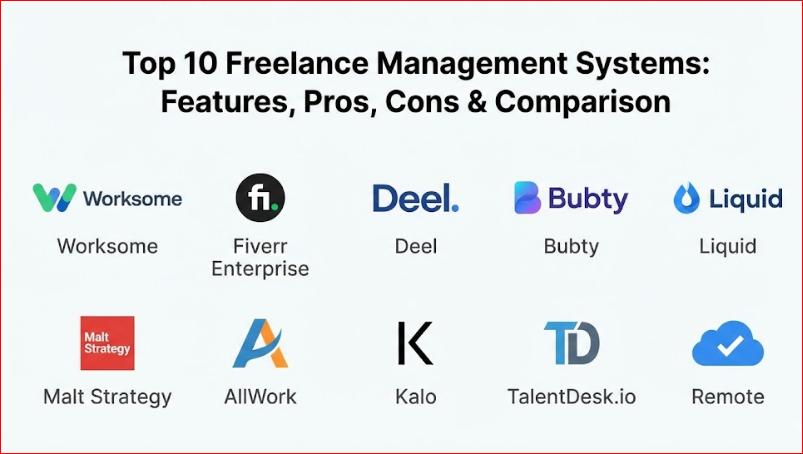
Top 10 Freelance Management Systems Tools
1 — Worksome
Worksome is a high-end FMS that prioritizes the elimination of administrative friction. It is designed for companies that want to move away from disparate spreadsheets and manual bank transfers toward a fully automated, compliance-first workflow.
- Automated Compliance Engine: Automatically classifies workers based on local laws to prevent misclassification risks.
- Global Payment Consolidation: Allows companies to pay all their freelancers via a single invoice, regardless of their location.
- Talent Pool Management: Build and categorize private clouds of “vetted” freelancers for recurring projects.
- Integrated Contract Management: Generates and stores legally binding contracts tailored to specific jurisdictions.
- API First Architecture: Easily connects with ERPs like NetSuite or HRIS platforms like Workday.
- Real-time Spend Analytics: Dashboards that provide a granular look at where every dollar of the freelance budget is going.
Pros:
- Drastically reduces the time spent on “paperwork” by centralizing all contractor data in one place.
- The “Single Invoice” feature is a massive benefit for accounts payable departments.
Cons:
- The setup process can be intensive for companies with very complex existing internal processes.
- Higher price point makes it less accessible for very small teams.
Security & compliance: SOC 2 Type II, GDPR compliant, SSO, and advanced encryption protocols.
Support & community: Offers dedicated account managers for enterprise clients, a comprehensive help center, and regular webinars on the future of contingent labor.
2 — Fiverr Enterprise (formerly Stoke Talent)
Following its acquisition, Fiverr Enterprise has evolved into a powerhouse for sourcing and managing high-end talent. It focuses on giving companies a “central command center” to manage both freelancers they found on Fiverr and those they sourced elsewhere.
- Frictionless Sourcing: Integrated access to a global marketplace of pre-vetted professionals.
- Tax & Compliance Guardrails: Automated collection of tax forms (W-9, W-8BEN) and automated 1099 filing.
- Budget Tracking: Set caps on specific projects or departments to prevent overspending on freelance labor.
- Workforce Visibility: A bird’s-eye view of who is working on what, ensuring no overlap or wasted resources.
- Legal Shield: Provides indemnification against worker misclassification in many jurisdictions.
Pros:
- Excellent user interface that feels modern and intuitive for both managers and freelancers.
- Strong focus on the legal “safety” of the hiring company.
Cons:
- Deepest integration is with the Fiverr ecosystem, which might not suit companies with highly specific offline sourcing needs.
- Reporting features can feel a bit light for very large, data-heavy enterprises.
Security & compliance: ISO 27001, GDPR, and SOC 2 compliance.
Support & community: Responsive live chat support, a robust resource library, and specialized onboarding for mid-market teams.
3 — Deel
While widely known for its “Employer of Record” (EOR) services, Deel’s contractor management module is world-class. It is particularly suited for companies that are aggressively hiring freelancers on a global scale and need a platform that “just works” in over 150 countries.
- Localized Contracts: Contracts are reviewed by local legal experts in every country Deel operates in.
- Deel Card: Allows freelancers to receive payments and spend them directly via a Deel-branded debit card.
- Withdrawal Flexibility: Freelancers can withdraw funds in crypto, local bank transfer, or via Wise and Revolut.
- Automated Invoicing: Generates professional, compliant invoices for every payment made through the system.
- HRIS Integration: Syncs seamlessly with platforms like BambooHR and Hibob.
Pros:
- Unrivaled global footprint; if you can hire there, Deel likely has a compliant contract for it.
- The freelancer experience is exceptional, which helps companies retain top-tier talent.
Cons:
- Can be more expensive than “management-only” tools if you opt for full compliance coverage.
- The platform moves so fast with new features that the UI can occasionally feel a bit cluttered.
Security & compliance: SOC 2, GDPR, HIPAA (where applicable), and ISO 27001.
Support & community: 24/7 global support, a massive community of remote workers, and deep-dive country guides.
4 — Bubty
Bubty takes a “white-label” approach to freelance management. It is designed for companies that want to build their own internal talent ecosystem under their own brand, rather than relying on a third-party marketplace.
- White-Label Portal: Freelancers log into a portal that looks and feels like your company’s internal system.
- Private Talent Pools: Organize your proven freelancers into “squads” based on skills or previous performance.
- Automated Onboarding: Customizable workflows that ensure every freelancer completes required training and signs NDAs.
- Global Payroll: Supports payments in over 100 currencies with automated currency conversion.
- Skill Matching: AI-driven tools that suggest the best freelancer in your pool for a specific job description.
Pros:
- Perfect for building a “closed-loop” ecosystem of trusted partners.
- Gives the company complete ownership over the freelancer relationship without a middleman.
Cons:
- Requires a proactive approach to building a talent pool; it’s not a “sourcing” tool.
- Smaller integration library compared to some of the larger, older players in the space.
Security & compliance: GDPR compliant, SSO, and secure data encryption at rest and in transit.
Support & community: High-touch onboarding and a dedicated customer success team for enterprise implementation.
5 — Liquid
Liquid is built for speed and simplicity. It focuses on the “operationally lean” company that wants to manage contracts, projects, and payments without getting bogged down in complex enterprise software.
- Easy Project Proposals: Allows freelancers to send structured proposals that can be converted into contracts in one click.
- Compliance Guardrails: Includes built-in checks for 1099 compliance and independent contractor status.
- Vendor Management: A simplified directory for all external vendors, not just individual freelancers.
- Work Order Automation: Standardize how work is requested across different departments.
- Flexible Payment Terms: Support for hourly, flat-fee, and recurring milestone payments.
Pros:
- One of the fastest platforms to get up and running; very low training time required.
- Transparent, per-contractor pricing that is very competitive for smaller teams.
Cons:
- Lacks the deep global “EOR” capabilities of a tool like Deel.
- Reporting is sufficient for basic needs but may not satisfy a CFO at a Fortune 500 company.
Security & compliance: Standard encryption, GDPR compliance, and secure document storage.
Support & community: Knowledge base, email support, and a growing community of operations professionals.
6 — Malt Strategy (formerly Comatch)
Malt is a European leader that combines an FMS with a high-end marketplace. It is specifically designed for the European regulatory landscape, which is often more stringent than the US.
- European Compliance Focus: Deeply integrated with local European labor laws and social security requirements.
- End-to-End Workflow: From finding the expert to the final payment and project review.
- Pre-Vetted Professional Network: High concentration of senior-level consultants and digital experts.
- Project Insurance: Provides professional liability insurance for every mission carried out through the platform.
- Centralized Dashboard: Track all ongoing European missions from a single interface.
Pros:
- The gold standard for companies operating heavily in France, Germany, and Spain.
- High quality of talent compared to “generalist” marketplaces.
Cons:
- Not as effective for companies looking to hire talent primarily in North America or Asia.
- The “Marketplace” feel can sometimes overshadow the “Management System” features.
Security & compliance: GDPR, ISO 27001, and specialized European data protection certifications.
Support & community: Strong local presence in major European cities with localized support teams.
7 — AllWork
AllWork focuses on the “total talent” approach, specifically for industries with high-volume, deskless workforces like retail, beauty, and hospitality. It bridges the gap between staffing and management.
- Shift-Based Management: Perfect for scheduling freelancers for specific blocks of time or specific locations.
- Mobile-First Interface: Designed for workers who are on the go and managing their work from a smartphone.
- Integrated Payroll: Handles tax withholdings and payments specifically for the “gig” retail sector.
- Geo-Fencing: Ensure that workers are at the correct location when they clock in for a shift.
- Talent Sourcing: Access to a specific network of retail and event-based freelancers.
Pros:
- The absolute best choice for event-based or shift-based freelance work.
- Strong compliance features for the complicated US retail labor laws.
Cons:
- Not designed for long-term “knowledge work” projects like software development or writing.
- The UI is specialized for retail, which may feel odd to a tech company.
Security & compliance: SOC 2, GDPR, and standard US payroll compliance.
Support & community: Industry-specific consulting and dedicated customer success managers.
8 — Kalo
Kalo is an FMS that has historically served some of the world’s largest brands. It is designed to handle massive volumes of content creation and creative production.
- Visual Project Management: See project progress in a timeline or kanban view.
- Global Payouts: Pay people in over 70 countries through various payment methods.
- Review & Approval Workflows: Specific features for creative directors to approve work before payment is triggered.
- Custom Data Fields: Tailor the system to collect the specific data your company needs for its freelancers.
- Bulk Onboarding: Bring on hundreds of freelancers at once for a new product launch or campaign.
Pros:
- Highly scalable; handles very large rosters of talent without slowing down.
- Beautifully designed interface that appeals to creative teams.
Cons:
- Can be complex to configure for smaller, simpler use cases.
- Pricing is typically geared toward the enterprise market.
Security & compliance: SSO, SOC 2, GDPR, and enterprise-grade audit logs.
Support & community: Enterprise-level support with dedicated account management.
9 — TalentDesk.io
TalentDesk.io is an FMS that focuses heavily on the “Agency” use case. It allows companies to manage their own freelancers and also act as a bridge for their clients to see the progress of the work.
- Budget Hierarchy: Manage budgets at the organization, department, or individual project level.
- Automated Payments: Set up “Auto-Pay” for trusted freelancers once a milestone is approved.
- Compliance Automation: Collects and validates all necessary tax documents automatically.
- Multi-Currency Support: Essential for agencies with a global client and freelancer base.
- Collaboration Tools: Integrated chat and file sharing to keep project context within the FMS.
Pros:
- Excellent for organizations that need to strictly control and report on budgets.
- Simplifies the “Agency to Freelancer” relationship significantly.
Cons:
- Some users find the initial configuration of the budget hierarchy a bit tedious.
- The mobile experience is good but not as robust as the desktop version.
Security & compliance: SSO, GDPR, and standard data encryption.
Support & community: Helpful onboarding documentation and responsive email support.
10 — Remote (Contractor Management)
While Remote is a leader in global EOR, their standalone “Contractor Management” tool is a powerful, low-cost way for companies to manage international freelancers with absolute legal certainty.
- Ironclad Local Contracts: Created by local legal experts to ensure 100% compliance.
- Zero-Fee Payments: In many regions, Remote offers payments with no hidden markups on exchange rates.
- Automatic Tax Collection: Handles all the localized tax requirements for contractors around the world.
- Management Dashboard: A clean, easy-to-use interface for both the company and the contractor.
- Simple Flat Pricing: No complex tiers; just a simple price per contractor per month.
Pros:
- Incredible value for money for international contractor management.
- Backed by one of the strongest legal and compliance teams in the world.
Cons:
- Lacks the deep “sourcing” and “project management” features of an FMS like Worksome or Kalo.
- Focuses strictly on the administrative and compliance side, not the “talent pool” side.
Security & compliance: SOC 2, ISO 27001, GDPR, and HIPAA.
Support & community: World-class 24/7 support and a very deep library of global hiring guides.
Comparison Table
| Tool Name | Best For | Platform(s) Supported | Standout Feature | Rating (Approx.) |
| Worksome | Large Enterprises | Web | Single Invoice Global Payouts | 4.6/5 |
| Fiverr Ent. | Sourcing + Management | Web | Integrated Marketplace Access | 4.5/5 |
| Deel | Global Scalability | Web, Mobile | Deel Card & Crypto Payouts | 4.8/5 |
| Bubty | White-Label Pools | Web | Private Talent Ecosystem | 4.4/5 |
| Liquid | Lean SMBs | Web | Proposal-to-Contract Speed | 4.5/5 |
| Malt | European Operations | Web | Project Liability Insurance | 4.3/5 |
| AllWork | Retail & Events | Web, iOS, Android | Geo-Fencing & Shift Mgmt | 4.2/5 |
| Kalo | Creative Productions | Web | Scale for Global Brands | 4.4/5 |
| TalentDesk.io | Agencies & Budgeting | Web | Tiered Budgeting Hierarchy | 4.3/5 |
| Remote | Global Compliance | Web, Mobile | Ironclad Local Contracts | 4.7/5 |
Evaluation & Scoring of Freelance Management Systems
Choosing the right FMS requires looking past the flashy UI and understanding how the system will handle your legal and financial liabilities.
| Criteria | Weight | What We Evaluated |
| Core Features | 25% | Onboarding, contract mgmt, project tracking, and payments. |
| Ease of Use | 15% | Intuitiveness for both the hiring manager and the freelancer. |
| Integrations | 15% | How well it talks to NetSuite, QuickBooks, Workday, etc. |
| Security & Compliance | 10% | SOC 2, GDPR, and automated tax form collection. |
| Performance | 10% | Platform uptime and speed of global payment processing. |
| Support | 10% | Responsiveness and depth of legal/compliance knowledge. |
| Price / Value | 15% | Transparent pricing versus the amount of manual work saved. |
Which Freelance Management System Tool Is Right for You?
The decision-making process for an FMS should be guided by your specific risk profile and the geographic spread of your talent.
Solo Users vs. SMBs vs. Mid-Market vs. Enterprise
- Solo Users/Small Teams: You likely don’t need a full-blown FMS. A tool like Liquid or the free tier of a payment platform may suffice.
- High-Growth SMBs: Focus on Remote or Deel. You need to hire globally and quickly without breaking local laws.
- Mid-Market Agencies: TalentDesk.io or Worksome are ideal. You need to manage budgets strictly while handling a rotating cast of specialized talent.
- Large Enterprises: Fiverr Enterprise or Kalo. You need massive scale, SSO integration, and a dedicated account manager to handle thousands of users.
Budget-Conscious vs. Premium Solutions
If budget is the primary concern, Remote offers a very competitive per-contractor price. If you are looking for a “premium” experience where the software does 90% of the work for you (at a higher cost), Worksome is the market leader.
Feature Depth vs. Ease of Use
For those who want a simple, beautiful experience, Fiverr Enterprise wins on UI. However, if you need deep, specialized features for a shift-based workforce, you must trade some “simplicity” for the specialized depth of a tool like AllWork.
Security and Compliance Requirements
If your legal department is highly conservative, you should prioritize tools that offer worker misclassification insurance or “Legal Shields,” such as Deel or Worksome. For European companies, Malt Strategy offers the most nuanced understanding of local EU labor directives.
Frequently Asked Questions (FAQs)
1. What is the difference between an FMS and an EOR (Employer of Record)?
An FMS is for managing independent contractors (freelancers) who handle their own taxes. An EOR is for hiring full-time employees in countries where you don’t have a legal entity; the EOR becomes their legal employer for tax and benefits purposes.
2. How do these tools prevent worker misclassification?
Most FMS tools use AI-driven questionnaires and localized contract templates to ensure that the relationship between you and the freelancer doesn’t look like a “hidden” employee relationship in the eyes of the law.
3. Can these tools handle 1099-NEC filings?
Yes, high-quality FMS platforms like Fiverr Enterprise and Worksome can automatically generate and file 1099 forms with the IRS at the end of the year.
4. Are global payments expensive through these systems?
It varies. Some platforms charge a flat fee per contractor, while others take a percentage of the transaction. Often, the exchange rates offered by an FMS are much better than what a traditional bank would provide.
5. Do I need to invite my existing freelancers to the platform?
Yes. To get the benefits of centralized management, you usually invite your existing freelancers to “onboard” onto the platform so their contracts and payments are tracked in one place.
6. Is my data secure in an FMS?
Most top-tier systems are SOC 2 compliant, meaning they undergo regular third-party audits of their security and data privacy practices.
7. Can an FMS integrate with my accounting software?
Yes, most connect directly with QuickBooks, Xero, NetSuite, and Sage to ensure that every freelance payment is automatically recorded in your general ledger.
8. What is a “Private Talent Pool”?
It is a curated database of freelancers who have already worked with your company, been vetted, and are ready to be re-hired for future projects without repeating the onboarding process.
9. Can I manage agencies through an FMS?
Yes, many systems allow you to onboard “Vendor Agencies” just as you would an individual freelancer, managing the agency’s invoices and contracts centrally.
10. What is the biggest mistake companies make when choosing an FMS?
Choosing based on the “Sourcing” feature (finding talent) rather than the “Management” feature (compliance, tax, and payments). The management side is where the legal risk and administrative burden actually lie.
Conclusion
The shift toward a contingent workforce is inevitable, but it doesn’t have to be chaotic. A Freelance Management System is no longer a luxury; it is the infrastructure required to run a modern, agile business. By centralizing your external talent, you don’t just save time—you protect your company from significant legal liabilities and gain a competitive edge in the war for talent.
The “best” tool will always be the one that solves your most painful bottleneck. If your problem is compliance, look at Deel or Remote. If your problem is administrative overhead, look at Worksome. If your problem is finding and managing talent in one place, Fiverr Enterprise is your best bet. Start with a pilot program for one department, and as you see the efficiency gains, scale it across your entire organization.

- Top 10 Email Deliverability Tools: Features, Pros, Cons & Comparison - September 6, 2026
- Top 10 Pharmacovigilance Software: Features, Pros, Cons & Comparison - September 6, 2026
- Top 10 Manufacturing Execution Systems (MES) - July 30, 2026