Introduction
Creator Monetization Platforms are specialized software solutions designed to help independent content creators—such as influencers, writers, videographers, and educators—generate revenue directly from their audience. Unlike traditional social media platforms that pay a fraction of ad revenue, these tools provide the infrastructure for subscriptions, digital product sales, tipping, and exclusive memberships.
The importance of these platforms lies in platform independence. By moving fans from a “rented” audience on social media to a “owned” platform, creators gain control over their data, branding, and income. Real-world use cases range from podcasters offering ad-free bonus episodes to fitness coaches selling monthly workout programs and digital artists taking custom commissions.
When evaluating these tools, users should prioritize fee structures (transaction vs. subscription), payout speed, integration capabilities, and ease of use.
Best for: Solo entrepreneurs, niche experts, mid-to-large scale influencers, and media startups looking to build recurring revenue streams and direct audience ownership.
Not ideal for: Casual social media users without a consistent content strategy or businesses that rely solely on B2B lead generation through traditional corporate channels.
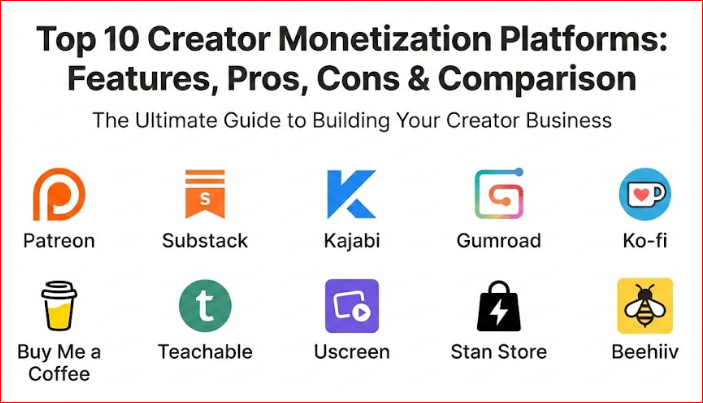
Top 10 Creator Monetization Platforms
1 — Patreon
Patreon is the industry pioneer for membership-based monetization, allowing creators to offer tiered subscription levels to their most dedicated fans in exchange for exclusive content and community perks.
- Key features:
- Tiered monthly and annual membership options.
- Native video and audio hosting for “Patreon-only” releases.
- Direct fan messaging and community polling tools.
- Integrated merch fulfillment and benefit tracking.
- Creator-led commerce for one-off digital product sales.
- Robust analytics for member retention and growth tracking.
- Pros:
- High brand recognition builds instant trust with fans.
- Excellent community-building features like gated Discord integration.
- Cons:
- High platform fees (up to 12% + payment processing).
- Limited aesthetic customization for creator landing pages.
- Security & compliance: GDPR compliant, secure payment processing (Stripe/PayPal), SOC 2 compliance for enterprise tiers.
- Support & community: Extensive knowledge base, email support, and a massive global community of creators.
2 — Substack
Substack simplified the newsletter economy by combining a powerful email delivery system with a seamless payment gateway, making it the go-to for writers and journalists.
- Key features:
- Integrated newsletter and website publishing.
- Subscription paywall with customizable free/paid previews.
- Podcast and video hosting with private RSS feeds.
- “Substack Notes” for social discovery within the platform.
- Gift subscriptions and group discount tools.
- Referral programs to incentivize audience growth.
- Pros:
- Zero upfront costs; you only pay when you start earning.
- Simple, distraction-free writing and reading experience.
- Cons:
- Fixed 10% platform fee can become expensive as revenue scales.
- Limited design flexibility compared to dedicated CMS platforms.
- Security & compliance: SSL encryption, GDPR compliance, secure Stripe integration.
- Support & community: Active writer community, comprehensive documentation, and dedicated “Substack Grow” resources.
3 — Kajabi
Kajabi is an all-in-one powerhouse for creators who want to build a full-scale business around their knowledge, offering courses, coaching, and marketing automation.
- Key features:
- Advanced online course and digital product builders.
- Automated marketing funnels and email sequences.
- Integrated CRM (Customer Relationship Management).
- Built-in website builder with customizable templates.
- Native mobile app for student learning on the go.
- Affiliate management system for scaling sales.
- Pros:
- Replaces multiple tools (email, hosting, CRM) with one subscription.
- Extremely high-quality professional templates and branding.
- Cons:
- One of the most expensive monthly subscription fees in the market.
- Significant learning curve due to the depth of features.
- Security & compliance: SSO (Single Sign-On) options, GDPR, ISO 27001, and 256-bit encryption.
- Support & community: 24/7 live chat support, “Kajabi University” training, and a highly active peer community.
4 — Gumroad
Gumroad is a flexible e-commerce platform that allows creators to sell almost anything digital or physical, from eBooks and software to memberships and art.
- Key features:
- Simple checkout process with “pay what you want” options.
- Automatic VAT/tax handling for international sales.
- Built-in affiliate marketing tools for creators.
- Subscription and license key management.
- Direct email marketing to customers.
- “Gumroad Discover” for marketplace exposure.
- Pros:
- Incredibly fast setup—go live with a product in minutes.
- Handles the complexity of global tax compliance automatically.
- Cons:
- Flat 10% transaction fee is higher than many competitors.
- Minimal community-building or engagement tools.
- Security & compliance: PCI-compliant payments, GDPR support, secure digital delivery.
- Support & community: Email-based support, helpful creator guides, and developer API documentation.
5 — Ko-fi
Ko-fi provides a “tip-jar” style interface that has evolved into a full creator suite, supporting donations, memberships, and shop sales without platform fees on tips.
- Key features:
- Zero-fee donation and tipping system.
- Digital storefront for selling files and services.
- Subscription membership tiers with gated content.
- Commission system for custom requests (e.g., art/writing).
- Stream alerts and goal-tracking overlays.
- Direct PayPal and Stripe payouts.
- Pros:
- Most affordable option for beginners (0% fees on tips for basic users).
- Friendly, low-pressure monetization model for fans.
- Cons:
- Advanced features require a monthly “Ko-fi Gold” subscription.
- Analytics are relatively basic compared to enterprise tools.
- Security & compliance: Secure payment gateways, GDPR compliant, no storage of sensitive card data.
- Support & community: Community Discord, email support, and creator-focused blog tutorials.
6 — Buy Me a Coffee
Similar to Ko-fi, this platform focuses on simplicity and “frictionless” support, designed for creators who want a professional and minimalist way to accept payments.
- Key features:
- One-tap “Coffee” donations for quick support.
- “Extras” feature for selling one-off services or digital goods.
- Simple membership tiers with recurring billing.
- Integrated email newsletter tool for supporters.
- Mobile app for managing earnings on the go.
- Customizable “Thank You” messages and shoutouts.
- Pros:
- Clean, modern UI that looks professional on any website.
- Very high conversion rate due to the simplicity of the checkout.
- Cons:
- Standard 5% transaction fee on all earnings.
- Limited customization for the storefront appearance.
- Security & compliance: SSL encryption, PCI-compliant processing, GDPR compliance.
- Support & community: 24/7 email support and a growing library of creator success stories.
7 — Teachable
Teachable is a dedicated learning management system (LMS) that prioritizes the student experience, making it ideal for those focused purely on online education.
- Key features:
- Drag-and-drop course curriculum builder.
- Integrated quiz and course completion certificates.
- Support for multiple media types (video, PDF, audio).
- Bulk student enrollment and coaching management.
- Advanced sales page builder with conversion tools.
- Comprehensive tax handling (Teachable BackOffice).
- Pros:
- Highly intuitive student interface that minimizes churn.
- Strong emphasis on student progress and outcome tracking.
- Cons:
- Transaction fees apply even on some paid monthly plans.
- Requires external tools for advanced email marketing.
- Security & compliance: GDPR, PCI Level 1, secure video hosting via Wistia/Vimeo integrations.
- Support & community: Knowledge base, email support, and “Teachable:u” training.
8 — Uscreen
Uscreen is a video-first monetization platform that allows creators to build their own “Netflix-style” streaming service, complete with mobile and TV apps.
- Key features:
- Branded video-on-demand (VOD) library.
- OTT (Over-the-Top) apps for iOS, Android, Roku, and Apple TV.
- Live streaming with integrated chat and monetization.
- Churn reduction tools and automated win-back emails.
- Gift cards and coupon code management.
- In-depth video analytics (watch time, heatmaps).
- Pros:
- Best-in-class for professional video creators and fitness brands.
- Allows for true “brand ownership” across all devices.
- Cons:
- Higher monthly base fee plus a per-subscriber fee.
- Setup process for OTT apps can take several weeks.
- Security & compliance: SOC 2, GDPR, secure DRM (Digital Rights Management) for video protection.
- Support & community: Dedicated account managers (for higher tiers) and expert onboarding.
9 — Stan Store (Stan)
Stan Store is the leading “link-in-bio” monetization tool, specifically optimized for TikTok and Instagram creators who want to sell products directly within social apps.
- Key features:
- Mobile-optimized checkout that stays within the social app.
- One-click digital product and course sales.
- Direct calendar booking for coaching and consultations.
- Lead magnet and email list building tools.
- Automated email follow-ups for customers.
- Recurring membership and subscription support.
- Pros:
- Highest conversion rate for social media traffic.
- Eliminates “website fatigue” with a simple, scrollable list.
- Cons:
- Subscription-only model (no free tier with transaction fees).
- Limited branding depth compared to a full website.
- Security & compliance: Secure Stripe/PayPal integration, GDPR compliant.
- Support & community: Quick email support and a very active creator education program.
10 — Beehiiv
Beehiiv is a rapidly growing newsletter platform built by the early team at Morning Brew, designed for high-growth publishers who want advanced data and ad network access.
- Key features:
- Advanced audience segmentation and tagging.
- Built-in “Ad Network” for monetizing free newsletters.
- “Boosts” referral network for paid audience growth.
- Customized “magic links” for one-click subscriptions.
- Robust A/B testing for subject lines and content.
- Premium subscription tiers with customizable landing pages.
- Pros:
- Superior analytics and data visualization compared to competitors.
- Aggressive feature rollout based on modern creator needs.
- Cons:
- Free tier is limited; scaling requires moving to paid plans quickly.
- More complex interface than Substack.
- Security & compliance: Varies / N/A (Standard GDPR and encryption protocols applied).
- Support & community: High-quality documentation, video tutorials, and active social support.
Comparison Table
| Tool Name | Best For | Platform(s) Supported | Standout Feature | Rating (TrueReviewnow.com) |
| Patreon | Community Building | Web, iOS, Android | Tiered Memberships | 4.6 / 5 |
| Substack | Writers & Journalists | Web, iOS, Android | Content Gating | 4.4 / 5 |
| Kajabi | Knowledge Businesses | Web, iOS, Android | All-in-One Funnels | 4.8 / 5 |
| Gumroad | Digital Goods | Web | Tax & VAT Handling | 4.2 / 5 |
| Ko-fi | Low-Fee Tipping | Web, Mobile | 0% Fee on Tips | 4.5 / 5 |
| Buy Me a Coffee | Professional Tipping | Web, Mobile | Frictionless Checkout | 4.7 / 5 |
| Teachable | Online Educators | Web, iOS | Course Experience | 4.3 / 5 |
| Uscreen | Video/OTT Brands | Web, TV, Mobile | Branded TV Apps | 4.9 / 5 |
| Stan Store | Social Media Sellers | Web (Mobile First) | 1-Tap Checkout | 4.8 / 5 |
| Beehiiv | Newsletter Growth | Web | Ad Network Integration | 4.6 / 5 |
Evaluation & Scoring of Creator Monetization Platforms
| Evaluation Criteria | Weight (%) | Patreon | Kajabi | Substack | Uscreen |
| Core Features | 25% | 22/25 | 25/25 | 20/25 | 24/25 |
| Ease of Use | 15% | 13/15 | 11/15 | 15/15 | 12/15 |
| Integrations & Ecosystem | 15% | 14/15 | 14/15 | 10/15 | 13/15 |
| Security & Compliance | 10% | 09/10 | 10/10 | 09/10 | 10/10 |
| Performance & Reliability | 10% | 09/10 | 10/10 | 10/10 | 10/10 |
| Support & Community | 10% | 09/10 | 10/10 | 08/10 | 09/10 |
| Price / Value | 15% | 11/15 | 10/15 | 12/15 | 11/15 |
| TOTAL SCORE | 100% | 87/100 | 90/100 | 84/100 | 89/100 |
Which Creator Monetization Tool Is Right for You?
Selecting the perfect platform requires balancing your current audience size with your long-term business goals. Here is a practical guide:
Solo Users vs. SMB & Enterprise
If you are a solo creator starting from scratch, platforms like Ko-fi or Buy Me a Coffee offer the lowest barrier to entry with minimal risk. As you transition into a Small Business (SMB), you will likely need the advanced automation of Kajabi or the professional video delivery of Uscreen. Enterprise publishers often choose Beehiiv for its deep data analytics and scalable ad network.
Budget-Conscious vs. Premium Solutions
- Budget-Conscious: Substack and Gumroad are excellent because they take a percentage of sales rather than a monthly fee. You only pay when you make money.
- Premium: Kajabi and Uscreen require high monthly fees (often $150+), but they offer superior branding and eliminate the “fragmented” feeling of using ten different tools.
Feature Depth vs. Ease of Use
If you want to “set it and forget it,” Stan Store is the winner for ease of use. However, if you need deep feature sets—like automated email funnels, affiliate programs, and complex landing pages—you must accept the steeper learning curve of a tool like Teachable or Kajabi.
Integration and Scalability
For creators who already have a website (WordPress/Webflow), Memberful or Gumroad are easier to integrate. For those looking to scale a massive newsletter, Beehiiv’s growth-focused features (referral programs and boosts) are unmatched.
Frequently Asked Questions (FAQs)
1. What is the average platform fee for creator tools?
Most “free-to-start” platforms charge between 5% and 12% of your total revenue. Subscription-based platforms like Kajabi usually charge 0% transaction fees but have high monthly costs.
2. Can I use multiple monetization platforms at once?
Yes, many creators use a “stack.” For example, a YouTuber might use Patreon for memberships, Gumroad for selling a digital guide, and Buy Me a Coffee for one-time tips.
3. Do these platforms handle sales tax and VAT?
Some, like Gumroad and Teachable (via BackOffice), act as a “Merchant of Record” and handle global taxes. Others, like Patreon or Kajabi, provide tools to collect tax but leave the filing to the creator.
4. Is it better to choose a percentage-based fee or a monthly subscription?
If you earn less than $1,000/month, percentage-based is usually cheaper. Once you cross the $2,000–$3,000 threshold, a flat monthly subscription often saves you thousands in transaction fees.
5. Can I move my audience if I decide to switch platforms?
Most reputable platforms like Substack and Beehiiv allow you to export your email list. However, migrating recurring subscriptions (credit card data) is much harder and often requires manual intervention.
6. How do I prevent piracy of my digital products?
Tools like Gumroad offer license key management, and Uscreen provides professional DRM (Digital Rights Management) to prevent unauthorized downloading or sharing of your videos.
7. Which platform is best for “link-in-bio” sales?
Stan Store is currently the industry leader for mobile-first, link-in-bio sales due to its one-tap checkout and seamless integration with TikTok and Instagram.
8. Do I need a website to use these tools?
No. Most of these platforms (Kajabi, Substack, Patreon) provide a hosted landing page or a full website for you, eliminating the need for separate hosting or a domain.
9. What is the fastest way to get paid?
Platforms that integrate directly with Stripe (like Ko-fi or Buy Me a Coffee) usually offer “instant” or 2-day payouts. Some older models may hold funds for 30 days.
10. Are these platforms secure for my fans?
Yes, the top tools use enterprise-grade encryption and PCI-compliant payment processors (Stripe/PayPal), ensuring that creators never see or store fan credit card numbers.
Conclusion
The “best” monetization platform is not a universal winner; it is a strategic choice based on your content medium and audience behavior. If your strength is video, Uscreen and Patreon offer the best recurring models. For writers, Substack and Beehiiv provide the necessary infrastructure to thrive. If you are a social media native selling digital products, Stan Store is unparalleled in its conversion rates.
When choosing, remember that the most critical factor is ownership. Prioritize platforms that allow you to own your email list and customer data. In the volatile world of the 2026 creator economy, your direct connection to your fans is the only asset that truly belongs to you.

- Top 10 Email Deliverability Tools: Features, Pros, Cons & Comparison - September 6, 2026
- Top 10 Pharmacovigilance Software: Features, Pros, Cons & Comparison - September 6, 2026
- Top 10 Manufacturing Execution Systems (MES) - July 30, 2026