Introduction
Patronage platforms are digital ecosystems that facilitate direct financial support from an audience to a creator, typically through recurring memberships, one-time donations, or exclusive digital sales. Unlike ad-based models that prioritize broad reach and click-through rates, patronage platforms prioritize depth of engagement, rewarding creators for the value they provide to their core community.
Why Patronage Platforms Matter
These tools are critical because they offer financial stability in an era of volatile platform algorithms. When a social media giant changes its distribution logic, a creator’s ad revenue can plummet overnight. Patronage platforms provide a “safety net” of predictable, monthly recurring revenue (MRR), allowing creators to focus on quality over quantity. Furthermore, they foster a sense of shared ownership and community, where fans feel like “patrons of the arts” rather than mere consumers.
Key Real-World Use Cases
- Independent Journalism: Writers using platforms like Substack or Ghost to fund investigative reporting without corporate oversight.
- Podcasting: Audio creators offering ad-free episodes and “behind-the-scenes” content to monthly subscribers.
- Software Development: Open-source contributors receiving “sponsorships” to maintain critical libraries and tools.
- Visual Arts & Illustration: Digital artists providing high-resolution downloads, tutorials, and early access to new works.
Evaluation Criteria
When choosing a patronage tool, users should evaluate the following:
- Fee Structure: Does the platform take a percentage of revenue or charge a flat monthly fee?
- Ownership: Do you own your member list and email data, or is it locked within the platform?
- Feature Set: Does it support tiered memberships, physical merch, or community forums?
- Ease of Use: How steep is the learning curve for both the creator and the supporter?
Best for: Independent creators (YouTubers, podcasters, artists), small media brands, and nonprofit organizations looking to build a stable, recurring revenue stream from a dedicated audience.
Not ideal for: Purely viral “one-hit” creators with high reach but low engagement, or large-scale enterprises that require complex, custom-built ERP and CRM integrations beyond what standard SaaS platforms offer.
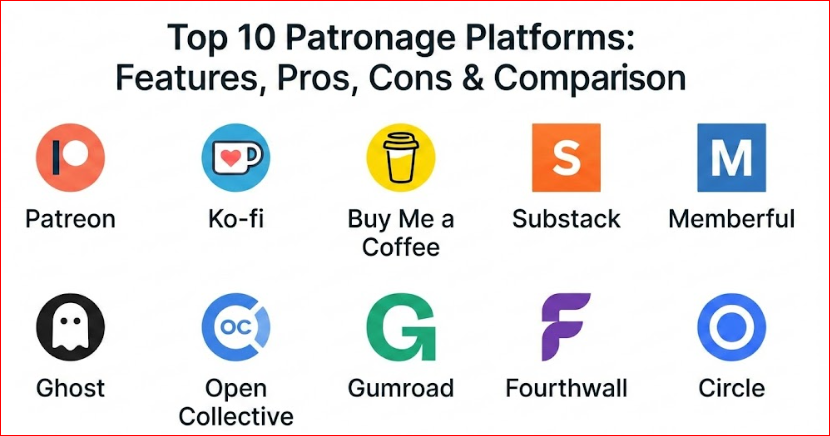
Top 10 Patronage Platforms
1 — Patreon
Patreon is the industry pioneer that popularized the concept of tiered memberships. It is designed for creators who want a “set it and forget it” solution for managing thousands of monthly subscribers across various benefit levels.
- Key Features:
- Tiered membership levels with customizable perks.
- Native “Community” tab for patron-only discussions.
- Integration with Discord for exclusive role-based access.
- Merch-for-membership fulfillment services.
- Private RSS feeds for exclusive podcast content.
- Detailed analytics on patron growth and churn.
- Pros:
- Massive brand recognition; fans trust the payment process.
- Robust ecosystem of integrations with other creator tools.
- Cons:
- High platform fees (up to 12% plus processing).
- The platform “owns” the discovery experience, often suggesting other creators.
- Security & Compliance: GDPR compliant; uses industry-standard encryption; SOC 2 Type II certified.
- Support & Community: Extensive help center, active creator community, and dedicated partner managers for high-earning creators.
2 — Ko-fi
Ko-fi is a “tip jar” style platform that has evolved into a full-featured membership site. It is uniquely known for its creator-friendly fee structure, particularly for one-time donations.
- Key Features:
- “Buy me a coffee” style one-time tipping.
- Commission requests for custom work.
- Simple digital storefront for selling files.
- Basic membership tiers with post-locking.
- Stream alerts for live engagement.
- Pros:
- 0% platform fee on one-time donations (standard plan).
- Instant payouts directly to PayPal or Stripe.
- Cons:
- Less robust community features than Patreon.
- Visual customization is somewhat limited on the free tier.
- Security & Compliance: PCI Level 1 compliant via payment processors; GDPR compliant.
- Support & Community: Active Twitter/X presence, responsive email support, and a helpful knowledge base.
3 — Buy Me a Coffee
Similar to Ko-fi, Buy Me a Coffee focuses on simplicity and a sleek, modern user interface. It is a favorite for developers and writers who want a professional-looking support page without the complexity of a full site.
- Key Features:
- Simplified one-click support for fans.
- “Extras” feature to sell one-off services or digital products.
- Native email marketing tools to message supporters.
- Membership tiers for recurring support.
- Beautiful, mobile-optimized profile pages.
- Pros:
- Highly intuitive interface that converts well.
- Lower barrier to entry for fans (no account required to tip).
- Cons:
- Flat 5% platform fee on all transactions.
- Limited advanced analytics for large-scale operations.
- Security & Compliance: Secure SSL encryption; GDPR compliant; payments handled by Stripe.
- Support & Community: 24/7 chat support, weekly creator spotlights, and clear documentation.
4 — Substack
Substack transformed the newsletter industry by making it incredibly easy for writers to charge for their content. It is the gold standard for text-based patronage.
- Key Features:
- Integrated newsletter and blogging platform.
- Paywall system for exclusive posts.
- Native podcast hosting and private feeds.
- “Notes” social feed for audience discovery.
- Group subscriptions for teams or schools.
- Pros:
- No upfront cost; you only pay when you earn.
- Strong internal discovery network helps grow your audience.
- Cons:
- High 10% platform fee (on top of Stripe fees).
- Limited design flexibility; all Substacks look relatively similar.
- Security & Compliance: GDPR compliant; CCPA compliant; robust anti-spam protections.
- Support & Community: Comprehensive writer resources, community workshops, and a “Substack Grow” series.
5 — Memberful
Memberful is a “white-label” membership solution that integrates into your existing website. It is owned by Patreon but serves a more professional, brand-conscious segment of the market.
- Key Features:
- Seamless WordPress integration via a dedicated plugin.
- Custom branding for checkout and member areas.
- Deep integration with Mailchimp, Campaign Monitor, and Discord.
- Staff accounts and permission management.
- Support for multiple currencies and localized checkout.
- Pros:
- Total control over the user experience and branding.
- You own the relationship with your customers entirely.
- Cons:
- Requires you to host and manage your own website.
- Monthly subscription fee + transaction fee.
- Security & Compliance: SOC 2 Type II; HIPAA-ready for certain configurations; GDPR/CCPA.
- Support & Community: High-tier concierge onboarding and rapid-response technical support.
6 — Ghost
Ghost is an open-source alternative to Substack. It is a powerful, professional publishing platform for those who want to own their data and customize every aspect of their site.
- Key Features:
- Built-in membership and subscription management.
- Clean, minimalist writing editor.
- Native SEO tools and social media metadata management.
- Advanced theme engine for complete design control.
- API-first architecture for developers.
- Pros:
- 0% platform fees; you only pay for hosting.
- Truly open-source; no platform lock-in.
- Cons:
- Requires more technical setup than Substack.
- Self-hosting requires server management knowledge.
- Security & Compliance: GDPR compliant; supports 2FA; secure hosting via Ghost(Pro).
- Support & Community: Vibrant developer community and extensive documentation.
7 — Open Collective
Open Collective is unique in this list because it focuses on financial transparency. It is primarily used by open-source projects, neighborhood groups, and activist collectives.
- Key Features:
- Transparent public ledger of all income and expenses.
- “Fiscal Hosting” for groups without a legal entity.
- Automated invoicing and expense reimbursement.
- Tiered contribution levels.
- Integration with GitHub for developer sponsorship.
- Pros:
- Builds immense trust through total transparency.
- Solves the legal/tax hurdles for unincorporated groups.
- Cons:
- Not designed for individual “influencer” style content.
- UI is more utilitarian than “creative.”
- Security & Compliance: Open-source code; financial auditing features; GDPR compliant.
- Support & Community: Forum-based support and documentation for fiscal hosts.
8 — Gumroad
While primarily an e-commerce platform for digital products, Gumroad has become a powerhouse for patronage through its recurring subscription features.
- Key Features:
- Superb digital product delivery (PDFs, Videos, Software).
- Subscription tiers with content updates.
- Built-in affiliate marketing system.
- Mobile app for customers to consume content.
- “Pay what you want” pricing options.
- Pros:
- Excellent for creators who mix memberships with one-off product sales.
- Handles global VAT/sales tax compliance automatically.
- Cons:
- Flat 10% platform fee can be expensive for high earners.
- Community engagement tools are relatively weak.
- Security & Compliance: PCI compliant; GDPR compliant; advanced anti-piracy measures.
- Support & Community: Extensive University guides and email-based creator support.
9 — Fourthwall
Fourthwall is an all-in-one creator shop that combines memberships, e-commerce, and branded websites into a single platform.
- Key Features:
- Integrated merch shelf with print-on-demand.
- Supporter-only posts and videos.
- Gifted memberships (similar to Twitch).
- Custom domain and site builder.
- Supporter “thank you” video feature.
- Pros:
- The best integration of physical merch and digital patronage.
- High level of visual customization without coding.
- Cons:
- Focus on merch might be distracting for pure content creators.
- Relatively newer platform compared to Patreon.
- Security & Compliance: Secure checkout; GDPR compliant; robust data privacy.
- Support & Community: Discord-based support community and dedicated success managers.
10 — Circle
Circle is a community-first platform. While it includes robust membership tools, its primary differentiator is the focus on building a private “social network” for your fans.
- Key Features:
- Organized discussion spaces and threads.
- Live streaming and group video calls.
- Course hosting and curriculum management.
- Member directory and private messaging.
- Flexible paywalls for different community “spaces.”
- Pros:
- Ideal for creators whose value lies in fan-to-fan interaction.
- Modern, clean UI that rivals Slack or Discord.
- Cons:
- Pricey monthly subscription (no free tier).
- May be “too much” for creators just looking for a tip jar.
- Security & Compliance: SOC 2 Type II; GDPR compliant; SSO options for enterprise.
- Support & Community: Expert-led “Circle Journey” onboarding and a massive community of community managers.
Comparison Table
| Tool Name | Best For | Platform(s) Supported | Standout Feature | Rating (Gartner/True) |
| Patreon | General Creators | Web, iOS, Android | Multi-tiered Memberships | 4.5/5 |
| Ko-fi | Low-cost Tipping | Web | 0% Platform Fees (Tips) | 4.7/5 |
| Buy Me a Coffee | Quick Support | Web | One-click Checkout | 4.6/5 |
| Substack | Writers/Journalists | Web, iOS, Android | Internal Discovery Engine | 4.4/5 |
| Memberful | Branded Websites | WordPress, Web | White-label Control | 4.8/5 |
| Ghost | Independent Pubs | Web (Self-hosted/Cloud) | Open-source Freedom | 4.7/5 |
| Open Collective | Nonprofits/OSD | Web | Financial Transparency | N/A |
| Gumroad | Digital Sellers | Web, iOS, Android | Automated VAT Handling | 4.3/5 |
| Fourthwall | Merch + Members | Web | Merch Integration | 4.6/5 |
| Circle | Communities | Web, iOS, Android | Interactive Spaces | 4.8/5 |
Evaluation & Scoring of Patronage Platforms
To help you decide, we have evaluated the general category using a weighted scoring rubric based on industry standards for 2026.
| Criteria | Weight | Score (1-10) | Evaluation Notes |
| Core Features | 25% | 9.0 | Most platforms now offer tiers, digital sales, and basic messaging as standard. |
| Ease of Use | 15% | 8.5 | Conversion-focused checkouts have significantly improved supporter friction. |
| Integrations | 15% | 7.5 | Patreon leads, but others are catching up via Zapier and native APIs. |
| Security | 10% | 9.0 | SSL and PCI compliance are universal; SOC 2 is becoming the enterprise standard. |
| Performance | 10% | 8.5 | High uptime is standard; mobile app performance varies across the board. |
| Support | 10% | 8.0 | Email support is common; live chat is reserved for premium tiers. |
| Price / Value | 15% | 7.0 | Revenue-share models (10%+) are starting to feel expensive for large creators. |
Which Patronage Platforms Tool Is Right for You?
Choosing the “right” tool depends entirely on your specific stage of growth and the type of content you produce.
Solo Users vs. Enterprise
- Solo Users: Start with Ko-fi or Buy Me a Coffee. The setup time is negligible, and you won’t be bogged down by complex tier management while you’re still finding your voice.
- SMBs & Professional Creators: Patreon or Substack are the safest bets for scaling. They provide the infrastructure to manage thousands of users without a dedicated tech team.
- Enterprise / Mid-Market: Memberful or Ghost are the choices here. At this scale, owning your data and having a custom-branded experience is more valuable than platform discovery.
Budget vs. Premium
- Budget-Conscious: If you hate the idea of losing 10% of your income, Ghost (self-hosted) or Ko-fi (Gold) are the most cost-effective.
- Premium / Feature-Rich: Circle or Fourthwall provide a premium experience for your fans but come with higher monthly costs or specific commerce focuses.
Feature Depth vs. Ease of Use
If you need deep community interaction (forums, live calls), go with Circle. If you want the simplest possible way for someone to give you $5, stick with Buy Me a Coffee.
Frequently Asked Questions (FAQs)
1. Do I need a following before joining a patronage platform?
Yes, generally. These platforms are not discovery engines (with some exceptions like Substack). They are “monetization engines” for an audience you have already built on social media or elsewhere.
2. Can I use multiple platforms at once?
You can, but it is not recommended. Splitting your audience between Patreon and Ko-fi, for example, dilutes your community and creates administrative headaches for you.
3. How do these platforms handle taxes?
Most platforms (like Gumroad) handle global VAT/GST for you. Others (like Patreon) collect sales tax where required by law but leave income tax reporting to the creator.
4. Is my data safe on these platforms?
Most top-tier platforms use Stripe or PayPal for payments, meaning they never see your fans’ credit card numbers. Look for SOC 2 compliance if you are handling sensitive data.
5. What is the average platform fee?
The industry average is 5% to 10% of your gross revenue, plus credit card processing fees (usually 2.9% + $0.30).
6. Can I export my member list if I decide to leave?
Platforms like Ghost, Substack, and Memberful allow full exports. Patreon allows list exports, but moving recurring credit card “tokens” to a new platform is notoriously difficult.
7. Do fans have to create an account to support me?
On Buy Me a Coffee and Ko-fi, fans can often tip without an account. On Patreon or Circle, an account is mandatory for accessing content.
8. Can I offer physical rewards?
Yes, platforms like Patreon and Fourthwall have built-in tools for physical merch fulfillment.
9. Are patronage platforms better than YouTube ad revenue?
For most niche creators, yes. Patronage revenue is typically 5x to 10x higher per “view” than AdSense because you are capturing the full value of a superfan.
10. What is the biggest mistake creators make?
Choosing a platform based on current features rather than long-term data ownership. Always ensure you can at least export your email list.
Conclusion
The shift toward patronage platforms represents a fundamental change in how we value creative work. By moving away from “attention at any cost” and toward “value for the few,” creators are finding more fulfillment and better financial health.
When choosing your platform, remember that there is no one-size-fits-all winner. If you are a writer, Substack or Ghost are your homes. If you are a community builder, Circle is unparalleled. If you are a visual artist looking for simplicity, Ko-fi is hard to beat. Focus on the tool that aligns with your content style and, most importantly, provides the best experience for your supporters.

- Top 10 Email Deliverability Tools: Features, Pros, Cons & Comparison - September 6, 2026
- Top 10 Pharmacovigilance Software: Features, Pros, Cons & Comparison - September 6, 2026
- Top 10 Manufacturing Execution Systems (MES) - July 30, 2026