Introduction
In the modern business landscape, efficiency isn’t just a goal—it’s a survival requirement. Managing the journey from the moment an employee realizes they need a product to the final click of a “pay” button is a complex web of approvals, tax laws, and supplier negotiations. This is where Procure-to-Pay (P2P) Suites come into play. These integrated software solutions automate the entire procurement lifecycle, bridging the gap between the purchasing department and accounts payable.
At its core, a P2P suite is a digital thread that connects requisitioning, purchasing, receiving, and payment. By centralizing these functions, companies can eliminate the “paper trail” that often leads to errors, delays, and lost discounts. Beyond just buying things, these tools are essential for spend visibility. Without them, a company might not realize they are buying the same office supplies from ten different vendors at ten different prices. Real-world use cases range from a global tech firm managing thousands of software licenses to a manufacturing plant ensuring that raw materials arrive just in time to prevent a line stoppage. When choosing a suite, you should evaluate the platform’s automation capabilities, ease of integration with your existing ERP (Enterprise Resource Planning), and how friendly the interface is for the average employee.
Best for: Large-scale enterprises, global corporations, and mid-market companies with complex supply chains or high transaction volumes. It is particularly valuable for Finance Directors, Procurement Managers, and Accounts Payable (AP) specialists who need to enforce spending policies and reduce manual data entry.
Not ideal for: Early-stage startups or very small businesses with low purchasing needs. For these groups, a simple corporate credit card and a basic accounting tool like QuickBooks are often sufficient. Additionally, companies with highly specialized, “one-off” purchasing requirements might find the rigid structure of a P2P suite more of a hurdle than a help.
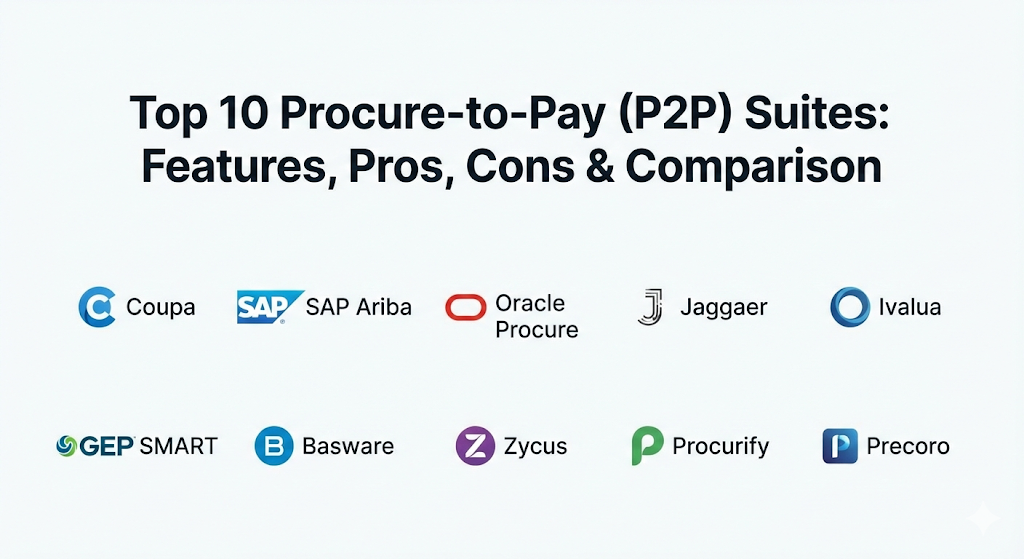
Top 10 Procure-to-Pay (P2P) Suites
1 — Coupa
Coupa is widely regarded as the “gold standard” for user-centric spend management. It is an AI-native platform designed to give businesses total control over their global spend by unifying procurement, invoicing, and expenses into a single, sleek interface.
- Key features:
- Community Intelligence: Uses anonymized data from all Coupa users to provide benchmarked savings tips and risk alerts.
- Guided Buying: A consumer-like shopping experience that directs employees to preferred suppliers.
- Coupa Pay: Integrated payment infrastructure to handle global B2B payments securely.
- AI-Powered Spend Guard: Automatically detects fraudulent activity or duplicate invoices.
- Open Business Network: Connects with over 5 million suppliers without requiring them to pay “portal fees.”
- Pros:
- The interface is incredibly intuitive, leading to high adoption rates among non-procurement staff.
- Strong mobile functionality allows for quick approvals while on the go.
- Cons:
- The implementation process can be expensive and may require specialized consultants.
- Some advanced reporting features require a steep learning curve to master.
- Security & compliance: SOC 1 & 2, ISO 27001, GDPR, and SOX compliant. Features robust audit trails and role-based access control.
- Support & community: Extensive customer success programs, a massive user community (Coupa Community), and 24/7 enterprise support.
2 — SAP Ariba
As one of the oldest and largest players in the space, SAP Ariba is built for complexity. It excels in managing massive, global supply chains and offers the deepest integration possible for organizations already running on SAP S/4HANA.
- Key features:
- SAP Business Network: The world’s largest B2B network, facilitating deep supplier collaboration.
- Guided Buying: A structured search interface that ensures compliance with corporate policy.
- Dynamic Discounting: Tools to negotiate early payment discounts with suppliers automatically.
- Strategic Sourcing: Advanced RFX (Request for X) and auction tools for complex procurement.
- Direct Materials Support: One of the few suites that handles both indirect and direct manufacturing materials effectively.
- Pros:
- Unmatched global reach and supplier visibility.
- Native, seamless integration with the SAP ecosystem.
- Cons:
- The user interface can feel “legacy” or clunky compared to newer cloud-native competitors.
- Supplier onboarding can be difficult if vendors are not already part of the Ariba network.
- Security & compliance: Globally compliant in over 190 countries; adheres to GDPR, HIPAA (for specific modules), and various ISO standards.
- Support & community: Strong documentation and enterprise-level support, though smaller companies may find the support experience less personalized.
3 — Oracle Fusion Cloud Procurement
Oracle’s P2P offering is part of its broader Fusion Applications Suite. It is built natively for the cloud and focuses heavily on data discipline and embedded AI to drive “touchless” procurement.
- Key features:
- Self-Service Procurement: A consumer-style shopping cart for employees.
- Embedded AI: Automates invoice matching and sourcing recommendations.
- Supplier Qualification Management: Rigorous tools to vet and monitor supplier risk.
- Project-Driven Supply Chain: Links procurement directly to specific projects for accurate accounting.
- Automated Invoice Processing: Uses optical character recognition (OCR) to eliminate manual entry.
- Pros:
- Excellent data consistency across finance, HR, and supply chain modules.
- Strong analytics that surface “savings leakage” and risk hotspots automatically.
- Cons:
- Best suited for those already in the Oracle ecosystem; standalone implementation can be a heavy lift.
- Configuration can be complex, often requiring significant IT involvement.
- Security & compliance: SOX, ISO 27001, SOC 2, and GDPR compliant with industry-leading encryption.
- Support & community: Massive global support infrastructure and a well-documented knowledge base.
4 — Jaggaer
Jaggaer (formerly SciQuest) is known for its “Autonomous Commerce” vision. It is particularly popular in specific verticals like higher education, manufacturing, and the public sector due to its ability to handle very complex sourcing requirements.
- Key features:
- Industry-Specific Templates: Tailored workflows for labs, universities, and government agencies.
- Supplier Risk Management: Deep vetting tools that monitor financial and ESG (Environmental, Social, and Governance) data.
- Direct Materials Management: Specialized modules for manufacturing supply chains.
- Jaggaer Assist: An AI bot that helps users navigate the procurement process.
- Inventory Management: Tracks physical stock levels in real-time to prevent over-ordering.
- Pros:
- Highly configurable to fit unique, non-standard business processes.
- Strong reputation for deep functionality in complex “Direct” procurement.
- Cons:
- The “Jaggaer ONE” platform can feel fragmented across its many modular pieces.
- Implementation timelines can be longer due to the high level of customization.
- Security & compliance: HIPAA, ITAR, ISO 27001, and SOC 2 Type II compliant.
- Support & community: Offers dedicated customer success managers and has a strong presence in the education/research community.
5 — Ivalua
Ivalua stands out for its “single-code” architecture. While other suites are often a collection of different companies bought over time, Ivalua was built from the ground up on one platform, leading to exceptional data cleanliness.
- Key features:
- Highly Configurable Workflows: No-code/low-code tools to change processes without needing a developer.
- Unified Data Model: One source of truth for all supplier and spend data.
- Strategic Sourcing: Advanced RFx management with generative AI for contract drafting.
- Direct S2P: Strong support for bill-of-materials (BOM) and manufacturing needs.
- Supplier Collaboration Hub: A shared space for joint dashboards and innovation planning.
- Pros:
- Flexible enough to support “one-of-a-kind” business models that other tools can’t handle.
- Very high customer retention rates due to its adaptability.
- Cons:
- Higher price point makes it a “premium” choice for larger organizations.
- The sheer number of options can be overwhelming for a small procurement team.
- Security & compliance: ISO 27001, SOC 2 Type II, and GDPR compliant.
- Support & community: Known for high-touch service and a helpful maintenance team that assists with enhancements.
6 — GEP SMART
GEP SMART is a unified, cloud-native platform that combines procurement software with GEP’s deep consulting expertise. It is often chosen by firms that want a software vendor that also understands the “playbook” of procurement strategy.
- Key features:
- AI-Assisted Buying: Uses machine learning to suggest better items or vendors during the checkout process.
- Unified S2P: A single platform covering everything from spend analysis to payments.
- Contract Insights: AI that scans contracts for “hidden” risks or missing clauses.
- Supplier Diversity Tracking: Built-in tools to manage and report on diversity spend.
- Mobile-First Design: A very modern, app-like experience for all users.
- Pros:
- Excellent user experience (UX) that requires minimal training.
- Fast “time-to-value” compared to larger legacy suites.
- Cons:
- GEP’s services-heavy approach might feel pushy if you only want the software.
- Integration with non-standard legacy ERPs can sometimes be tricky.
- Security & compliance: SOX, GDPR, and ISO 27001 compliant.
- Support & community: High-quality customer support that acts more like a strategic partner.
7 — Basware
Basware is the specialist in AP Automation and e-invoicing. While it has a full P2P suite, it is most famous for its ability to handle “100% spend visibility” by capturing every single invoice, regardless of how it arrives.
- Key features:
- SmartPDF: Automatically extracts data from PDF invoices without manual mapping.
- Global E-Invoicing Network: Complies with complex VAT and tax regulations in over 100 countries.
- Peppol Connectivity: Native support for the global electronic document exchange standard.
- Predictive Analytics: AI that predicts when an invoice is likely to be late or disputed.
- Marketplace: A simplified e-procurement catalog for employees.
- Pros:
- Best-in-class for global tax and regulatory compliance.
- Handles complex, multi-national invoice workflows with ease.
- Cons:
- The procurement (buying) side of the tool is slightly less robust than specialists like Coupa.
- Implementation can be complex if your supplier base is not tech-savvy.
- Security & compliance: High compliance standards, particularly for EU VAT and GDPR. ISO 27001 certified.
- Support & community: Strong European presence and excellent documentation for global compliance.
8 — Zycus
Zycus focuses on “AI-led” procurement. Its Merlin AI agents are designed to act like digital teammates that handle the “grunt work” of procurement, such as classifying spend or extracting data from contracts.
- Key features:
- Merlin AI Studio: A suite of bots for invoice automation and supplier risk.
- Guided Procurement: An intake process that asks questions and directs users to the right workflow.
- Savings Tracker: Real-time dashboards to prove procurement’s ROI to the CFO.
- Supplier Risk Monitor: Uses external news feeds to flag supplier financial stress or scandals.
- Inventory Tracking: Links P2P directly to warehouse stock levels.
- Pros:
- Very strong AI capabilities that actually reduce manual data entry.
- Offers a good balance between deep enterprise features and a modern interface.
- Cons:
- Reporting can be rigid and sometimes requires manual work to get specific views.
- Customer support responsiveness is rated as “variable” in some expert reviews.
- Security & compliance: SOC 2 and GDPR compliant with standard encryption.
- Support & community: Growing user community and a strong focus on rapid adoption.
9 — Procurify
Procurify is the standout choice for the mid-market. It strips away the complexity of the “mega-suites” and focuses on what mid-sized companies need: speed, spend visibility, and ease of use.
- Key features:
- Real-Time Spend Dashboards: See exactly how much budget is left before you approve a purchase.
- Virtual Cards: Integrated card management to handle software subscriptions and travel.
- Mobile Approvals: A top-rated mobile app for managers to approve POs in seconds.
- Budget Tracking: Department-level budget locks to prevent overspending.
- Amazon Business Integration: Direct “PunchOut” connection for easy shopping.
- Pros:
- Much faster to implement (weeks, not months).
- Very affordable pricing model for companies with 50–500 employees.
- Cons:
- Lacks the deep global tax compliance and manufacturing features of SAP or Basware.
- Reporting is good, but might not be “granular” enough for a multi-billion dollar corporation.
- Security & compliance: SOC 2 Type II, GDPR, and ISO 27001 compliant.
- Support & community: High-quality, personalized support and a dedicated customer success manager.
10 — Precoro
Precoro is designed for small-to-midmarket companies that have outgrown spreadsheets but aren’t ready for a six-figure enterprise contract. It’s a clean, efficient, and highly automated cloud platform.
- Key features:
- Automated PO Creation: Turns requisitions into purchase orders instantly.
- Budget Management: Visual trackers that show spend vs. budget in real-time.
- Inventory Management: Basic stock tracking to manage office or lab supplies.
- Three-Way Matching: Automatically compares PO, Receipt, and Invoice.
- NetSuite & QuickBooks Integration: Direct, two-way sync for accounting.
- Pros:
- One of the most user-friendly interfaces in the category.
- Transparent pricing and a 14-day free trial.
- Cons:
- Not built for “Direct Material” manufacturing or complex global supply chains.
- Limited advanced AI features compared to Zycus or Coupa.
- Security & compliance: GDPR compliant with role-based permissions and encrypted data.
- Support & community: Responsive customer support and a helpful library of setup guides.
Comparison Table
| Tool Name | Best For | Platform(s) Supported | Standout Feature | Rating |
| Coupa | Global Enterprise Spend | Web, iOS, Android | Community Intelligence | 4.7/5 |
| SAP Ariba | SAP Ecosystem Users | Web, Mobile | SAP Business Network | 4.1/5 |
| Oracle Procure | Finance-Led Enterprises | Web, Mobile | Embedded “Touchless” AI | N/A |
| Jaggaer | Higher Ed & Public Sector | Web, Mobile | Autonomous Commerce | 4.4/5 |
| Ivalua | High Configurability | Web, Mobile | Single-Code Architecture | 4.4/5 |
| GEP SMART | Strategy-Focused Firms | Web, Mobile | Unified S2P Intelligence | 4.4/5 |
| Basware | Global AP & Compliance | Web, Mobile | 100% Invoice Capture | 4.0/5 |
| Zycus | AI-First Procurement | Web, Mobile | Merlin AI Agents | 4.3/5 |
| Procurify | Growth-Stage Mid-Market | Web, iOS, Android | Real-Time Spend Dashboards | 4.6/5 |
| Precoro | Small-to-Mid Sized Biz | Web, Mobile | Intuitive UX/Budget Sync | 4.7/5 |
Evaluation & Scoring of Procure-to-Pay (P2P) Suites
Selecting a P2P suite requires a rigorous assessment. We have evaluated the top 10 tools based on a weighted rubric that reflects the priorities of modern finance and procurement leaders.
| Scoring Category | Weight | Evaluation Criteria |
| Core features | 25% | Requisitioning, PO management, invoicing, and spend analytics. |
| Ease of use | 15% | Intuitive interface, mobile accessibility, and employee adoption rates. |
| Integrations | 15% | Compatibility with major ERPs (SAP, Oracle, NetSuite) and third-party APIs. |
| Security & compliance | 10% | Data encryption, audit logs, and adherence to global standards (GDPR, SOC 2). |
| Performance | 10% | System uptime, processing speed, and “touchless” automation rates. |
| Support & community | 10% | Onboarding quality, technical support, and active user forums. |
| Price / Value | 15% | Total cost of ownership (TCO) relative to the efficiency gains and savings. |
Which Procure-to-Pay (P2P) Suite Tool Is Right for You?
The “right” tool is not necessarily the one with the most features; it is the one that fits your organization’s specific complexity and culture.
Solo Users vs. SMB vs. Mid-Market vs. Enterprise
- SMBs (10–100 employees): You need speed and simplicity. Precoro or Procurify are excellent because they don’t require a dedicated procurement department to manage.
- Mid-Market (100–1,000 employees): You likely need deeper spend control and better ERP sync. Procurify is a market leader here, providing a great balance of power and ease.
- Enterprise (1,000+ employees): Complexity is your main challenge. Coupa, SAP Ariba, and Oracle are the heavyweights capable of managing global tax laws and multi-currency environments.
Budget-Conscious vs. Premium Solutions
- Value Seekers: Basware and Jaggaer offer incredible functionality for their price points, especially if you focus on specific pain points like invoicing or academic sourcing.
- Premium Investment: Coupa and Ivalua command higher prices but offer the highest ROI through advanced AI and “community” insights that find savings other tools miss.
Feature Depth vs. Ease of Use
If your main goal is employee compliance, prioritize a simple UI like Coupa or GEP SMART. If your main goal is complex direct materials tracking, you may have to sacrifice some “friendliness” for the depth found in Jaggaer or SAP Ariba.
Integration and Scalability Needs
Always check if the suite has a “native connector” for your ERP. If you use NetSuite, look at Procurify. If you use SAP, Ariba is the logical choice. For those with unique, homegrown systems, Ivalua’s configurable no-code platform is the best for future-proofing.
Frequently Asked Questions (FAQs)
1. What is the difference between S2P and P2P?
P2P (Procure-to-Pay) covers the operational side of buying things: requesting, ordering, and paying. S2P (Source-to-Pay) includes P2P but adds the “Strategic” side: finding vendors, negotiating contracts, and analyzing long-term spend patterns.
2. How long does a typical P2P implementation take?
For mid-market tools like Precoro, it can be as little as 2 to 4 weeks. For enterprise giants like SAP Ariba, expect a 6 to 12-month journey depending on the complexity of your global integrations.
3. Does P2P software replace my ERP?
No. A P2P suite sits on top of your ERP. It handles the “messy” human side of buying things (shopping, approvals) and then pushes the clean data into the ERP for your official financial records.
4. Can we track employee expenses (like travel) in these suites?
Most leading suites like Coupa and GEP SMART have expense modules built-in, or they integrate seamlessly with specialized tools like SAP Concur.
5. What is “Three-Way Matching”?
It is a safety check where the system automatically compares the Purchase Order (what we asked for), the Receiving Slip (what arrived), and the Invoice (what they charged). If all three match, the system pays the bill automatically.
6. Is my data safe in a cloud P2P suite?
Yes. Modern P2P suites use bank-level encryption and are audited annually for SOC 2 and ISO standards. They are often more secure than old-fashioned paper-based or local server systems.
7. Why do suppliers have to use a portal?
Portals allow suppliers to see their payment status, submit electronic invoices, and update their banking info without calling your AP team. This reduces administrative “noise” for both sides.
8. Can P2P software help with sustainability (ESG)?
Yes. Tools like Ivalua and Jaggaer allow you to “tag” suppliers by their diversity status or carbon footprint, helping you direct spend toward more responsible vendors.
9. What is the biggest mistake companies make when buying a P2P suite?
Choosing the tool with the most features rather than the one employees will actually use. If the software is too hard to use, employees will find “workarounds,” and you’ll lose all your spend visibility.
10. How much does P2P software cost?
Pricing is almost always quote-based. SMB tools can start at a few thousand dollars a year, while Enterprise suites can cost hundreds of thousands in licensing and millions in implementation for global rollouts.
Conclusion
Choosing a Procure-to-Pay suite is one of the most significant digital transformations a company can undergo. It is the bridge that turns a chaotic “cost center” into a strategic, data-driven engine. While Coupa leads in user experience and SAP Ariba dominates in global reach, the market has evolved to offer specialized solutions like Ivalua for flexibility and Procurify for the fast-growing mid-market.
The key insight is that there is no universal “winner.” The best tool is the one that solves your specific bottlenecks—whether that’s a slow approval process, a lack of spend visibility, or a nightmare in accounts payable. Focus on employee adoption and ERP integration first; once those are secured, the automation and savings will naturally follow.

- Top 10 Email Deliverability Tools: Features, Pros, Cons & Comparison - September 6, 2026
- Top 10 Pharmacovigilance Software: Features, Pros, Cons & Comparison - September 6, 2026
- Top 10 Manufacturing Execution Systems (MES) - July 30, 2026