Introduction
As we move through 2026, the digital asset landscape has matured into a cornerstone of the global financial system. A Crypto Custody Platform is a specialized financial service or software infrastructure designed to secure, store, and manage private keys for digital assets. Unlike individual “self-custody” wallets, these platforms are built to meet the rigorous demands of institutional investors, providing a layer of security and compliance that protects billions in capital from theft, loss, and unauthorized access.
The importance of professional custody has never been higher. With institutional adoption reaching new peaks, the risks associated with “key management” have become systemic. Crypto custody platforms mitigate these risks by using advanced cryptographic techniques like Multi-Party Computation (MPC) and Multi-Signature (Multi-sig), ensuring that no single individual or point of failure can compromise the funds. Key real-world use cases include hedge funds managing diversified portfolios, corporations holding Bitcoin on their balance sheets, and banks offering digital asset services to their retail clients.
When choosing a platform in 2026, users must evaluate criteria such as regulatory licensing, insurance coverage, asset support, and settlement speed. The ideal provider offers a “qualified custodian” status, ensuring that assets are held in segregated accounts and are bankruptcy-remote.
Best for: Institutional investors, hedge funds, family offices, and large enterprises requiring high-security infrastructure, regulatory compliance, and deep liquidity integration.
Not ideal for: Casual retail investors with small holdings who may find the high minimum fees and complex onboarding processes prohibitive. Individual self-custody wallets (like hardware wallets) remain better for those seeking full autonomy without institutional overhead.
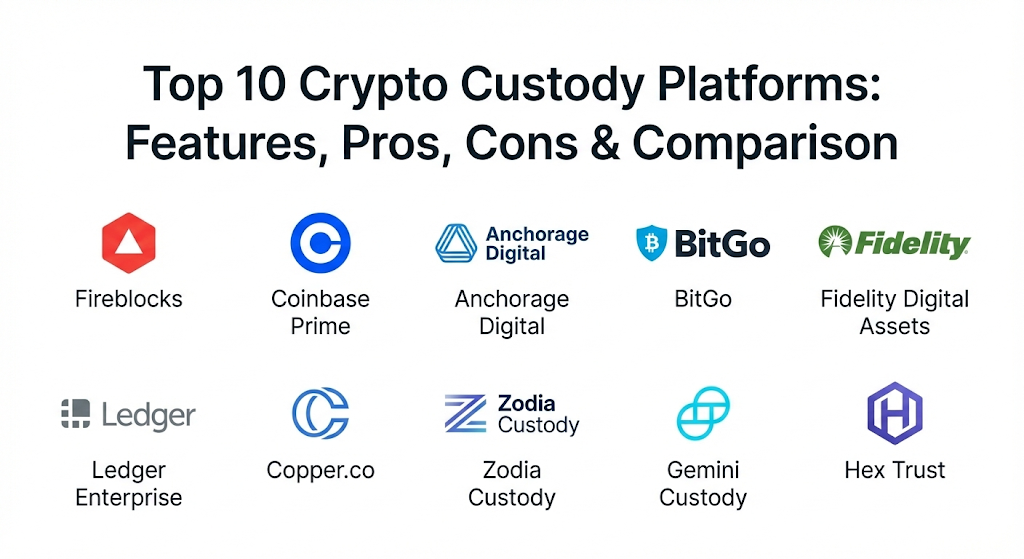
Top 10 Crypto Custody Platforms
1 — Fireblocks
Fireblocks is a leading enterprise-grade platform for moving, storing, and issuing digital assets. In 2026, it remains the gold standard for high-frequency trading and high-volume operations due to its innovative MPC-CMP technology.
- Key Features:
- Proprietary MPC-CMP cryptography for ultra-fast transaction signing.
- Policy Engine for granular control over workflows and approvals.
- Integration with over 1,800 exchanges and liquidity providers via the Fireblocks Network.
- Support for thousands of digital assets, including tokens and NFTs.
- Tokenization engine for creating and managing stablecoins and security tokens.
- Cold and hot wallet management within a single interface.
- Real-time automated AML/KYT (Know Your Transaction) screening.
- Pros:
- Unmatched speed and scalability for high-volume institutional desks.
- Highly flexible policy configurations that adapt to complex organizational hierarchies.
- Cons:
- Significant technical overhead for initial integration and API setup.
- Premium pricing that can be expensive for smaller emerging funds.
- Security & Compliance: SOC 2 Type II, ISO 27001, and ISO 27017/27018 certified. Uses Hardware Security Modules (HSMs) and TEEs for key fragment isolation.
- Support & Community: 24/7 dedicated enterprise support, extensive developer documentation, and a robust community of financial institutions.
2 — Coinbase Prime (Custody)
As a publicly-traded company in the U.S., Coinbase Prime offers a “trust-first” approach to custody. It provides a seamless transition from safe storage to professional trading and staking.
- Key Features:
- Qualified Custodian status through Coinbase Custody Trust Company, LLC.
- Integrated prime brokerage services, including advanced execution and liquidity.
- Segregated cold storage with 100% offline private keys.
- Direct institutional staking for major networks like Ethereum and Solana.
- Advanced reporting and tax documentation tools.
- Programmatic access via robust institutional APIs.
- Pros:
- Extreme brand trust and regulatory transparency as a NASDAQ-listed entity.
- Deep liquidity integration allows for large-scale trading directly from custody.
- Cons:
- Higher custody and trading fees compared to software-only infrastructure.
- Customer support can be slower for non-priority clients during high-market volatility.
- Security & Compliance: Regulated by the NYDFS as a Limited Purpose Trust Company. SOC 1 and SOC 2 Type II certified.
- Support & Community: Dedicated account managers for high-net-worth and institutional clients; vast public knowledge base.
3 — Anchorage Digital
Anchorage Digital distinguishes itself as the first federally chartered crypto bank in the United States. It provides a unique blend of traditional banking security with cutting-edge digital asset tech.
- Key Features:
- Only OCC-chartered national bank dedicated to digital assets in the U.S.
- Bankruptcy-remote custody structure for ultimate investor protection.
- Hardware-based security that eliminates the need for “human” cold storage delays.
- Integrated lending, staking, and governance participation.
- Support for a wide range of EVM and non-EVM blockchains.
- Seamless USD and stablecoin on/off-ramps within one portal.
- Pros:
- Federal regulatory status provides unparalleled legal peace of mind for U.S. institutions.
- Fast withdrawal times compared to traditional “cold storage” legacy systems.
- Cons:
- Strict onboarding requirements and high minimum asset thresholds.
- Limited availability for retail or smaller corporate entities.
- Security & Compliance: Qualified Custodian; oversight from the OCC (U.S.) and MAS (Singapore). Advanced cryptographic hardware security.
- Support & Community: Institutional-grade concierge support; white-glove onboarding for banks and asset managers.
4 — BitGo
BitGo is widely regarded as the pioneer of multi-signature (multi-sig) security. In 2026, BitGo continues to serve as the infrastructure backbone for many of the world’s leading crypto exchanges.
- Key Features:
- Battle-tested multi-sig technology (2-of-3 or 3-of-5 structures).
- Integrated insurance coverage of up to $250 million.
- Cold and hot wallet solutions tailored for specific risk appetites.
- Qualified Custody via BitGo Trust Company.
- Support for over 600 tokens and dozens of major blockchains.
- Go-to market for white-label wallet infrastructure for other platforms.
- Pros:
- Transparent, long-standing security track record with zero historical hacks of its core custody.
- Broadest industry adoption as a sub-custodian for other fintech players.
- Cons:
- The UI can feel more technical and “infrastructure-focused” than consumer-friendly.
- Multi-sig can occasionally be more expensive in network fees for certain complex chains.
- Security & Compliance: Regulated by the South Dakota Division of Banking. SOC 2 Type II certified.
- Support & Community: High-quality developer APIs, 24/7 support, and a highly active presence in industry standards committees.
5 — Fidelity Digital Assets
Fidelity brings traditional finance (TradFi) pedigree to the crypto world. Its platform is designed for institutions that require the same level of security they expect from a legacy investment bank.
- Key Features:
- Omnibus storage structure that balances high security with liquidity.
- Hardware-based cold storage in physically hardened, TEMPEST-shielded facilities.
- Integrated trade execution and market data services.
- 24/7 internal monitoring and radio-frequency-blocked secure sites.
- Direct staking support for institutional Ether holders.
- Strict non-rehypothecation policy (assets are never lent out).
- Pros:
- The comfort of a 75-year-old financial brand with trillions in AUM.
- Superior physical security protocols that exceed typical software-only firms.
- Cons:
- Very limited asset selection, typically focusing only on the “blue chips” (BTC and ETH).
- US-only focus for the primary retail-integrated services.
- Security & Compliance: NYDFS-chartered trust company. SOC 1 and 2 certified.
- Support & Community: White-glove institutional service; deeply integrated with Fidelity’s broader advisor network.
6 — Ledger Enterprise
Ledger Enterprise leverages the world-famous security of Ledger’s hardware devices but scales it for massive corporate teams and high-security governance.
- Key Features:
- Hardware-based security using Secure Element (SE) chips.
- Governance platform for defining complex approval rules and daily limits.
- Dedicated DeFi and NFT management tools with secure “Clear Signing.”
- Integration with major staking providers directly through the dashboard.
- Multi-layer security combining MPC and hardware isolation.
- Real-time audit logs and compliance reporting.
- Pros:
- Combines the “best of both worlds”: hardware security and software agility.
- Excellent for managing complex web3 assets like NFTs and DeFi positions.
- Cons:
- Setup requires physical hardware management for key personnel.
- May be slower to add new, obscure chains compared to pure software MPC platforms.
- Security & Compliance: SOC 2 Type II and ISO 27001 certified. Secure Element chips with EAL5+ security ratings.
- Support & Community: Enterprise-grade customer success teams; extensive library of webinars and tutorials.
7 — Copper.co
Copper is famous for its ClearLoop technology, which allows institutional investors to trade on centralized exchanges without moving their assets out of secure custody.
- Key Features:
- ClearLoop off-exchange settlement to eliminate counterparty risk.
- MPC-based key management for secure and agile transactions.
- Advanced collateral management for prime brokerage activities.
- Support for over 500 assets and 40+ blockchains.
- Dedicated staking and governance dashboards.
- White-label custody solutions for regional banks.
- Pros:
- ClearLoop is a massive advantage for traders who fear exchange hacks.
- Highly responsive and modern user interface designed for traders.
- Cons:
- Primarily focused on institutional clients; not suitable for individuals.
- Regulatory footprint is evolving and varies by jurisdiction.
- Security & Compliance: SOC 2 certified; insurance backed by A+ rated insurers.
- Support & Community: Strong presence in the European and Middle Eastern markets; active institutional user group.
8 — Zodia Custody
Zodia is a bank-backed custody provider (Standard Chartered and Northern Trust) that brings a compliance-first “bank-grade” mentality to digital assets.
- Key Features:
- Cold-wallet by design infrastructure that minimizes attack surfaces.
- “Interchange” solution for off-exchange settlement (similar to ClearLoop).
- Real-time transaction monitoring and sanctions screening.
- Specialized support for tokenized real-world assets (RWAs).
- Staking services with curated, pre-vetted validators.
- Fully white-labelled solutions for other financial institutions.
- Pros:
- Massive institutional backing provides deep financial stability.
- Specifically built to meet the needs of regulated Tier-1 banks.
- Cons:
- Slower to implement experimental or highly speculative “degen” assets.
- Operations are currently more concentrated in the UK, Europe, and Asia.
- Security & Compliance: Regulated by the FCA (UK) and CBI (Ireland). SOC compliant and audited.
- Support & Community: High-touch bank-level relationship management.
9 — Gemini Custody
Gemini, founded by the Winklevoss twins, was one of the first platforms to obtain a trust charter. It remains a top choice for those seeking high security with a user-friendly interface.
- Key Features:
- Regulated by the New York State Department of Financial Services (NYDFS).
- Up to $200 million in cold storage insurance.
- Support for over 100 assets, including major stablecoins and DeFi tokens.
- Instant liquidity for assets held in custody through the Gemini exchange.
- SOC 1 Type II and SOC 2 Type II certifications.
- Hardware security modules (HSMs) for air-gapped cold storage.
- Pros:
- One of the best user interfaces in the institutional space.
- Very strong regulatory standing in the United States.
- Cons:
- Trading fees on the basic platform are high compared to advanced competitors.
- Staking rewards can be lower due to higher internal commissions.
- Security & Compliance: Qualified Custodian status. First custodian to achieve both SOC 1 and 2.
- Support & Community: 24/7 priority support for institutional tiers; robust retail knowledge base.
10 — Hex Trust
Hex Trust is the leading institutional custodian in Asia, providing a gateway for global institutions to access the digital asset markets in the East.
- Key Features:
- Hex Safe platform for institutional-grade asset management.
- Specialized NFT dashboard for managing digital artwork and game assets.
- Licensed and regulated across Hong Kong, Singapore, and Dubai (VARA).
- Institutional-grade staking with 24/7 monitoring.
- Full segregation of roles to eliminate insider threats.
- SWIFT/FIX connectivity for traditional finance integrations.
- Pros:
- Deepest localized expertise in the APAC and Middle East regulatory regions.
- Unique focus on the “Gaming” and “Metaverse” economy.
- Cons:
- Less brand recognition in the United States and North American markets.
- The platform can feel overwhelming due to the variety of services offered.
- Security & Compliance: SOC 2 compliant; insurance coverage for all storage tiers.
- Support & Community: Regional hubs in major Asian financial centers; high-touch client service.
Comparison Table
| Tool Name | Best For | Platform(s) Supported | Standout Feature | Rating (G2/Expert) |
| Fireblocks | High-volume Ops | Web, API, iOS/Android | MPC-CMP Speed | 4.9/5 |
| Coinbase Prime | U.S. Institutions | Web, API | NASDAQ Trust & Liquidity | 4.8/5 |
| Anchorage | Fed-Regulated Bank | Web, iOS, API | OCC Federal Charter | 4.7/5 |
| BitGo | Exchange Infra | Web, API | Multi-sig Pioneer | 4.7/5 |
| Fidelity DA | TradFi Pedigree | Web | TEMPEST-shielded Vaults | 4.6/5 |
| Ledger Ent. | Hardware Control | Web, Hardware | Clear Signing & SE Chips | 4.7/5 |
| Copper.co | Traders/Settlement | Web, API | ClearLoop (Off-Exchange) | 4.6/5 |
| Zodia Custody | Bank-grade Security | Web, API | Cold-Wallet by Design | 4.5/5 |
| Gemini Custody | Ease of Use | Web, iOS/Android | SOC 1 & 2 Audited | 4.5/5 |
| Hex Trust | Asia/NFT Focus | Web, API | Hex Safe NFT Dashboard | 4.4/5 |
Evaluation & Scoring of Crypto Custody Platforms
| Criteria | Weight | Scoring Rubric |
| Core Security Features | 25% | Evaluation of MPC/Multi-sig, HSM usage, and “cold” vs “warm” efficiency. |
| Ease of Use | 15% | Intuitiveness of the dashboard and ease of multi-user approval flows. |
| Integrations | 15% | Availability of trading, staking, DeFi access, and API robustness. |
| Security & Compliance | 10% | Licensing (Trust/Bank), SOC audits, and insurance limits. |
| Performance & Reliability | 10% | Uptime, transaction signing speed, and withdrawal latency. |
| Support & Community | 10% | Quality of account management and documentation. |
| Price / Value | 15% | Transparency of AUM fees and trade execution spreads. |
Which Crypto Custody Platform Tool Is Right for You?
Solo Users vs SMB vs Mid-Market vs Enterprise
- Solo High-Net-Worth (HNW): Look at Gemini Custody or Coinbase. They offer institutional-grade protection but with interfaces that an individual can navigate.
- SMB / Emerging Funds: BitGo or Fireblocks are excellent. They allow you to start with professional infrastructure that can scale as your fund grows.
- Enterprise / Traditional Banks: Zodia, Fidelity, or Anchorage are the top choices. Their focus on bank-level compliance and federal charters makes them a natural fit for internal compliance departments.
Budget-Conscious vs Premium Solutions
- Budget-Conscious: BitGo or Hex Trust often offer flexible pricing models. Using software-only MPC fragments can reduce the costs associated with physical vault maintenance.
- Premium: Fidelity Digital Assets and Coinbase Prime are premium services. You pay for the brand, the absolute regulatory peace of mind, and the comprehensive service suite.
Security and Compliance Requirements
If you are a U.S. institutional investor, Anchorage Digital (Federal Bank) and Fidelity (NYDFS Trust) are your primary choices for meeting “Qualified Custodian” requirements. For traders operating in the UK or Asia, Zodia or Hex Trust provide the necessary local regulatory frameworks.
Frequently Asked Questions (FAQs)
1. What is the difference between a hot and cold wallet?
A hot wallet is connected to the internet, allowing for fast transactions but carrying higher hack risks. A cold wallet keeps private keys offline, often in a physical vault, making it the gold standard for long-term security.
2. Is my crypto insured on these platforms?
Most institutional platforms carry insurance (e.g., Gemini and BitGo have $200M+ policies). However, this usually covers theft or hardware failure, not a drop in the asset’s market price.
3. What is Multi-Party Computation (MPC)?
MPC is a cryptographic technique where a private key is never fully created in one place. Instead, multiple “shards” are generated on different devices, ensuring no single piece of information can be used to steal funds.
4. Why can’t I just use a hardware wallet like a Ledger Nano?
For individuals, you can. For a fund managing $100M, a single hardware wallet is a “single point of failure.” Institutional platforms provide governance—requiring multiple people (e.g., 3 out of 5 directors) to approve a spend.
5. How long does a withdrawal take?
It varies. “Hot” MPC transactions take seconds. Traditional “Cold” storage might take 24–48 hours because it requires a human in a physical vault to verify the request.
6. What is a “Qualified Custodian”?
In the U.S., a qualified custodian is a regulated entity (like a bank or trust company) that is legally permitted to hold client assets in a way that protects them from the custodian’s own creditors if they go bankrupt.
7. Can I earn interest on my crypto in custody?
Yes, platforms like Anchorage and Coinbase Prime allow you to stake your assets directly from cold storage, letting you earn rewards (yield) while keeping the assets safe.
8. What happens if the custody company goes bankrupt?
On regulated platforms like Anchorage or Fidelity, your assets are held in segregated accounts. This means they are not part of the company’s assets and should be returned to you in full.
9. Are these platforms safe from “insider threats”?
Yes. Through “role-based access control” (RBAC), no single employee at the custody firm can access your keys. Most systems require “m-of-n” approvals from your team to initiate any move.
10. Do I have to do KYC (Know Your Customer)?
Yes. Every institutional platform on this list requires strict identity verification for the company and all individuals who will have access to the account.
Conclusion
The crypto custody landscape in 2026 is no longer the “Wild West.” It is an industry defined by SOC audits, federal bank charters, and advanced MPC cryptography. Choosing the “best” platform depends entirely on your operational needs: Fireblocks is the clear winner for high-velocity traders, Fidelity and Anchorage lead for those seeking maximum regulatory security, and Ledger Enterprise remains the top choice for those who want to blend hardware control with corporate governance.
When making your decision, prioritize Qualified Custody and Insurance. In the digital asset world, security is not an expense—it is the foundation upon which all other investment activities are built.

- Top 10 Email Deliverability Tools: Features, Pros, Cons & Comparison - September 6, 2026
- Top 10 Pharmacovigilance Software: Features, Pros, Cons & Comparison - September 6, 2026
- Top 10 Manufacturing Execution Systems (MES) - July 30, 2026