Introduction
Cloud Identity Security Tools are a set of solutions designed to manage and secure user identities in cloud environments. These tools are essential in ensuring that only authorized users can access cloud resources while protecting sensitive data from unauthorized access. With the increasing reliance on cloud computing and SaaS platforms, organizations face significant security challenges around identity and access management.
The importance of Cloud Identity Security Tools lies in their ability to provide robust authentication, authorization, and auditing mechanisms to safeguard cloud-based applications, networks, and data. These tools help organizations protect user identities, enforce policies, and prevent unauthorized access, reducing the risk of data breaches and security incidents.
Key real-world use cases include managing access to cloud applications, ensuring compliance with security standards such as GDPR and HIPAA, enabling Single Sign-On (SSO) for seamless user experiences, and preventing identity theft and fraud. When selecting a Cloud Identity Security Tool, organizations should evaluate factors such as integration capabilities, security features, ease of use, and scalability.
Best for:
Cloud Identity Security Tools are best for security teams, IT administrators, and organizations using cloud-based services and applications. They are crucial for companies of all sizes, particularly those in industries such as finance, healthcare, and technology, which handle sensitive data and need to ensure strong identity management practices.
Not ideal for:
Smaller organizations or those with minimal cloud infrastructure may not require advanced cloud identity security tools. In such cases, simpler authentication and access management solutions may suffice.
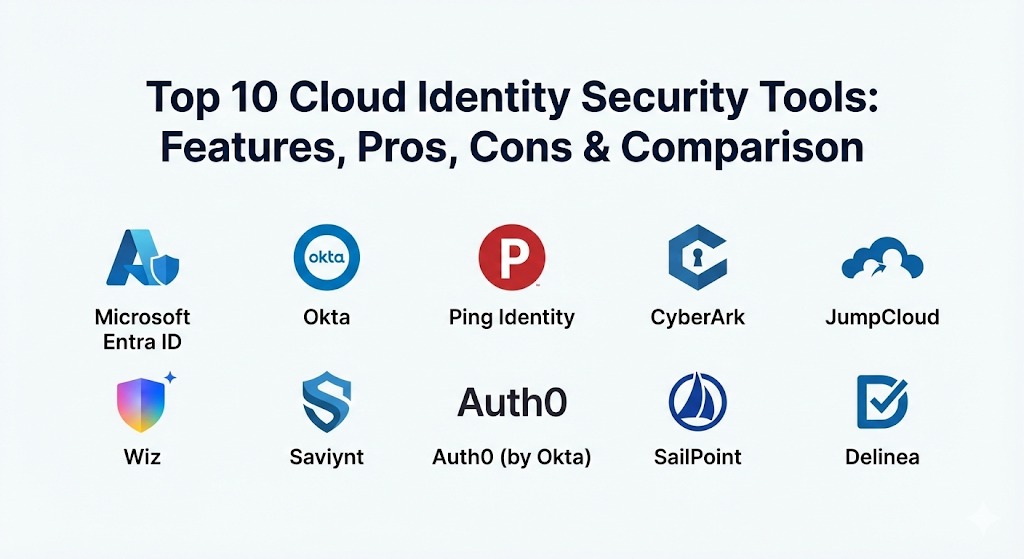
Top 10 Cloud Identity Security Tools
1 — Okta Identity Cloud
Short description:
Okta Identity Cloud is a comprehensive identity management solution that provides secure access to applications and resources across cloud environments. It is designed for enterprises seeking robust security, user management, and compliance capabilities. Okta offers both cloud-native and hybrid identity management, making it a versatile tool for businesses transitioning to the cloud or managing a combination of on-premise and cloud resources. With a user-friendly interface and extensive integrations with third-party applications, Okta simplifies identity and access management at scale.
Key features:
- Single Sign-On (SSO) for seamless access to applications
- Multi-Factor Authentication (MFA) for added security
- Adaptive authentication based on user behavior
- API access management and secure cloud integrations
- User lifecycle management and self-service features
- Enterprise-grade security with SOC 2 and GDPR compliance
Pros:
- Easy to integrate with hundreds of applications
- High scalability for large enterprises
- Strong user and group management features
Cons:
- Premium pricing for larger teams
- Advanced features may require technical expertise
Security & compliance:
SOC 2, HIPAA, ISO 27001, GDPR, encryption at rest and in transit.
Support & community:
Comprehensive documentation, enterprise support, onboarding resources, active user community.
2 — Microsoft Azure Active Directory (Azure AD)
Short description:
Microsoft Azure AD is a cloud-based identity and access management service that offers secure, scalable, and cost-effective identity management for enterprises. It is designed for organizations already leveraging Microsoft cloud products. Azure AD offers extensive integration with other Microsoft services, providing users with a seamless experience across applications, devices, and platforms. It’s ideal for businesses that rely heavily on Microsoft 365 and other Microsoft-based infrastructure, ensuring a unified security model.
Key features:
- SSO for Microsoft and third-party applications
- Conditional access policies
- MFA and passwordless authentication
- Seamless integration with Microsoft 365 and other services
- User and device management
- Compliance with major security standards
Pros:
- Deep integration with Microsoft products
- Robust support for enterprise environments
- Strong security features with flexible access policies
Cons:
- Can be complex for non-Microsoft environments
- Requires an Azure subscription for full features
Security & compliance:
SOC 2, HIPAA, ISO 27001, GDPR, MFA support, advanced threat protection.
Support & community:
Extensive Microsoft support, large user community, detailed documentation.
3 — Ping Identity
Short description:
Ping Identity provides an intelligent identity and access management solution designed to support both on-premise and cloud environments. It enables secure SSO, MFA, and adaptive authentication across applications. With a strong focus on identity federation and user access policies, Ping Identity supports complex and hybrid IT infrastructures. Its flexibility and powerful features make it an excellent choice for enterprises looking to streamline access management and improve security across diverse environments.
Key features:
- Adaptive authentication and risk-based policies
- Enterprise-grade SSO and federated identity management
- Secure API and cloud service access
- Self-service password management
- Integration with legacy systems and modern cloud apps
- Identity governance and compliance reporting
Pros:
- Comprehensive identity federation support
- Scalable for large and complex environments
- Strong security and compliance features
Cons:
- Initial setup can be challenging
- Price may be prohibitive for small businesses
Security & compliance:
SOC 2, HIPAA, ISO 27001, GDPR, encryption, and audit logs.
Support & community:
Robust enterprise support, extensive documentation, and global customer community.
4 — Auth0
Short description:
Auth0 is a flexible identity management platform that simplifies authentication and authorization processes for developers. It is ideal for building secure login experiences across web, mobile, and enterprise applications. Auth0 allows companies to customize their authentication flows, ensuring a seamless user experience while maintaining high-security standards. It supports numerous login methods, including social login, enterprise login, and passwordless authentication, making it versatile for different use cases.
Key features:
- Customizable authentication and SSO
- MFA and passwordless login options
- Social and enterprise login integrations
- Universal login page for branding
- Rules engine for fine-grained access control
- Built-in compliance with security standards
Pros:
- Developer-friendly with extensive APIs and SDKs
- Easy to implement and highly customizable
- Supports a wide range of login providers
Cons:
- May require developer resources for advanced customization
- Limited advanced features in the basic plan
Security & compliance:
SOC 2, GDPR, ISO 27001, encrypted data storage.
Support & community:
Strong developer community, robust documentation, dedicated support.
5 — IBM Security Identity Governance and Intelligence
Short description:
IBM Security Identity Governance and Intelligence offers comprehensive identity and access management solutions with an emphasis on compliance and governance, ideal for large enterprises with complex security needs. This tool provides detailed reporting, automated workflows, and extensive access controls, ensuring that only authorized users have access to critical resources. Its ability to automate the process of access request approvals and audits makes it an efficient choice for highly regulated industries.
Key features:
- Identity lifecycle management and automation
- Access request and approval workflows
- Role-based access control (RBAC) and entitlement management
- Compliance reporting and audit logs
- Self-service password reset and profile management
- Integration with cloud and on-premise applications
Pros:
- Excellent governance and compliance features
- Scalable for large enterprises
- Flexible access management
Cons:
- Complex deployment and configuration
- High cost for smaller organizations
Security & compliance:
SOC 2, HIPAA, ISO 27001, GDPR, advanced encryption.
Support & community:
Comprehensive enterprise support, detailed product documentation, large customer base.
6 — OneLogin
Short description:
OneLogin offers a comprehensive cloud-based identity and access management platform that delivers secure SSO, MFA, and user provisioning across cloud and on-premise applications. With a focus on simplicity, OneLogin is suitable for SMBs and enterprises that need a solution that is easy to deploy and manage. It also offers a unified experience for users across applications, making it an excellent tool for improving user productivity while maintaining security.
Key features:
- SSO for cloud and on-premise applications
- MFA and contextual access policies
- Directory integration and management
- User provisioning and lifecycle automation
- Reporting and analytics dashboards
- Custom branding for login experiences
Pros:
- Simple user interface and easy-to-deploy solution
- Affordable pricing for small to mid-sized businesses
- Integrates with a wide range of third-party applications
Cons:
- Limited advanced features in lower-tier plans
- Can be slower to scale in large environments
Security & compliance:
SOC 2, HIPAA, ISO 27001, GDPR, SSO, and MFA support.
Support & community:
Strong documentation, dedicated customer support, and a growing user community.
7 — CyberArk Identity
Short description:
CyberArk Identity focuses on privileged access management (PAM) and identity security, providing secure authentication and governance for high-risk user accounts and applications. This tool is especially valuable for organizations with complex IT environments that require strict control over access to critical systems and data. CyberArk offers in-depth monitoring and auditing of privileged users, ensuring comprehensive access management.
Key features:
- Privileged access management and monitoring
- Adaptive authentication and risk analysis
- Session recording for privileged accounts
- Cloud and on-premise integration
- Comprehensive reporting and analytics
- Identity governance and compliance tools
Pros:
- Strong focus on privileged accounts and high-risk access
- Ideal for industries with strict compliance requirements
- Extensive auditing and monitoring capabilities
Cons:
- Requires significant setup and maintenance
- High cost for smaller businesses
Security & compliance:
SOC 2, HIPAA, ISO 27001, GDPR, MFA and SSO support.
Support & community:
Enterprise-grade support, documentation, professional services.
8 — JumpCloud
Short description:
JumpCloud is a cloud-based directory platform that provides secure identity management and centralized access control across cloud and on-premise resources. It offers a cost-effective solution for SMBs that need to streamline user management and ensure security across multiple platforms. JumpCloud provides seamless integration with cloud-based applications, making it a great choice for businesses shifting to cloud-first strategies.
Key features:
- Centralized directory for user management
- SSO and MFA support
- System and application provisioning
- User lifecycle management
- Integration with cloud and on-premise environments
- Reporting and compliance features
Pros:
- Affordable for SMBs
- Simple to deploy and manage
- Strong integration with cloud applications
Cons:
- Limited advanced security features compared to larger platforms
- Basic reporting in lower-tier plans
Security & compliance:
SOC 2, HIPAA, GDPR, SSO, and MFA support.
Support & community:
Good documentation, responsive customer support, active user community.
9 — SecureAuth
Short description:
SecureAuth offers adaptive authentication and identity security solutions, focusing on providing secure access with a focus on preventing fraud and identity theft. This tool is ideal for organizations that need to secure high-risk user accounts while providing a seamless login experience. SecureAuth offers unique fraud prevention capabilities, including behavior analysis and risk-based authentication.
Key features:
- Adaptive MFA and passwordless login
- Fraud detection and prevention capabilities
- Identity protection across cloud and on-premise systems
- API access management and integrations
- Risk-based access policies
- Customizable login experiences
Pros:
- Strong fraud prevention features
- Scalable for enterprises and cloud environments
- Customizable and flexible authentication
Cons:
- Requires expertise for advanced configuration
- Can be complex for small organizations
Security & compliance:
SOC 2, HIPAA, ISO 27001, encryption, advanced fraud detection.
Support & community:
Enterprise support, onboarding services, documentation, active user community.
10 — Centrify Identity-Centric Security
Short description:
Centrify provides identity-centric security solutions with a focus on securing both privileged access and regular user identities in hybrid IT environments. Centrify is highly suitable for organizations operating in complex hybrid environments, ensuring comprehensive security policies and access controls across both cloud and on-premise systems.
Key features:
- Privileged access management (PAM)
- SSO and MFA for cloud and on-premise systems
- Risk-based authentication
- Identity and access governance
- Cloud application security
- Detailed auditing and compliance reporting
Pros:
- Comprehensive identity governance features
- Ideal for hybrid IT environments
- Strong PAM capabilities
Cons:
- Complexity of setup and management
- High cost for SMBs
Security & compliance:
SOC 2, HIPAA, ISO 27001, GDPR, MFA and SSO support.
Support & community:
Enterprise-grade support, extensive documentation, professional services.
Comparison Table
| Tool Name | Best For | Platform(s) Supported | Standout Feature | Rating |
|---|---|---|---|---|
| Okta Identity Cloud | Enterprises | Cloud, SaaS, mobile apps | Comprehensive SSO | N/A |
| Azure Active Directory | Microsoft-centric organizations | Cloud, Microsoft services | Deep Microsoft integration | N/A |
| Ping Identity | Enterprises with complex identity needs | Cloud, SaaS | Identity federation | N/A |
| Auth0 | Developers, startups | Web, mobile, enterprise apps | Customizable authentication | N/A |
| IBM Security Identity Governance | Large enterprises | Cloud, on-prem | Identity lifecycle management | N/A |
| OneLogin | SMBs, mid-market | Cloud, SaaS | User provisioning and SSO | N/A |
| CyberArk Identity | High-risk industries | Cloud, on-prem | Privileged access management | N/A |
| JumpCloud | SMBs, cloud-first organizations | Cloud, on-prem | Centralized directory | N/A |
| SecureAuth | Enterprises with high fraud risk | Cloud, hybrid environments | Adaptive MFA | N/A |
| Centrify | Hybrid IT environments | Cloud, on-prem | Identity-centric security | N/A |
Evaluation & Scoring of Cloud Identity Security Tools
| Criteria | Weight | Notes |
|---|---|---|
| Core features | 25% | SSO, MFA, access control, governance |
| Ease of use | 15% | User-friendly interface and setup |
| Integrations & ecosystem | 15% | Support for cloud and on-prem environments |
| Security & compliance | 10% | MFA, encryption, audit logs, compliance readiness |
| Performance & reliability | 10% | Speed, uptime, and accuracy of identity verification |
| Support & community | 10% | Documentation, customer support, user community |
| Price / value | 15% | Cost vs feature set |
Which Cloud Identity Security Tool Is Right for You?
- Solo users: JumpCloud or OneLogin offer affordable, easy-to-use solutions.
- SMBs: OneLogin, Auth0, or JumpCloud provide a good balance of features and pricing.
- Mid-market: Okta or Ping Identity offer scalability and strong integration features.
- Enterprise: Okta, CyberArk, or Centrify are suited for large, complex environments with high security needs.
Frequently Asked Questions (FAQs)
1. What are Cloud Identity Security Tools used for?
They help manage and secure user identities and access to cloud-based systems and applications.
2. Why is MFA important?
MFA adds an extra layer of security, requiring users to provide multiple forms of authentication.
3. How do I integrate Cloud Identity Security Tools with my systems?
These tools typically provide APIs and integrations for cloud, on-premise, and third-party apps.
4. Are Cloud Identity Security Tools expensive?
Prices vary; many tools offer tiered pricing, with enterprise plans costing more.
5. What is the best Cloud Identity Security Tool for small businesses?
JumpCloud and OneLogin are affordable and feature-rich for SMBs.
6. Can these tools prevent identity theft?
Yes, they provide secure authentication mechanisms that prevent unauthorized access.
7. Are Cloud Identity Security Tools GDPR compliant?
Many of these tools are GDPR-compliant and offer data encryption and audit logs.
8. Can Cloud Identity Security Tools integrate with my current IT infrastructure?
Most tools integrate well with existing cloud and on-premise systems.
9. What is Single Sign-On (SSO)?
SSO allows users to log in once and access multiple applications without re-entering credentials.
10. How secure are these tools?
These tools use encryption, MFA, and advanced authentication policies to ensure security.
Conclusion
Cloud Identity Security Tools are crucial for protecting user identities and sensitive data across cloud environments. Whether you’re managing a small business or an enterprise, choosing the right tool depends on your specific security needs, integrations, and budget. By evaluating each tool’s features, security capabilities, and support options, organizations can ensure their cloud environments are secure and compliant. Remember, there is no one-size-fits-all solution—what works best for your organization will depend on the complexity of your systems and the scale of your operations.

- Top 10 Email Deliverability Tools: Features, Pros, Cons & Comparison - September 6, 2026
- Top 10 Pharmacovigilance Software: Features, Pros, Cons & Comparison - September 6, 2026
- Top 10 Manufacturing Execution Systems (MES) - July 30, 2026
This is a very useful comparison of cloud identity security tools, especially for organizations moving to hybrid and multi-cloud environments where identity has effectively become the new perimeter. Cloud identity security matters because most breaches today involve compromised credentials, excessive permissions, weak MFA posture, or poor lifecycle controls, and these tools help reduce that risk through stronger authentication, continuous access evaluation, privileged access controls, and visibility into risky sign-ins and misconfigurations. The features, pros, and cons format makes it easier to assess real-world fit, such as integration with existing IAM and SSO, conditional access and MFA capabilities, identity threat detection, least-privilege enforcement, reporting for audits, and ease of rollout across many users and applications. Overall, this guide is valuable for security and IT leaders who want to harden access, improve compliance, and reduce identity-driven attack paths without creating friction for end users.