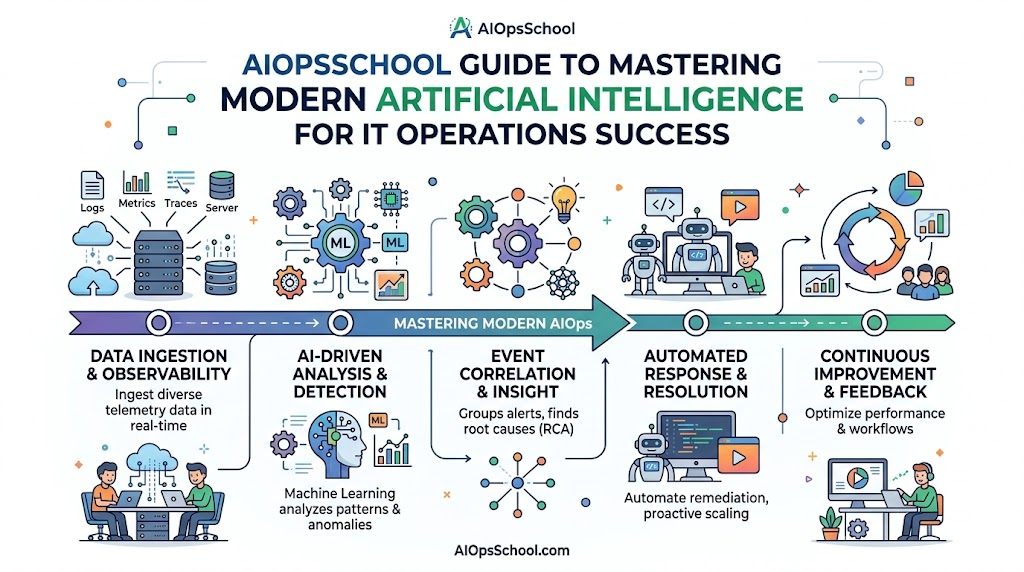
The modern enterprise IT infrastructure is expanding at an unprecedented rate, generating massive streams of telemetry data every second. Consequently, operations engineering teams frequently face massive alert fatigue, where crucial system signals get buried under thousands of redundant notifications. Traditional monitoring tools fall short because they lack the intelligence to correlate disparate events across multi-cloud environments. Therefore, engineering teams require a more sophisticated mechanism to maintain system reliability and prevent costly downtime. Investing in comprehensive AIOps Training has become the primary strategy for teams striving to navigate this operational complexity. By understanding how machine learning applies to system health, engineering professionals can transform chaotic workflows into proactive environments. To bridge this knowledge gap effectively, professionals can leverage specialized educational platforms like AiOpsSchool to build real-world competence.
The Operational Reality Behind What is AIOps
To survive in this fast-paced software landscape, understanding What is AIOps is no longer optional for infrastructure teams. In plain terms, Artificial Intelligence for IT Operations represents the application of machine learning, data science, and advanced analytics to modern infrastructure management. It does not replace human engineering talent; instead, it acts as an intelligent assistant that processes vast operational datasets at scale. Furthermore, it ingests unstructured logs, metrics, and network traces to uncover hidden patterns that human operators might miss. As a result, teams shift from a reactive state of fighting fires to a proactive state of continuous optimization.
Key Operational Concepts You Must Know
Before deploying any intelligent algorithms, engineering teams must master the fundamental building blocks of AIOps in IT operations. First, observability forms the foundation, moving beyond simple uptime checks to provide deep visibility into internal system states. This baseline relies heavily on telemetry data, which comprises logs, metrics, and distributed traces gathered from every layer of the software stack. Additionally, event correlation acts as the filtering mechanism, grouping thousands of scattered alerts into a single, cohesive operational incident. By comparing real-time telemetry against historical data, systems can differentiate between a normal baseline vs. an anomaly. Ultimately, this leads to automated remediation, where software automatically executes predefined scripts to resolve known infrastructure failures without manual intervention.
Driving Career Growth Through AIOps for Beginners
Starting a new technical journey can feel overwhelming, but AIOps for beginners offers an accessible and highly rewarding pathway.
- Modern cloud environments have grown too complex for manual oversight, making automated intelligence an absolute necessity for enterprise sustainability.
- Industry demand for professionals who understand intelligent automation is skyrocketing, leading to premium salary packages and faster career advancement.
- Transitioning early into this domain establishes your authority as a forward-thinking infrastructure engineer who solves problems using data science.
Navigating the Technical Landscape: AIOps vs DevOps vs MLOps
Understanding how different operational paradigms intersect is crucial for modern enterprise architecture. While they share common goals regarding software delivery and system stability, their core focus areas differ significantly.
| Concept | Primary Focus | Core Question It Answers |
|---|---|---|
| AIOps vs DevOps | Applying machine learning to automate and optimize IT operations and incident management. | How can we use data science to detect and fix production issues faster? |
| DevOps | Streamlining the software development lifecycle through continuous integration and automated deployment. | How can we safely accelerate the delivery of code from development to production? |
| AIOps vs MLOps | Operationalizing, deploying, and monitoring machine learning models within enterprise production environments. | How do we reliably manage the lifecycle of AI models at scale? |
Platform Implementation vs. Culture — What’s the Real Difference?
Many enterprise organizations mistakenly treat intelligent operations as a simple software package that they can install and forget. In reality, successful adoption requires a profound cultural shift that redefines how cross-team collaboration occurs across engineering silos. Furthermore, building absolute trust in automation is a gradual process that demands strict change management and continuous validation. Buying and configuring a modern platform represents only a fraction of the journey; the true challenge lies in establishing healthy operational habits. Therefore, engineering teams must focus heavily on structured AIOps Training to ensure their staff can interpret machine learning insights correctly. Embracing AIOps in IT operations requires moving away from traditional finger-pointing culture and shifting toward shared, data-driven accountability.
| Operational Element | Platform Implementation Focus | Cultural Transformation Focus |
|---|---|---|
| Primary Objective | Configuring software, ingestion pipelines, and alerting dashboards. | Building trust in automated decisions and breaking down team silos. |
| Workflow Impact | Centralizing telemetry data from multi-cloud environments into a single plane. | Adjusting daily engineering habits to respond to predictive insights proactively. |
| Long-Term Value | Providing the underlying computational power and machine learning algorithms. | Ensuring the organization adapts, evolves, and scales with automated remediation. |
Core AIOps Use Cases
Implementing machine learning within your production environment unlocks several critical capabilities that maximize system availability.
- Continuous anomaly detection isolates unusual behavior by comparing live metric streams against dynamically calculated historical baselines.
- Advanced event correlation compresses noisy alert streams, ensuring that on-call engineers receive only actionable notifications.
- Rapid AIOps root cause analysis instantly traces complex system failures across microservices down to the exact offending line of code or configuration change.
- Proactive predictive capacity planning analyzes long-term usage trends to forecast exactly when storage or computational resources will deplete.
- Instant automated remediation triggers self-healing scripts the moment a known failure pattern emerges, eliminating manual triage.
- Seamless integration of AIOps in IT operations shifts the entire engineering department from firefighting to high-value architectural innovation.
Real-World Use Cases of Modern Operations
A major global e-commerce platform utilized intelligent AIOps use cases to automatically detect a sudden, subtle microservice latency spike during a high-traffic holiday sale. Consequently, the system correlated the performance degradation with a recent database configuration change, isolating the issue within ninety seconds. Furthermore, a multinational banking institution deployed these capabilities to monitor security anomalies and transaction patterns across thousands of global ATMs simultaneously. As a result, the automated platform flagged a distributed credential-stuffing attempt and updated firewall rules instantly, protecting millions in customer assets. Additionally, a prominent enterprise SaaS provider leverages intelligent forecasting models to execute predictive capacity planning, saving thousands in monthly cloud over-provisioning costs. Through these diverse applications, AIOps in IT operations continuously proves its immense value across varied enterprise sectors.
AIOps Tools You Should Know
To implement these advanced strategies effectively, engineers must familiarize themselves with the leading AIOps Tools across the enterprise ecosystem. Reviewing a complete AIOps tools list allows infrastructure teams to choose the right framework for their architectural requirements. Furthermore, exploring a structured AIOps Tutorial serves as an excellent next step for mastering these platform categories:
- Monitoring and Observability Platforms: Dynatrace, Datadog, New Relic, ScienceLogic
- Event Correlation and ITSM Tools: BigPanda, PagerDuty, Moogsoft, ServiceNow
- Open-Source Stacks: Prometheus, Grafana, ELK Stack (Elasticsearch, Logstash, Kibana)
- Cloud-Native Services: AWS DevOps Guru, Azure Monitor OpenTelemetry, Google Cloud Operations Suite
Common Mistakes in Operations Engineering
Many organizations stumble during their modernization journey due to predictable, avoidable architectural and cultural blunders. For instance, teams often suffer from over-alerting because they fail to configure proper noise reduction thresholds within their new platform. To fix this, engineers must establish strict filtering rules that prioritize user-facing symptoms over minor, temporary infrastructure blinks. Another prevalent pitfall is treating machine learning software as a “set and forget” appliance without continuous model retraining. Consequently, the system fails to adapt to new deployment patterns, which requires operational teams to treat model maintenance as a standard weekly engineering task.
Furthermore, skipping initial data quality and normalization results in corrupted data ingest, rendering the underlying algorithms completely ineffective. Organizations must validate their telemetry pipelines first, ensuring clean, structured data inputs across all environments before activating machine learning features. Additionally, executing automated remediation too early without establishing human trust can lead to catastrophic, widespread cascading failures across production. The logical remedy is to start with automated recommendations, allowing engineers to validate suggestions manually before granting full execution autonomy. Finally, a total lack of cross-team buy-in isolates the platform within a single department, defeating the purpose of holistic visibility. Leaders must foster open documentation and shared training sessions to demonstrate the collective value of AIOps root cause analysis across all engineering units. Ultimately, embedding AIOps in IT operations successfully depends on balancing technical discipline with organizational empathy.
AIOps for SRE
Site Reliability Engineers benefit immensely from integrating intelligent automation into their daily software maintenance workflows. Specifically, AIOps for SRE directly impacts core reliability metrics by accelerating Mean Time to Detection (MTTD) and Mean Time to Resolution (MTTR). Machine learning models ingest real-time telemetry to flag emerging anomalies before they breach defined Service Level Objectives (SLOs). Consequently, on-call engineers can address underlying system regressions before the end-user experiences any visible slowdown or error. By offloading event correlation to automated software, SREs reclaim valuable time to focus on architectural engineering rather than manual firefighting.
Seeing AIOps in Action
Consider a severe production incident where a containerized payment microservice suddenly began dropping twenty percent of customer transactions. Under traditional monitoring, separate alerts would fire simultaneously for high CPU usage, database connection timeouts, and HTTP 500 error rates. This chaotic scenario leads to finger-pointing between the database administration team, the network engineers, and the application developers.
Fortunately, an intelligent platform running AIOps in IT operations immediately intercepts these fragmented, overlapping alerts. The machine learning engine groups the disparate notifications into a single incident and performs an instant AIOps root cause analysis. Within moments, the platform determines that a rogue code deployment caused a thread pool exhaustion, which blocked database connections. It automatically rolls back the microservice to the previous stable version and verifies that the transaction success rate has returned to normal. Consequently, this automated intervention saves the enterprise thirty minutes of manual investigation, preserving thousands of dollars in transaction revenue.
How to Become an Operations Expert — Career Roadmap
Transitioning into a high-tier operations professional requires a structured approach to learning and practical implementation.
- Build foundational IT experience by mastering cloud computing environments, Linux administration, and standard application monitoring tools.
- Learn core data science and machine learning concepts to understand how algorithms analyze time-series metrics and log patterns.
- Gain hands-on practice with leading industrial platforms through structured courses, practical labs, and comprehensive AIOps Tutorial guides.
- Achieve an industry-recognized AIOps Certification to validate your practical skills and stand out to premium enterprise employers.
- Specialize in a modern discipline like Site Reliability Engineering or Platform Engineering, leveraging your specialized AIOps Course knowledge to architect resilient systems.
Frequently Asked Questions
- What prerequisites should I learn before enrolling in an AIOps Course?Candidates should possess a basic understanding of cloud computing, system monitoring concepts, and general Linux command-line operations. Familiarity with basic scripting languages like Python also helps accelerate your progress through the practical modules.
- How does an AIOps Certification enhance my professional engineering resume?Obtaining this professional credential demonstrates your ability to manage complex cloud architectures using cutting-edge data science methodologies. Consequently, it signals to enterprise employers that you can reduce operational overhead and minimize costly system downtime.
- What is the core focus of an AIOps Foundation Certification program?This foundational program introduces candidates to key concepts including data ingestion pipelines, automated event correlation, anomaly detection, and basic self-healing architectures. It provides the essential vocabulary and theoretical knowledge required for advanced practical implementation.
- Can traditional DevOps engineers transition into this field without a data science degree?Yes, traditional engineers can easily transition because modern platforms abstract the complex underlying mathematical formulas behind clean interfaces. Enrolling in a targeted educational program provides the practical framework needed to apply these models without deep academic research.
- How does automated root cause analysis differ from traditional manual troubleshooting?Manual troubleshooting requires engineers to comb through disparate logs and dashboards while guessing the source of a failure. In contrast, intelligent systems automatically correlate millions of data points across the entire stack to pinpoint the exact failure source in seconds.
- Why are enterprises prioritizing hiring professionals who hold an AIOps Certification?Enterprises face massive financial risks from system downtime and alert fatigue, which traditional monitoring strategies cannot adequately resolve. Certified professionals possess the verified skills to design, build, and maintain intelligent systems that safeguard corporate revenue.
- How often should engineering teams update their automated remediation scripts?Teams should review and update their automated remediation scripts whenever they modify application architecture or introduce new microservices. Continuous validation ensures that self-healing behaviors align perfectly with current production system states.
Why Get an AIOps Certification?
Earning a formal AIOps Certification provides deep personal and professional validation in a highly competitive technology market. First, it offers a structured learning framework that prevents students from getting lost in the overwhelming sea of online resources. Furthermore, holding an AIOps Foundation Certification establishes immediate credibility with hiring managers looking for forward-thinking engineering talent. As enterprise organizations scale their cloud environments, they actively seek professionals who can prove their ability to manage complex automated ecosystems. Ultimately, this specialized credential grants you significant leverage during salary negotiations and opens doors to elite platform engineering positions.
Where to Learn AIOps
Navigating this educational shift requires access to high-quality learning resources, real-world case studies, and expert mentorship. Aspiring professionals must focus on comprehensive learning paths that balance underlying theoretical data science with hands-on enterprise platform configuration. To maximize your educational investment, look for curriculum structures that explicitly cover the following core areas:
- Comprehensive AIOps Training that teaches data ingestion, telemetry processing, and cross-team operational workflows.
- Structured AIOps Course materials focusing on real-world incident resolution, predictive capacity management, and system observability.
- Targeted preparation paths designed to help you clear your formal AIOps Certification exam on the very first attempt.
- Deep-dive AIOps Tutorial exercises providing practical experience with industry-standard monitoring and automation platforms.
Final Thoughts
The rapid evolution of enterprise cloud architecture demands a fundamental shift away from manual, reactive system monitoring. Embracing specialized AIOps Training empowers infrastructure engineers to stay ahead of the curve and build highly resilient production systems. By earning an industry-recognized AIOps Certification, you position yourself as an indispensable asset capable of guiding enterprises through complex automation journeys. Explore the comprehensive learning paths available at AiOpsSchool.com to transform your technical capabilities and secure your place at the forefront of modern operations engineering.

- Accelerating Modern Business Growth Through Intelligent Software Engineering And Scalable Cloud Architectures - September 5, 2026
- Building Resilient Enterprise Cloud Platforms Through Automation And Modern Reliability Engineering - September 5, 2026
- Building Resilient Software Platforms Through Modern Engineering And Enterprise Automation - September 4, 2026