Introduction
Artificial intelligence now drives everyday business operations, turning instruction design into a core competency for modern professionals. Creative workers, software developers, and business strategists routinely spend dozens of hours writing, refining, and testing text inputs, only to misplace those effective phrases across disorganized local files, chat logs, and temporary notes. Mismanaging these high-value assets triggers constant rework, generates unpredictable AI outputs, and drains team productivity. Establishing a unified prompt environment transforms temporary text inputs into structured, reusable digital assets. By adopting an active management system, professionals safeguard output standards, accelerate project delivery, and maximize efficiency across every artificial intelligence workflow.
Why Prompt Management Matters More Than Ever
Integrating generative tools across enterprise workflows demands total consistency from every team member. Companies face significant operational friction when employees interact with AI models using inconsistent phrasing styles and unstructured formats. A centralized repository bridges the gap between chaotic trial-and-error attempts and reliable, repeatable outcomes. Moreover, systematic template management reduces daily cognitive fatigue by eliminating the need to write routine queries from scratch. Treating prompts as evolving technical infrastructure helps organizations preserve operational knowledge effortlessly. Moving to an active management platform turns individual breakthroughs into reliable, enterprise-wide productivity gains.
Common Problems Faced by AI Users
Professionals encounter constant operational hurdles when managing unorganized interactions with language models. Hunting through thousands of past chat logs for an instruction written weeks ago consumes valuable time and focus. Furthermore, subtle changes in prompt wording often produce drastic variations in output quality, triggering costly errors. Departments also waste resources on duplicate efforts when multiple employees independently solve identical prompting problems. Lacking version control makes returning to previously successful iterations nearly impossible during fast-paced projects. Finally, missing standardized guidelines causes inconsistent brand messaging and fragmented technical outputs across projects.
What is Promptosia
Promptosia provides a modern workspace engineered to convert loose text instructions into structured, reusable digital assets. Users store, categorize, and refine their best prompts inside a centralized database rather than letting valuable text vanish into past chat sessions. The platform functions as a complete environment for drafting, testing, scoring, and sharing instruction assets across diverse technical and creative fields. Consequently, users retain full control over their prompting tools without sacrificing speed or adaptability. Combining structured libraries with deep real-time analytics converts basic text inputs into powerful operational drivers.
What it Helps in Real Life
Deploying a dedicated prompt system accelerates task completion while standardizing quality across daily operations. Marketers quickly generate on-brand campaign copy using pre-tested, variable-driven prompt layouts. Software engineers archive complex code-generation and debugging frameworks, saving development hours and cutting software bug rates. Additionally, researchers and data analysts standardize data extraction queries, securing accurate, repeatable analytical summaries across large datasets. Eliminating the friction of tracking down misplaced text allows professionals to direct their main energy toward strategic analysis and creative innovation.
What Makes a Modern AI Prompt Management Tool?
An effective instruction environment must deliver capabilities far beyond simple plain-text storage. Powerful search tools, custom variable support, and flexible tagging features ensure immediate asset retrieval during busy workdays. Built-in optimization engines help users turn vague concepts into clear, highly effective instructions instantly. Advanced analytical modules evaluate prompt structure, tone, and potential risk factors before active model execution. Robust version control ensures every modification remains fully tracked, navigable, and easy to restore. Ultimately, a complete system pairs deep diagnostic tools with an intuitive, clean workspace.
Building a Centralized AI Prompt Library
Establishing a centralized repository creates the foundation for scalable, high-efficiency artificial intelligence operations. Consolidating high-performing prompts into a single database replaces scattered text files across personal drives and messaging channels. This organized approach allows team members to find needed templates in seconds, dramatically speeding up project execution. Grouping templates by department, skill level, or project type prevents redundant work across different roles. As colleagues contribute successful variations, the central repository grows in value, ensuring long-term operational continuity across all technical initiatives.
Promptosia as a Complete Prompt Engineering Platform
Supporting instructions across their entire operational lifecycle, the platform serves as an end-to-end development hub. Creators draft initial ideas, enhance phrasing using automated optimization features, and deploy assets seamlessly. Integrated testing features allow creators to evaluate model performance across different phrasing structures side by side. Detailed diagnostic engines assess structural clarity, formatting rules, and safety parameters before assets reach live production environments. Uniting creation, analysis, version tracking, and asset distribution within one interface removes software clutter entirely, offering creators a complete workspace built for prompt engineering excellence.
Organizing Prompts Efficiently
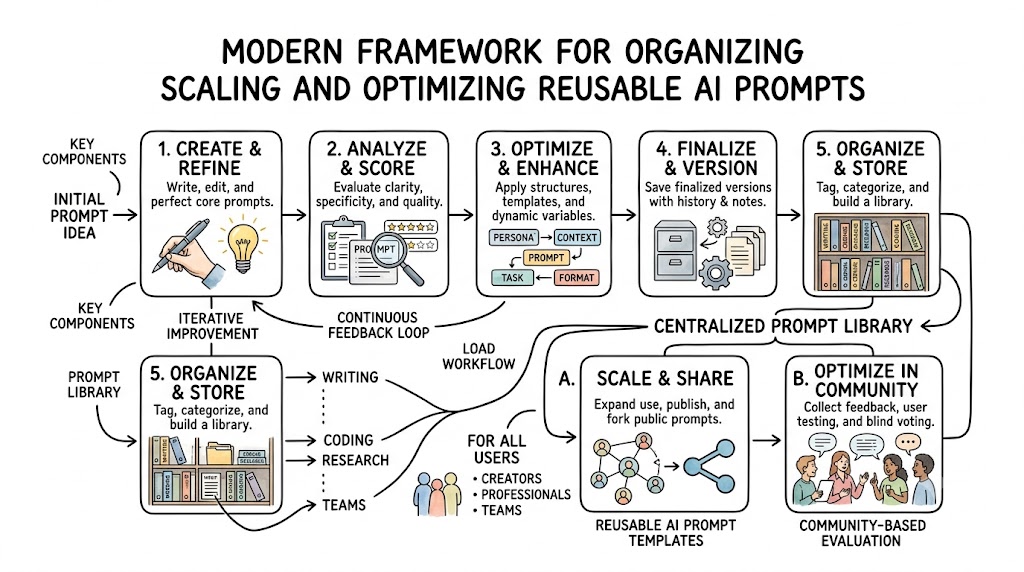
Maintaining focus and speed during complex technical projects requires systematic asset organization. Using an intuitive AI prompt organizer, professionals tag templates, assign dynamic variables, and organize content into clear functional groups. Dynamic variables allow static prompts to adapt instantly to fresh task inputs without requiring manual rewriting. Fast search tools ensure critical templates surface immediately during high-priority tasks. Structured file hierarchies prevent massive repositories from becoming cluttered or confusing as asset counts grow. Consequently, users maintain direct access to their sharpest tools without interrupting active creative flow.
+--------------------------------------------------------------------------+
|                        PROMPT ENGINEERING LIFECYCLE                      |
+--------------------------------------------------------------------------+
|  1. CREATE   --> Draft raw concepts & define key variables               |
|  2. OPTIMIZE --> Refine phrasing using the AI prompt optimizer           |
|  3. ANALYZE  --> Run quality checks with the AI prompt analyzer          |
|  4. TEST     --> Execute side-by-side prompt testing tool comparisons   |
|  5. VERSION  --> Track revisions via the prompt version control tool     |
|  6. DEPLOY   --> Store in AI prompt library & share reusable templates    |
+--------------------------------------------------------------------------+
Improving Prompt Quality with AI
Converting basic thoughts into clear, high-performing instructions often requires tedious trial-and-error tweaking. An integrated AI prompt optimizer transforms vague ideas into structured, high-impact prompts instantly. The optimization engine adds essential context, defines expected output formats, and removes confusing ambiguity automatically. As a result, users receive superior responses from their models on the initial attempt. Observing automated optimizations also helps creators build better personal prompt-writing habits over time. Automated enhancement converts unpredictable writing cycles into a reliable, streamlined engineering routine.
Understanding Prompts with AI Prompt Analysis
Deep diagnostic insights show creators exactly why certain prompt structures perform well while others fail. Utilizing an advanced AI prompt analyzer, users evaluate goal clarity, audience targeting, and structural strength in real time. The analytical framework checks tone requirements, variable placement, output layouts, and safety parameters across every stored asset. Creators gain total visibility into the operational drivers behind generated outputs, replacing guesswork with data. Detecting structural flaws early allows creators to correct issues before running prompts in active production, maintaining high standards across all tasks.
Measuring Prompt Effectiveness
Evaluating prompt performance based only on personal impression introduces inconsistencies and leaves flaws unaddressed. Diagnostic evaluation frameworks allow teams to measure output quality using objective, reliable benchmarks. Establishing baseline metrics for clarity, contextual completeness, and formatting accuracy helps users track operational trends over time. Data-driven assessments highlight specific phrasing patterns that consistently yield precise, reliable results. Eliminating subjective bias from evaluation allows organizations to standardize their strongest asset configurations with full confidence, keeping repository quality consistently high as new content accumulates.
Why Prompt Scoring Is Valuable
Objective scoring frameworks provide instant visual feedback on an instruction’s operational readiness. An automated prompt quality checker scores phrasing across multiple quality criteria simultaneously. The system yields an easy-to-read numeric score alongside clear, actionable recommendations for structural improvement. Team members verify whether a shared template meets internal standards before running costly AI processes. Scoring eliminates internal guesswork, motivating creators to uphold rigorous quality standards across every project. Systematic evaluation guarantees that only fully vetted, high-scoring instructions enter active production workflows.
Tracking Improvements with Prompt Version Control
Iterative refining naturally occurs when building complex instructions for advanced tasks. A dedicated prompt version control tool records every text change sequentially, building a full edit history. Users compare new phrasing variations against historical baselines to examine how subtle changes alter outputs. Furthermore, if a fresh edit produces poor results, creators revert to previous stable versions with a single click. Complete revision histories prevent accidental overwrites while giving creators full confidence to experiment freely. Detailed version tracking transforms prompt creation into a clean, systematic software development process.
+--------------------------------------------------------------------------------------+
|                     PROMPT OPTIMIZATION & EVALUATION METRICS                         |
+--------------------------------------------------------------------------------------+
| Metric              | Evaluation Focus              | Target Outcome                 |
+---------------------+-------------------------------+--------------------------------+
| Structural Clarity  | Eliminates ambiguous jargon   | Direct, crisp instructions     |
| Context Depth       | Provides background data      | Highly accurate responses      |
| Output Formatting   | Defines layout & syntax       | Ready-to-use structured data   |
| Safety & Compliance | Scans risk & policy violations| Secure, compliant execution    |
| Reusability Score   | Variable modularity           | Multi-project adaptability     |
+--------------------------------------------------------------------------------------+
Community-Based Prompt Evaluation
Evaluating instructions in total isolation often overlooks practical operational issues and edge cases. A community-supported AI prompt testing tool enables peer evaluations to discover optimal prompt designs faster. Features like blind side-by-side output voting help users select effective phrasing without bias. Crowd-sourced feedback reveals exceptionally strong phrasing choices that individual creators might miss. Shared insights speed up overall refinement while introducing creators to innovative prompting methods developed by peers. Collaborative testing turns isolated writing tasks into an engaging, high-value technical learning environment.
Reusable AI Prompt Templates Save Time
Drafting routine instructions repeatedly for everyday tasks wastes critical focus and working time. Built-in reusable AI prompt templates give professionals instant access to structured, proven starting points. These flexible templates include custom variables, allowing instant adaptations for changing project requirements. Standardized template layouts also enforce formatting consistency across different team departments, protecting output standards. Building an extensive collection of reusable templates allows companies to scale operational throughput while reducing manual effort, boosting daily productivity across all departments.
Sharing and Collaborating on Prompts
Collaboration flourishes when team members freely exchange effective assets and technical methods. Modern management systems allow users to publish public assets, export cards, and fork community templates effortlessly. Colleagues adapt shared framework files to fit unique task requirements without altering the master files. Furthermore, transparent asset distribution accelerates team learning curves, raising technical proficiency across the entire organization. Centralized collaboration tools remove communication barriers, ensuring everyone benefits from single breakthroughs. Smooth sharing mechanisms convert individual innovations into powerful team capabilities.
Benefits for Different Types of Users
Various roles across modern enterprises gain massive efficiency advantages from structured instruction platforms:
| Target Role | Primary Operational Benefit | Typical Use Cases |
| Software Engineers | Standardizes code generation and automated debugging | API design, code refactoring, test case generation |
| Content Marketers | Enforces brand tone and speeds up asset production | Campaign copy, editorial outlines, social posts |
| Data Analysts | Ensures repeatable data extraction and formatting | Report generation, data cleaning, trend summaries |
| Educators & Researchers | Organizes complex study guides and analytical queries | Curriculum planning, literature reviews, tutoring |
| Product Managers | Aligns team specifications and user story creation | PRDs, feature specs, stakeholder updates |
Why Prompt Management Will Become Essential
As artificial intelligence tools become more advanced, structured instruction management will form a basic requirement across all technical industries. Organizations relying on scattered notes will face mounting operational delay, higher error rates, and inconsistent outputs. Conversely, companies adopting organized management platforms secure clear competitive advantages in execution speed, precision, and clarity. Centralized workflows protect corporate knowledge, ensuring critical expertise remains accessible even during team transitions. Structured instruction management will shift from an optional efficiency habit into a core standard for forward-thinking organizations.
Why Promptosia Is Worth Exploring
Adopting an all-in-one prompt environment offers a transformative advantage for anyone looking to maximize AI productivity. Uniting advanced library tools, automated optimization, detailed diagnostics, and seamless collaboration within a single dashboard simplifies template engineering completely. Users stop wasting time chasing lost notes and start treating instructions as valuable, continuously evolving assets. Whether working as an independent creator or leading a large engineering team, structured prompt management delivers immediate productivity gains. Exploring these comprehensive tools provides the structural foundation needed to excel in an AI-driven environment.
Frequently Asked Questions About Promptosia
- How does an AI prompt management tool improve daily productivity?Gathering scattered instructions into one searchable database removes lost text notes and yields consistent, high-performing output across routine tasks.
- Can team members collaborate and share templates inside the library?Engineers and creators publish shared assets, copy working models, export cards, and fork public templates directly into their personal workspaces.
- What is the main function of an AI prompt optimizer?Scanning unorganized draft inputs, the optimizer automatically adds context, sharpens clarity, and enforces formatting rules to generate superior AI responses.
- How does version control protect existing prompt assets from accidental loss?Tracking every wording modification sequentially lets users analyze output changes over time or restore past stable versions whenever new edits fail.
- What specific elements are analyzed by the prompt quality checker?The diagnostic engine evaluates structural clarity, context depth, formatting parameters, variable modularity, reusability potential, safety risks, and operational value.
- Are reusable templates customizable for different projects or client requirements?Dynamic variables enable creators to update input fields instantly without altering the core instruction structure or lowering output quality.
- How do community testing features like blind voting help refine phrasing?Side-by-side evaluations allow users to compare output samples objectively, identifying top-performing prompt variations through collective feedback.
- Is the platform suitable for both technical and non-technical creators?An intuitive interface allows writers, educators, and marketers to organize files easily, while robust versioning tools satisfy complex development demands.
- How does centralized management prevent duplicate work across enterprise departments?Storing team assets in a single searchable repository lets employees discover existing solutions rather than spending time re-creating identical instructions.
- Why is structured prompt engineering critical for long-term operational success?Treating text inputs as evolving assets protects corporate knowledge, maintains brand voice, lowers operational friction, and supports scalable productivity across expanding AI operations.
Practical Summary
Upgrading from disorganized text files to an organized prompt repository completely redefines how teams build, test, and deploy artificial intelligence instructions. Storing, optimizing, evaluating, and tracking prompts inside a single platform turns basic text into dependable technical infrastructure. Purpose-built management tools remove operational friction, safeguard institutional knowledge, and drive seamless cross-team collaboration. As artificial intelligence continues to reshape modern business, adopting structured prompt management guarantees the operational speed, precision, and architectural foundation needed to stay competitive.

- Accelerating Modern Business Growth Through Intelligent Software Engineering And Scalable Cloud Architectures - September 5, 2026
- Building Resilient Enterprise Cloud Platforms Through Automation And Modern Reliability Engineering - September 5, 2026
- Building Resilient Software Platforms Through Modern Engineering And Enterprise Automation - September 4, 2026