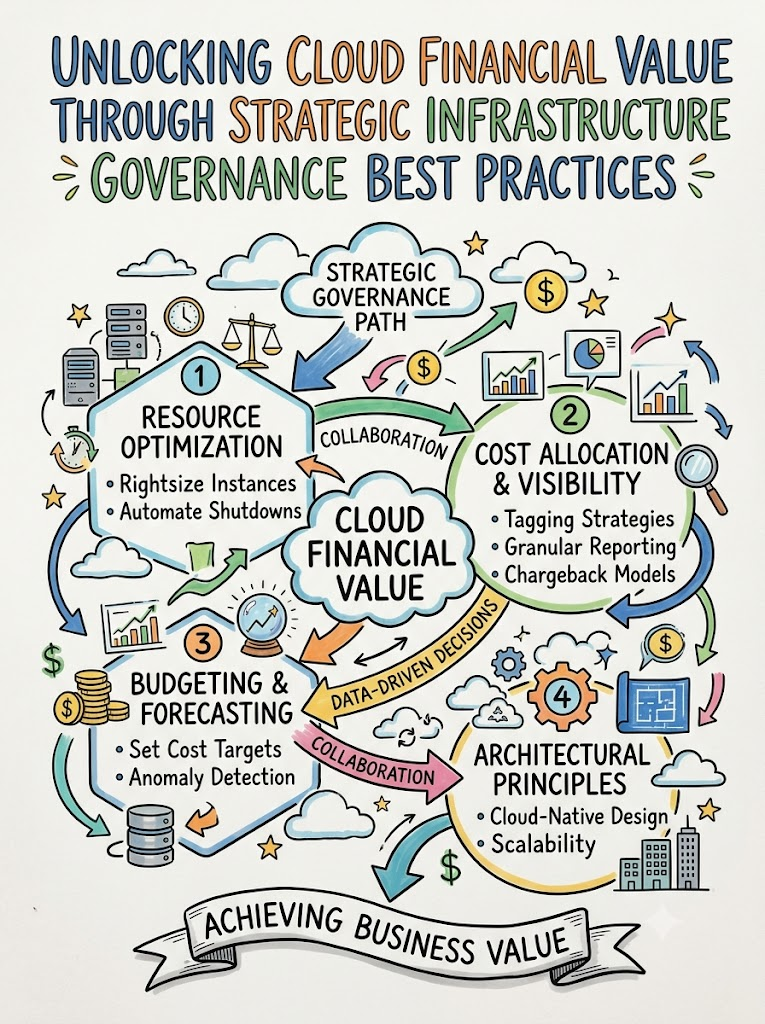
Driving Strategic Efficiency Across Cloud Infrastructure
Rapid digital expansion empowers engineering organizations to ship modern applications quickly, but unmanaged resource provisioning drives up monthly operational invoices. Platform engineers continuously allocate elastic compute capacity to achieve delivery targets, while corporate finance leaders struggle to map variable expenses to precise product lines.
Resolving this organizational challenge demands structured operational governance, complete spending transparency, and active executive alignment. Targeted FinOps Training equips software architects and finance directors with proven frameworks to synchronize technical velocity with corporate fiscal benchmarks, transforming unpredictable cloud bills into reliable drivers of sustainable business value.
Defining Strategic Cloud Financial Management
Cloud financial operations combines technology, procurement, and commercial leadership into a unified, metric-driven operational cadence. Rather than imposing blunt spending caps that stall innovation, this operational framework creates continuous spending transparency and fine-grained resource tracking across multi-cloud deployments.
Cross-functional teams evaluate unit economics, track gross margins, and assess resource performance in real time. Consequently, engineering departments retain their delivery speed while actively protecting enterprise operating margins.
Managing Economic Complexities in Dynamic Environments
Consumption-based platforms swap predictable capital outlays for fluid operational billing. Unmonitored cloud environments therefore trigger extensive resource sprawl, abandoned data volumes, and sudden budget overruns.
- Rapid deployment pipelines frequently bypass manual budget reviews.
- Decentralized compute creation hides resource ownership and running operational expenses.
- Diverse pricing models across distinct providers confuse future capacity projections.
Adopting formal governance frameworks eliminates these roadblocks by removing dormant capacity, improving resource forecasting, and sustaining peak efficiency across production systems.
Prioritizing Business Value Over Cost Cutting
Strategic financial operations never treats blunt cost cutting as the primary objective. Top-tier teams focus on boosting business output, feature delivery speed, and the overall return generated by every dollar spent on cloud resources.
Arbitrary infrastructure cuts regularly degrade application responsiveness, frustrate end users, and cause platform instability. Competent specialists evaluate unit economics, tracking exact compute expenditure against completed user transactions to validate essential technical investments.
Implementing the Continuous Improvement Lifecycle
Operational success relies on a three-phase continuous loop that systematically elevates organizational efficiency.
- Inform: Build total visibility into infrastructure usage, assign resources to distinct business owners through robust tagging schemas, and deliver timely showback reports.
- Optimize: Downsize overbuilt instances, eliminate detached disks, and capture substantial volume savings using long-term provider commitments.
- Operate: Evaluate live expenditure against defined operational key performance indicators, automate policy guardrails, and streamline communication between developers and finance teams.
Developing Core Capabilities for Technical Leaders
Excelling in this domain requires combining deep systems architecture knowledge, data analysis capabilities, and persuasive stakeholder communication. Practitioners translate raw telemetry and system metrics into actionable strategic insights for senior executives.
Essential competencies include parsing billing data exports, programmatically enforcing metadata policies, modeling unit economics, and managing discount portfolios. Building these capabilities closes the traditional rift between software development cycles and corporate financial oversight.
Executing Practical Waste Elimination Tactics
Durable infrastructure optimization blends immediate rate reductions with ongoing architectural streamlining across compute, storage, and networking layers.
| Tactical Approach | Infrastructure Target | Measurable Business Result |
|---|---|---|
| Instance Rightsizing | Over-provisioned virtual servers and memory | Eradicates payments for unused compute capacity |
| Commitment Management | Stable baseline processing requirements | Secures major rate discounts from cloud providers |
| Storage Lifecycle Policies | Aging object and cold block storage | Cuts long-term data retention costs significantly |
| Automated Shutdowns | Development, testing, and staging clusters | Halts non-essential spending during idle weekend hours |
Navigating Multi-Cloud Architecture Realities
Each major cloud service provider maintains proprietary billing models, native management tools, and discount instruments. AWS features Savings Plans and Cost Explorer, Microsoft Azure offers Cost Management with automated Advisor recommendations, and Google Cloud delivers committed use discounts alongside BigQuery billing exports.
Cross-functional teams must navigate these unique platform mechanics with confidence. Standardizing resource consumption metrics across varied providers ensures uniform policy enforcement and clean executive reporting across the whole company.
Accelerating Careers Through Financial Engineering
Global enterprise demand for professionals who blend technical depth with balance sheet acumen continues to surge. Completing structured FinOps Certification Training proves an individual’s ability to drive architectural efficiency without slowing down software deployment schedules.
Acquiring this specialized skill set accelerates career trajectories, establishing practitioners as pivotal leaders who defend corporate margins while supporting rapid technological innovation.
Validating Expertise with Industry Certification
Securing an official FinOps Certification validates your command over cloud accounting methodologies, automated governance architectures, and resource consumption analytics. It signals to prospective employers that you possess both strategic business insight and practical technical execution skills.
Certified specialists win top-tier roles across cloud architecture, platform engineering, technology procurement, and corporate financial planning.
Choosing an Optimal Learning Track
Selecting a high-impact learning path requires evaluating your current technical background alongside your long-term career goals. A comprehensive FinOps Course combines real-world billing datasets, hands-on optimization exercises, and practical organizational change frameworks.
Prioritize programs that offer real-world scenario analysis, interactive tooling sandboxes, and dedicated mentorship from active practitioners. Hands-on learning ensures you can immediately apply financial engineering concepts inside live enterprise environments.
Exploring Role-Specific Training Programs
- FinOps Practitioner Training: Business analysts, finance managers, project leaders, and technology directors master foundational governance concepts, cost visibility frameworks, and cross-departmental collaboration workflows.
- FinOps Engineer Training: DevOps engineers, cloud architects, and site reliability specialists master infrastructure automation scripts, container cost monitoring, and programmatic policy enforcement inside deployment pipelines.
- Corporate FinOps Training: Enterprise engineering, platform, finance, and procurement departments align around shared operational standards, eliminating departmental silos and controlling cloud expenditure.
- Cloud Cost Optimization Training: Technical teams master granular waste remediation, advanced serverless tuning, storage lifecycle management, and multi-provider discount mechanics.
Fostering Accountability Across Engineering Squads
Instilling fiscal responsibility requires offering developers immediate feedback without creating heavy administrative bottlenecks. Software architects must recognize the financial impact of their sizing decisions the moment they write code.
Embedding automated cost-estimation linters directly into continuous integration workflows provides immediate visibility during pull requests. When engineers evaluate compute cost as an essential architectural factor alongside security and uptime, cost efficiency becomes an organic property of software design.
Building Clear Visualizations and Dashboards
Clear, stakeholder-specific visualization forms the foundation of successful cloud governance. Tailored dashboards translate raw, complex billing exports into intuitive, actionable operational data for every business function.
- Executive Dashboards: High-level budget burn rates, margin forecasts, and unit economic health indicators.
- Engineering Dashboards: Granular service consumption, unallocated cluster costs, and rightsizing alerts.
- Finance Dashboards: Departmental cost center breakdowns, showback reports, and monthly run-rate projections.
Deploying Automated Anomaly Tracking Systems
Unmonitored spending surges quickly destroy annual technology budgets when teams discover them only during end-of-month reconciliations. Modern cloud operations demand real-time anomaly detection pipelines that monitor infrastructure telemetry around the clock.
Machine learning algorithms establish normal baseline spending behaviors and trigger instant alerts whenever rogue scripts or provisioning accidents cause unexpected cost spikes. Prompt notifications enable immediate remediation, limiting unexpected financial liabilities.
Eliminating Common Organizational Mistakes
Organizations regularly run into severe operational roadblocks when implementing financial governance due to predictable tactical mistakes.
- Treating financial governance purely as an external audit managed by accounting teams.
- Neglecting standardized tagging taxonomies across production and non-production accounts.
- Focusing exclusively on compute instances while ignoring networking egress and persistent storage.
- Ignoring commitment portfolios, which leads to expired reservations and missed discounts.
Establishing an Internal Center of Excellence
Building an internal governance program starts with securing executive sponsorship and forming an agile, cross-functional working group. This centralized team establishes mandatory tagging taxonomies, selects enterprise visibility platforms, and defines initial allocation frameworks.
Expand the program across the organization by launching team-based optimization challenges, automating routine reporting schedules, and incorporating cost-efficiency benchmarks directly into quarterly performance reviews.
Utilizing Modern Telemetry and Automation Stacks
Modern cloud governance relies on a balanced ecosystem of native cloud tools, third-party management platforms, and open-source utilities. Native tools provide reliable foundational telemetry, while enterprise platforms deliver advanced multi-cloud aggregation, automated rightsizing, and detailed forecasts.
Technical teams also deploy container cost attribution tools and Infrastructure as Code linters to enforce budgetary guardrails programmatically before infrastructure changes ever reach live production environments.
Governing AI and High-Performance Compute
Emerging artificial intelligence initiatives and large language model pipelines introduce massive compute demands that quickly inflate cloud invoices. Dedicated accelerators, graphic processing clusters, and large data stores require meticulous financial supervision.
Specialists track training job expenses, optimize inference resource utilization, leverage specialized capacity reservations, and verify that machine learning initiatives deliver clear, measurable enterprise returns.
Expanding Global Reach and Enterprise Demand
Enterprise technology centers and global delivery hubs manage massive international cloud footprints. Consequently, FinOps Training in India and flexible FinOps Online Training programs provide direct pathways for professionals worldwide to master advanced cloud economics.
Acquiring expertise in multi-cloud cost visibility, containerized infrastructure allocation, and automated governance positions individuals to lead critical transformation initiatives across modern tech organizations.
Mastering Essential Industry Competencies
Thriving in this evolving domain requires building a well-rounded skill set that spans software engineering, financial analysis, and strategic communication. Mastering these diverse capabilities ensures long-term professional influence across modern engineering organizations.
Build deep expertise in database query languages like SQL, study distributed systems architecture, master corporate budgeting principles, and practice executive stakeholder presentations to maximize your impact.
Frequently Asked Questions About FinOpsSchool
- Which specific subjects does this comprehensive certification program cover?The curriculum covers multi-cloud billing analysis, cost allocation, tagging enforcement, automated rightsizing, commitment discount strategies, and enterprise governance frameworks.
- Which professional roles benefit most from this educational track?Software engineers, cloud architects, DevOps practitioners, financial analysts, procurement specialists, and technology directors seeking to master cloud cost governance will benefit directly.
- Do students complete live practical projects during the course?Students analyze realistic enterprise billing datasets, implement tagging standards, identify infrastructure waste, and build automated cost monitoring dashboards during interactive labs.
- Why are enterprises actively prioritizing cloud financial operations today?Enterprises need to control rapidly escalating multi-cloud expenses, eliminate idle infrastructure, and align development velocity directly with corporate financial sustainability.
- How does the online learning format accommodate full-time working schedules?The online curriculum delivers flexible weekend cohorts, interactive evening sessions, hands-on lab environments, and recorded walkthroughs for self-paced review.
- What distinguishes foundational practitioner coursework from advanced engineer tracks?Practitioner courses focus on operational frameworks, business alignment, and collaborative culture, while engineer courses dive into automation scripting, container allocation, and continuous integration pipelines.
- How does corporate team training accelerate organizational maturity?Custom enterprise workshops align software engineers, finance managers, and platform teams around shared cost metrics, eliminating cross-departmental friction and immediately lowering cloud bills.
- Does the instruction cover multi-cloud environments like AWS, Azure, and Google Cloud?The modules deliver balanced, comprehensive techniques for managing infrastructure expenses across AWS, Microsoft Azure, and Google Cloud Platform environments.
- What baseline technical or financial experience should candidates possess?A basic familiarity with general cloud computing concepts or corporate IT budgeting is helpful, although foundational lessons prepare professionals from diverse backgrounds effectively.
- How does the curriculum ensure high exam readiness for industry certifications?Structured lessons, practical labs, and practice exams align directly with global certification standards to build practical confidence and ensure strong pass rates.
Charting the Future of Enterprise Cloud Governance
Establishing structured financial operations provides modern digital enterprises with a durable competitive advantage. As multi-cloud architectures grow in scale and operational complexity, organizations require proactive leaders who balance software delivery speed with fiscal discipline.
Developing advanced financial engineering capabilities bridges lingering organizational divides, optimizes ongoing technical investments, and puts technology teams in control of their infrastructure economics. Organizations that master these disciplines ensure that every compute cluster and cloud resource accelerates strategic business objectives.

- Accelerating Modern Business Growth Through Intelligent Software Engineering And Scalable Cloud Architectures - September 5, 2026
- Building Resilient Enterprise Cloud Platforms Through Automation And Modern Reliability Engineering - September 5, 2026
- Building Resilient Software Platforms Through Modern Engineering And Enterprise Automation - September 4, 2026