Introduction
Enterprise leaders face growing market pressure to upgrade their core digital capabilities and accelerate product delivery. When companies modernize technical foundations, they unlock immediate efficiency gains and safeguard long-term profitability. Delaying essential infrastructure overhauls, on the other hand, leaves development teams trapped in endless cycles of reactive fire-fighting.
Uniting strategic business goals with disciplined engineering practices turns slow release cadences into decisive market advantages. Sustained market success requires deep operational competence across cloud platforms, automated delivery, and intelligent software systems. Examining actionable technical blueprints allows growing enterprises to construct resilient architectures that absorb explosive user growth without degradation.
Diagnosing Architectural Bottlenecks That Paralyze Delivery
Fast-scaling companies run into severe productivity hurdles when early design shortcuts collide with expanding customer volume. Programmers exhaust valuable hours manually patching brittle third-party integrations, debugging flaky test environments, and resolving circular code dependencies.
Engineering leaders face several recurring delivery bottlenecks:
- Monolithic codebases choke deployment frequency and magnify the blast radius of single defects.
- Untracked manual infrastructure tweaks produce continuous drift across operational environments.
- Fragmented analytical pipelines starve production machine learning workflows of real-time operational context.
- Unfocused telemetry setups overwhelm engineers with notification storms instead of highlighting root causes.
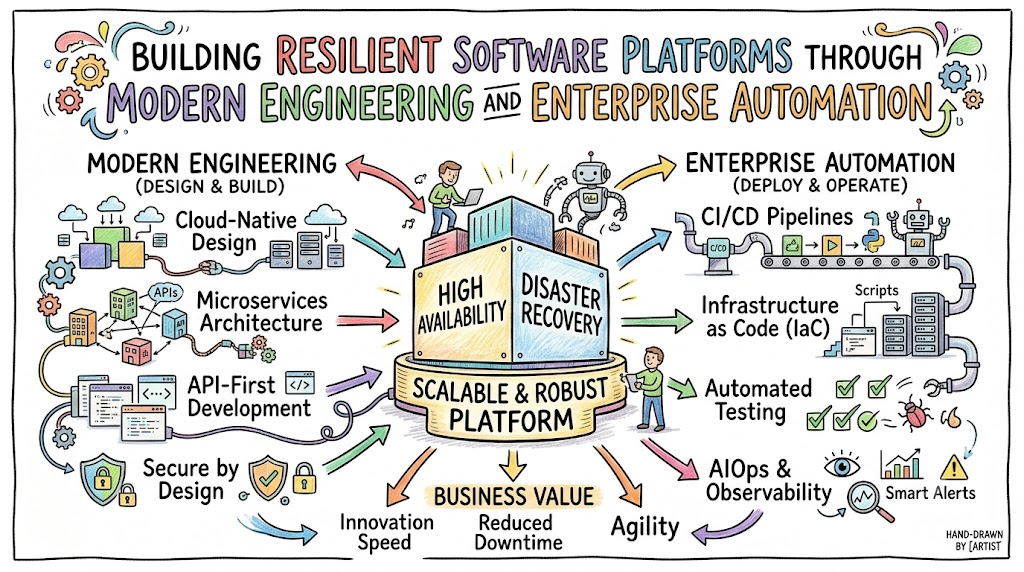
Eliminating these systemic obstacles requires engineering departments to decouple services, manage infrastructure via code, and enforce comprehensive automated integration testing.
Integrating Applied Intelligence Into Everyday Enterprise Operations
Theoretical sandbox experiments create zero business value unless engineering teams operationalize them directly into revenue-generating workflows. Progressive businesses embed machine learning algorithms straight into customer-facing applications to unlock measurable financial returns. Recent operational benchmarks show that embedding machine learning directly into transactional pipelines cuts client task completion times by over forty percent.
Forward-looking engineering departments construct continuous ingestion pipelines that clean, structure, and index domain data into low-latency vectors. This proactive discipline turns dormant relational tables into high-velocity operational intelligence engines. Collaborating with a specialized AI Software Development Company supplies the expertise necessary to launch hardened model endpoints that reliably handle peak traffic spikes.
Harnessing Generative Systems For High-Impact Commercial Workflows
Generative artificial intelligence drives transformative operational improvements when developers implement purposeful architectures instead of generic conversational prompts. Autonomous agent pipelines extract critical terms from multi-page agreements, validate financial records, and automate complex regulatory reporting sequences.
High-performance generative implementations rely on five foundational pillars:
- High-Performance Vector Storage: Catalogs proprietary documentation to deliver instant contextual grounding for language models.
- Hybrid Semantic Retrievers: Combines keyword search and semantic matching to anchor model outputs in verifiable corporate data.
- Automated Safety Gateways: Inspects user inputs and filters system responses to uphold stringent compliance standards.
- Agent Orchestration Layers: Coordinates multi-step execution tasks across specialized neural models and internal business APIs.
- Continuous Telemetry Monitors: Tracks latency limits, token consumption patterns, and hallucination drift throughout live operations.
Leveraging specialized Generative AI Development Services equips technical leaders with proven design patterns to embed foundational models securely within private corporate networks.
Engineering Custom Platforms For Distinct Operational Edge
Packaged software platforms offer fast setups, but off-the-shelf tools rarely mirror intricate proprietary business models. Furthermore, rigid commercial software limits user interface innovation, restricts integration patterns, and imposes mounting per-seat licensing costs. Bespoke digital platforms, in sharp contrast, support proprietary operational workflows with total fidelity.
Engaging a seasoned Custom Software Development Company gives organizations direct authority over database design, backend microservices, and client-facing interfaces. Consequently, organizations protect proprietary operational secrets while establishing valuable digital assets.
Structuring Scalable SaaS Architectures For Rapid User Expansion
Building an elastic subscription product requires deliberate architectural design that absorbs sudden tenant surges without systemic outages. Inadequate data tenancy controls and poorly scoped database instances cause early-stage products to stall during sudden traffic spikes.
| Critical Architecture Pillar | Standard Tenancy Setup | Enterprise Tenancy Setup |
|---|---|---|
| Data Partitioning | Single database with row-level filtering logic | Dedicated schema per organization with isolated read-replicas |
| Identity Routing | Basic authentication tokens and credentials | Enterprise Single Sign-On paired with automated tenant discovery |
| Usage Tracking | Batched monthly billing cron scripts | Real-time event instrumentation and dynamic metered billing |
| Resource Allocation | Uncapped shared processing resources | Distributed Redis rate-limiters with dedicated background job queues |
Teaming up with an accomplished SaaS Product Development Company helps technical founders design resilient multi-tenant foundations, frictionless payment engines, and scalable onboarding paths from day one.
Eliminating Cloud Overhead Through Infrastructure Precision
Public cloud deployments easily expand into chaotic cost centers characterized by sprawling virtual machines and ambiguous security boundaries. Even so, clean cloud architecture slashes administrative toil while guaranteeing uninterrupted service availability.
Applying specialized Cloud Consulting Services guides development teams across AWS, Microsoft Azure, and Google Cloud environments. By writing clear infrastructure-as-code manifests, infrastructure teams eliminate configuration drift and automate compute optimization routines.
+-------------------------------------------------------------+
|                Unified Cloud Control Plane                  |
+-------------------------------------------------------------+
         |                                           |
         v                                           v
+-------------------------------+   +-------------------------------+
|    Infrastructure as Code     |   |   Continuous Cost & SecOps    |
| (Terraform / OpenTofu Engine) |   |  (Policy as Code & Budgets)   |
+-------------------------------+   +-------------------------------+
         |                                           |
         +--------------------+----------------------+
                              |
                              v
       +---------------------------------------------+
       | Multi-Cloud Fabric (AWS / Azure / GCP)     |
       | Elastic Compute | Serverless | Object Store |
       +---------------------------------------------+
Removing Delivery Roadblocks With Continuous Deployment Pipelines
Manual release processes frustrate developers and slow down strategic roadmap execution. Conversely, automated deployment pipelines empower cross-functional teams to push incremental, well-tested code updates to production every single day.
Implementing seasoned DevOps Consulting Services introduces automated code linters, security audits, container packaging, and GitOps deployments. Consequently, development organizations slash recovery intervals while banishing high-risk midnight release marathons.
Securing Uninterrupted Operations With Site Reliability Standards
Achieving high service availability demands deliberate engineering controls rather than wishful thinking. Site Reliability Engineering translates system uptime targets into concrete Service Level Objectives that govern daily software delivery trade-offs.
Adopting professional SRE Consulting Services empowers organizations to launch blameless incident post-mortems, automated resilience tests, and distributed tracing systems. As a direct result, operations engineers identify underlying capacity bottlenecks long before end users encounter platform outages.
Accelerating Feature Delivery Through Internal Developer Portals
Expanding development teams often saddle engineers with administrative tickets, complex infrastructure access requests, and tedious cloud provisioning. Modern platform engineering relieves this cognitive fatigue by assembling a unified Internal Developer Platform.
Utilizing dedicated Platform Engineering Services, infrastructure teams provide reliable self-service templates for spinning up databases, message brokers, and compute clusters. Consequently, application engineers direct their complete attention to delivering business logic rather than troubleshooting cloud configurations.
+---------------------------------------------------------------+
|            Internal Developer Platform (IDP Portal)           |
+---------------------------------------------------------------+
       |                                                |
       v                                                v
+-----------------------------+          +-----------------------------+
|    Self-Service Catalog     |          |    Standard Golden Paths    |
| (Databases, Queues, App env)|          | (CI/CD, Monitoring, Auth)   |
+-----------------------------+          +-----------------------------+
       |                                                |
       +-----------------------+------------------------+
                               |
                               v
+---------------------------------------------------------------+
|     Automated Infrastructure & Container Orchestration        |
+---------------------------------------------------------------+
Directing Modernization Roadmaps Toward Financial Returns
Large-scale digital transformations regularly fall flat when technical teams decouple software rewrites from actual commercial priorities. Transformational projects succeed only when engineering choices directly serve strategic business outcomes.
Enlisting seasoned Digital Transformation Consulting bridges technology modernizations directly with core balance sheet objectives and efficiency targets. By pairing specific operational friction points with modern architectural patterns, enterprises phase out brittle legacy platforms without disrupting daily business revenue.
Empowering Human Developers Alongside Intelligent Automation
Generative coding copilots accelerate routine syntax generation, yet human engineers must design system boundaries, manage identity controls, and guarantee data integrity. Unchecked machine-generated code frequently introduces subtle vulnerabilities, broken business logic, and maintenance hazards.
Enrolling engineers in practical Corporate DevOps Training equips development teams with foundational expertise across container orchestration, cloud observability, and automated deployment pipelines. Consequently, technical organizations leverage automated code generation safely while preserving high system reliability.
Delivering Enduring Technical Value As An Engineering Ally
Innovative organizations require strategic implementation partners who unite technical vision with hands-on development expertise across the modern application stack. Rather than applying rigid boilerplate templates, skilled practitioners construct bespoke architectures that match specific operational milestones and performance goals.
Uniting intelligent automation pipelines, custom software craftsmanship, cloud infrastructure, and practical team training enables technology organizations to ship dependable digital platforms. This deliberate execution approach links corporate strategy directly to resilient, high-performance software systems.
Frequently Asked Questions
- What core capabilities empower enterprises to construct resilient platforms?
Comprehensive technology partners deliver specialized capabilities across artificial intelligence engineering, custom software development, cloud infrastructure design, automated delivery pipelines, and developer portals.
- How does an AI Software Development Company speed up product development?
An AI Software Development Company implements tested machine learning pipelines, vector retrieval databases, and low-latency serving infrastructure to eliminate technical uncertainty.
- What tangible commercial results do Generative AI Development Services produce?
Generative AI Development Services streamline contextual information retrieval, automate complex data validation, and power autonomous customer interactions using secure enterprise knowledge repositories.
- Why do growing businesses build bespoke software rather than licensing tools?
Bespoke software eliminates recurring licensing expenses, builds defensible proprietary assets, and gives engineering teams total ownership over roadmap priorities.
- How does a SaaS Product Development Company support sustained platform growth?
A SaaS Product Development Company configures isolated multi-tenant data stores, provisions usage-based billing logic, and builds reliable autoscale infrastructure.
- What clear advantages do Cloud Consulting Services offer engineering teams?
Cloud Consulting Services reduce infrastructure expenditures, automate resource provisioning using declarative code, and establish robust multi-cloud security baselines.
- How do DevOps Consulting Services eliminate delivery bottlenecks?
DevOps Consulting Services create automated validation tests, standardize containerized applications, and introduce GitOps workflows that compress deployment timelines.
- Why do high-throughput platforms require dedicated SRE Consulting Services?
SRE Consulting Services define actionable error budgets, implement distributed tracing systems, and construct self-healing architectures that withstand extreme traffic spikes.
- What measurable operational benefits do Platform Engineering Services deliver?
Platform Engineering Services establish self-service internal portals that remove operational tickets, lower cognitive overhead, and accelerate code delivery cycles.
- How does Corporate DevOps Training upskill existing engineering talent?
Corporate DevOps Training delivers practical, mentor-led coaching across container scheduling, infrastructure security, delivery automation, and telemetry monitoring.
Final Thoughts
Thriving in competitive digital markets requires disciplined architectural decisions, active system monitoring, and automated delivery pipelines. Businesses that modernize their delivery pipelines while weaving machine intelligence into core workflows create massive competitive advantages.
Dismantling legacy friction, codifying system resilience, and supporting engineers through self-service platforms positions businesses for unconstrained commercial expansion. Establishing an engineering culture that prizes continuous iteration ensures that your technology remains a formidable engine for long-term growth.

- Accelerating Modern Business Growth Through Intelligent Software Engineering And Scalable Cloud Architectures - September 5, 2026
- Building Resilient Enterprise Cloud Platforms Through Automation And Modern Reliability Engineering - September 5, 2026
- Building Resilient Software Platforms Through Modern Engineering And Enterprise Automation - September 4, 2026