Introduction
In 2026, organizations are generating and collecting more data than ever before—from customer interactions and transactions to IoT devices and AI-driven analytics. However, with this surge in data comes the challenge of inaccurate, duplicate, or incomplete data, which can undermine business intelligence and decision-making. This is where Data Cleansing Tools play a vital role.
Data Cleansing Tools help identify, correct, and standardize corrupt or inaccurate records within a dataset. Whether you’re managing a CRM, preparing data for analytics, or maintaining compliance, clean data ensures reliability and accuracy across systems. When choosing a data cleansing solution in 2026, businesses should focus on automation, AI-assisted detection, integration capabilities, scalability, and ease of use. Below, we explore the Top 10 Data Cleansing Tools that are shaping the data management landscape in 2026.
Top 10 Data Cleansing Tools in 2026
1. Informatica Data Quality
Short Description: Informatica is a market leader in enterprise data management and offers a powerful Data Quality suite for data profiling, cleansing, and enrichment.
Key Features:
- AI-powered data profiling and matching
- Real-time data validation
- Address and name standardization
- Integration with major data lakes and warehouses
- Prebuilt cleansing templates
- Cloud-native architecture
Pros:
- Enterprise-grade performance
- Seamless integration with Informatica ecosystem
- Excellent support and documentation
Cons:
- High licensing costs
- Steeper learning curve for small teams
2. Talend Data Preparation
Short Description: Talend offers an intuitive data preparation tool for cleansing, transforming, and enriching data before analytics or migration.
Key Features:
- Drag-and-drop interface
- Real-time collaboration
- Machine learning-based anomaly detection
- Integration with Snowflake, AWS, and Azure
- Built-in connectors for popular databases
- Automated data profiling
Pros:
- Easy to use for non-technical users
- Open-source and enterprise editions available
- Scales well with cloud data
Cons:
- Complex setup for on-premise deployment
- Some advanced features limited to paid version
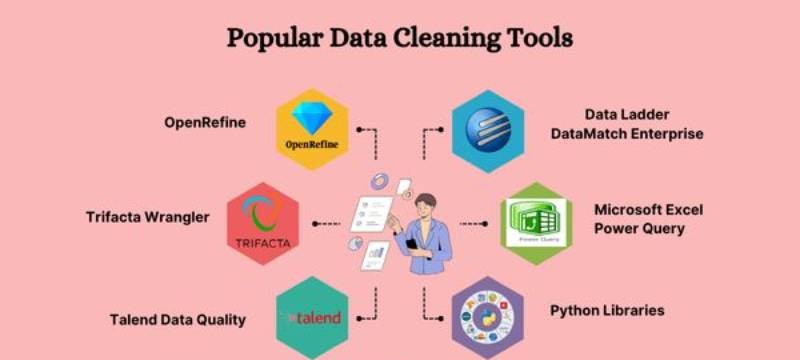
3. OpenRefine
Short Description: Formerly Google Refine, OpenRefine is a free, open-source tool ideal for cleaning messy data.
Key Features:
- Data transformation and normalization
- Duplicate detection
- Faceted browsing for quick data exploration
- Undo/redo functionality
- Supports large datasets
- Extensible via APIs
Pros:
- Completely free and open-source
- Great for quick ad-hoc cleaning
- Lightweight and flexible
Cons:
- Limited automation
- Requires manual operation for repetitive tasks
4. Trifacta Wrangler (now part of Alteryx Cloud)
Short Description: Trifacta, now under Alteryx, provides powerful AI-driven data wrangling for analytics, data science, and governance.
Key Features:
- AI-powered pattern recognition
- Automated data profiling and validation
- Cloud-native and scalable
- Visual workflow builder
- Integration with Snowflake, Databricks, BigQuery
- Real-time collaboration
Pros:
- Extremely user-friendly
- Advanced automation for complex datasets
- Excellent integration with analytics platforms
Cons:
- Pricing may be high for small teams
- Internet connection required for cloud version
5. IBM InfoSphere QualityStage
Short Description: Enterprise-level data quality and cleansing tool designed for complex data integration across large organizations.
Key Features:
- Probabilistic data matching
- Address and name standardization
- Data enrichment and profiling
- Seamless integration with IBM InfoSphere suite
- Batch and real-time processing
- Metadata management
Pros:
- Highly accurate matching algorithms
- Enterprise-grade scalability
- Strong compliance support
Cons:
- Expensive and resource-intensive
- Complex implementation process
6. Melissa Clean Suite
Short Description: Melissa focuses on data verification, deduplication, and enrichment across CRM and ERP systems.
Key Features:
- Address, phone, and email validation
- Duplicate record detection
- Data enrichment from global datasets
- Batch and API-based cleansing
- Compliance-ready (GDPR, HIPAA)
- Plug-ins for Salesforce, Dynamics 365, etc.
Pros:
- Easy integration with CRMs
- Cost-effective
- Excellent for contact data
Cons:
- Limited for complex data models
- UI could be more modern
7. WinPure Clean & Match
Short Description: A user-friendly desktop solution for deduplication, data cleansing, and record matching.
Key Features:
- No-code interface
- Advanced fuzzy matching algorithms
- Address standardization
- Multi-source matching
- Built-in data quality dashboard
- On-premise data privacy
Pros:
- Great for SMBs
- One-time purchase available
- Intuitive and offline-capable
Cons:
- Not ideal for very large datasets
- Limited cloud integrations
8. Ataccama ONE Data Quality
Short Description: A unified data management platform that combines AI-powered data quality, governance, and cataloging.
Key Features:
- AI-driven data profiling
- Auto-detection of anomalies
- Data lineage and governance
- Centralized metadata management
- Automation workflows
- Hybrid deployment options
Pros:
- Modern, AI-driven approach
- Integrated governance and cleansing
- Excellent UI/UX
Cons:
- Premium pricing
- Requires technical setup
9. Data Ladder DataMatch Enterprise
Short Description: A data matching and cleansing platform designed for deduplication, validation, and enrichment.
Key Features:
- Fuzzy matching and deduplication
- Data profiling and standardization
- Address verification
- Multi-format data support
- Real-time data validation APIs
- Integration with SQL, CRM, and ERP systems
Pros:
- Strong matching accuracy
- Easy to implement
- Cost-effective for enterprises
Cons:
- Interface could be more intuitive
- Limited automation beyond matching
10. TIBCO Clarity
Short Description: A self-service data cleansing and enrichment platform for business and IT users alike.
Key Features:
- Visual data profiling
- Address, name, and email cleansing
- Real-time collaboration
- Integration with TIBCO Spotfire
- Cloud and on-premise support
- Machine learning-based anomaly detection
Pros:
- Simple interface for business users
- Excellent visualization tools
- Good for data preparation workflows
Cons:
- Limited free version
- Smaller ecosystem than competitors
Comparison Table
| Tool Name | Best For | Platforms | Standout Feature | Pricing | Rating |
|---|---|---|---|---|---|
| Informatica Data Quality | Large enterprises | Cloud, On-prem | AI-powered profiling | Custom | 4.6/5 |
| Talend Data Preparation | Mid-size teams | Cloud, On-prem | Machine learning-based anomaly detection | Free/Custom | 4.5/5 |
| OpenRefine | Freelancers, analysts | Desktop | Open-source flexibility | Free | 4.4/5 |
| Trifacta Wrangler | Data analysts | Cloud | Visual data wrangling | Starts at $80/month | 4.7/5 |
| IBM InfoSphere QualityStage | Corporates, banks | On-prem | Probabilistic matching | Custom | 4.5/5 |
| Melissa Clean Suite | SMBs, CRMs | Cloud, On-prem | Address & email verification | Starts at $99/month | 4.6/5 |
| WinPure Clean & Match | SMBs | Desktop | No-code deduplication | $599 one-time | 4.3/5 |
| Ataccama ONE | Enterprises | Cloud, On-prem | AI-driven governance | Custom | 4.8/5 |
| Data Ladder DataMatch | Enterprises | Cloud, Desktop | Fuzzy matching engine | Starts at $1,499/year | 4.5/5 |
| TIBCO Clarity | Mid-size orgs | Cloud | Visual data profiling | Custom | 4.4/5 |
Which Data Cleansing Tool is Right for You?
- For Beginners or Small Teams: OpenRefine and WinPure are ideal for quick, cost-effective cleaning.
- For Enterprises: Informatica, Ataccama, and IBM InfoSphere offer robust scalability and governance.
- For Data Scientists and Analysts: Trifacta and Talend excel with automation and machine learning features.
- For CRM-focused Businesses: Melissa Clean Suite and Data Ladder provide excellent contact data management.
- For Visualization-driven Teams: TIBCO Clarity integrates cleansing with analytics beautifully.
Conclusion
In 2026, clean and reliable data is the foundation of AI, analytics, and decision-making. The Top 10 Data Cleansing Tools listed above offer diverse features—from open-source flexibility to enterprise-grade governance—ensuring there’s a perfect fit for every business size and need. As data continues to scale, investing in a data cleansing tool is not just a best practice—it’s a necessity for maintaining integrity, accuracy, and trust in your information ecosystem. Always explore free trials or demos to see which tool best aligns with your workflow.
FAQs
Q1. What are Data Cleansing Tools used for?
They help identify and correct inaccurate, duplicate, or incomplete data in databases or datasets.
Q2. What is the best free Data Cleansing Tool in 2026?
OpenRefine is the best free option, offering flexible, open-source data transformation.
Q3. Which tools are best for enterprise data cleansing?
Informatica Data Quality, Ataccama ONE, and IBM InfoSphere are ideal for enterprise-scale needs.
Q4. Are Data Cleansing Tools necessary for small businesses?
Yes. Clean data ensures accurate marketing, reporting, and customer communication even for small firms.
Q5. How does AI improve data cleansing?
AI automates error detection, matching, and anomaly detection, making cleansing faster and more accurate.

- Top 10 AI Model Serving Frameworks Tools in 2026: Features, Pros, Cons & Comparison - August 30, 2026
- Top 10 Construction Management Software Tools in 2026: Features, Pros, Cons & Comparison - August 11, 2026
- Top 10 AI Academic Writing Tools in 2026: Features, Pros, Cons & Comparison - August 11, 2026