
The future of blockchain isn’t siloed — it’s multichain. As decentralized applications (dApps) evolve and crypto ecosystems mature, interoperability has become the holy grail. Enter Wormhole, one of the most powerful and widely-used cross-chain communication protocols in the Web3 space today.
Wormhole acts as the invisible thread that connects isolated blockchains, allowing them to share data, assets, and logic without sacrificing decentralization or security. Whether it’s moving tokens from Ethereum to Solana, or transferring NFTs across chains, Wormhole makes the multichain dream a working reality.
#WhatIsWormhole
1. What is Wormhole?
Wormhole is a decentralized, general-purpose cross-chain messaging protocol that facilitates seamless communication between more than 30 blockchain ecosystems. It enables secure and verifiable transfer of data, tokens, NFTs, and arbitrary messages across disparate networks.
In the fragmented world of blockchain, each chain (Ethereum, Solana, Polygon, etc.) operates in isolation, unable to natively share data with others. Wormhole addresses this challenge by offering a secure bridge architecture where messages are observed, validated, and transmitted by decentralized entities called Guardians.
Launched in 2020 by Certus One, and now backed by the Wormhole Foundation, it has become a critical piece of infrastructure for multichain DeFi, interoperable NFTs, oracle communication, governance voting, and interchain smart contracts.
🧠 Key Features:
- Trust-minimized: Security rooted in a decentralized Guardian network
- Composable: Enables token, NFT, and arbitrary messaging modules
- Universal: Integrates with EVM, non-EVM, Layer 1 and Layer 2 chains
- Developer-friendly: SDKs, tooling, and APIs for seamless dApp integration
#WormholeUseCases
2. Major Use Cases of Wormhole
Wormhole’s versatility makes it valuable across multiple domains in the Web3 space. Below are some of its most impactful use cases:
🔁 2.1. Cross-Chain Token Transfers
Users can move tokens (e.g., ETH, SOL, USDC) between blockchains with ease. This:
- Increases liquidity portability
- Supports multichain DeFi strategies
- Enables access to cheaper or faster chains (e.g., Solana, Avalanche)
🖼️ 2.2. NFT Interoperability
Wormhole allows bridging NFTs between platforms. For instance:
- Transfer PFPs from Ethereum to Solana for use in Solana games
- Preserve metadata, rarity, and ownership proofs
- Unlock NFT utility across chains
🛠️ 2.3. Cross-Chain dApps
Smart contracts can call each other across chains. For example:
- Lending on one chain triggers collateral movement on another
- Governance on Chain A can affect protocol parameters on Chain B
- Enables modular, composable DeFi
🧠 2.4. Oracles and Messaging
Wormhole acts as a transport layer for data:
- Oracle networks can push price feeds across chains
- DAOs can cast cross-chain governance votes
- Bridges between rollups (e.g., Optimism to Base) can share execution results
💹 2.5. Cross-Chain Yield Aggregation
Protocols can:
- Aggregate liquidity from multiple chains
- Deploy vaults where funds are staked on one chain and yield is distributed on another
- Create multi-chain index funds
🏦 2.6. Institutional Finance
Interbank settlements or on-chain treasuries can:
- Migrate stablecoins across networks for yield optimization
- Access cross-chain liquidity pools
- Enable digital asset transfers between compliance chains
#WormholeArchitecture
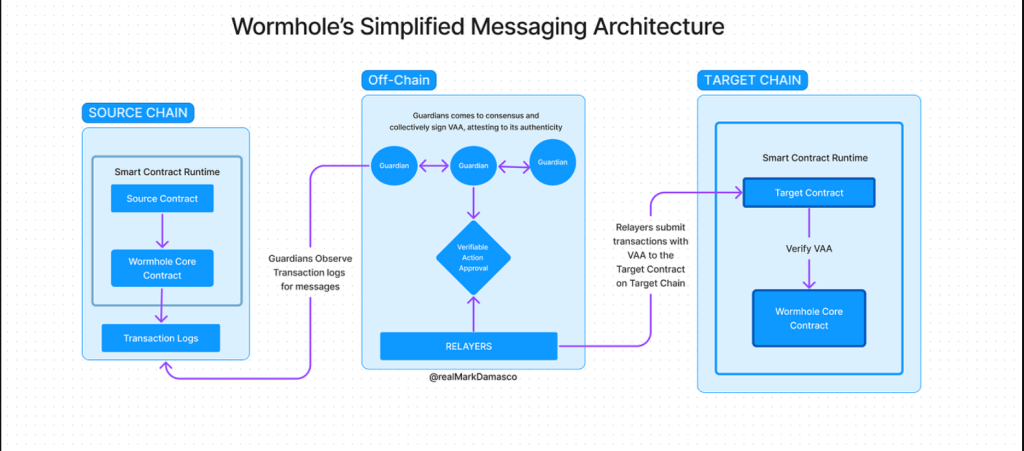
3. How Wormhole Works – Core Architecture Overview
Wormhole’s architecture is composed of both on-chain and off-chain components working together to securely transport messages across chains.
🧱 3.1. Main Architectural Components
🔐 A. Guardians
- 19+ independent validator nodes
- Run by institutions (e.g., Jump Crypto, Chainlayer)
- Observe transactions on source chains
- Sign and attest to valid messages
- Use BLS multi-signature scheme
- A VAA (Verifiable Action Approval) is formed when 2/3+ Guardians sign
🔁 B. Relayers
- Community-run nodes or protocols
- Fetch VAAs and submit them to destination chains
- Enable near-instant message delivery
- Permissionless (anyone can run one)
📩 C. VAAs (Verifiable Action Approvals)
- Encoded messages signed by Guardians
- Includes: nonce, timestamp, payload hash, signatures
- Used to ensure authenticity and prevent replay attacks
💡 D. Smart Contracts on Source and Target Chains
Core Bridge Contract: Validates VAAsToken Bridge Contract: Handles lock/mint logicNFT Bridge Contract: Manages metadata and transferGeneric Messaging Contract: Executes custom payloads
🔗 E. Wormhole SDK / CLI
- Developers use SDK or CLI to build on top of Wormhole
- Provides abstraction over message creation, signing, submission, and decoding
🌐 Supported Chains
- EVM: Ethereum, BNB Chain, Polygon, Avalanche, Fantom, Base, Celo
- Non-EVM: Solana, Sui, Aptos, Near
- Cosmos-based: Osmosis, Injective (via IBC)
- Layer 2s: Arbitrum, Optimism
#WormholeWorkflow
4. Basic Workflow of Wormhole
Let’s break down the full journey of a cross-chain asset transfer or message propagation.
✅ Step-by-Step Process (Token Transfer: Ethereum → Solana)
| Step | Action |
|---|---|
| 1. | User initiates transfer of 100 USDC from Ethereum to Solana |
| 2. | The Ethereum smart contract locks/burns USDC |
| 3. | Guardians observe this transaction and sign a VAA |
| 4. | A relayer (or the user) submits the VAA to the Solana contract |
| 5. | Solana smart contract verifies the VAA and mints 100 USDCet |
| 6. | User receives wrapped USDC on Solana for further use in DeFi |
✅ For Messaging Use Cases
- The VAA payload could contain custom data (e.g., “executeLoan()” or “changeRate(5%)”)
- The target chain parses and executes logic accordingly
#GettingStartedWithWormhole
5. Getting Started Guide – Users & Developers
Wormhole can be accessed via UI portals (Portal Bridge), SDKs, and command-line tools.
🧑💻 5.1. For End Users – Bridging Assets via Portal Bridge
🔹 Step 1: Visit
🔹 Step 2: Connect Wallet
- Choose source and target chains
- Connect wallets (e.g., MetaMask for Ethereum, Phantom for Solana)
🔹 Step 3: Select Asset
- Choose token (USDC, ETH, SOL, etc.)
- Enter amount and destination wallet address
🔹 Step 4: Approve Transaction
- Confirm transaction in wallet
- Pay gas fee (Ethereum gas or Solana lamports)
🔹 Step 5: Wait for Guardians
- Within ~15–120 seconds, Guardians sign the VAA
🔹 Step 6: Redeem on Target Chain
- Token arrives as a wrapped asset
- You can swap, stake, or redeem depending on the use case
👨💻 5.2. For Developers – Build on Wormhole
✅ Step 1: Install SDK
npm install @certusone/wormhole-sdk
✅ Step 2: Create a Transfer Script
import { transferFromEth } from "@certusone/wormhole-sdk";

await transferFromEth({
  tokenBridgeAddress: '0x...ETH Bridge',
  signer: yourSigner,
  tokenAddress: '0x...USDC',
  amount: 1000000, // 6 decimals
  recipientChain: 1, // Solana
  recipientAddress: '0x...SOL Address',
});
✅ Step 3: Get and Submit VAA
import { getSignedVAA } from "@certusone/wormhole-sdk";

const { vaaBytes } = await getSignedVAA(
  WORMHOLE_RPC_HOSTS,
  sourceChainId,
  emitterAddress,
  sequence
);

// Use smart contract on destination to process VAA
✅ Step 4: Verify on Block Explorer
Use https://wormholescan.io to trace messages, VAAs, and relayer status.
