Introduction
Fraud Prevention for E-commerce is the specialized practice of using technology, data analysis, and processes to identify and block fraudulent transactions on online stores. It goes beyond basic address verification, employing sophisticated algorithms and machine learning to analyze hundreds of data points per transaction—such as device fingerprinting, behavioral biometrics, IP reputation, and purchase velocity—to distinguish legitimate customers from fraudsters in real-time.
Its importance is existential for online businesses. Effective fraud prevention directly protects your revenue and profitability by stopping chargebacks (where you lose the product and pay a fee), safeguards your operational resources from investigative drain, and preserves your customer experience by minimizing false declines of good orders. In the real world, these tools are used to stop card-not-present (CNP) fraud using stolen credit cards, prevent sophisticated identity theft and account takeover (ATO) attacks, detect fraudulent refund and promo code abuse, and block organized “carding” attacks that test stolen card data.
When choosing a fraud prevention tool, merchants must evaluate detection accuracy (balancing fraud caught with false positives), speed of decisioning (to not slow down checkout), depth of customization (rules, risk scoring), quality of reporting and insights, and ease of integration with your existing e-commerce platform, payment gateway, and order management system.
Best for: E-commerce merchants of all sizes, online marketplaces, subscription services, and digital goods sellers. Key roles include founders, operations managers, risk analysts, and IT/development teams in retail, travel, ticketing, gaming, and fintech. Any business that processes online payments is a potential target.
Not ideal for: Pure brick-and-mortar retailers who only accept in-person, chip-and-PIN payments (though online components may still need it). Extremely low-volume hobbyists selling a few items per month manually, where manual review may suffice. Businesses using a full-service platform like Amazon or Etsy that bakes fraud protection into its marketplace fees.
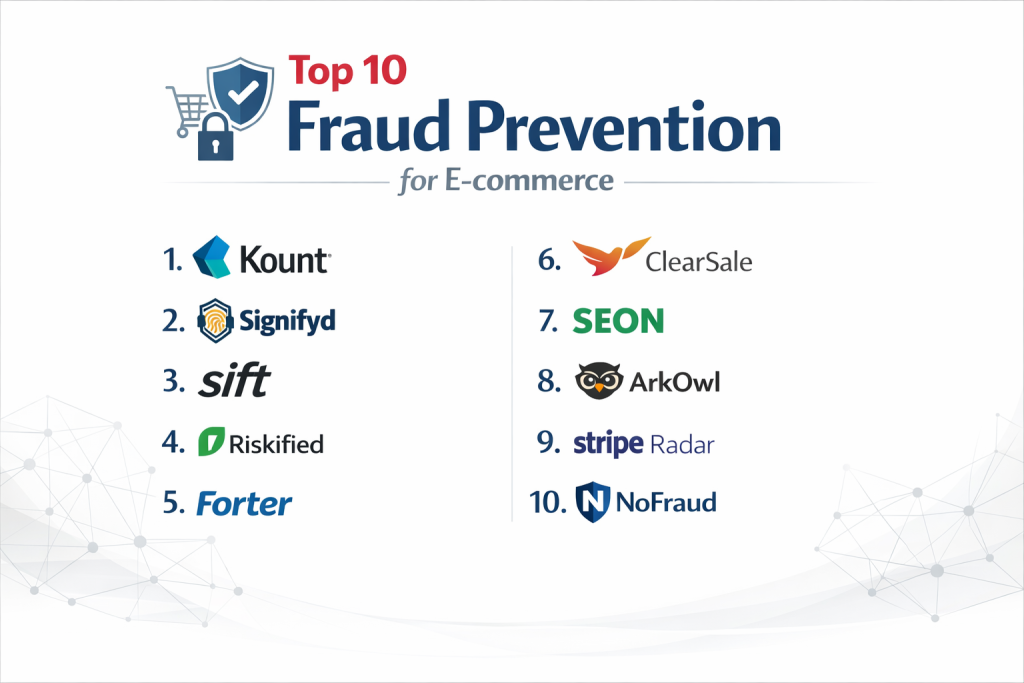
Top 10 Fraud Prevention for E-commerce Tools
1 — Kount
Kount is an industry-leading, AI-driven fraud prevention platform known for its vast data network (the “Identity Trust Global Network”). It specializes in providing a unified score and decision for all payment and non-payment interactions across digital channels.
- Key features:
- AI-powered decision platform analyzing billions of annual interactions.
- Proprietary Identity Trust Global Network for cross-merchant intelligence.
- Holistic view linking devices, identities, emails, phones, and cards.
- Real-time scoring for transactions, account creation, and logins.
- Highly customizable rules and workflows for specific business policies.
- Advanced chargeback protection with representment tools.
- Seamless integration with major e-commerce platforms and payment processors.
- Pros:
- Exceptional accuracy from a massive, cross-industry data consortium that improves fraud detection while reducing false positives.
- True omnichannel protection covering payments, ATO, and promotional abuse in one platform.
- Enterprise-grade configurability and detailed investigative case management.
- Cons:
- Pricing is oriented toward mid-market and enterprise businesses, can be costly for very small stores.
- Can be complex to fully leverage; optimal use often benefits from dedicated risk staff or strategic use of their services team.
- Security & compliance: PCI DSS Level 1 Service Provider, SOC 2 Type II certified, GDPR compliant. Employs tokenization and encryption for all data.
- Support & community: 24/7/365 support, dedicated account management for key clients, detailed documentation, and access to a team of fraud prevention experts.
2 — Signifyd
Signifyd pioneered the financial guarantee model for e-commerce fraud. They use machine learning and a big-data network to make automated, guaranteed decisions on every order, promising to cover the cost of any chargeback on an approved transaction.
- Key features:
- Chargeback Guarantee for approved orders, transferring fraud liability from merchant to Signifyd.
- Machine learning models built on a vast commerce graph of merchant data.
- Fully automated decisioning, designed to approve more good orders without manual review.
- Focus on optimizing revenue by reducing false declines.
- Integration as a “set-and-forget” solution with major platforms like Shopify, Magento, and BigCommerce.
- Post-purchase protection including shipment tracking and investigation support.
- Pros:
- Eliminates financial risk of fraud chargebacks through its guarantee, providing predictable costs.
- Excellent for merchants wanting hands-off operation, maximizing automation and approval rates.
- Strong focus on improving customer experience and conversion by minimizing friction for good customers.
- Cons:
- Cost model (typically a % of order value) can be higher than transactional fee models for high-volume, low-margin businesses.
- Less granular, merchant-controlled rule-setting by design, as the system’s AI makes the ultimate call to back its guarantee.
- Security & compliance: PCI DSS Level 1 Service Provider, SOC 2 compliant. As the guarantor, they maintain rigorous data security and compliance standards.
- Support & community: Dedicated support team, comprehensive integration guides, and strategic customer success management.
3 — Sift
Sift is a Digital Trust & Safety platform that extends beyond payment fraud to prevent a wide spectrum of abuse, including account takeover, content scams, and promo abuse. Its dynamic machine learning adapts to new fraud patterns in real-time.
- Key features:
- Real-time machine learning that adapts to emerging fraud tactics.
- Broad focus on payment fraud, account takeover, content abuse, and promo abuse.
- Customizable workflows and risk policies across the user journey.
- Global data network insights from thousands of sites.
- Detailed visual insights and reporting into user actions and risk signals.
- Robust API for deep integration into custom applications and workflows.
- Pros:
- Holistic approach protecting multiple business areas beyond just checkout.
- Powerful, real-time adaptability to novel and evolving fraud attacks.
- Excellent data visualization helps teams understand why a decision was made.
- Cons:
- Broad feature set can require more configuration to tailor to specific, pure e-commerce payment fraud needs.
- Pricing transparency can be less clear than some point solutions; typically custom-quoted.
- Security & compliance: SOC 2 Type II certified, GDPR, CCPA compliant. Implements enterprise-grade security protocols and data privacy controls.
- Support & community: 24/7 enterprise support, dedicated customer success managers, developer documentation, and an active trust & safety community.
4 — Riskified
Riskified is a leader in the e-commerce fraud prevention space, using advanced AI and human intelligence to provide a chargeback guarantee for approved orders. They emphasize maximizing order approval rates for legitimate customers, particularly in high-risk segments like luxury, electronics, and travel.
- Key features:
- AI-driven decisioning combined with manual review by expert analysts for edge cases.
- Chargeback guarantee that covers fraudulent chargebacks on approved orders.
- Specializes in high-risk industries and high-average-order-value (AOV) transactions.
- Deep analysis of user session behavior and identity stitching.
- Tools to fight friendly fraud and authorize chargeback representment.
- Pre-built integrations for all major e-commerce platforms.
- Pros:
- Strong track record in complex, high-risk verticals where fraud sophistication is high.
- “Human-in-the-loop” model adds a layer of expert scrutiny to difficult decisions.
- Focus on revenue recovery by confidently approving more good orders that other systems might decline.
- Cons:
- Premium pricing reflects its focus on high-value merchants and industries.
- Decision process can be less instantaneous than pure-machine solutions when human review is invoked, though still fast.
- Security & compliance: PCI DSS Level 1 Service Provider, SOC 2 Type II, ISO 27001 certified. GDPR and global privacy regulation compliant.
- Support & community: Dedicated account management, 24/7 operational support, and access to industry benchmarking and insights.
5 — Forter
Forter offers a real-time, fully automated decisioning platform for e-commerce fraud prevention, identity, and trust. It’s known for its instant, guaranteed decisions and deep integration into the customer journey from login to checkout to post-purchase.
- Key features:
- Real-time decision engine providing instant approve/decline outcomes.
- Fraud guarantee for approved transactions.
- Identity-based approach that creates a persistent “trust score” for users across sessions.
- Protection across the full funnel: account creation, login, checkout, promotions, and returns.
- Frictionless integration designed to not impact site performance or conversion rates.
- Specialized solutions for marketplaces, digital goods, and travel.
- Pros:
- Extremely fast decisioning enhances customer experience at critical points like checkout.
- True “no manual review” automation for merchants seeking full operational efficiency.
- Strong focus on reducing false positives and increasing good customer approval rates.
- Cons:
- Like other guaranteed solutions, cost is tied to order volume/value, which may not suit all business models.
- Less emphasis on merchant-configurable rules, relying more on its proprietary AI models.
- Security & compliance: PCI DSS Level 1, SOC 2 Type II, ISO 27001 certified. Adheres to global data privacy standards including GDPR.
- Support & community: 24/7 global support, strategic customer success teams, and detailed technical documentation.
6 — ClearSale
ClearSale takes a unique hybrid approach, combining robust statistical AI with a 100% manual review of all orders flagged as suspicious. This aims to eliminate false positives by ensuring no potentially good order is automatically declined without human verification.
- Key features:
- AI-powered initial scoring to filter clearly legitimate and fraudulent orders.
- 100% manual review by in-house fraud analysts for all orders in the “suspicious” middle range.
- Chargeback protection guarantee for orders they approve.
- Focus on markets with high fraud rates and complex fraud patterns, like Latin America and global cross-border.
- Detailed order investigation notes and reporting provided to the merchant.
- Pros:
- Virtually eliminates false declines due to the human review safety net, protecting customer relationships.
- Excellent for merchants selling in high-fraud regions where pure-automation can struggle.
- Provides clear reasoning behind every decision due to analyst notes.
- Cons:
- Manual review can slow down order fulfillment for flagged orders (often by several hours).
- Less suited for ultra-high-volume, low-margin businesses where manual review costs and delays are prohibitive.
- Security & compliance: PCI DSS Level 1 Service Provider. Maintains strict data security protocols for its global analyst teams.
- Support & community: Dedicated account management, 24/7 operational support for analysts, and regional expertise teams.
7 — SEON
SEON is a fast-growing, modular fraud prevention solution that emphasizes transparency, speed, and configurability. It provides a toolkit of enrichment and analysis modules (email, phone, IP, device fingerprinting) that merchants can use to build their own flexible risk rules.
- Key features:
- Real-time data enrichment for emails, phone numbers, IP addresses, and digital fingerprints.
- Modular, API-first platform allowing businesses to use only the tools they need.
- Transrisk score and highly customizable rules engine.
- Lightweight integration and fast setup, often cited in days, not months.
- Transparent pricing, often based on API lookups or monthly active users.
- Strong emphasis on data privacy and minimizing PII collection.
- Pros:
- High degree of control and flexibility for businesses with specific risk logic needs.
- Fast implementation and lower cost of entry compared to enterprise suites.
- Transparent pricing and operations; you see the data points used for decisions.
- Cons:
- Requires more hands-on setup and tuning to achieve optimal results compared to “full-service” AI solutions.
- Lacks the massive consortium data network of leaders like Kount or Signifyd out-of-the-box.
- Security & compliance: GDPR compliant by design (minimizes PII), ISO 27001 certified. Offers data hosting in EU and US.
- Support & community: Responsive support, detailed technical documentation, and an active user community for sharing rules and strategies.
8 — ArkOwl
ArkOwl provides essential, real-time fraud prevention data through simple API lookups. It focuses on email and transaction risk scoring, making it an accessible and cost-effective first line of defense or supplemental tool for small to medium-sized businesses.
- Key features:
- Real-time email risk analysis checking for disposable domains, recent creation, and known fraud associations.
- Transaction scoring API that evaluates multiple data points for a simple risk score.
- Phone number validation and carrier lookup.
- IP address risk assessment (proxy, VPN, data center detection).
- Simple, developer-friendly REST API.
- Very low-cost, pay-as-you-go pricing model based on API calls.
- Pros:
- Extremely affordable and simple to implement, ideal for startups and SMBs.
- Fast, actionable data to enrich internal decision-making or rule engines.
- Excellent as a supplemental tool to add specific data checks to an existing setup.
- Cons:
- Not a complete, standalone fraud prevention suite; lacks advanced machine learning and automated case management.
- Requires the merchant to build rules and processes around the provided data.
- Security & compliance: Varies / N/A. As a data API provider, security focuses on API key management and secure transmission. They do not typically hold full transaction data.
- Support & community: Documentation and email support. Community is largely developer-focused.
9 — Stripe Radar
Stripe Radar is the built-in fraud prevention tool for businesses using the Stripe payments ecosystem. It uses machine learning trained on data from the global Stripe network and allows for deep customization with rules and insights.
- Key features:
- Machine learning models trained on billions of Stripe transactions across industries.
- Fully integrated with Stripe’s payment APIs and dashboard for a seamless experience.
- Radar for Fraud Teams: Advanced rules editor, review queue, and reporting for hands-on control.
- Adaptive machine learning that customizes to your business’s specific fraud patterns.
- Built-in tools to fight chargebacks and submit evidence.
- Included for free with every Stripe transaction; advanced features have a fee.
- Pros:
- Unbeatable integration and ease of use for Stripe users; no additional setup needed.
- Powerful network effects from Stripe’s vast global transaction data.
- Scales from simple, automated protection to advanced rules as your business grows.
- Cons:
- Exclusively for Stripe users; not an option if you use a different payment processor.
- While powerful, it may lack some specialized features of best-of-breed standalone platforms for ultra-high-risk industries.
- Security & compliance: Inherits Stripe’s PCI DSS Level 1 certification and SOC 2 compliance. Fully integrated into Stripe’s security framework.
- Support & community: Support through standard Stripe channels. Documentation is part of the broader Stripe ecosystem.
10 — NoFraud
NoFraud is a fraud prevention platform that combines automated technology with human review, offering a chargeback protection guarantee. It emphasizes a partnership approach, providing dedicated analysts and clear communication.
- Key features:
- Automated screening using proprietary technology and data points.
- Human review of all medium/high-risk orders by in-house experts.
- Chargeback protection guarantee for approved transactions.
- Direct communication with merchants via dashboard, email, and phone.
- Pre-built integrations with popular e-commerce platforms.
- Specialized solutions for specific verticals like fashion, electronics, and NFTs.
- Pros:
- Personalized service and direct analyst access, which many SMB and mid-market merchants appreciate.
- Clear, proactive communication on order decisions and emerging fraud trends.
- Balanced hybrid model aims to catch fraud while protecting good orders.
- Cons:
- Human review component can introduce a delay on flagged orders compared to instant-guarantee platforms.
- Less suited for merchants requiring fully automated, instantaneous decisioning at massive scale.
- Security & compliance: PCI DSS Level 1 Service Provider. Maintains secure systems for handling transaction and customer data.
- Support & community: Dedicated account management and 24/7 support team. Prioritizes direct merchant communication over a large public community.
Comparison Table
| Tool Name | Best For (Target User) | Platform(s) Supported | Standout Feature | Rating |
|---|---|---|---|---|
| Kount | Mid-market to Enterprise seeking data-powered, omnichannel accuracy | API, Major E-commerce Platforms | Identity Trust Global Network & Cross-Channel Insights | N/A |
| Signifyd | Merchants wanting a hands-off, guaranteed solution to eliminate fraud liability | API, Native Shopify/Magento/BigCommerce Apps | Financial Guarantee & Revenue Optimization Focus | N/A |
| Sift | Digital businesses needing broad Trust & Safety beyond just payment fraud | API | Holistic Platform for Fraud, ATO, and Content Abuse | N/A |
| Riskified | High-AOV/High-Risk industries (luxury, travel) wanting AI + expert review | API, Major Platform Integrations | Expert-Led Review for Complex Cases & High-Risk Verticals | N/A |
| Forter | Enterprises seeking instant, automated, guaranteed decisions | API | Real-Time, Identity-Based Decisions & Full-Funnel Protection | N/A |
| ClearSale | Merchants in high-fraud regions or who prioritize eliminating false declines | API, Platform Integrations | 100% Manual Review of Suspicious Orders | N/A |
| SEON | Tech-savvy SMBs/Mid-market wanting flexible, transparent, modular tools | API | Modular Data Enrichment & Highly Customizable Rules Engine | N/A |
| ArkOwl | Startups and SMBs needing affordable, essential fraud data APIs | API | Low-Cost, Real-Time Email & Transaction Risk Data | N/A |
| Stripe Radar | Businesses already using Stripe for payments | Native within Stripe | Deep, Seamless Integration with Stripe’s Payment Ecosystem | N/A |
| NoFraud | SMB to Mid-market valuing a hybrid approach with personal support | API, Platform Integrations | Hybrid Automation + Human Review with Personal Service | N/A |
Evaluation & Scoring of Fraud Prevention for E-commerce
| Criteria | Weight | Explanation & What to Look For |
|---|---|---|
| Core Features | 25% | Accuracy of fraud detection (catch rate), false positive rate, speed of decision, availability of a chargeback guarantee, and depth of investigative tools (case management, reporting). |
| Ease of Use | 15% | Simplicity of integration, clarity of the dashboard, automation level (reducing manual review), and quality of alerts and reporting for your team. |
| Integrations & Ecosystem | 15% | Native integrations with your e-commerce platform (Shopify, Magento), payment gateway (Stripe, Braintree), and order management system. Flexibility of API for custom needs. |
| Security & Compliance | 10% | PCI DSS certification, SOC 2 compliance, data encryption standards, and adherence to privacy regulations (GDPR, CCPA). The vendor’s own security is paramount. |
| Performance & Reliability | 10% | System uptime, decision latency (must not slow down checkout), and ability to handle traffic spikes during sales or launches without degradation. |
| Support & Community | 10% | Quality of onboarding, availability of customer support (24/7?), access to fraud experts or account managers, and the existence of a knowledge base or user community. |
| Price / Value | 15% | Total cost: subscription fees, per-transaction costs, percentage fees, or setup charges. Evaluate ROI based on chargebacks prevented, manual review time saved, and revenue recovered from false positives. |
Which Fraud Prevention for E-commerce Tool Is Right for You?
- Solo Users vs. SMB vs. Enterprise: Startups and very small sellers should start with built-in tools like Stripe Radar (if using Stripe) or a lightweight, affordable API like ArkOwl. Growing SMBs need more robust protection; SEON, NoFraud, or Signifyd are excellent. Mid-market to Enterprise businesses require scale, advanced features, and guarantees; Kount, Riskified, Forter, and Sift are top contenders.
- Budget-Conscious vs. Premium: For strict budgets, ArkOwl provides essential data, and Stripe Radar is included with payments. Premium solutions like Signifyd, Forter, and Riskified offer financial guarantees and high automation, justifying their cost through risk transfer and operational savings.
- Feature Depth vs. Ease of Use: Kount and Sift offer immense depth and configurability for dedicated risk teams. Signifyd and Forter prioritize ease of use and a “set-and-forget” automated guarantee. SEON offers depth through flexibility but requires more setup.
- Integration and Scalability Needs: If you use Stripe, Radar is the natural first step. For Shopify Plus merchants, Signifyd has a renowned integration. For complex, custom tech stacks, an API-first platform like Sift, Kount, or SEON is essential. Ensure the platform can scale with your transaction volume without performance loss.
- Security and Compliance Requirements: All listed leaders maintain PCI DSS Level 1 and SOC 2 compliance. For global businesses, confirm GDPR and other regional data privacy compliance. The vendor’s security posture is non-negotiable, as they process your sensitive transaction data.
Frequently Asked Questions (FAQs)
- What is a false positive and why is it a problem?
A false positive is when a legitimate customer’s order is incorrectly flagged and declined as fraud. This directly loses a sale, damages customer trust, and can lead to negative reviews. A good system balances catching fraud with minimizing false positives. - How does a “chargeback guarantee” or “fraud guarantee” work?
The fraud prevention company fully approves an order. If that order later results in a fraudulent chargeback, the company reimburses you for the order value and the chargeback fee. This transfers the financial risk from you to them. - What’s the difference between fraud prevention and basic AVS/CVV checks?
AVS (Address Verification) and CVV checks are simple, rule-based filters. Modern fraud prevention uses machine learning to analyze hundreds of complex, hidden signals (device, behavior, network) to detect sophisticated fraud that easily passes AVS/CVV. - Can’t I just manually review all suspicious orders?
For low volume, this can work. As you scale, it becomes unsustainable, slows fulfillment, and is error-prone. Humans are poor at detecting sophisticated, patterned fraud compared to AI trained on millions of transactions. - How much does e-commerce fraud prevention typically cost?
Models vary: per-transaction fee (e.g., $0.10 – $0.50), percentage of order value (e.g., 0.5% – 1.5% for guaranteed solutions), monthly subscription + usage, or pay-as-you-go API calls. Costs scale with your volume and risk. - Will a fraud tool slow down my checkout process?
A well-designed tool makes its API calls in milliseconds and should not create any perceptible delay for the customer. Performance and low latency are key evaluation points. - What is Account Takeover (ATO) fraud and do these tools prevent it?
ATO is when a fraudster gains access to a legitimate customer’s account. Yes, modern tools like Sift, Kount, and Forter analyze login behavior, device familiarity, and credential stuffing attempts to prevent ATO at the login stage, not just checkout. - How long does it take to implement a fraud prevention solution?
A pre-built plugin for Shopify or Magento can be live in hours. A full API integration for a custom platform can take from a few days to several weeks, depending on complexity. - What’s the biggest mistake merchants make with fraud prevention?
Being too aggressive out of fear. Setting overly strict rules leads to high false decline rates, which can silently bleed more revenue than fraud itself. The goal is to optimize for profit, not to achieve 0% fraud at all costs. - Should I use more than one fraud prevention tool?
Typically, no. Using multiple full-stack systems can create conflicting decisions and complexity. However, it’s common to use a primary tool supplemented by specific data APIs (e.g., using ArkOwl for email checks within a broader rule set).
Conclusion
Selecting the right fraud prevention partner is a critical business decision that impacts your bottom line, operational efficiency, and customer relationships. The landscape offers specialized solutions for every need—from the simplicity and integration of Stripe Radar for startups, to the data-powered intelligence of Kount for enterprises, to the risk-eliminating guarantee of Signifyd for growth-focused merchants.
Remember, the “best” tool is not the one with the most features, but the one whose strengths align with your business model, risk tolerance, and operational style. Prioritize accuracy (in both fraud caught and good orders approved), ease of integration and use, and a clear pricing model that aligns with your growth. By carefully evaluating your options against the framework in this guide, you can choose a solution that acts not as a cost center, but as a strategic asset for profitable and secure growth.

- Top 10 Email Deliverability Tools: Features, Pros, Cons & Comparison - September 6, 2026
- Top 10 Pharmacovigilance Software: Features, Pros, Cons & Comparison - September 6, 2026
- Top 10 Manufacturing Execution Systems (MES) - July 30, 2026