Introduction
Cloud Policy as Code tools are software tools that help teams define, manage, and enforce cloud rules using code instead of manual processes. In simple words, these tools allow organizations to write policies in a readable language and automatically apply them across cloud environments. These policies control how cloud resources are created, used, and secured.
Cloud environments change very fast. New servers, storage, networks, and services are created every day. If rules are applied manually, mistakes happen. Cloud Policy as Code tools solve this problem by making policies automatic, repeatable, and consistent. Once a policy is written, it can be checked every time code is deployed or infrastructure is changed.
In real-world use, these tools help prevent security risks, control cloud costs, enforce compliance rules, and reduce human errors. When choosing a Cloud Policy as Code tool, users should look for simple policy language, strong cloud integration, good testing features, clear reporting, scalability, and strong security controls.
Best for:
Cloud Policy as Code tools are best for DevOps engineers, cloud engineers, security teams, platform teams, compliance teams, FinOps teams, startups growing fast, enterprises, and industries like finance, healthcare, SaaS, and government.
Not ideal for:
Small teams with very limited cloud usage or teams managing infrastructure manually may not need full policy-as-code tools. Basic cloud rules or manual checks may be enough in such cases.
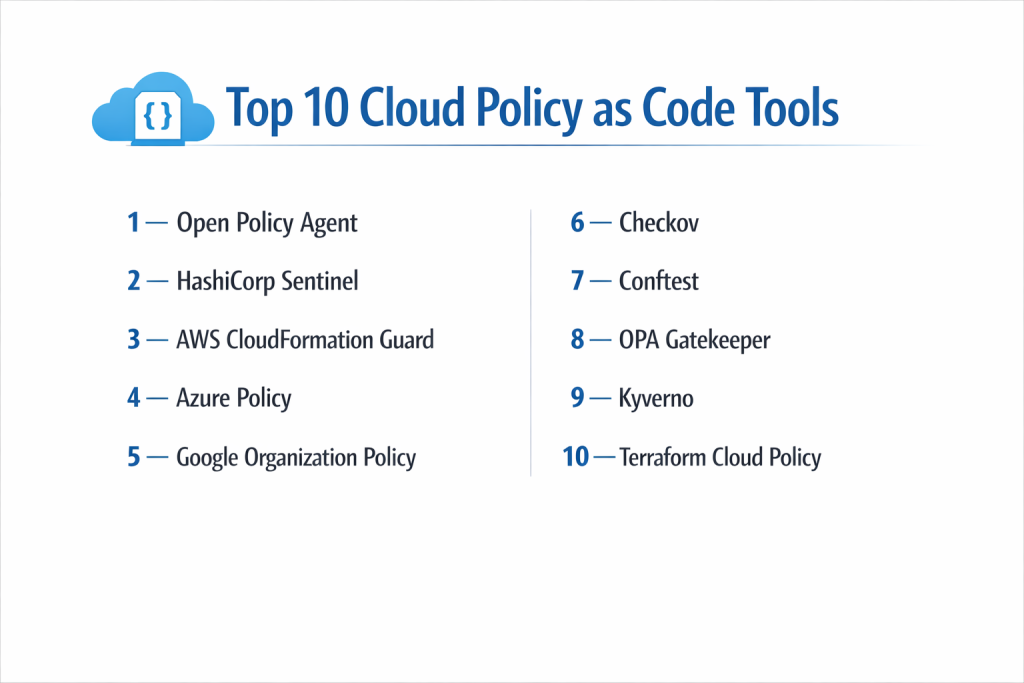
Top 10 Cloud Policy as Code Tools
1 — Open Policy Agent
Short description:
A general-purpose policy engine used to define and enforce policies across cloud, Kubernetes, and applications.
Key features:
- Policy definition using a simple rule language
- Works with Kubernetes, APIs, and CI pipelines
- Central policy management
- Fine-grained access control
- Reusable policy modules
- Strong integration support
Pros:
- Very flexible
- Widely adopted
- Strong community support
Cons:
- Learning curve for beginners
- Requires good policy design
Security & compliance:
Supports role-based access, audit logs, and secure policy evaluation.
Support & community:
Excellent documentation, very active open-source community, enterprise support options.
2 — HashiCorp Sentinel
Short description:
A policy-as-code framework designed to work closely with infrastructure automation tools.
Key features:
- Policy enforcement during deployments
- Tight integration with infrastructure workflows
- Version-controlled policies
- Policy testing
- Clear policy language
- Central governance
Pros:
- Strong governance
- Good for regulated environments
- Predictable behavior
Cons:
- Limited outside ecosystem
- Licensing required for full features
Security & compliance:
Supports access control, audit logging, and compliance enforcement.
Support & community:
Good documentation, enterprise support, smaller community.
3 — AWS CloudFormation Guard
Short description:
A policy tool used to validate infrastructure templates before deployment.
Key features:
- Rule-based template validation
- Prevents unsafe resource creation
- Works with infrastructure templates
- Easy rule syntax
- Pre-deployment checks
- Lightweight execution
Pros:
- Simple to use
- No extra infrastructure
- Native cloud integration
Cons:
- Cloud-specific
- Limited advanced logic
Security & compliance:
Uses cloud-native security and access controls.
Support & community:
Good documentation, cloud user community.
4 — Azure Policy
Short description:
A built-in policy engine for managing rules in cloud environments.
Key features:
- Policy definitions and assignments
- Automatic compliance checks
- Resource enforcement
- Audit and reporting
- Policy inheritance
- Native cloud integration
Pros:
- Easy setup
- Strong compliance visibility
- Built-in reporting
Cons:
- Cloud-specific
- Less flexible logic
Security & compliance:
Enterprise-grade security, compliance reporting, and audit logs.
Support & community:
Strong documentation and enterprise support.
5 — Google Organization Policy
Short description:
A policy service to control resource usage and configurations in cloud environments.
Key features:
- Organization-level constraints
- Project and folder policies
- Preventive controls
- Audit visibility
- Simple policy definitions
- Native integration
Pros:
- Strong preventive controls
- Simple management
- Reliable enforcement
Cons:
- Limited customization
- Cloud-specific
Security & compliance:
Built-in security controls and audit support.
Support & community:
Good documentation and cloud user community.
6 — Checkov
Short description:
A policy-as-code tool focused on infrastructure security and compliance checks.
Key features:
- Policy checks for infrastructure code
- Predefined security rules
- Custom policy support
- CI pipeline integration
- Multi-cloud support
- Clear scan reports
Pros:
- Easy to start
- Strong security focus
- Good rule library
Cons:
- Reporting can feel basic
- Best for scanning use cases
Security & compliance:
Supports compliance frameworks and audit-ready reports.
Support & community:
Active community, good documentation, enterprise options.
7 — Conftest
Short description:
A lightweight tool used to test configuration files against policies.
Key features:
- Policy testing for config files
- Uses common policy language
- CI integration
- Fast execution
- Works with many formats
- Simple command-line usage
Pros:
- Very fast
- Simple tool design
- Easy automation
Cons:
- Limited reporting
- Requires policy writing skills
Security & compliance:
Varies based on usage and environment.
Support & community:
Good documentation, open-source community support.
8 — OPA Gatekeeper
Short description:
A policy controller designed specifically for Kubernetes environments.
Key features:
- Admission control policies
- Kubernetes-native enforcement
- Policy templates
- Real-time enforcement
- Audit reports
- Centralized governance
Pros:
- Strong Kubernetes control
- Real-time blocking
- Scales well
Cons:
- Kubernetes-only
- Requires cluster knowledge
Security & compliance:
Supports audit logs and access controls.
Support & community:
Active Kubernetes and open-source community.
9 — Kyverno
Short description:
A Kubernetes-native policy engine that uses simple configuration rules.
Key features:
- YAML-based policies
- Validation and mutation
- Policy reporting
- Kubernetes-native design
- Easy rule creation
- Admission control
Pros:
- Very easy to use
- No new language to learn
- Clear policies
Cons:
- Kubernetes-only
- Limited outside cluster use
Security & compliance:
Supports audit mode and policy reports.
Support & community:
Strong open-source community and documentation.
10 — Terraform Cloud Policy
Short description:
A policy-as-code capability built into infrastructure automation platforms.
Key features:
- Policy checks during deployments
- Workspace-level controls
- Policy versioning
- Pre-deployment enforcement
- Integration with workflows
- Central governance
Pros:
- Seamless workflow integration
- Predictable enforcement
- Good for infrastructure teams
Cons:
- Platform-dependent
- Limited flexibility outside ecosystem
Security & compliance:
Supports access control, audit logs, and encryption.
Support & community:
Enterprise support, documentation, infrastructure-focused users.
Comparison Table
| Tool Name | Best For | Platform(s) Supported | Standout Feature | Rating |
|---|---|---|---|---|
| Open Policy Agent | Multi-platform governance | Multi-cloud | Flexible policy engine | N/A |
| HashiCorp Sentinel | Infrastructure governance | Cloud platforms | Deployment enforcement | N/A |
| AWS CloudFormation Guard | Template validation | Cloud platform | Pre-deploy checks | N/A |
| Azure Policy | Cloud governance | Cloud platform | Built-in compliance | N/A |
| Google Organization Policy | Org-level control | Cloud platform | Preventive rules | N/A |
| Checkov | Security scanning | Multi-cloud | Security rule library | N/A |
| Conftest | Config testing | Multi-platform | Lightweight testing | N/A |
| OPA Gatekeeper | Kubernetes control | Kubernetes | Admission control | N/A |
| Kyverno | Kubernetes teams | Kubernetes | YAML-based policies | N/A |
| Terraform Cloud Policy | Infrastructure teams | Multi-cloud | Workflow integration | N/A |
Evaluation & Scoring of Cloud Policy as Code Tools
| Criteria | Weight | Evaluation Focus |
|---|---|---|
| Core features | 25% | Policy depth and enforcement |
| Ease of use | 15% | Learning and readability |
| Integrations & ecosystem | 15% | Tool and cloud support |
| Security & compliance | 10% | Audit and access control |
| Performance & reliability | 10% | Speed and consistency |
| Support & community | 10% | Documentation and help |
| Price / value | 15% | Cost versus benefit |
Which Cloud Policy as Code Tool Is Right for You?
- Solo users: Lightweight tools or native cloud policies work well.
- SMBs: Simple policy tools with automation are ideal.
- Mid-market: Tools with multi-cloud and CI integration bring value.
- Enterprise: Advanced governance and audit-ready tools are essential.
Budget-focused teams should use open-source tools. Kubernetes teams should choose cluster-native policy engines. Regulated industries should prioritize audit and reporting features. Integration and scalability should guide final decisions.
Frequently Asked Questions (FAQs)
1. What is cloud policy as code?
It means managing cloud rules using code.
2. Why is policy as code important?
It reduces manual errors and improves consistency.
3. Do these tools block bad deployments?
Yes, many stop non-compliant changes automatically.
4. Are these tools cloud-specific?
Some are, others support multiple platforms.
5. Is policy as code hard to learn?
Basic rules are simple, advanced policies need practice.
6. Can developers use these tools?
Yes, especially in DevOps workflows.
7. Are these tools secure?
Most support enterprise security standards.
8. Do they support audits?
Many offer audit logs and reports.
9. What is a common mistake?
Writing too many complex policies early.
10. Can policies scale with growth?
Yes, if designed properly.
Conclusion
Cloud Policy as Code tools help organizations manage cloud environments in a safe, consistent, and automated way. They reduce risk, improve compliance, and support fast cloud growth. The most important factors when choosing the right tool are simplicity, integration, security, and scalability. There is no single best tool for everyone. The best choice always depends on cloud setup, team skills, and business needs.

- Top 10 Email Deliverability Tools: Features, Pros, Cons & Comparison - September 6, 2026
- Top 10 Pharmacovigilance Software: Features, Pros, Cons & Comparison - September 6, 2026
- Top 10 Manufacturing Execution Systems (MES) - July 30, 2026