Introduction
Supply chain management has become more complex than ever. Organizations must coordinate suppliers, manufacturers, warehouses, transportation providers, distributors, and customers across multiple locations. As operations expand, companies often struggle with delayed information, inventory inaccuracies, shipment disruptions, and limited visibility into real-time activities.
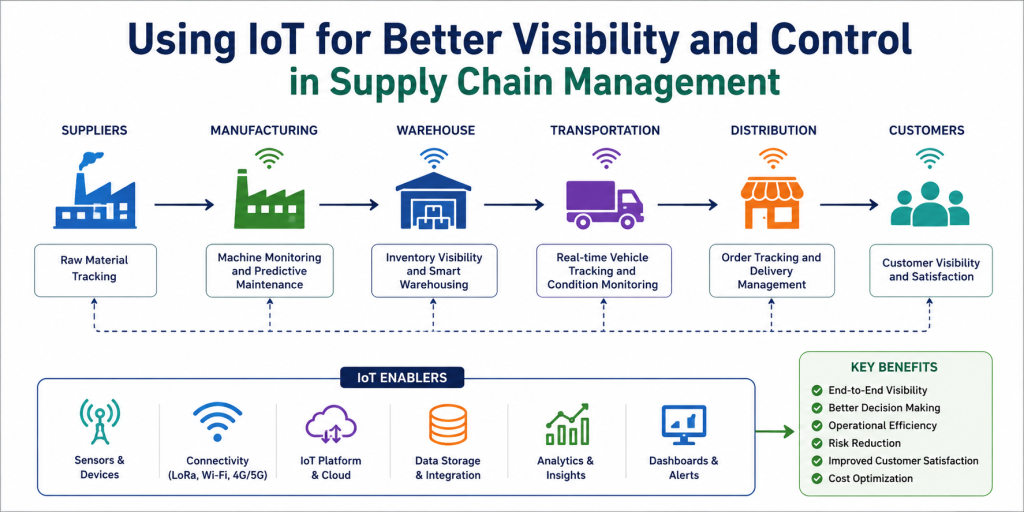
This is where the Internet of Things (IoT) creates significant value. IoT connects physical assets, devices, sensors, vehicles, machines, and products to digital systems. As a result, organizations can collect real-time data from every stage of the supply chain and make faster, more informed decisions. Instead of relying on manual updates and periodic reports, businesses gain continuous visibility into operations, inventory movement, transportation conditions, equipment health, and customer deliveries.
Organizations looking to strengthen supply chain capabilities often explore industry knowledge and operational frameworks from providers such as SCMGALAXY. Through practical learning and operational insights, professionals can better understand how modern technologies transform supply chain performance.
In today’s competitive environment, visibility is no longer optional. Companies need accurate information at the right time to reduce costs, improve service levels, and manage risks effectively. IoT enables this transformation by creating a connected ecosystem where assets continuously communicate their status and location. Consequently, businesses gain greater control over operations, improve responsiveness, and create more resilient supply chains.
This comprehensive guide explores how IoT improves visibility and control across supply chain operations, the technologies involved, implementation strategies, operational concepts, career opportunities, and common mistakes organizations should avoid.
Understanding IoT in Supply Chain Management
The Internet of Things refers to a network of connected devices that collect, transmit, and analyze data through sensors and communication technologies.
Within supply chain management, IoT devices can be attached to products, containers, pallets, vehicles, warehouse equipment, manufacturing assets, and storage facilities. These devices continuously capture operational data and send it to centralized systems for monitoring and analysis.
Traditional supply chains often depend on manual data entry and periodic reporting. Consequently, managers receive information after events have already occurred. IoT changes this approach by providing real-time visibility into operations.
For example, a transportation manager can monitor vehicle location, fuel consumption, driver behavior, and delivery status simultaneously. Similarly, warehouse managers can track inventory levels, equipment utilization, and environmental conditions without manual intervention.
The value of IoT comes from its ability to transform physical activities into digital information. Once organizations gain access to continuous operational data, they can improve decision-making, identify risks early, and optimize business processes more effectively.
Why Visibility Matters in Modern Supply Chains
Visibility refers to the ability to monitor activities, assets, inventory, and operational conditions across the entire supply chain.
Without visibility, organizations face numerous challenges:
- Inventory shortages
- Excess stock accumulation
- Shipment delays
- Product losses
- Equipment failures
- Customer dissatisfaction
- Increased operational costs
When managers lack real-time information, they often make decisions based on assumptions rather than facts. As a result, inefficiencies increase throughout the supply chain.
IoT improves visibility by providing accurate and continuous updates from operational environments. Instead of waiting for reports, organizations receive immediate information about changing conditions.
Better visibility creates several advantages:
- Faster decision-making
- Improved inventory accuracy
- Better customer service
- Reduced operational risks
- Stronger supplier coordination
- Enhanced transportation performance
As supply chains become increasingly global and interconnected, visibility becomes a critical factor for maintaining operational excellence.
Core Components of IoT in Supply Chain Management
Several technologies work together to create an effective IoT ecosystem.
Sensors
Sensors are the foundation of IoT systems.
They collect information such as:
- Temperature
- Humidity
- Pressure
- Motion
- Vibration
- Location
- Light exposure
These sensors continuously monitor operational conditions and generate valuable data.
RFID Technology
Radio Frequency Identification enables organizations to track products and assets automatically.
RFID tags store information about products and communicate with RFID readers. Unlike traditional barcode systems, RFID does not require direct line-of-sight scanning.
Consequently, inventory tracking becomes faster and more accurate.
GPS Tracking
Global Positioning System technology allows organizations to monitor the location of vehicles, shipments, and assets in real time.
Transportation managers can identify delays, optimize routes, and improve delivery performance using GPS data.
Connectivity Networks
IoT devices must communicate with centralized systems.
Common connectivity options include:
- Wi-Fi
- Cellular networks
- Bluetooth
- Satellite communication
- Low-power wide-area networks
These networks ensure continuous data transmission from operational environments.
Cloud Platforms
Cloud systems collect, store, and process IoT-generated data.
Organizations use cloud platforms to analyze information, generate reports, and support decision-making across supply chain operations.
Analytics Engines
Raw data alone provides limited value.
Analytics tools transform data into actionable insights by identifying patterns, trends, anomalies, and optimization opportunities.
How IoT Improves Supply Chain Visibility
Real-Time Asset Tracking
One of the most significant benefits of IoT is real-time asset tracking.
Organizations can monitor:
- Vehicles
- Containers
- Pallets
- Equipment
- High-value products
Real-time tracking reduces uncertainty throughout the supply chain.
Managers always know where assets are located and can respond quickly to disruptions.
End-to-End Shipment Visibility
Customers increasingly expect accurate delivery information.
IoT enables companies to monitor shipments from origin to destination. As products move through suppliers, warehouses, transportation networks, and distribution centers, their status remains visible.
This transparency improves customer satisfaction and operational planning.
Inventory Monitoring
Inventory inaccuracies create costly problems.
IoT-enabled inventory systems provide continuous updates on stock levels, product movement, and storage conditions.
As a result, organizations can maintain optimal inventory levels and reduce stock-related risks.
Environmental Monitoring
Certain products require strict environmental control.
Industries such as pharmaceuticals, food processing, and chemicals depend on temperature-sensitive logistics.
IoT sensors monitor:
- Temperature
- Humidity
- Air quality
- Storage conditions
Immediate alerts help organizations prevent product damage.
Equipment Monitoring
Operational equipment plays a critical role in supply chain performance.
IoT devices monitor equipment health and identify potential issues before failures occur.
This proactive approach reduces downtime and improves operational reliability.
How IoT Enhances Supply Chain Control
Visibility provides information. Control enables action.
Together, visibility and control create a powerful operational advantage.
Predictive Decision-Making
Traditional systems often react to problems after they occur.
IoT supports predictive decision-making by identifying trends and warning signs early.
Managers can address risks before they affect operations.
Automated Responses
Modern IoT systems can trigger automated actions.
For example:
- Inventory replenishment orders
- Maintenance requests
- Route adjustments
- Temperature control changes
- Security alerts
Automation improves efficiency while reducing manual effort.
Improved Resource Allocation
Real-time operational data enables better resource management.
Organizations can allocate:
- Labor
- Equipment
- Transportation assets
- Warehouse space
More effectively based on actual demand and conditions.
Risk Management
Supply chains face numerous risks including weather disruptions, transportation delays, equipment failures, and supplier issues.
IoT provides early warning signals that help organizations mitigate risks before they escalate.
Better Performance Measurement
Managers can track operational performance continuously.
Key metrics become more accurate because they are based on real-time data rather than manual reporting.
Key Operational Concepts You Must Know
Understanding several operational concepts helps organizations maximize IoT value.
Operational Visibility
Operational visibility means accessing accurate information about activities, assets, inventory, and processes throughout the supply chain.
Without visibility, organizations operate with uncertainty.
IoT removes many information gaps by providing continuous operational awareness.
Traceability
Traceability refers to tracking products throughout their lifecycle.
Organizations can identify:
- Product origin
- Manufacturing details
- Transportation history
- Storage conditions
- Delivery status
Traceability improves quality control and regulatory compliance.
Predictive Maintenance
Traditional maintenance follows fixed schedules.
Predictive maintenance uses sensor data to identify equipment issues before failures occur.
This approach reduces downtime and maintenance costs.
Demand Synchronization
Supply chains perform best when inventory aligns with actual demand.
IoT provides demand-related insights that help organizations synchronize supply chain activities more effectively.
Operational Resilience
Resilience refers to an organization’s ability to adapt to disruptions.
Real-time visibility and control improve resilience by enabling faster responses to changing conditions.
Continuous Optimization
Modern operations require ongoing improvement.
IoT provides the data necessary to identify inefficiencies and optimize performance continuously.
Platform Implementation vs. Culture — What’s the Real Difference?
Many organizations assume technology alone will solve operational challenges. However, successful IoT adoption requires both platform implementation and cultural transformation.
Platform Implementation
Platform implementation focuses on technology deployment.
This includes:
- Sensors
- Devices
- Networks
- Analytics systems
- Dashboards
- Data platforms
Technology provides the infrastructure necessary for visibility and control.
Without a reliable platform, organizations cannot capture or analyze operational data effectively.
Organizational Culture
Culture determines how people use technology.
Even the most advanced IoT platform delivers limited value if employees ignore data, resist change, or continue using outdated processes.
Successful organizations create cultures that emphasize:
- Data-driven decisions
- Continuous improvement
- Collaboration
- Accountability
- Innovation
Why Culture Often Matters More
Technology provides information.
People create results.
Organizations frequently invest heavily in technology but overlook employee adoption, training, and process changes.
Consequently, expected benefits fail to materialize.
The most successful supply chain transformations combine strong technology platforms with supportive organizational cultures.
When people trust data and act on insights, IoT investments generate meaningful business outcomes.
Real-World Use Cases of Modern Operations
Smart Warehousing
Warehouses increasingly use IoT sensors to monitor inventory, equipment, storage conditions, and worker activity.
Managers gain real-time visibility into operations and can optimize workflows more effectively.
Cold Chain Monitoring
Temperature-sensitive products require continuous monitoring.
IoT sensors track environmental conditions throughout transportation and storage.
Immediate alerts help prevent product spoilage and compliance violations.
Fleet Management
Transportation companies use IoT to monitor vehicle performance, driver behavior, route efficiency, and fuel consumption.
This visibility improves delivery performance while reducing operating costs.
Manufacturing Integration
Manufacturers connect production equipment to IoT systems for real-time monitoring.
Operational data supports predictive maintenance, quality control, and production optimization.
Retail Inventory Management
Retailers use IoT-enabled tracking systems to monitor inventory across stores, warehouses, and distribution centers.
Better visibility improves product availability and customer satisfaction.
Asset Utilization Monitoring
Organizations often own expensive operational assets.
IoT helps track usage patterns and identify underutilized resources.
Consequently, companies can improve asset productivity and reduce unnecessary investments.
Common Mistakes in Operations Engineering
Implementing Technology Without Clear Objectives
Many organizations deploy IoT solutions without defining measurable business goals.
As a result, investments generate data but fail to create value.
Clear objectives should guide every implementation effort.
Ignoring Data Quality
Poor data leads to poor decisions.
Organizations must ensure sensor accuracy, reliable connectivity, and proper data management practices.
Collecting Too Much Data
More data does not automatically create better insights.
Companies should focus on collecting information that supports operational decisions.
Weak Change Management
Employees must understand how new systems improve operations.
Without effective change management, adoption rates often remain low.
Lack of Cross-Functional Collaboration
Supply chains involve multiple departments.
Successful IoT initiatives require collaboration among operations, IT, logistics, procurement, and leadership teams.
Neglecting Cybersecurity
Connected devices increase security risks.
Organizations must protect operational systems through strong cybersecurity controls and monitoring practices.
Expecting Immediate Results
Supply chain transformation requires time.
Organizations should view IoT as a long-term operational improvement strategy rather than a quick fix.
How to Become an Operations Expert — Career Roadmap
Operations professionals play a critical role in modern organizations. As technology continues to reshape supply chains, demand for operational expertise continues to grow.
Step 1: Build Operational Foundations
Start by understanding:
- Supply chain management
- Logistics
- Inventory management
- Procurement
- Transportation
- Warehouse operations
Strong fundamentals create a solid career foundation.
Step 2: Learn Data Analysis
Modern operations depend heavily on data.
Professionals should develop skills in:
- Data interpretation
- Reporting
- Analytics
- Dashboard creation
- Performance measurement
Data literacy significantly increases career opportunities.
Step 3: Understand IoT Technologies
Operations experts should understand:
- Sensors
- RFID systems
- GPS tracking
- Cloud platforms
- Predictive analytics
- Automation technologies
Technical knowledge improves decision-making and implementation capabilities.
Step 4: Develop Process Improvement Skills
Organizations value professionals who can improve efficiency.
Learn methodologies such as:
- Lean Operations
- Six Sigma
- Continuous Improvement
- Process Optimization
These skills help identify and eliminate operational inefficiencies.
Step 5: Strengthen Communication Skills
Operations experts frequently coordinate multiple stakeholders.
Strong communication improves collaboration and project success.
Step 6: Gain Practical Experience
Hands-on experience remains essential.
Work on real projects involving logistics, warehousing, transportation, procurement, or technology implementation.
Step 7: Learn Leadership Skills
As careers advance, leadership becomes increasingly important.
Future operations leaders must guide teams, manage change, and support strategic initiatives.
Recommended Career Paths
- Supply Chain Analyst
- Logistics Coordinator
- Warehouse Manager
- Transportation Manager
- Operations Analyst
- Inventory Manager
- Supply Chain Consultant
- Operations Excellence Manager
- Digital Supply Chain Specialist
- Chief Operations Officer
Frequently Asked Questions (FAQ)
What is IoT in supply chain management?
IoT in supply chain management refers to the use of connected sensors, devices, and communication technologies that collect and share real-time operational data across supply chain activities.
How does IoT improve visibility?
IoT provides continuous monitoring of assets, inventory, vehicles, equipment, and environmental conditions, allowing organizations to access real-time operational information.
Can IoT reduce supply chain costs?
Yes. IoT helps reduce costs by improving inventory accuracy, optimizing transportation, reducing downtime, minimizing product losses, and increasing operational efficiency.
What industries benefit most from IoT supply chains?
Manufacturing, retail, healthcare, pharmaceuticals, food processing, logistics, automotive, and consumer goods industries benefit significantly from IoT-enabled supply chains.
Is IoT only useful for large organizations?
No. Small and medium-sized organizations can also benefit from improved visibility, better inventory management, and enhanced operational control.
What are the biggest implementation challenges?
Common challenges include data quality issues, employee resistance, cybersecurity concerns, integration complexity, and unclear business objectives.
How does predictive maintenance work?
Sensors continuously monitor equipment performance and identify warning signs before failures occur, allowing maintenance teams to act proactively.
Why is real-time tracking important?
Real-time tracking improves decision-making, reduces uncertainty, enhances customer service, and helps organizations respond quickly to operational disruptions.
Does IoT improve customer satisfaction?
Yes. Better visibility and control enable faster deliveries, more accurate tracking information, improved product quality, and higher service reliability.
What skills should operations professionals learn?
Operations professionals should learn supply chain management, analytics, IoT technologies, process improvement methodologies, communication skills, and leadership capabilities.
Final Summary
IoT has transformed supply chain management by providing unprecedented visibility and control across operations. Through connected devices, sensors, analytics platforms, and real-time communication technologies, organizations can monitor assets, inventory, equipment, shipments, and environmental conditions continuously.
Greater visibility allows businesses to identify problems earlier, improve decision-making, optimize resources, and enhance customer service. At the same time, increased control enables automation, predictive maintenance, proactive risk management, and operational efficiency improvements.
However, successful implementation requires more than technology alone. Organizations must combine strong platforms with supportive cultures, effective change management, quality data practices, and continuous improvement initiatives.
As supply chains continue to become more complex, IoT will remain a critical enabler of operational excellence. Organizations that embrace connected operations gain stronger resilience, better performance, and improved competitiveness. Likewise, professionals who develop expertise in supply chain operations, analytics, and IoT technologies will find valuable career opportunities in an increasingly data-driven business environment.
The future of supply chain management belongs to organizations that can see clearly, act quickly, and continuously optimize operations. IoT provides the foundation that makes those capabilities possible.

- Accelerating Modern Business Growth Through Intelligent Software Engineering And Scalable Cloud Architectures - September 5, 2026
- Building Resilient Enterprise Cloud Platforms Through Automation And Modern Reliability Engineering - September 5, 2026
- Building Resilient Software Platforms Through Modern Engineering And Enterprise Automation - September 4, 2026