Introduction
Supply chains have become increasingly complex. Products often travel through multiple countries, manufacturers, warehouses, distributors, and retailers before reaching the final customer. As a result, businesses frequently struggle to maintain visibility across every stage of the journey. Missing information, inaccurate records, fraud, counterfeit products, and communication gaps can create significant operational challenges.
This is where blockchain technology plays an important role. Blockchain introduces a secure and transparent way to record, verify, and share information among all participants in a supply chain network. Instead of relying on disconnected databases and manual reporting, organizations can create a shared record that helps improve trust, accountability, and traceability.
Companies seeking to strengthen their knowledge of modern supply chain technologies often explore professional learning platforms such as SCMGALAXY to understand emerging operational practices and digital transformation strategies.
In this comprehensive guide, we will explore how blockchain supports supply chain transparency, the operational principles behind it, practical implementation approaches, common challenges, career opportunities, and real-world applications across industries.
Understanding Supply Chain Transparency
Before discussing blockchain, it is important to understand what supply chain transparency means.
Supply chain transparency refers to the ability to track products, materials, transactions, and operational activities throughout the entire supply chain. Every stakeholder should be able to access relevant information regarding product origin, manufacturing processes, transportation, storage conditions, and delivery status.
Transparency helps organizations answer critical questions:
- Where did the raw materials originate?
- Who manufactured the product?
- Which suppliers handled the materials?
- How was the product transported?
- Were quality standards maintained?
- Were sustainability requirements followed?
- Is the product authentic?
When organizations can answer these questions accurately, they build trust with customers, regulators, suppliers, and business partners.
However, traditional systems often struggle to provide complete visibility because information is stored across multiple independent databases.
Blockchain addresses this challenge by creating a shared and trusted information environment.
What Is Blockchain?
Blockchain is a distributed digital ledger that records transactions across multiple computers in a network.
Instead of storing information in a single central database, blockchain distributes copies of records among participants. Every transaction becomes part of a block, and each block is connected to previous blocks, creating a continuous chain.
This structure makes records difficult to alter after they are recorded.
Key characteristics include:
- Decentralization
- Transparency
- Immutability
- Security
- Traceability
- Shared visibility
Every authorized participant can view relevant records, reducing disputes and increasing confidence in the information being shared.
Why Traditional Supply Chains Face Transparency Challenges
Many supply chain networks still rely on disconnected systems.
A supplier may use one software platform while manufacturers, logistics providers, warehouses, and retailers use completely different systems.
As information moves between organizations, problems frequently arise.
Common challenges include:
Data Silos
Information remains trapped within separate systems.
Teams often spend significant time collecting and reconciling data from multiple sources.
Manual Documentation
Paper-based records increase the likelihood of delays and human errors.
Manual updates also reduce real-time visibility.
Counterfeit Products
Industries such as pharmaceuticals, luxury goods, electronics, and food products frequently face counterfeit risks.
Without accurate traceability, identifying fake products becomes difficult.
Limited Trust
Organizations may hesitate to share information because they fear data manipulation or competitive disadvantages.
Slow Auditing Processes
Compliance audits often require extensive document reviews and verification activities.
This increases operational costs and delays decision-making.
Blockchain helps address these issues by creating a common source of truth.
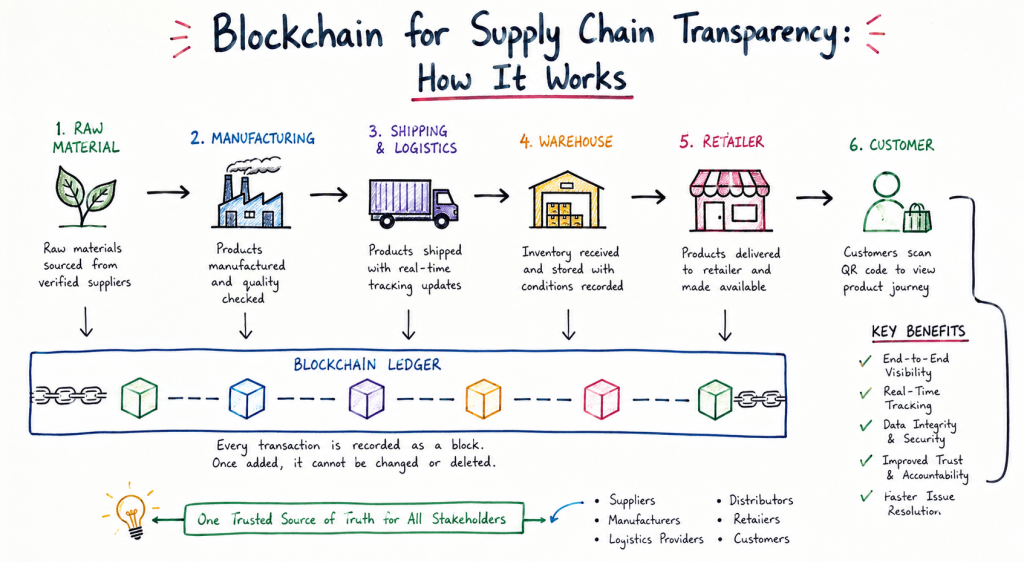
How Blockchain Works in Supply Chain Transparency
To understand the value of blockchain, it helps to follow the journey of a product through a blockchain-enabled supply chain.
Step 1: Raw Material Registration
The process begins when raw materials enter the supply chain.
Information may include:
- Source location
- Supplier details
- Quality certifications
- Sustainability credentials
- Batch numbers
This information is recorded on the blockchain.
Step 2: Manufacturing Updates
Manufacturers receive materials and add new information.
Records may include:
- Production dates
- Equipment details
- Inspection results
- Quality checks
- Packaging information
Each activity creates another blockchain entry.
Step 3: Logistics Tracking
Transportation providers update shipment information.
Records may contain:
- Departure times
- Arrival times
- Route information
- Delivery confirmations
- Environmental conditions
These updates provide real-time visibility.
Step 4: Warehouse Monitoring
Warehouses add inventory movements and storage records.
Organizations can track:
- Stock levels
- Storage conditions
- Product handling
- Inventory transfers
Step 5: Retail Distribution
Retailers receive products and record final distribution activities.
Customers may even access product history through QR codes or digital tracking systems.
Every participant contributes to a transparent chain of information.
Core Components of Blockchain-Based Supply Chains
Several important components make blockchain-enabled transparency possible.
Distributed Ledger
The ledger serves as the shared database for all authorized participants.
Everyone accesses the same version of information.
Consensus Mechanism
Participants agree on transaction validity before records are added.
This reduces unauthorized changes.
Smart Contracts
Smart contracts are automated rules that execute when predefined conditions are met.
Examples include:
- Automatic payment releases
- Shipment confirmations
- Quality approval processes
- Inventory replenishment triggers
Cryptographic Security
Encryption techniques protect sensitive information.
This ensures secure communication among participants.
Digital Identity Management
Every participant receives a verified identity.
This improves accountability and transaction verification.
Benefits of Blockchain for Supply Chain Transparency
Organizations increasingly explore blockchain because of its practical advantages.
Improved Traceability
Businesses can track products from origin to destination.
This helps identify quality issues quickly.
Enhanced Trust
Shared records reduce disputes between partners.
Participants rely on verified information rather than conflicting reports.
Better Compliance
Regulatory audits become easier when records are accessible and organized.
Documentation is available throughout the product lifecycle.
Faster Problem Resolution
Organizations can locate affected products quickly during recalls.
This reduces risk and protects customers.
Reduced Fraud
Immutable records make manipulation more difficult.
Counterfeit products become easier to detect.
Greater Customer Confidence
Consumers increasingly want visibility into sourcing, manufacturing, and sustainability practices.
Transparent information strengthens brand credibility.
Improved Operational Efficiency
Automation reduces paperwork and manual reconciliation efforts.
Teams spend less time searching for information.
Key Operational Concepts You Must Know
Understanding blockchain requires familiarity with several operational concepts that influence modern supply chain management.
End-to-End Visibility
Visibility means monitoring products throughout the entire value chain.
Organizations gain insight into sourcing, production, transportation, storage, and delivery activities.
Traceability
Traceability refers to following a product’s journey both forward and backward.
Businesses can identify where products came from and where they have been distributed.
Chain of Custody
Chain of custody documents every transfer of ownership or responsibility.
Blockchain provides a reliable record of these transfers.
Real-Time Data Sharing
Modern operations depend on timely information.
Real-time updates improve responsiveness and decision-making.
Data Integrity
Operational decisions require accurate information.
Blockchain helps preserve data integrity by preventing unauthorized modifications.
Process Standardization
Standardized processes create consistency across supply chain partners.
This improves collaboration and operational performance.
Risk Management
Organizations must identify and manage disruptions proactively.
Transparent information supports better risk assessment.
Operational Resilience
Resilience refers to maintaining operations despite unexpected disruptions.
Visibility and traceability strengthen resilience capabilities.
Blockchain and Smart Contracts in Operations
Smart contracts are among the most powerful blockchain features.
These digital agreements automatically execute when specified conditions are satisfied.
For example:
A supplier ships products.
The shipment reaches the destination.
Quality inspection passes.
Payment is automatically released.
No manual approval is required.
Benefits include:
- Faster transactions
- Reduced administrative work
- Improved accuracy
- Lower operational costs
- Better compliance
Smart contracts help organizations streamline complex workflows.
Platform Implementation vs. Culture — What’s the Real Difference?
Many organizations believe technology alone creates transformation.
In reality, successful blockchain adoption depends on both technology and organizational culture.
The difference between platform implementation and culture is significant.
Platform Implementation
Platform implementation focuses on technical deployment.
Activities include:
- Software selection
- Infrastructure setup
- System integration
- Security configuration
- User access management
- Data migration
These activities establish the technological foundation.
Organizational Culture
Culture influences how people use the technology.
It includes:
- Collaboration practices
- Leadership support
- Transparency mindset
- Continuous improvement
- Change acceptance
- Knowledge sharing
Without cultural alignment, even advanced systems may fail.
Comparison Table
| Platform Implementation | Organizational Culture |
|---|---|
| Technology focused | People focused |
| System deployment | Behavioral change |
| Infrastructure driven | Leadership driven |
| Process automation | Collaboration enhancement |
| Technical success metrics | Adoption success metrics |
| Short-term execution | Long-term sustainability |
Why Culture Matters More Than Technology
Organizations frequently invest heavily in technology but overlook employee engagement.
When teams resist sharing information, transparency initiatives struggle.
Successful blockchain projects typically involve:
- Executive sponsorship
- Employee education
- Cross-functional collaboration
- Process redesign
- Stakeholder alignment
Technology creates capability.
Culture creates results.
Real-World Use Cases of Modern Operations
Blockchain supports a wide range of operational applications.
Food Supply Chain Traceability
Food companies use blockchain to track ingredients from farms to consumers.
Benefits include:
- Faster recalls
- Improved food safety
- Better quality monitoring
- Enhanced consumer trust
Pharmaceutical Supply Chains
Medicine authenticity is critical.
Blockchain helps verify product origin and prevent counterfeit drugs from entering the market.
Manufacturing Operations
Manufacturers use blockchain to monitor component sourcing and production activities.
This improves quality assurance and supplier accountability.
Retail Product Verification
Retailers provide customers with product history information.
Consumers gain confidence in product authenticity.
Logistics and Transportation
Transportation providers use blockchain to improve shipment tracking.
Benefits include:
- Reduced paperwork
- Better visibility
- Faster customs processing
- Improved delivery accuracy
Sustainability Monitoring
Organizations track environmental and ethical sourcing practices.
Transparency supports sustainability goals and compliance requirements.
Aerospace Supply Chains
Aerospace companies require strict component tracking.
Blockchain improves documentation and maintenance history management.
Automotive Industry
Vehicle manufacturers monitor parts throughout production and distribution networks.
This strengthens quality control and recall management.
Challenges of Blockchain Adoption
Although blockchain offers significant benefits, implementation is not always simple.
Integration Complexity
Existing systems must connect with blockchain platforms.
Integration projects may require substantial planning.
Data Quality Issues
Blockchain preserves information.
However, inaccurate data entered initially remains inaccurate.
Good data governance remains essential.
Scalability Concerns
Large supply chains generate significant transaction volumes.
Organizations must ensure systems can handle operational demands.
Stakeholder Coordination
Successful implementation requires participation from multiple partners.
Achieving alignment can be difficult.
Initial Investment
Technology deployment involves infrastructure, training, and process redesign costs.
Organizations must evaluate long-term value.
Regulatory Considerations
Compliance requirements vary across industries and regions.
Organizations must ensure blockchain initiatives support legal obligations.
Common Mistakes in Operations Engineering
Operations engineering involves designing, improving, and managing operational systems.
Several mistakes frequently reduce effectiveness.
Focusing Only on Technology
Technology alone cannot solve operational problems.
Process improvement and people management are equally important.
Ignoring Data Quality
Poor-quality data produces poor decisions.
Organizations should establish strong data governance practices.
Lack of Stakeholder Engagement
Projects often fail when stakeholders are excluded from planning and implementation activities.
Overcomplicating Processes
Complex solutions increase maintenance requirements.
Simple and scalable approaches often perform better.
Weak Change Management
Employees need training and support during transformation initiatives.
Without change management, adoption rates decline.
Poor Performance Measurement
Organizations should define clear success metrics before implementation.
Examples include:
- Lead time reduction
- Inventory accuracy
- Recall response time
- Supplier compliance rates
- Customer satisfaction
Insufficient Risk Planning
Operational risks should be identified early.
Contingency plans improve resilience.
Limited Cross-Functional Collaboration
Operations depend on coordination across departments.
Siloed decision-making reduces effectiveness.
Building a Blockchain Strategy for Supply Chains
Organizations should approach blockchain strategically rather than treating it as a standalone technology project.
Define Business Objectives
Begin by identifying operational challenges.
Potential goals include:
- Improved traceability
- Enhanced compliance
- Better customer trust
- Reduced fraud
- Increased efficiency
Identify High-Value Use Cases
Focus on areas where transparency provides measurable value.
Engage Stakeholders Early
Involve suppliers, logistics providers, manufacturers, and customers.
Alignment increases implementation success.
Establish Governance Models
Define responsibilities for:
- Data ownership
- Access control
- Security management
- Compliance monitoring
Pilot Before Scaling
Start with a focused implementation.
Evaluate performance before expanding across larger networks.
Measure Outcomes
Track improvements using operational metrics.
Continuous evaluation supports long-term success.
Future Direction of Blockchain in Supply Chain Operations
Blockchain continues evolving alongside other digital technologies.
Several trends are influencing adoption.
Internet of Things Integration
Connected sensors generate operational data automatically.
Blockchain secures and verifies sensor-generated information.
Artificial Intelligence Support
AI systems analyze blockchain records to identify trends, risks, and optimization opportunities.
Advanced Automation
Organizations increasingly automate operational workflows using smart contracts.
Greater Supply Chain Visibility
Businesses continue seeking end-to-end transparency across global networks.
Enhanced Sustainability Reporting
Transparency supports environmental and social responsibility initiatives.
The combination of these technologies creates more intelligent and responsive supply chains.
How to Become an Operations Expert — Career Roadmap
Operations expertise combines business knowledge, process understanding, technology awareness, and leadership capabilities.
The journey requires continuous learning and practical experience.
Step 1: Learn Supply Chain Fundamentals
Develop a strong understanding of:
- Procurement
- Manufacturing
- Inventory management
- Logistics
- Warehousing
- Distribution
These foundations support advanced operational concepts.
Step 2: Build Analytical Skills
Operations professionals regularly analyze data.
Important skills include:
- Data interpretation
- Process analysis
- Root cause investigation
- Performance measurement
Step 3: Understand Digital Technologies
Modern operations increasingly depend on technology.
Focus on learning:
- ERP systems
- Analytics platforms
- Automation tools
- Blockchain concepts
- Cloud technologies
Step 4: Gain Practical Experience
Hands-on experience accelerates learning.
Look for opportunities involving:
- Process improvement
- Inventory projects
- Supply chain planning
- Operational reporting
Step 5: Learn Process Improvement Methodologies
Study structured improvement approaches.
Examples include:
- Lean principles
- Continuous improvement
- Process optimization
- Quality management
Step 6: Develop Communication Skills
Operations experts collaborate across departments and organizations.
Strong communication improves influence and leadership effectiveness.
Step 7: Strengthen Leadership Capabilities
As responsibilities grow, leadership becomes increasingly important.
Focus on:
- Team management
- Stakeholder engagement
- Strategic thinking
- Decision-making
Recommended Skill Matrix
| Skill Area | Importance |
|---|---|
| Supply Chain Knowledge | Very High |
| Process Improvement | Very High |
| Data Analytics | High |
| Technology Awareness | High |
| Communication | High |
| Project Management | High |
| Leadership | High |
| Risk Management | Medium to High |
Career Paths in Operations
Professionals may pursue roles such as:
- Supply Chain Analyst
- Operations Analyst
- Logistics Manager
- Inventory Manager
- Procurement Specialist
- Process Improvement Manager
- Operations Manager
- Supply Chain Consultant
- Digital Transformation Specialist
- Chief Operations Officer
The most successful professionals combine technical expertise with business understanding.
FAQ Section
What is blockchain in supply chain management?
Blockchain is a distributed digital ledger that records and shares supply chain transactions securely among authorized participants.
Why is supply chain transparency important?
Transparency improves trust, traceability, compliance, quality control, and operational decision-making.
How does blockchain improve traceability?
Blockchain records every transaction and movement throughout the supply chain, creating a verifiable product history.
Can blockchain eliminate counterfeit products?
While it cannot eliminate counterfeiting entirely, blockchain significantly improves product verification and detection capabilities.
What are smart contracts?
Smart contracts are automated digital agreements that execute predefined actions when specific conditions are met.
Is blockchain suitable for all supply chains?
Not every supply chain requires blockchain. Organizations should evaluate business needs, complexity, and expected benefits before implementation.
What industries benefit most from blockchain transparency?
Food, pharmaceuticals, manufacturing, retail, automotive, aerospace, and logistics industries commonly benefit from enhanced traceability.
What is the biggest challenge in blockchain implementation?
Stakeholder coordination is often one of the most significant challenges because multiple organizations must collaborate effectively.
Does blockchain replace existing ERP systems?
No. Blockchain typically complements existing operational systems rather than replacing them entirely.
What skills are needed for blockchain-related operations careers?
Supply chain knowledge, data analysis, technology understanding, process improvement, project management, and communication skills are highly valuable.
Final Summary
Blockchain has emerged as a powerful tool for improving supply chain transparency. By creating a secure, shared, and tamper-resistant record of transactions, it helps organizations strengthen traceability, accountability, trust, and operational visibility. Instead of relying on disconnected systems and fragmented information, businesses can establish a single source of truth that supports better decision-making and collaboration.
Successful implementation requires more than technology deployment. Organizations must align processes, people, governance structures, and cultural expectations to achieve meaningful results. When combined with strong operational practices, blockchain can improve compliance, reduce fraud, accelerate problem resolution, and enhance customer confidence.
As supply chains continue to become more interconnected and data-driven, transparency will remain a critical competitive advantage. Professionals who understand blockchain, operations management, digital transformation, and process improvement will be well-positioned to contribute to the next generation of efficient, resilient, and trustworthy supply chain networks.

- Accelerating Modern Business Growth Through Intelligent Software Engineering And Scalable Cloud Architectures - September 5, 2026
- Building Resilient Enterprise Cloud Platforms Through Automation And Modern Reliability Engineering - September 5, 2026
- Building Resilient Software Platforms Through Modern Engineering And Enterprise Automation - September 4, 2026