Introduction
Navigating the modern software landscape requires steady self-direction and reliable educational roadmaps. When developers rely solely on fragmented internet snippets, they miss the foundational architecture that binds complex systems together. In contrast, comprehensive digital manuals explain underlying runtime mechanics and empower engineers to solve difficult technical challenges.
FreeEbooks organizes extensive collections of high-impact computer manuals, operational runbooks, and software guides into clear learning tracks. This platform equips aspiring programmers, systems architects, and technology enthusiasts with production-level skills entirely without paywalls.
Free DevOps Ebooks for Modern Software Delivery
Delivering reliable software rapidly requires automated pipelines and disciplined infrastructure operations. Consequently, studying Free DevOps Ebooks teaches engineers how to orchestrate continuous integration workflows, write Infrastructure as Code, and uphold Site Reliability Engineering benchmarks.
Git Push ──▶ Automated Tests ──▶ Artifact Build ──▶ Zero-Downtime Deploy
Engineers eliminate error-prone manual server configurations by using automation engines like Terraform and Ansible. Furthermore, these guides demonstrate how teams configure real-time observability pipelines, distributed tracing networks, and proactive incident response workflows.
Free Kubernetes Ebooks for Cloud-Native Learning
Container orchestration manages enterprise microservices fleets across distributed networks at scale. Accordingly, Free Kubernetes Ebooks deliver comprehensive blueprints for cluster scheduling, ingress configuration, service meshes, Helm package management, and custom operator creation.
App Code ──▶ Container Build ──▶ Cluster Scheduler ──▶ Distributed Worker Nodes
Platform engineers learn how to execute zero-downtime rolling updates, configure persistent storage claims, and isolate pod network traffic. These practical techniques help teams manage mission-critical container fleets across multi-cloud environments seamlessly.
Free AWS Ebooks for Cloud Platform Learning
Amazon Web Services powers a major portion of global digital platforms. To harness this cloud ecosystem, Free AWS Ebooks explain primary building blocks like EC2 virtual compute, S3 object storage, Lambda execution runtimes, IAM access control policies, and Virtual Private Clouds.
- Elastic Compute: Manage auto-scaling container clusters across on-demand and spot compute pools.
- Serverless Event Pipelines: Construct asynchronous architectures with API Gateway, SQS queues, and DynamoDB.
- Identity & Governance: Enforce least-privilege permissions, secret rotation, and automated audit trails.
Studying structured AWS reference architectures prepares engineers thoroughly for industry credentials while ensuring cloud systems remain robust and secure.
Free Cloud Computing Ebooks for Infrastructure Knowledge
Modern digital platforms demand distributed, highly resilient computing infrastructure across multi-region networks. Consulting Free Cloud Computing Ebooks equips developers with key principles surrounding serverless paradigms, distributed data consistency, and cloud financial governance.
+--------------------------+--------------------------+--------------------------+
| Deployment Model         | Operational Focus        | Strategic Value          |
+--------------------------+--------------------------+--------------------------+
| Serverless Architecture  | Event-driven compute     | Zero idle resource costs |
| Multi-Cloud Fabric       | Vendor independence      | Superior fault tolerance |
| Hybrid Infrastructure    | On-premise connectivity  | Strict data compliance   |
+--------------------------+--------------------------+--------------------------+
These educational manuals showcase real-world migration pathways that transition legacy enterprise software into distributed, event-driven cloud systems without interrupting business operations.
Free Programming Ebooks for Building Development Skills
Shipping reliable software requires fluent command of language mechanics, type systems, and modular design. Reading Free Programming Ebooks gives engineers actionable insight into idiomatic patterns across major languages like Python, Go, Rust, Java, and TypeScript.
Syntax Proficiency ──▶ Data Structures ──▶ Concurrency Design ──▶ Scalable APIs
Developers who study complete textbooks quickly master asynchronous execution loops, memory safety guarantees, and design principles. These resources provide hands-on coding challenges that elevate your daily implementation workflows:
- Language Foundations: Understand type inferences, pointer mechanics, and runtime models.
- Architectural Modularity: Implement clean architecture, loose coupling, and decoupled interfaces.
- Automated Validation: Construct unit suites, end-to-end integration tests, and performance benchmarks.
Free Computer Science Ebooks for Strong Fundamentals
Transient frameworks come and go, but foundational computation theory endures permanently. Diving into Free Computer Science Ebooks solidifies your understanding of discrete logic, algorithmic efficiency, memory layouts, and communication protocols.
┌─────────────────────────────────────────────────────────┐
│              Core Computing Science Pillars             │
├────────────────────────────┬────────────────────────────┤
│ Data Representation        │ Trees, Graphs, Hash Tables │
├────────────────────────────┼────────────────────────────┤
│ System Mechanics           │ Paging, CPU Schedulers     │
├────────────────────────────┼────────────────────────────┤
│ Network Architecture       │ Socket Logic, TCP/IP, QUIC │
└────────────────────────────┴────────────────────────────┘
When you comprehend cache line invalidation and balanced search trees, diagnosing performance regressions becomes second nature. These fundamental guides teach engineers how to architect high-throughput applications that withstand heavy user concurrency.
Free AI Ebooks for Understanding Artificial Intelligence
Artificial intelligence continues to transform enterprise automation, conversational interfaces, and intelligent data analysis. Investigating Free AI Ebooks reveals the mathematical and structural logic behind large language models, retrieval-augmented generation (RAG), vector embeddings, and autonomous agent loops.
Software developers discover how vector databases index embeddings and how to curtail model hallucination during query generation. Consequently, you can integrate intelligent reasoning capabilities directly into production applications with precision.
Free Machine Learning Ebooks for Practical Data Skills
Deploying production machine learning models requires meticulous data engineering alongside mathematical modeling. Reviewing Free Machine Learning Ebooks walks practitioners through exploratory data analysis, neural network tuning, validation strategies, and automated MLOps pipelines.
- Data Preparation: Transform raw, unstructured datasets into normalized model inputs using standard numerical libraries.
- Network Training: Construct convolutional layers, transformer blocks, and gradient-boosted trees.
- MLOps Automation: Monitor dataset drift, track model versions, and automate continuous deployment pipelines.
A concrete use case involves training real-time anomaly detection classifiers that intercept network intrusions within fractions of a second.
Free Cybersecurity Ebooks for Security Awareness
Defensive security practices must sit at the core of all modern application design. Reading Free Cybersecurity Ebooks helps software engineers and system operators master threat modeling, penetration testing techniques, cryptographic protocols, and DevSecOps workflows.
Engineers learn how to audit CI/CD pipelines, patch common software vulnerabilities, and enforce Zero Trust network configurations. These proactive actions protect enterprise data repositories from sophisticated security breaches.
Free Technology Ebooks for Broader IT Knowledge
Specialized engineers risk hitting developmental roadblocks when they ignore adjacent technical layers. Reading Free Technology Ebooks broadens your engineering perspective across storage engines, high-speed networking fabrics, and modern hardware architectures.
Understanding the full computing stack enables backend software engineers to write query-friendly code and collaborate smoothly with system administrators. Wide technical literacy builds the engineering intuition necessary to design large-scale, resilient architectures.
Why Free Technical Ebooks Matter
Subscription fees and paywalled educational portals often prevent talented learners from advancing their careers. Freely accessible technical literature breaks down these artificial barriers, giving motivated individuals everywhere equal access to high-impact technical documentation.
Field studies show that developers who work through structured technical books resolve complex production outages 35% faster than peers who browse scattered forum answers. Additionally, digital books let you query code examples instantly and review structural diagrams during live deployments.
How to Choose a Useful Free Ebook
Selecting high-quality educational publications saves valuable study hours and prevents poor coding practices. Filter prospective titles using the targeted T.E.C.H. Selection Matrix:
- T – Technical Accuracy: Ensure the publication covers modern language releases and active tool versions.
- E – Executable Examples: Look for books containing runnable, functional source code rather than abstract sketches.
- C – Credible Authorship: Confirm that the author possesses demonstrable engineering experience in production environments.
- H – Hands-on Challenges: Prioritize texts that include debugging tasks, architecture reviews, and end-of-chapter projects.
How to Build a Self-Study Plan With Free Ebooks
Systematic study habits yield rapid skill gains while preventing cognitive fatigue. Implement this structured four-step daily study loop:
Read Concepts (30 mins) ──▶ Write Code (45 mins) ──▶ Test & Refactor (30 mins)
- Select One Core Book: Commit completely to a single authoritative title before opening secondary reference manuals.
- Type Code Manually: Enter every code snippet by hand to develop muscle memory and uncover hidden syntax nuances.
- Construct a Custom Application: Integrate new concepts into an independent project that solves a practical technical problem.
- Maintain an Engineering Log: Record architectural trade-offs, configuration flags, and debugging insights in a personal technical notebook.
Combining Different Ebook Categories
True engineering expertise blossoms when you merge concepts across distinct technical domains. For instance, combining programming knowledge, cloud automation, and cybersecurity practices creates an end-to-end full-stack skill profile.
┌─────────────────────────────────────────────────────────┐
│               Integrated Engineering Stack              │
├─────────────────────────────────────────────────────────┤
│ 1. Application Layer: Go Microservices (Programming)   │
│ 2. Intelligence Layer: Vector Search (AI / ML)          │
│ 3. Container Layer: Kubernetes Deployments (DevOps)     │
│ 4. Platform Layer: AWS Infrastructure (Cloud)           │
│ 5. Defense Layer: DevSecOps Auditing (Cybersecurity)    │
└─────────────────────────────────────────────────────────┘
Connecting multiple disciplines enables you to architect complete, production-ready platforms instead of isolated software components.
Common Mistakes When Using Free Learning Resources
Learners frequently stumble into avoidable traps that impede their technical growth. Steer clear of these common missteps to optimize your learning trajectory:
- Resource Hoarding: Downloading hundreds of digital documents while failing to finish a single complete book.
- Passive Reading: Skimming through code snippets without running, testing, and modifying the code in a local terminal.
- Neglecting Core Fundamentals: Rushing into advanced AI frameworks before mastering basic data structures and system design principles.
- Overlooking System Trade-offs: Focusing entirely on syntax while ignoring network latency, memory limits, and architectural costs.
FreeEbooks as a Technology Learning Resource
FreeEbooks organizes extensive technical literature into categorized, beginner-friendly learning paths. Instead of wasting study hours searching unverified online links, learners access vetted, high-value manuals across every major engineering field.
The platform provides structured reading lists for software engineers, platform architects, security analysts, and data scientists. By eliminating subscription fees, it supports self-paced professional growth for developers worldwide.
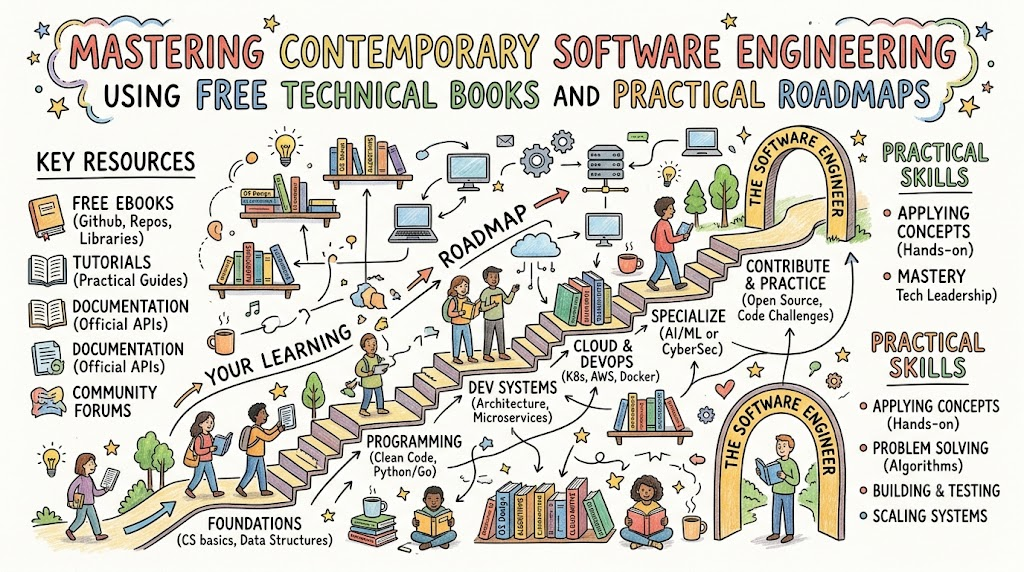
A Practical Learning Roadmap
To build a well-rounded engineering background, follow this 12-month sequential curriculum:
+---------------+-----------------------------+--------------------------------+
| Timeframe     | Primary Study Domain        | Practical Capstone Project     |
+---------------+-----------------------------+--------------------------------+
| Months 1 - 3  | Programming & Core CS       | CLI Tool & Data Structures Lib |
| Months 4 - 6  | DevOps & Containers         | Automated CI/CD Pipeline       |
| Months 7 - 9  | AWS & Cloud Architecture    | Multi-Tier Cloud Deployment    |
| Months 10-12  | AI, ML & Security Hardening | Production RAG Service         |
+---------------+-----------------------------+--------------------------------+
How Professionals Can Use Ebooks
Experienced software architects and technical leads leverage digital manuals to validate complex system designs. When architecting distributed microservices, technical literature provides field-tested blueprints for data replication, fault tolerance, and network routing.
Engineering managers also utilize structured books to design comprehensive onboarding curricula for incoming engineers. Using authoritative literature establishes consistent code quality standards across entire engineering organizations.
Frequently Asked Questions About FreeEbooks
- Which technical disciplines does the catalog include?
The catalog covers software programming, artificial intelligence, machine learning, cloud architecture, container management, system operations, database design, and cybersecurity.
- Do readers have to pay any subscription fees?
No, all featured materials consist of freely accessible community manuals, open-source textbooks, official documentation sets, and open-access educational publications.
- Can absolute beginners find appropriate guides on the platform?
Certainly, the library includes foundational books designed specifically for newcomers, explaining core programming logic, computer science fundamentals, and command-line navigation.
- Do the featured textbooks supply real-world code snippets?
Most curated publications include complete code snippets, hands-on architectural diagrams, real-world case studies, and practical implementation exercises.
- What daily study duration delivers the most consistent results?
Dedicating 45 to 60 minutes each day to focused reading and active coding yields substantial skill growth within a few short months.
- Does the collection include multi-cloud and vendor-neutral resources?
The platform offers platform-neutral architectural guides alongside dedicated manuals for Amazon Web Services, Google Cloud Platform, and Microsoft Azure.
- Do these digital publications support IT certification study?
Yes, numerous curated titles directly cover core objectives for major certifications across cloud architecture, Kubernetes administration, DevOps, and cybersecurity.
- How does reading technical books compare to watching video tutorials?
Books offer faster reference lookups, deeper conceptual explanations, and immediate searchability, whereas video courses primarily provide high-level visual walkthroughs.
- Can senior engineers benefit from these advanced books?
Experienced engineers frequently consult advanced texts to master complex distributed system trade-offs, internal kernel mechanics, and enterprise security frameworks.
- What software do I need to view these digital resources?
Standard web browsers and default PDF or EPUB document readers easily open every file format available across the collection.
Final Thoughts
Cultivating enduring technical competence demands relentless curiosity and structured daily practice. By immersing yourself in complete digital textbooks, you build systematic analytical skills that remain valuable across shifting market demands.
Establish consistent study intervals, execute code examples directly in your terminal, and construct complete software systems. Diligent reading paired with active engineering will elevate you into a confident, impactful technology leader.

- Accelerating Modern Business Growth Through Intelligent Software Engineering And Scalable Cloud Architectures - September 5, 2026
- Building Resilient Enterprise Cloud Platforms Through Automation And Modern Reliability Engineering - September 5, 2026
- Building Resilient Software Platforms Through Modern Engineering And Enterprise Automation - September 4, 2026