Introduction
Nonconformance Management Tools are specialized software solutions designed to identify, document, evaluate, and resolve instances where a product, process, or material fails to meet specified requirements. In a manufacturing or regulated environment, a “nonconformance” (NC) occurs when something goes wrong—be it a defective raw material from a vendor or a finished product that fails a final stress test. These tools provide a structured workflow to handle these deviations, ensuring that the “bad” items are sequestered, analyzed, and either scrapped, reworked, or accepted through a formal concession process.
The importance of these tools lies in their ability to mitigate risk and ensure regulatory compliance. Without a digital system, nonconformances often go undocumented or are handled inconsistently, leading to costly recalls or audit failures. Key real-world use cases include quarantining defective medical device components, tracking “off-spec” chemical batches, and managing supplier quality deviations in automotive assembly. When choosing a tool, users should evaluate mobile intake capabilities, automated quarantine workflows, integration with CAPA (Corrective and Preventive Actions), and robust audit trail functionality.
Best for:
Nonconformance Management tools are most beneficial for Quality Engineers, Production Supervisors, and Compliance Managers in mid-to-large-scale manufacturing sectors. Industries such as aerospace, defense, pharmaceuticals, and electronics, where strict adherence to ISO 9001, AS9100, or FDA standards is mandatory, will see the highest return on investment.
Not ideal for:
Small businesses with very low production volumes or simple assembly processes may find these tools too administrative. If your organization rarely encounters quality deviations or if you operate in a non-regulated service industry, a basic internal task-tracking list or a simple spreadsheet might suffice until your operational complexity increases.
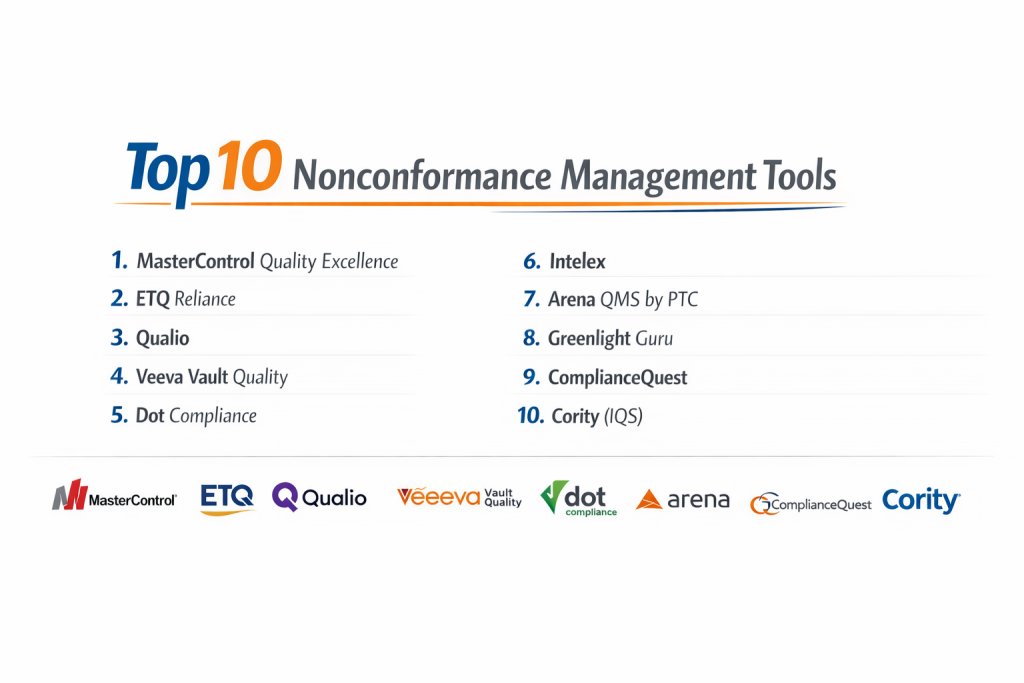
Top 10 Nonconformance Management Tools
1 — MasterControl Quality Excellence
MasterControl is a leading enterprise Quality Management System (QMS) that offers a high-precision nonconformance module designed for the strict requirements of life sciences.
- Key features
- Automated Data Capture: Pulls information from ERP and MES to populate NC reports.
- Dynamic Form Routing: Automatically sends NC reports to the Material Review Board (MRB).
- Electronic Signatures: Fully compliant with FDA 21 CFR Part 11 requirements.
- Analytics Dashboards: Tracks NC trends by product line, vendor, or failure code.
- Seamless CAPA Linkage: One-click conversion of a nonconformance into a full CAPA investigation.
- Pros
- Exceptionally strong for companies facing frequent FDA or ISO audits.
- Reduces the risk of human error by automating the hand-off between departments.
- Cons
- The user interface can feel dense and requires significant training for new users.
- The implementation process is rigorous and typically requires a high upfront investment.
- Security & compliance: SOC 2 Type II, HIPAA, GDPR, and FDA 21 CFR Part 11 compliant.
- Support & community: Offers a dedicated customer success portal, “MasterControl University,” and a massive global user base.
2 — ETQ Reliance
ETQ Reliance is a highly flexible, platform-based QMS that allows organizations to customize their nonconformance workflows to match unique manufacturing steps.
- Key features
- No-Code Configuration: Admins can adjust workflows without specialized programming.
- Centralized Dashboard: A “Control Center” for all open nonconformances across global sites.
- Mobile App: Allows floor workers to take photos of defects and attach them to reports instantly.
- Risk Management Integration: Automatically assigns risk scores to every nonconformance.
- Material Review Board (MRB) Tools: Facilitates digital meetings and voting for disposition.
- Pros
- One of the most scalable solutions; it grows effortlessly with the company.
- The mobile functionality significantly improves the speed of reporting from the factory floor.
- Cons
- High level of customization can lead to “feature bloat” if not managed carefully.
- Support response times can vary depending on the service tier.
- Security & compliance: ISO 27001, SOC 2, and GDPR compliant.
- Support & community: Professional global services and a robust library of webinars and best-practice guides.
3 — Qualio
Qualio is a modern, cloud-native QMS built specifically for startups and scaling companies in the medical device and biotech industries.
- Key features
- Simplified Workflow: A clean, intuitive interface that mimics modern consumer software.
- Automated SOP Linking: Connects nonconformances directly to relevant Standard Operating Procedures.
- Cloud-First Logic: Accessible from any browser with no local hardware required.
- Integrated Training: Ensures that if a process changes due to an NC, the team is automatically retrained.
- Rapid Search: Find any historical NC record in seconds for audit readiness.
- Pros
- Very fast time-to-value; companies can go live in a matter of weeks.
- Lower administrative overhead makes it perfect for smaller quality teams.
- Cons
- May lack the “deep” industrial engineering tools (like SPC) found in legacy systems.
- Less flexibility for extremely complex, multi-layered manufacturing logic.
- Security & compliance: FDA 21 CFR Part 11, ISO 13485, and GDPR compliant.
- Support & community: Known for high-quality onboarding support and a library of “Compliance-as-a-Service” resources.
4 — Veeva Vault Quality
Veeva is the dominant player in the pharmaceutical industry, providing a unified suite that manages quality, regulatory, and clinical data.
- Key features
- Unified Platform: Nonconformances are linked to clinical and regulatory filings.
- External Collaboration: Securely share NC reports with contract manufacturing organizations (CMOs).
- Real-time Insights: Advanced reporting that identifies systemic quality issues across locations.
- Validated Cloud: Every update is pre-validated to meet GxP standards.
- Standardized Templates: Pre-built industry-standard NC forms for rapid deployment.
- Pros
- The “gold standard” for big pharma; provides total trust during regulatory inspections.
- Unrivaled ability to manage quality across a vast, global supply chain.
- Cons
- Generally the most expensive option on the market.
- Not designed for general manufacturing; very specific to life sciences.
- Security & compliance: SOC 1/2, ISO 27001, HIPAA, and global GxP compliance.
- Support & community: Enterprise-tier support with dedicated account managers and a vast partner ecosystem.
5 — Dot Compliance
Dot Compliance leverages the Salesforce platform to provide an “out-of-the-box” quality system that is both modern and highly scalable.
- Key features
- Salesforce Ecosystem: Built on the world’s most secure and robust cloud infrastructure.
- Pre-Configured Best Practices: Ready-to-use workflows for nonconformance and CAPA.
- AI Insights: Uses Salesforce Einstein AI to predict potential quality hotspots.
- Unified Experience: Seamlessly connects with Salesforce CRM for customer complaint data.
- E-signatures: Built-in compliant electronic signatures for all approvals.
- Pros
- Lower technical barrier for companies already using Salesforce.
- Modular pricing allows you to start with just the Nonconformance module.
- Cons
- Customizing deep logic requires Salesforce admin expertise.
- Pricing can be complex due to the combination of App and Platform licenses.
- Security & compliance: HIPAA, GDPR, 21 CFR Part 11, and SOC 2 compliant.
- Support & community: Strong remote support and access to the global Salesforce developer community.
6 — Intelex
Intelex is a powerhouse in Environmental, Health, Safety, and Quality (EHSQ) management, making it ideal for the oil, gas, and chemical industries.
- Key features
- Integrated EHSQ: Tracks product nonconformances alongside worker safety incidents.
- Root Cause Analysis (RCA): Includes built-in Fishbone and 5-Why methodology tools.
- Asset Management: Links equipment failures directly to the nonconformance report.
- Offline Data Entry: Essential for field workers in remote locations with no internet.
- Multi-Language Support: Localized interfaces for global workforces.
- Pros
- The best choice for heavy industries where safety and quality are inextricably linked.
- Excellent mobile reporting for “dirty” environments like mines or refineries.
- Cons
- The user interface can feel a bit dated and “clunky” compared to newer SaaS apps.
- Implementation typically requires a large amount of internal data mapping.
- Security & compliance: ISO 27001, GDPR, and SOC 2 Type II compliant.
- Support & community: Offers a professional community forum called “Intelex Exchange.”
7 — Arena QMS by PTC
Arena is a product-centric QMS that integrates Nonconformance Management directly into the Product Lifecycle Management (PLM) process.
- Key features
- Product-Centric Records: NCs are linked to the specific Bill of Materials (BOM) revision.
- Supplier Collaboration: Securely share NC reports with part suppliers in real-time.
- Closed-Loop Quality: NCs directly trigger Engineering Change Orders (ECOs).
- Cloud-Native Deployment: Easy access for global teams and remote engineers.
- Compliance Dashboards: Track RoHS, REACH, and other environmental compliance data.
- Pros
- Perfect for electronics and hardware companies where the “fix” involves a design change.
- Eliminates the wall between the Quality department and the Engineering department.
- Cons
- Less focus on “process” industries like food or pharma.
- Reporting is geared more toward product data than organizational behavior.
- Security & compliance: SOC 2 Type II, GDPR, and ISO 27001 certified.
- Support & community: Robust online training, responsive help desk, and an active user forum.
8 — Greenlight Guru
Greenlight Guru is the only QMS platform built exclusively for the medical device industry, with a focus on “True Quality” and ISO 14971 risk standards.
- Key features
- Medical Device Focused: Workflows are hard-coded for medical device regulations.
- Visualize the Linkage: A visual “Quality Management Map” shows how NCs relate to Risk.
- Audit-Ready Workspace: A dedicated “Audit” mode for inspectors to view relevant NCs.
- Native Risk Management: Every NC is automatically assessed against the device’s risk profile.
- Guru Drive: High-speed document management specifically for MedTech files.
- Pros
- The most specialized tool on the market for medical device startups.
- High-touch support from actual regulatory experts (the “Gurus”).
- Cons
- Completely inapplicable for industries outside of medical devices.
- Rigid workflows may not suit companies with unique, non-standard processes.
- Security & compliance: ISO 13485, FDA 21 CFR Part 11, and GDPR compliant.
- Support & community: Renowned for their “Medical Device Academy” and industry-leading blog.
9 — ComplianceQuest
ComplianceQuest is a Salesforce-native solution that offers an AI-driven approach to nonconformance and supplier quality.
- Key features
- AI-Driven Root Cause: Suggests root causes based on historical NC data.
- Omnichannel Intake: Capture NCs via email, web forms, or mobile app.
- Social Collaboration: Uses “Chatter” for real-time discussion on disposition decisions.
- Supplier Portal: Allows suppliers to participate in the NC investigation and disposition.
- Dynamic Workflow: Automatically adjusts the NC path based on the severity of the defect.
- Pros
- Outstanding for companies managing a massive global supply chain.
- Very strong communication features that speed up “Time-to-Disposition.”
- Cons
- Licensing can be expensive when adding multiple modules.
- Requires a Salesforce-savvy administrator for the best experience.
- Security & compliance: ISO 9001, AS9100, and 21 CFR Part 11 compliant.
- Support & community: Global 24/7 support and access to the Salesforce AppExchange ecosystem.
10 — Cority (IQS)
Cority’s IQS is a deeply industrial QMS that excels in automotive and aerospace manufacturing, where technical standards are paramount.
- Key features
- APQP/PPAP Integration: Links NCs to the Advanced Product Quality Planning process.
- SPC Tools: Integrated Statistical Process Control to catch nonconformances before they happen.
- Gage R&R: Tracks the calibration of tools used to measure nonconforming parts.
- FMEA Linkage: Automatically updates Risk assessments when a new NC type is found.
- Material Review Board: Dedicated tools for managing complex disposition approvals.
- Pros
- Understands the “Shop Floor” better than almost any other tool on this list.
- Best-in-class for automotive suppliers needing to meet IATF 16949.
- Cons
- The software can feel technically complex and “dry” for non-engineers.
- Modernization of the UI has been slower than its SaaS competitors.
- Security & compliance: ISO 27001, SOC 2, and GDPR compliant.
- Support & community: High-level technical support and a community of industrial quality veterans.
Comparison Table
| Tool Name | Best For | Platform(s) Supported | Standout Feature | Rating (Gartner) |
| MasterControl | Large Life Sciences | Cloud (SaaS) | Integrated Quality/Mfg | 4.6 / 5 |
| ETQ Reliance | Enterprise Flexibility | Cloud, On-Prem | Modular App Library | 4.5 / 5 |
| Qualio | MedTech Startups | Cloud (SaaS) | Ease of Use / UX | 4.8 / 5 |
| Veeva Vault | Big Pharma | Cloud (SaaS) | Regulatory Data Sync | 4.7 / 5 |
| Dot Compliance | Salesforce Users | Cloud (SaaS) | Einstein AI Insights | 4.6 / 5 |
| Intelex | Heavy Industry / EHS | Cloud, Mobile | Offline Field Data | 4.3 / 5 |
| Arena QMS | Electronics / PLM | Cloud (SaaS) | BOM-Level Quality | 4.4 / 5 |
| Greenlight Guru | Medical Device Only | Cloud (SaaS) | Native ISO 14971 Risk | 4.7 / 5 |
| ComplianceQuest | Global Supply Chain | Cloud (Salesforce) | AI Root Cause Engine | 4.5 / 5 |
| Cority (IQS) | Automotive / Aero | Cloud, On-Prem | APQP / SPC Tools | 4.2 / 5 |
Evaluation & Scoring of Nonconformance Management Tools
| Category | Weight | Key Evaluation Points |
| Core Features | 25% | Quarantine logic, MRB tools, RCA, and CAPA linkage. |
| Ease of Use | 15% | Mobile access, UI intuition, and training time. |
| Integrations | 15% | Connectivity to ERP, MES, and PLM systems. |
| Security & Compliance | 10% | FDA, ISO, GDPR, and SOC 2 certifications. |
| Performance | 10% | System uptime and data retrieval speed. |
| Support | 10% | Documentation, local integrators, and community. |
| Price / Value | 15% | Transparent licensing and ROI for the sector. |
Which Nonconformance Management Tools Tool Is Right for You?
Solo Users vs SMB vs Mid-market vs Enterprise
- Small Manufacturers (SMB): If you are a medical startup, Qualio or Greenlight Guru are the clear winners. They provide the necessary regulatory guardrails without the enterprise price tag.
- Mid-Market: Dot Compliance and Arena offer a perfect balance of power and price, especially for companies growing out of manual spreadsheets.
- Enterprise: MasterControl, Veeva, and ETQ Reliance are built for the heavy-duty needs of global giants with thousands of users.
Budget-conscious vs Premium Solutions
If budget is the primary driver, Dot Compliance (if you already have Salesforce) or Qualio often provide the best entry point. Veeva and MasterControl are premium, “best-of-breed” solutions where the cost is justified by the reduction in regulatory risk and recall expenses.
Feature Depth vs Ease of Use
If you need Feature Depth (e.g., advanced statistical process control for an automotive plant), Cority (IQS) is the tool for you. If you need Ease of Use so your shop floor workers actually use the system every day, Qualio and Veeva Vault lead the pack with modern interfaces.
Frequently Asked Questions (FAQs)
1. What is the difference between a Nonconformance and a CAPA?
A Nonconformance is a record of a specific “bad” event (e.g., this part is broken). A CAPA is an investigation into the systemic reason why that bad event happened, designed to ensure it never happens again.
2. Can I use these tools on a tablet?
Yes. Most modern tools like ETQ, Qualio, and ComplianceQuest have native mobile apps or responsive web designs specifically for shop floor use.
3. Do these tools replace my ERP?
No. They complement your ERP. The ERP handles the movement of “good” inventory, while the Nonconformance tool handles the “bad” inventory and the investigations around it.
4. How long does implementation take?
For a modern SaaS tool, expect 4–8 weeks. For a large enterprise system with heavy customization, it can take 6–12 months.
5. What is disposition?
Disposition is the final decision on what to do with a nonconforming product. Common dispositions include: Scrap, Rework, Return to Vendor, or Use-As-Is.
6. Does the software come pre-validated?
No software is “pre-validated” because validation depends on how you use it. However, tools like Veeva and Qualio provide “Validation Packages” that significantly speed up the process.
7. Can I track supplier nonconformances?
Yes, tools like ComplianceQuest and MasterControl have specific portals where you can issue a nonconformance report directly to a supplier for their input.
8. Is it possible to attach photos to an NC report?
Yes, almost all modern systems allow you to attach photos, videos, and PDFs as evidence directly to the digital record.
9. What is an MRB?
The Material Review Board (MRB) is the group of people (usually from Quality, Engineering, and Production) who meet to decide the disposition of a nonconforming item.
10. Is my data safe in a cloud QMS?
Generally, yes. Modern QMS providers use enterprise-level encryption and security (SOC 2, ISO 27001) that is far more robust than what most individual companies can maintain on-site.
Conclusion
The “best” Nonconformance Management Tool is the one that fits your specific regulatory environment and technical maturity. In 2026, the competitive advantage belongs to manufacturers who can identify quality issues in real-time and resolve them before they impact the customer.
If you are in life sciences, Veeva and MasterControl remain the standard-bearers. For discrete manufacturing and electronics, Arena and IQS offer the best hardware-centric features. Ultimately, the goal is to move from a culture of “policing” to a culture of “quality,” where every nonconformance is seen as an opportunity for improvement.

- Top 10 Email Deliverability Tools: Features, Pros, Cons & Comparison - September 6, 2026
- Top 10 Pharmacovigilance Software: Features, Pros, Cons & Comparison - September 6, 2026
- Top 10 Manufacturing Execution Systems (MES) - July 30, 2026
Thank you for this comprehensive comparison of nonconformance management tools! Nonconformance management is a critical part of any quality system because it helps organizations quickly identify, document, and resolve deviations from standards—reducing risk, minimizing rework, and improving product and process quality. By clearly outlining key features along with the pros and cons of each solution, this article gives readers practical insight into how different tools support root cause analysis, CAPA linkage, audit trails, real‑time reporting, and regulatory compliance. These insights make it much easier for quality teams to evaluate which platform best aligns with their industry requirements, team workflows, and continuous improvement goals.