Introduction
Compensation management is the strategic process of designing, implementing, and maintaining a salary and benefits structure that is fair, competitive, and aligned with an organization’s goals. In today’s dynamic talent market, it’s more than just payroll—it involves salary benchmarking, bonus planning, equity distribution, pay equity analysis, and ensuring compliance with ever-changing regulations. Compensation management tools are specialized software platforms that automate and streamline these complex processes, moving organizations from cumbersome spreadsheets to data-driven, strategic decision-making.
These tools are crucial for attracting and retaining top talent, maintaining internal equity, ensuring compliance with laws like the Equal Pay Act and various global regulations, and optimizing compensation budgets. Real-world use cases include conducting annual compensation reviews, managing sales commission plans, administering employee bonuses, analyzing pay gaps across demographics, and modeling the financial impact of proposed salary structures.
When choosing a compensation management tool, buyers should evaluate several key criteria: the depth of market data integration, flexibility in modeling complex compensation plans, robustness of reporting and analytics, strength of security and compliance features, ease of use for managers and HR, quality of customer support, and the tool’s ability to scale with the organization’s growth.
Best for: These tools are most beneficial for mid-to-large-sized companies (typically 200+ employees), fast-growing startups managing equity, and organizations in highly competitive industries where talent acquisition and retention are critical. They are invaluable for HR leaders, Total Rewards specialists, Compensation & Benefits managers, CFOs, and executives who need visibility into compensation spend.
Not ideal for: Very small businesses or solopreneurs with simple, fixed salary structures may find these tools overly complex and expensive. Organizations with extremely static compensation models or those with minimal compliance concerns might manage adequately with advanced spreadsheet templates and manual processes for a time.
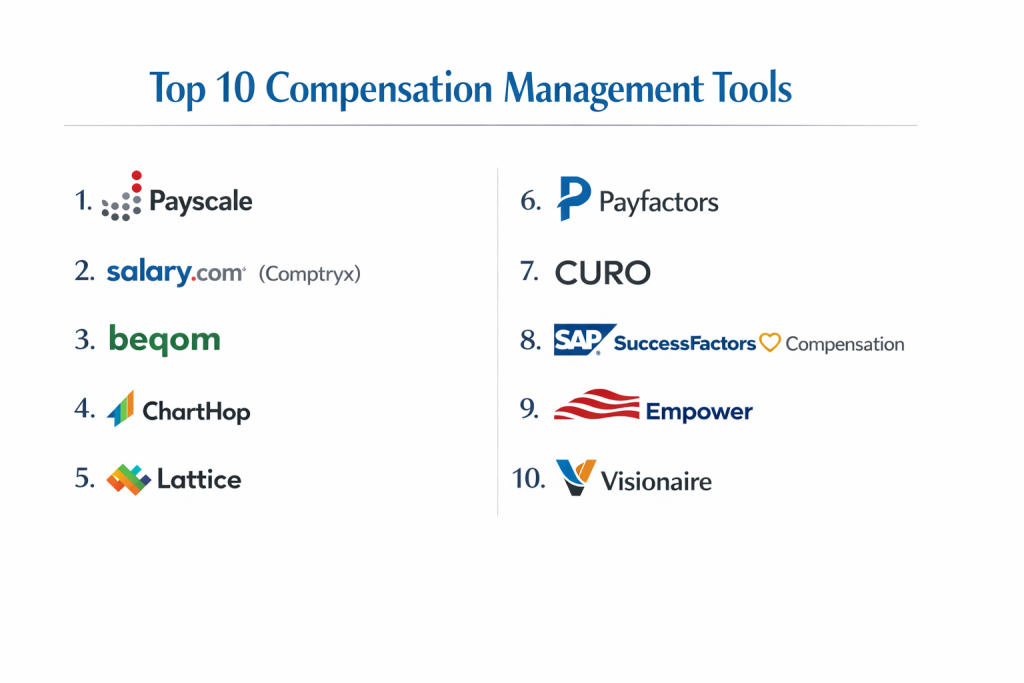
Top 10 Compensation Management Tools
1 — Payscale
Payscale is a market leader that combines a massive, continuously updated salary database with powerful compensation management software. It’s designed for organizations of all sizes that want to base their pay decisions on real-time, validated market data.
Key features:
- Industry’s largest crowdsourced and employer-reported compensation database.
- MarketPay tool for salary benchmarking, survey management, and pay structure design.
- Advanced pay equity analysis and reporting capabilities.
- Compensation planning workflows for merit increases, bonuses, and adjustments.
- Integration with major HRIS platforms like Workday, SAP SuccessFactors, and UKG.
- Insight Lab advisory services for strategic compensation consulting.
Pros:
- Unmatched access to granular, location-specific, and role-specific market data.
- Strong focus on pay equity and transparency, helping mitigate compliance risk.
- User-friendly interface that makes complex data accessible to managers.
Cons:
- Can be cost-prohibitive for very small organizations.
- The wealth of data and features requires a solid implementation and manager training to utilize fully.
Security & compliance: SOC 2 Type II certified, GDPR compliant, data encryption at rest and in transit, robust access controls and audit trails.
Support & community: Offers dedicated customer success management, 24/7 support options for enterprise clients, comprehensive online knowledge base, and an active user community forum.
2 — Salary.com (Comptryx)
Salary.com, through its Comptryx platform, provides deep compensation data and software focused on helping enterprises build defensible, fair, and explainable pay practices.
Key features:
- Access to the Compensation Data Bank and participation in custom salary surveys.
- Comptryx suite for compensation planning, benchmarking, and analytics.
- Tools for creating and managing geographic pay differentials.
- Robust reporting for board-level compensation disclosures and pay equity audits.
- Scenario modeling for “what-if” compensation planning.
Pros:
- Extremely high-quality, vetted data trusted by large enterprises for critical decisions.
- Powerful analytics suited for complex, global compensation structures.
- Strong reputation and long-standing presence in the compensation data space.
Cons:
- The platform’s enterprise focus can make it less intuitive for smaller teams.
- Pricing is typically oriented towards larger budgets.
Security & compliance: Adheres to stringent data security protocols, including encryption and access management. Compliant with global data privacy standards.
Support & community: Enterprise-level support with designated account managers. Provides implementation services, training, and access to compensation experts.
3 — beqom
beqom is a comprehensive total rewards and compensation platform that unifies compensation, employee performance, and sales incentives management. It targets large, complex global enterprises.
Key features:
- End-to-end compensation management for salary, bonuses, long-term incentives, and sales commissions.
- Integrated performance management to align pay with goals.
- Highly configurable workflows to match complex organizational hierarchies and approval chains.
- Advanced analytics and “total statements” for employee compensation transparency.
- Strong support for global operations with multi-currency and localization.
Pros:
- Exceptional flexibility and configurability for unique business rules.
- Unifies disjointed processes (comp, performance, sales incentives) into one platform.
- Scalable and robust enough for the largest multinational corporations.
Cons:
- Implementation can be lengthy and complex due to high configurability.
- Overkill for small or mid-market companies with simpler needs.
Security & compliance: ISO 27001 certified, GDPR compliant, offers granular data permissioning, and detailed audit logs. Often undergoes individual client security audits.
Support & community: Provides 24/7 global support, a dedicated customer success team, and professional services for implementation and optimization.
4 — ChartHop
ChartHop takes a unique organizational analytics approach to compensation, visualizing people data on dynamic organizational charts to inform planning and equity.
Key features:
- Interactive org chart that visualizes compensation, demographics, and reporting lines.
- Compensation planning tools integrated directly with the org chart view.
- Advanced analytics and scenario modeling for headcount and compensation budgeting.
- Built-in surveys and pulsing tools for gathering employee feedback.
- Seamless two-way sync with HRIS, ATS, and finance systems.
Pros:
- Intuitive visual interface makes compensation data and equity gaps immediately apparent.
- Excellent for connecting compensation planning to broader org design and headcount strategy.
- Strong emphasis on transparency and communication with employees.
Cons:
- Less focused on deep, granular salary benchmarking compared to pure-play comp data leaders.
- Best value is realized when used as a central people analytics platform, not just for comp.
Security & compliance: SOC 2 Type II certified, GDPR/CCPA compliant, data encryption, and role-based access control.
Support & community: Responsive customer support, detailed help center, and an active user community sharing templates and best practices.
5 — Lattice
Lattice is a people success platform that elegantly bundles compensation management with its core strengths in performance management, engagement, and career growth.
Key features:
- Compensation Reviews module for managing cycles of merit, bonus, and equity adjustments.
- Direct integration with performance data to reward based on achievements.
- Budgeting tools and approval workflows for compensation cycles.
- Compensation bands and architecture management.
- Tight integration with Lattice’s Goals, Reviews, and Engagement modules.
Pros:
- Perfect for companies already using (or considering) Lattice for performance management.
- User-friendly and manager-centric design reduces administrative burden.
- Creates a clear link between performance, growth, and rewards.
Cons:
- As an integrated suite, it may not offer the sheer depth of compensation-specific features as some standalone tools.
- Benchmarking data is provided through partners, not natively built.
Security & compliance: SOC 2 Type II certified, GDPR/CCPA compliant, and offers enterprise-grade security features.
Support & community: Known for excellent customer support, extensive help documentation, and a large community of HR tech users.
6 — Payfactors (by MarketPay)
Payfactors, now part of the Payscale family, offers a robust compensation management platform with strong data aggregation and analysis tools, appealing to data-driven HR teams.
Key features:
- Market Data Aggregation from multiple survey sources into a single platform.
- Compensation structure design and management tools.
- Pay equity auditing and statistical analysis features.
- Compensation planning and budgeting workflows.
- Custom survey participation and management.
Pros:
- Powerful data aggregation reduces the need to juggle multiple survey sources.
- Strong analytical and modeling capabilities for compensation professionals.
- Helps create a single source of truth for all compensation data.
Cons:
- The interface can feel more functional than modern compared to some newer platforms.
- May have a steeper learning curve for non-compensation specialists.
Security & compliance: Varies based on deployment and data sources, but generally includes enterprise-level data protection and privacy measures.
Support & community: Offers customer support, training, and access to compensation consultants.
7 — CURO
CURO is a compensation software platform focused on simplicity and efficiency, aiming to make compensation management accessible and less time-consuming.
Key features:
- Streamlined compensation review cycle management.
- Salary benchmarking and market pricing.
- Pay equity analysis and reporting.
- Budgeting and allocation tools.
- Integration with common HRIS and payroll systems.
Pros:
- Often praised for its intuitive and easy-to-use interface.
- Good balance of essential features without overwhelming complexity.
- Responsive customer service and support.
Cons:
- May lack the extreme depth or configurability required by the most complex global enterprises.
- Brand recognition is lower than some of the giant incumbents.
Security & compliance: Varies. Prospective buyers should inquire about specific SOC 2, GDPR, and data encryption certifications.
Support & community: Known for hands-on, quality customer support and implementation guidance.
8 — SAP SuccessFactors Compensation
SAP SuccessFactors Compensation is the native compensation module within the larger SAP SuccessFactors Human Experience Management (HXM) Suite, designed for enterprises deeply invested in the SAP ecosystem.
Key features:
- Tight integration with SuccessFactors Performance & Goals, and core HR data.
- Support for complex variable pay, bonus, and long-term incentive plans.
- Advanced approval routing and workflow capabilities.
- Built-in analytics and reporting.
- Global capabilities supporting multiple currencies and regulations.
Pros:
- Seamless, real-time integration for companies using the full SuccessFactors suite.
- Extremely powerful and capable of handling the most intricate enterprise compensation plans.
- Strong governance, compliance, and audit features.
Cons:
- Can be notoriously complex to configure and implement.
- Cost and complexity are significant, making it viable primarily for large enterprises.
Security & compliance: Enterprise-grade security as part of the SAP cloud infrastructure, with comprehensive compliance certifications globally.
Support & community: Access to SAP’s global support network, extensive documentation, and a large partner ecosystem for implementation.
9 — Empower (by Equity Admin Solutions)
Empower is a specialized platform focused heavily on equity compensation management, serving venture-backed startups to large public companies.
Key features:
- End-to-end equity award lifecycle management (grants, vesting, exercises, releases).
- Cap table management and modeling.
- 409A valuation support and integration.
- Detailed reporting for employees, management, and board/legal (e.g., SEC filings).
- Liquidity event planning and modeling.
Pros:
- Industry leader and specialist in equity compensation complexity.
- Critical for startups using equity as a key hiring and retention tool.
- Scales from early-stage cap tables to the reporting needs of public companies.
Cons:
- Focus is narrowly on equity; general salary/bonus management is not its primary strength.
- Pricing reflects its specialized, critical nature in the financing stack.
Security & compliance: SOC 1 & SOC 2 certified, adheres to stringent financial data security standards essential for cap table and equity data.
Support & community: High-touch, expert support model given the critical and complex nature of equity management.
10 — Visionaire (V) by VNDLY
Visionaire (V) by VNDLY (a Workday company) is a workforce management platform with a strong compensation planning module, particularly effective for managing contingent and full-time worker pay in unison.
Key features:
- Unified compensation planning for both employees and contingent workers.
- Direct tie-in with vendor management system (VMS) for total workforce cost visibility.
- Budgeting, modeling, and approval workflows.
- Market rate insights for contingent roles.
- Analytics on total talent spend.
Pros:
- Unique value proposition for companies with a large blend of contingent and full-time labor.
- Provides a holistic view of all workforce compensation, breaking down silos.
- Leverages Workday’s technology and data backbone.
Cons:
- Newer to the market as a unified platform compared to established comp-only tools.
- Most logical for organizations already invested in or considering the Workday/VNDLY ecosystem.
Security & compliance: Inherits Workday’s robust, enterprise-level security, privacy, and compliance certifications.
Support & community: Supported by Workday’s customer success and support infrastructure, along with a partner network.
Comparison Table
| Tool Name | Best For | Platform(s) Supported | Standout Feature | Rating |
|---|---|---|---|---|
| Payscale | Companies prioritizing real-time market data & pay equity | Web, HRIS Integrations | Largest compensation database & pay equity analytics | 4.5/5 |
| Salary.com | Large enterprises needing defensible, audit-ready data | Web | High-quality, vetted compensation data bank | 4.4/5 |
| beqom | Complex global enterprises unifying comp, performance & sales incentives | Web, Mobile | Extreme configurability for total rewards | 4.6/5 |
| ChartHop | Visually-driven org planning & connecting comp to org design | Web | Dynamic org chart with integrated comp visualization | 4.3/5 |
| Lattice | Companies using Lattice for performance who want integrated comp | Web | Seamless integration of comp with performance reviews | 4.5/5 |
| Payfactors | Data-driven teams needing to aggregate multiple survey sources | Web | Market data aggregation from multiple providers | 4.2/5 |
| CURO | Mid-market companies seeking an intuitive, efficient platform | Web | User-friendly interface & streamlined processes | 4.1/5 |
| SAP SuccessFactors Comp | Large enterprises deeply embedded in the SAP ecosystem | Web | Deep integration within SuccessFactors HXM Suite | 4.4/5 |
| Empower | Startups to public companies managing complex equity compensation | Web | Industry-leading equity admin & cap table management | 4.7/5 |
| Visionaire (V) | Managing compensation for a blended (FTE & contingent) workforce | Web | Unified comp planning for all worker types | 4.0/5 |
Ratings are illustrative syntheses based on common review sentiment from platforms like Gartner Peer Insights. Always check latest reviews.
Evaluation & Scoring of Compensation Management Tools
To objectively compare tools, we used the following weighted scoring rubric. This helps move beyond features to assess real-world usability and value.
| Criteria | Weight | Description | Top Scorers (Example) |
|---|---|---|---|
| Core Features | 25% | Depth of benchmarking, planning, modeling, equity analysis, and reporting. | Payscale, beqom, Salary.com |
| Ease of Use | 15% | Intuitiveness for admins, managers, and employees. Quality of UI/UX. | Lattice, ChartHop, CURO |
| Integrations & Ecosystem | 15% | Native HRIS (Workday, SAP), payroll, and finance system connectivity. | SAP SuccessFactors, Lattice, beqom |
| Security & Compliance | 10% | Certifications (SOC 2, ISO), data encryption, access controls, auditability. | Empower, beqom, SAP SuccessFactors |
| Performance & Reliability | 10% | Uptime, speed, and stability, especially during peak planning cycles. | beqom, Payscale, SAP |
| Support & Community | 10% | Quality of onboarding, training, customer support, and user community. | Lattice, CURO, Payscale |
| Price / Value | 15% | Cost relative to features, scalability, and ROI for the target company size. | CURO, Payfactors, ChartHop |
Which Compensation Management Tool Is Right for You?
Choosing the right tool is about matching its strengths to your specific context. Here’s a practical guide:
- Solo Users / Very Small Businesses (<50 employees): These tools are likely overkill. Focus on robust spreadsheet templates, possibly augmented by accessing standalone salary reports from data providers.
- SMBs & Mid-Market (50 – 1000 employees): Prioritize ease of use, clear ROI, and scalability. Lattice (if you want performance integration), ChartHop (if org visualization is key), CURO, or Payscale (for data-driven cultures) are strong contenders.
- Enterprises & Large Corporations (1000+ employees): You need power, security, and global scalability. beqom, SAP SuccessFactors Compensation, Salary.com (Comptryx), and Payscale are built for this scale.
- Budget-Conscious vs. Premium: CURO and Payfactors often offer compelling value. Premium solutions like beqom, Salary.com, and Empower (for equity) justify cost with depth and specialization.
- Feature Depth vs. Ease of Use: beqom and SAP offer immense depth at the cost of complexity. Lattice and ChartHop prioritize user-friendly, integrated experiences.
- Integration & Scalability Needs: If you’re a Workday or SAP shop, their native modules offer seamless integration. For best-of-breed, check the tool’s pre-built connectors to your HRIS. beqom and Payscale are known for scalability.
- Security & Compliance Requirements: Highly regulated industries (finance, healthcare) or public companies should prioritize tools with top-tier certifications like SOC 2 Type II, ISO 27001. Empower (for equity/ financial data) and enterprise-focused platforms lead here.
Frequently Asked Questions (FAQs)
1. What is the average cost of a compensation management tool?
Pricing varies widely based on company size and features, typically starting around $5,000/year for SMBs and scaling to six figures or more for enterprise solutions. Costs are usually based on employee count and required modules.
2. How long does implementation typically take?
Implementation can range from 2-4 months for mid-market companies to 6-12 months for large enterprises with complex requirements. Simpler cloud tools may deploy in weeks.
3. Can these tools help with pay equity analysis?
Yes, most modern platforms include statistical analysis features to identify potential pay disparities across gender, race, or other demographics, supporting compliance and fairness initiatives.
4. Do I need to provide my own salary benchmark data?
No, a key value of these tools is access to their integrated, subscription-based market data. However, most also allow you to upload and blend your own survey data.
5. How do these tools integrate with existing HRIS or payroll systems?
They offer pre-built, API-based integrations with major platforms like Workday, SAP, UKG, and Oracle. Data typically syncs bi-directionally to ensure consistency across systems.
6. Are these tools suitable for managing sales commissions?
Some, like beqom, have strong sales incentive modules, while others focus more on salaried compensation. Complex commission structures may still require a dedicated Incentive Compensation Management (ICM) system.
7. What’s the biggest mistake companies make when choosing a tool?
The most common mistakes are overbuying (selecting overly complex enterprise tools for simple needs) or under-scoping (failing to account for future growth and integration requirements).
8. How do we ensure manager adoption of a new compensation tool?
Choose an intuitive platform, provide role-specific training, and clearly communicate how it simplifies their workflow—such as one-click recommendations and eliminating spreadsheet work.
9. Can we use these for global compensation management?
Yes, leading platforms support multiple currencies, country-specific regulations, and localized benchmark data, making them suitable for multinational organizations.
10. What’s the alternative if we can’t afford a dedicated tool?
Advanced Excel/Google Sheets with Power Query or scripting, combined with purchased benchmark reports, serves as a manual but cost-effective alternative for smaller teams.
Conclusion
Choosing the right compensation management tool is a strategic investment in fairness, efficiency, and talent competitiveness. The landscape offers solutions for every need, from the data-rich power of Payscale and Salary.com, to the unified total rewards vision of beqom, the visual clarity of ChartHop, and the people-centric integration of Lattice. For the critical task of managing equity, Empower stands alone, while SAP SuccessFactors Compensation serves enterprises embedded in its ecosystem.
The key takeaway is that there is no single “best” tool. The optimal choice hinges entirely on your organization’s size, complexity, budget, integration landscape, and strategic priorities around pay transparency and equity. By carefully weighing the evaluation criteria and aligning them with your specific use cases, you can select a platform that not only automates a cumbersome process but transforms compensation into a true strategic lever for your business.

- Top 10 Email Deliverability Tools: Features, Pros, Cons & Comparison - September 6, 2026
- Top 10 Pharmacovigilance Software: Features, Pros, Cons & Comparison - September 6, 2026
- Top 10 Manufacturing Execution Systems (MES) - July 30, 2026
Thank you for this comprehensive comparison of compensation management tools! In today’s competitive talent market, having a dedicated compensation management system is crucial for HR and finance teams to design fair pay structures, plan salary increases, manage bonuses, and ensure pay equity across the organization. These platforms replace error‑prone spreadsheets with automated workflows, real‑time analytics, and structured approval processes — making compensation planning more transparent, efficient, and strategic. By outlining key features, strengths, and trade‑offs, this guide makes it much easier for decision‑makers to evaluate which solution best fits their company size, pay strategy, and integration needs. Great resource for anyone looking to modernize and streamline how they manage employee compensation!