Introduction
Credit Scoring Platforms are specialized software solutions that aggregate financial data to calculate a numerical representation of a borrower’s risk profile. While traditional methods relied heavily on payment history and debt-to-income ratios, modern platforms now incorporate “alternative data”—such as utility payments, social media behavior, and even psychometric testing—to build a more holistic view of the consumer.
The importance of these tools cannot be overstated. For financial institutions, they represent the primary line of defense against defaults and fraud. For the consumer, especially the “credit invisible” population, these platforms can be the gateway to homeownership, education, and entrepreneurship. Key real-world use cases include automated mortgage underwriting, instant personal loan approvals at the point of sale, and risk-based pricing for insurance premiums.
When choosing a platform, users should evaluate data diversity (the variety of sources the platform taps into), explainability (the ability to explain why a score was given, which is often a legal requirement), integration speed, and compliance features that adhere to regional fair lending laws.
Best for: Banks, FinTech startups, credit unions, and micro-lending institutions. It is particularly beneficial for risk officers and data scientists at mid-to-large enterprises who need to automate high volumes of applications while maintaining strict regulatory compliance.
Not ideal for: Small-scale landlords or individuals looking for a one-time credit check. These users are typically better served by consumer-facing credit monitoring apps or simple tenant screening services that do not require the heavy infrastructure of a professional B2B platform.
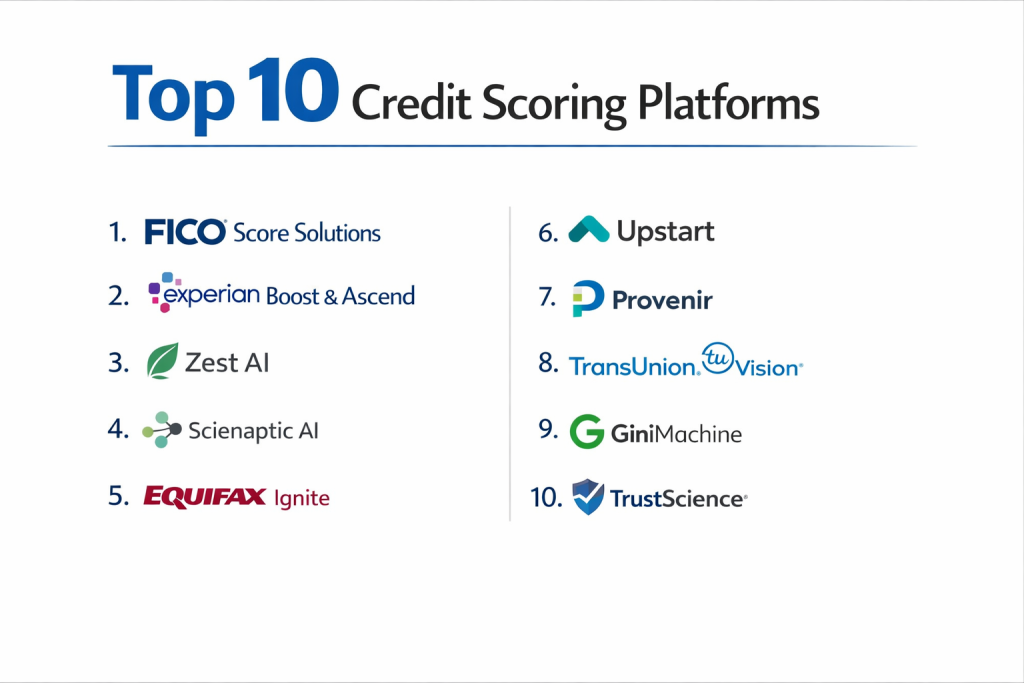
Top 10 Credit Scoring Platforms
1 — FICO Score Solutions
FICO remains the gold standard in the credit industry, used by 90% of top lenders in the United States. Its platform provides the predictive analytics that power the most recognized credit score in the world.
- Key features:
- Industry-Specific Models: Tailored scores for auto loans, mortgages, and credit cards.
- FICO Score 10 T: Incorporates trended data to show how consumers manage debt over time.
- FICO Resilience Index: Measures how sensitive a borrower is to an economic downturn.
- Explainable AI (XAI): Tools that help lenders meet regulatory transparency requirements.
- FICO Blaze Advisor: A high-speed decision engine for automated approvals.
- Pros:
- Unrivaled market acceptance; most secondary markets require FICO scores.
- Deeply tested and validated historical predictive power.
- Cons:
- Can be slower to integrate “alternative” data compared to agile FinTech competitors.
- Licensing costs are generally higher than newer market entries.
- Security & compliance: SOC 2 Type II, GDPR, CCPA, and strict adherence to the Fair Credit Reporting Act (FCRA).
- Support & community: Extensive professional certification programs, global enterprise support, and a massive community of financial analysts.
2 — Experian Boost & Ascend
Experian has pivoted from being a “bureau” to a “tech platform.” Their Ascend platform allows lenders to use real-time data and big data analytics to build custom scoring models.
- Key features:
- Ascend Analytical Sandbox: A research environment to test new scoring models against Experian’s data.
- Alternative Data Integration: Includes rent, utility, and telecom payment history.
- Experian Clarity Services: Specialized scoring for underbanked and subprime segments.
- Instant Decisioning: API-driven workflows for real-time loan offers.
- Visual Analytics: Interactive dashboards for monitoring portfolio risk.
- Pros:
- Access to one of the world’s largest consumer credit databases.
- Excellent tools for identifying “credit invisible” but low-risk borrowers.
- Cons:
- Data privacy concerns associated with large-scale bureaus can lead to increased audit scrutiny.
- Some advanced features require a steep technical learning curve.
- Security & compliance: ISO 27001, SOC 2, HIPAA, and GDPR compliant.
- Support & community: High-tier enterprise support with dedicated data consultants and technical account managers.
3 — Zest AI
Zest AI is a pioneer in using machine learning for credit underwriting. It is designed to help lenders build, shift, and deploy complex AI models without needing a PhD-level data science team.
- Key features:
- Model Management: End-to-end platform for building and monitoring ML models.
- Fair Lending Tools: Automated bias detection and mitigation to ensure compliance.
- Adverse Action Notices: Generates clear reasons for credit denial automatically.
- Standardized Documentation: One-click generation of model validation reports.
- Cloud-Native Deployment: Easily integrates with existing loan origination systems (LOS).
- Pros:
- Significantly higher approval rates without increasing risk compared to traditional models.
- Strongest focus on regulatory compliance for AI in the industry.
- Cons:
- Requires a significant amount of historical data to train models effectively.
- Purely AI-focused; lacks the raw data access of a bureau.
- Security & compliance: SOC 2, rigorous encryption standards, and built-in fair lending auditing.
- Support & community: Robust onboarding for risk officers and proactive legal/compliance support.
4 — Scienaptic AI
Scienaptic offers an AI-native credit underwriting platform called “Ether.” It focuses on the “spirit” of the borrower, aiming to approve more people through more nuanced data analysis.
- Key features:
- Ether Decision Engine: Real-time credit decisioning powered by ML.
- Alternative Data Connectors: Easy hooks into non-traditional data streams.
- Risk Segmentation: Highly granular categorization of borrowers.
- Model Explainability: Detailed “why” behind every score.
- Dynamic Pricing: Automatically adjusts interest rates based on real-time risk.
- Pros:
- Very fast implementation times for FinTechs.
- Highly adaptable to specific regional or niche markets.
- Cons:
- User interface is less polished than some enterprise competitors.
- Smaller community compared to giants like FICO or Experian.
- Security & compliance: GDPR, SOC 2 Type II, and data localized hosting options.
- Support & community: Responsive technical support and personalized implementation strategy.
5 — Equifax Ignite
Equifax Ignite is a powerful analytics suite that allows businesses to link their internal data with Equifax’s massive external datasets to create custom scores.
- Key features:
- Trended Data Analytics: Analyzes the direction of a borrower’s financial health.
- Advanced Modeling: Support for both traditional regression and machine learning.
- Attribute Engine: Access to thousands of pre-calculated credit attributes.
- NeuroDecision Technology: Explains complex neural network decisions to regulators.
- Industry Benchmarking: Compare your portfolio risk against national averages.
- Pros:
- Exceptional data depth, particularly in employment and income verification (The Work Number).
- Very reliable for large-scale, high-consequence lending.
- Cons:
- Enterprise-level pricing is prohibitive for small startups.
- Integration can be cumbersome due to the legacy nature of some back-end systems.
- Security & compliance: ISO/IEC 27001, SOC 2, and rigorous post-breach security overhauls.
- Support & community: Massive resource library, webinars, and global 24/7 technical assistance.
6 — Upstart
Upstart is unique because it is both a lending marketplace and a provider of AI-driven credit scoring technology to other banks and credit unions.
- Key features:
- 1,000+ Data Points: Analyzes education, employment history, and more.
- Highly Automated: Nearly 70% of loans are fully automated without human intervention.
- Rapid Integration: Designed to sit on top of existing bank infrastructure.
- Fraud Detection: Advanced identity verification layers built into the score.
- Mobile-First Experience: Built for the modern borrower journey.
- Pros:
- Proven to reduce loss rates significantly while maintaining high volume.
- Great for banks looking to modernize without building their own AI.
- Cons:
- Lenders may feel like they are “renting” an algorithm they don’t fully own.
- Sensitivity to macroeconomic changes can be higher in AI-heavy models.
- Security & compliance: SOC 2, PCI-DSS, and compliance with CFPB guidelines.
- Support & community: Dedicated partner success managers and technical integration teams.
7 — Provenir
Provenir is a data-agnostic decisioning platform. It doesn’t just provide a score; it provides the “plumbing” to bring in any data source and apply any scoring logic you want.
- Key features:
- Low-Code Design: Drag-and-drop interface for building credit workflows.
- Data Marketplace: One-click access to hundreds of global data providers.
- Real-Time Integration: Connects to core banking systems via REST APIs.
- Global Scalability: Handles different currencies and languages effortlessly.
- Self-Service Analytics: Allows risk teams to change rules without IT help.
- Pros:
- Maximum flexibility; you are not locked into one data provider.
- Fast time-to-market for new credit products.
- Cons:
- Does not provide its own “proprietary” data; you must buy data separately.
- Requires a clear strategy, otherwise, the flexibility can become overwhelming.
- Security & compliance: SOC 2, GDPR, and localized cloud hosting.
- Support & community: Extensive developer documentation and a global support network.
8 — TransUnion TruVision
TransUnion’s TruVision suite focuses on “Trended Data,” looking back 24–30 months at a consumer’s behavior rather than just a snapshot in time.
- Key features:
- Trended Credit Data: Identifies if a user is “paying down” or “charging up.”
- Risk-Based Pricing: Precise tools for determining APRs.
- Synthetic Identity Detection: Flags credit profiles that aren’t real people.
- Alternative Lending Scores: Scores for short-term and installment loans.
- Debt Management Insights: Predicts which customers are likely to default soon.
- Pros:
- Strongest tools for combating synthetic identity fraud.
- Excellent predictive power for credit card and auto lending.
- Cons:
- Heavy focus on traditional bureau data can miss very thin-file consumers.
- The platform can feel fragmented across different service modules.
- Security & compliance: ISO 27001, SOC 2, and FCRA compliant.
- Support & community: Robust B2B support portal and annual industry summits.
9 — GiniMachine
GiniMachine is an agile AI platform specifically built for high-speed credit scoring in the micro-finance and FinTech sectors.
- Key features:
- No-Code AI: Build models in minutes by uploading a CSV of historical data.
- Automatic Feature Engineering: The tool finds patterns you didn’t know existed.
- Real-Time Scoring API: Instant responses for web and mobile apps.
- Model Validation: Built-in Gini index and ROC curve reporting.
- Bias Detection: Alerts users if certain data points are causing unfair outcomes.
- Pros:
- Fastest setup time on this list.
- Very affordable for smaller lenders and startups.
- Cons:
- Lacks the deep “bureau” data of Equifax or Experian.
- Not suitable for highly complex mortgage underwriting.
- Security & compliance: GDPR compliant and secure data processing.
- Support & community: Direct access to technical developers and clear documentation.
10 — TrustScience
TrustScience uses “Credit Bureau 2.0” technology, leveraging AI and “Social Data” to score the billions of people worldwide who are underbanked.
- Key features:
- Six°Score: A proprietary score that uses alternative data.
- Consent-Based Data: Borrowers provide access to their data for a better score.
- Psychometric Analysis: Optional testing to determine “willingness to pay.”
- Cloud-Native API: Seamlessly connects to any LOS.
- Auto-Underwriting: Fully automates the “Yes/No” decision.
- Pros:
- Best-in-class for reaching the unbanked and Gen Z.
- Ethical data usage policies.
- Cons:
- “Social” and “Psychometric” data can be controversial in some jurisdictions.
- Higher consumer friction if they have to “provide consent” for extra data.
- Security & compliance: SOC 2 Type II, GDPR, and CCPA.
- Support & community: Boutique-style support with high attention to client needs.
Comparison Table
| Tool Name | Best For | Platform(s) Supported | Standout Feature | Rating |
| FICO | Standard Lending | Cloud / On-prem | Industry-standard Acceptance | 4.9/5 |
| Experian Ascend | Data Science Teams | Cloud / SaaS | Massive Bureau Data Sandbox | 4.7/5 |
| Zest AI | ML Compliance | Cloud-Native | Automated Fair Lending Audits | 4.6/5 |
| Scienaptic AI | FinTech Agility | Cloud / Web | Ether ML Decision Engine | 4.4/5 |
| Equifax Ignite | Large Enterprises | Web / API | Employment Verification (Work Number) | 4.5/5 |
| Upstart | Modern Banks | SaaS / API | 1,000+ Alternative Data Points | 4.8/5 |
| Provenir | Data-Agnostic Org | Cloud / Low-code | Drag-and-drop Decisioning | 4.7/5 |
| TransUnion | Fraud Prevention | Cloud / SaaS | Synthetic Identity Detection | 4.6/5 |
| GiniMachine | SMB / Micro-finance | Web / CSV | No-code ML Model Builder | 4.3/5 |
| TrustScience | Underbanked | Cloud / API | Consent-based Alternative Data | 4.2/5 |
Evaluation & Scoring of Credit Scoring Platforms
| Category | Weight | FICO | Zest AI | Provenir | GiniMachine |
| Core Features | 25% | 10/10 | 9/10 | 10/10 | 7/10 |
| Ease of Use | 15% | 6/10 | 8/10 | 9/10 | 10/10 |
| Integrations | 15% | 8/10 | 9/10 | 10/10 | 8/10 |
| Security/Compliance | 10% | 10/10 | 10/10 | 9/10 | 8/10 |
| Performance/Rel. | 10% | 10/10 | 9/10 | 9/10 | 9/10 |
| Support/Community | 10% | 10/10 | 9/10 | 8/10 | 7/10 |
| Price / Value | 15% | 7/10 | 8/10 | 8/10 | 10/10 |
| TOTAL SCORE | 100% | 8.65 | 8.85 | 9.10 | 8.20 |
Which Credit Scoring Platform Tool Is Right for You?
Selecting the right platform depends on your technical maturity, the types of loans you issue, and your regulatory environment.
- Solo Users & SMBs: If you are a small lender or starting a boutique finance firm, GiniMachine is the most accessible. You don’t need a team of developers to get an AI-powered score running from a simple spreadsheet.
- Mid-Market FinTechs: If you are building a modern app and need to differentiate your risk model, Scienaptic AI or Provenir offer the agility to integrate unique data sources without the overhead of a legacy bureau.
- Enterprise & Tier 1 Banks: For traditional institutions, FICO and Equifax are non-negotiable for their secondary market requirements and massive historical datasets. However, adding a layer like Zest AI on top can help modernize these legacy systems.
- Budget-Conscious: If you are trying to keep costs low, look for platforms that offer “Success-based” pricing or tiered API calls like TrustScience. Avoid the heavy implementation fees of the big three bureaus.
- High-Security & Compliance: If you operate in a highly litigious environment (like the US or EU), Zest AI is the clear winner due to its focus on “Explainable AI” and automated fair-lending documentation.
Frequently Asked Questions (FAQs)
What is the difference between a credit score and a credit scoring platform?
A credit score is the final three-digit number. A credit scoring platform is the entire software ecosystem that gathers data, applies algorithms, and manages the decisioning process.
Can these platforms really reduce default rates?
Yes. By using machine learning to identify complex patterns that human underwriters or simple linear models miss, many platforms report a 20% to 35% reduction in defaults.
How does “Alternative Data” affect my compliance?
It depends on the region. In the US, any data used must comply with the FCRA. Platforms like Zest AI and FICO have built-in tools to ensure that alternative data doesn’t inadvertently discriminate against protected classes.
Is it difficult to switch from one platform to another?
It can be. The biggest hurdle is “Model Drift” and re-training your staff. Most institutions choose to run a new platform in “shadow mode” for several months before fully switching.
Do these platforms support international credit scoring?
Some do. Provenir and Experian have strong global footprints. However, credit data is highly localized due to different privacy laws (like GDPR), so you must choose a platform with local data connectors.
How much do these platforms cost?
Pricing varies wildly. Small-scale API-based tools may charge $1–$5 per pull, while enterprise platforms can cost hundreds of thousands in annual licensing plus implementation fees.
What is “Explainable AI” in credit scoring?
Explainable AI (XAI) is the ability of a machine learning model to provide the specific reasons why a borrower was rejected, ensuring the lender can provide the legally required “Adverse Action” notice.
Can I build my own scoring model on these platforms?
Yes. Platforms like Experian Ascend and Provenir are specifically designed to allow your data scientists to build, test, and deploy proprietary models using their infrastructure.
How fast is a real-time credit decision?
With modern API-based platforms, a full credit decision—including data pull and risk calculation—usually takes between 200 milliseconds and 2 seconds.
What is a “Thin File” consumer?
A thin-file consumer is someone with little to no traditional credit history. Platforms like TrustScience and Upstart are specifically designed to score these individuals using alternative data points.
Conclusion
The shift from static credit snapshots to dynamic, AI-driven credit scoring is the most significant change in lending history. While FICO remains the anchor of the industry, platforms like Provenir and Zest AI are redefining what it means to be “creditworthy.”
Ultimately, the best platform is the one that aligns with your specific risk appetite and technical capability. If you are a traditional bank, reliability and market acceptance are key. If you are a FinTech, speed and the ability to find “hidden gems” in the unbanked population will be your competitive advantage.

- Top 10 Email Deliverability Tools: Features, Pros, Cons & Comparison - September 6, 2026
- Top 10 Pharmacovigilance Software: Features, Pros, Cons & Comparison - September 6, 2026
- Top 10 Manufacturing Execution Systems (MES) - July 30, 2026