Introduction
A Customer Loyalty Platform is a software solution that allows businesses to create, manage, and analyze programs designed to reward repeat customers and foster brand engagement. These platforms move beyond simple punch cards to encompass digital points systems, tiered VIP memberships, referral campaigns, and experiential rewards. They are the central engine for turning transactions into relationships.
In an era where acquiring a new customer can cost five times more than retaining an existing one, loyalty platforms are a critical investment. They directly combat churn, increase customer lifetime value (CLV), and transform buyers into brand advocates. Key real-world use cases include: a coffee shop offering a free drink after ten purchases via a mobile app; an e-commerce brand creating a VIP tier with early access to sales; or a service-based company incentivizing referrals with account credits.
When choosing a platform, businesses should evaluate several key criteria: the flexibility of the reward structures (points, tiers, cashback), the quality of customer data and segmentation tools, the ease of integration with your POS, e-commerce, or CRM systems, the robustness of marketing automation (emails, push notifications), and the depth of analytics and reporting to prove ROI.
Best for: These platforms are most beneficial for Marketing Managers, Customer Success teams, and small business owners across retail, e-commerce, hospitality, and subscription-based services. Companies with repeat purchase cycles, from SMBs to large enterprises, see the highest return by systematically increasing retention and average order value.
Not ideal for: Startups or solopreneurs without an established customer base or repeatable sales model may find the cost and complexity unjustified. Businesses with very long or one-time purchase cycles (e.g., real estate, high-end B2B equipment) might benefit more from a traditional CRM. If you only need simple social media contests, a dedicated contest tool may suffice.
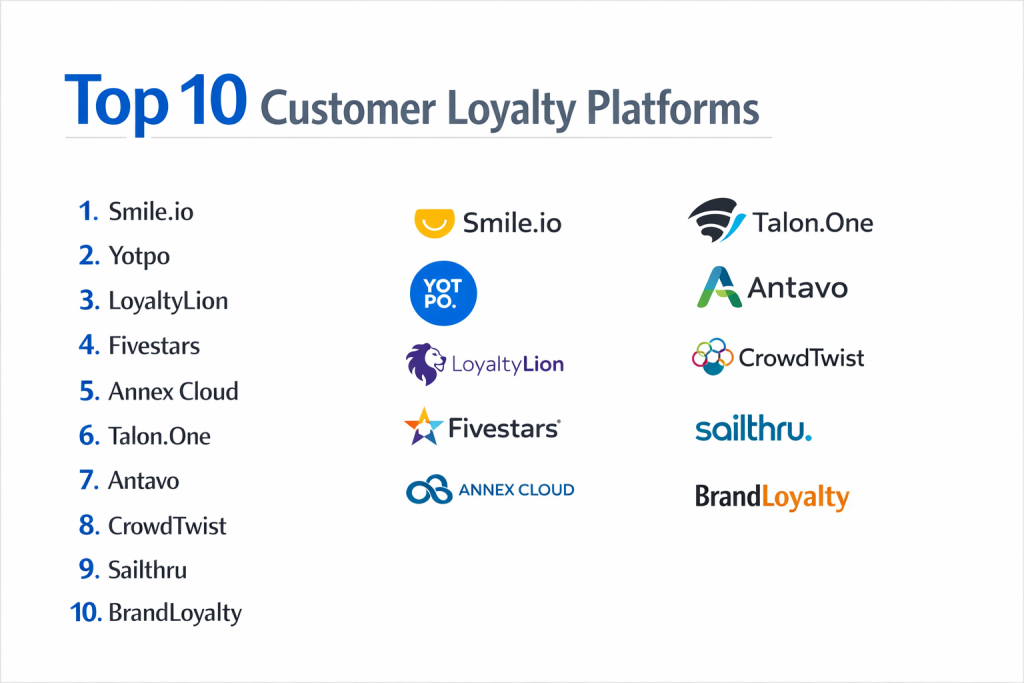
Top 10 Customer Loyalty Platforms
1 — Smile.io (Now “Loyalty” by Shopify)
A leading, no-code loyalty platform deeply integrated with the Shopify ecosystem, designed to help e-commerce merchants easily launch points, VIP, and referral programs.
- Key Features
- Pre-built programs: Points & rewards, VIP tiers, and customer referrals.
- Seamless one-click integration with Shopify stores.
- Customizable program rules and reward options.
- Built-in email automation for program communications.
- Customer segmentation and program analytics dashboard.
- Mobile-friendly rewards page.
- Pros
- Incredibly fast and simple setup for Shopify merchants; can launch in hours.
- Transparent, value-focused pricing scales directly with store orders.
- Cons
- Primarily built for Shopify; functionality is limited outside that ecosystem.
- Advanced customization or unique reward structures can be constrained.
- Security & Compliance: Inherits robust security via Shopify’s infrastructure (SOC 2, PCI DSS compliance). Data encryption and secure access are standard.
- Support & Community: Offers 24/7 email support, detailed help center, and an active community of Shopify merchants. Enterprise-level plans include priority support.
2 — Yotpo Loyalty & Referrals
A comprehensive, data-driven loyalty and advocacy platform that integrates deeply with major e-commerce systems, focusing on turning customers into vocal brand advocates.
- Key Features
- Unified loyalty and referral program management.
- Deep two-way integrations with platforms like Shopify Plus, BigCommerce, and Salesforce.
- Advanced segmentation using purchase and behavioral data.
- Customizable rewards, including experiential and donation-based options.
- Robust API for custom development and unique workflows.
- Pros
- Powerful integration capabilities make it a strong choice for mid-market and enterprise brands on popular tech stacks.
- Excellent for creating a combined loyalty and user-generated content (reviews, referrals) strategy.
- Cons
- Can become a significant investment, with pricing that scales into the enterprise range.
- The breadth of features may require more initial setup and configuration than simpler tools.
- Security & Compliance: Enterprise-grade security with SSO, encryption, and compliance with GDPR, CCPA, and SOC 2 Type II standards.
- Support & Community: Provides dedicated customer success management for higher-tier plans, 24/7 support, and a resource library with webinars and case studies.
3 — LoyaltyLion
A loyalty and engagement platform built specifically for mid-market and enterprise e-commerce brands, emphasizing deep data integration and sophisticated program design.
- Key Features
- Highly flexible program builder for complex points, tier, and mission-based structures.
- Powerful customer data engine that syncs with your tech stack for smart segmentation.
- A/B testing for program rules and communications.
- Detailed customer lifetime value (LTV) and program ROI reporting.
- Extensive API and integrations with CRM, ESP, and analytics tools.
- Pros
- Unmatched flexibility for designing sophisticated, unique loyalty strategies beyond basic points.
- Provides deep insights into customer behavior and program performance, justifying its cost.
- Cons
- Not a self-service tool; typically requires implementation support and a higher budget.
- Overkill for very small or new businesses with straightforward needs.
- Security & Compliance: Adheres to strict data protection standards including GDPR and ISO 27001. Offers SSO and data encryption.
- Support & Community: Features strategic customer success partnerships, technical account management, and an enterprise-grade SLA for support.
4 — Fivestars (Part of SumUp)
A platform focused on unifying online and offline loyalty for local brick-and-mortar businesses, combining a digital loyalty program with a marketing automation suite.
- Key Features
- Integrated POS, loyalty program, and customer marketing tools.
- Easy-to-use mobile app for both merchants and customers.
- Automated SMS and email campaigns based on customer activity.
- Offers, punch cards, and points programs.
- Insights and reporting on customer visits and spending.
- Pros
- Excellent for local service businesses and retailers looking for a simple all-in-one solution.
- Strong focus on driving repeat foot traffic with targeted, automated promotions.
- Cons
- Primarily serves the SMB/local business market; lacks enterprise-scale features.
- The merchant must use (or integrate) with the Fivestars POS system for full functionality.
- Security & Compliance: Complies with PCI DSS for payment security and standard data protection regulations. Specific enterprise certifications may vary.
- Support & Community: Provides phone, email, and in-app support, along with setup assistance and training resources for small business owners.
5 — Annex Cloud
An enterprise-level customer loyalty and engagement platform offering extensive customization and a wide array of program types for large, complex brands.
- Key Features
- Supports points, referrals, reviews, VIP tiers, and gamified contests.
- Highly customizable front-end widgets and user experience.
- Global capabilities for multi-currency and multi-language programs.
- Advanced fraud prevention and compliance tools.
- Deep integrations with major e-commerce, CRM, and ERP systems.
- Pros
- Extremely powerful and configurable for global enterprises with unique requirements.
- “One platform” approach to loyalty, referrals, and user-generated content can consolidate vendors.
- Cons
- High cost and complexity make it unsuitable for SMBs.
- Long implementation timelines and need for dedicated technical resources.
- Security & Compliance: Enterprise-grade with SOC 2 Type II, ISO 27001, GDPR, and CCPA compliance. Features robust security controls and audit trails.
- Support & Community: Offers 24/7 dedicated enterprise support, strategic services, and a client success team for implementation and optimization.
6 — Talon.One
A headless promotion and loyalty engine delivered via API, designed for businesses that need to embed and fully customize loyalty logic within their own apps and websites.
- Key Features
- API-first, headless architecture for complete flexibility.
- Visual campaign manager to design complex rules and rewards.
- Real-time promotion engine for coupons and loyalty actions.
- Powerful simulation tools to test campaigns before launch.
- Seamless integration with existing customer data platforms and commerce systems.
- Pros
- Unparalleled control over the customer experience and loyalty logic for tech-savvy teams.
- Scales elegantly with high transaction volumes and complex global rulesets.
- Cons
- Requires significant in-house development resources to implement and maintain.
- No out-of-the-box front-end; you must build your own user interface.
- Security & Compliance: Features enterprise security standards, including data encryption, SSO, and compliance with GDPR. SOC 2 report available.
- Support & Community: Provides developer-centric documentation, technical support, and dedicated solution engineering for enterprise clients.
7 — Antavo
A cloud-native loyalty platform specializing in experiential, tier-based programs, with a strong focus on gamification and personalized customer journeys.
- Key Features
- Emphasis on “paid” and experiential rewards (events, exclusive content).
- Advanced gamification features like missions, badges, and leaderboards.
- Journey designer for creating personalized loyalty lifecycles.
- AI-powered personalization engine for reward recommendations.
- API-driven with pre-built integrations for major commerce platforms.
- Pros
- Ideal for brands wanting to build emotional connections through non-monetary rewards and game mechanics.
- Modern, cloud-based architecture ensures agility and scalability.
- Cons
- The experiential focus may not suit brands whose customers purely want cashback or discounts.
- As a growing platform, its partner ecosystem is not as vast as some legacy providers.
- Security & Compliance: Cloud security best practices with ISO 27001 certification, GDPR compliance, and regular penetration testing.
- Support & Community: Offers customer success management, 24/5 support, and access to a knowledge base and development documentation.
8 — CrowdTwist (An Oracle Company)
An enterprise loyalty solution now part of Oracle’s CX suite, offering deep capabilities for orchestrating complex, multi-brand loyalty programs.
- Key Features
- Supports intricate coalition and multi-brand loyalty programs.
- Deep integration with Oracle’s advertising, CRM, and commerce clouds.
- Advanced analytics and predictive modeling for customer behavior.
- Comprehensive partner management tools.
- Configurable reward catalog and redemption options.
- Pros
- A top-tier choice for large corporations, especially those already using Oracle’s ecosystem.
- Unmatched for managing sophisticated, partnership-driven loyalty ecosystems (e.g., airline alliances, retail coalitions).
- Cons
- Oracle-level pricing and complexity; only viable for the largest enterprises.
- Can be less agile and more costly to customize than cloud-native competitors.
- Security & Compliance: Leverages Oracle’s global enterprise security, compliance, and data center infrastructure, meeting the highest industry standards.
- Support & Community: Access to Oracle’s global support network, consulting services, and user conferences. Requires an enterprise relationship.
9 — Sailthru (Part of CM Group)
A personalized marketing automation platform with a strong loyalty module, focused on using 1:1 messaging to drive retention for retail and e-commerce brands.
- Key Features
- Loyalty program management integrated with a powerful email/Journey orchestration engine.
- Real-time behavioral data collection and predictive customer scoring.
- Hyper-personalized cross-channel messaging (email, mobile, web).
- Focus on post-purchase journeys and win-back campaigns.
- Integrations with major e-commerce platforms and data warehouses.
- Pros
- Loyalty actions seamlessly fuel a superior personalized marketing strategy.
- Exceptional for data-driven brands that prioritize email and mobile messaging as core channels.
- Cons
- Loyalty features are part of a broader marketing suite, not a standalone best-of-breed tool.
- The primary value is unlocked only when fully utilizing its marketing automation capabilities.
- Security & Compliance: Enterprise security with SOC 2 Type II compliance, GDPR readiness, and data protection commitments.
- Support & Community: Includes a dedicated strategist (for eligible plans), 24/7 support, and a resource center with best practice guides.
10 — BrandLoyalty
A global provider specializing in short-term, campaign-based loyalty promotions and gift-with-purchase programs, often for grocery, fuel, and retail sectors.
- Key Features
- Expertise in time-bound promotional campaigns (collect & save, sticker albums).
- Full-service program management including creative, logistics, and fulfillment.
- Physical and digital reward fulfillment on a global scale.
- Data capture and performance analytics for promotions.
- Focus on driving specific, short-term sales lifts.
- Pros
- Unique focus on high-impact, short-term promotions that create buzz and immediate sales.
- Handles the heavy lifting of physical reward logistics and campaign execution.
- Cons
- Not a platform for building a permanent, always-on loyalty program.
- Model involves project-based costs and is less transparent than SaaS pricing.
- Security & Compliance: Varies by project and region, but maintains standards for data handling and fulfillment partner agreements.
- Support & Community: Provides a full-service, consultative partnership model with a dedicated project team rather than standard tech support.
Comparison Table
| Tool Name | Best For (Target User/Scenario) | Platform(s) Supported | Standout Feature | Rating |
|---|---|---|---|---|
| Smile.io | Shopify merchants wanting a simple, fast-to-launch program. | Shopify, BigCommerce (limited) | Deep, seamless Shopify integration & ease of use. | N/A |
| Yotpo | Mid-market e-commerce brands seeking a unified loyalty & UGC strategy. | Shopify Plus, BigCommerce, Salesforce, Magento | Powerful combo of loyalty, reviews, and referrals in one suite. | N/A |
| LoyaltyLion | Data-savvy e-commerce brands designing sophisticated, unique programs. | Major e-commerce platforms, CRM systems | Extreme flexibility and deep customer insights/segmentation. | N/A |
| Fivestars | Local brick-and-mortar businesses (retail, services). | Primarily its own POS, with integrations | All-in-one POS, loyalty, and marketing for local SMBs. | N/A |
| Annex Cloud | Large global enterprises needing a highly customized, multi-feature platform. | Enterprise e-commerce, CRM, ERP | Enterprise-scale configurability for complex, global programs. | N/A |
| Talon.One | Tech-heavy businesses wanting to embed loyalty logic into their own apps. | API-first, integrates with any stack | Headless, API-only engine for complete control and customization. | N/A |
| Antavo | Brands focusing on experiential rewards, gamification, and emotional connection. | Cloud-native, API-driven | Experiential rewards & advanced gamification features. | N/A |
| CrowdTwist | Large corporations running complex multi-brand or coalition programs. | Oracle ecosystem, legacy enterprise | Sophisticated management of coalition/partnership loyalty ecosystems. | N/A |
| Sailthru | Retailers who view loyalty as a key data source for personalized messaging. | Major e-commerce platforms, data lakes | Loyalty data tightly integrated with predictive marketing automation. | N/A |
| BrandLoyalty | CPG or retail brands launching short-term, promotional loyalty campaigns. | N/A (service-based) | Expertise in high-impact, campaign-based promotions with physical fulfillment. | N/A |
Evaluation & Scoring of Customer Loyalty Platforms
| Criteria | Weight | What to Look For (Evaluation Guidelines) |
|---|---|---|
| Core Features | 25% | Flexibility of program types (points, tiers, referrals), reward options, segmentation, and built-in marketing automation. |
| Ease of Use | 15% | Intuitive interface for both program managers and customers, speed of setup, and quality of onboarding. |
| Integrations & Ecosystem | 15% | Native integrations with your commerce platform, POS, CRM, and email service provider. API robustness. |
| Security & Compliance | 10% | Data encryption, SOC 2/ISO 27001 compliance, adherence to GDPR/CCPA, and fraud prevention tools. |
| Performance & Reliability | 10% | Platform uptime, speed of points processing/redemption, and scalability during high traffic (e.g., sales). |
| Support & Community | 10% | Quality of customer support, availability of strategic guidance, and access to documentation or user communities. |
| Price / Value | 15% | Transparent and scalable pricing model (SaaS vs. service-based). ROI justification based on features and support. |
Which Customer Loyalty Platform Tool Is Right for You?
- Solo Users vs SMB vs Mid-Market vs Enterprise: Solo entrepreneurs on Shopify should start with Smile.io. SMBs, especially local businesses, should evaluate Fivestars. Mid-market e-commerce brands have strong options in Yotpo and LoyaltyLion. Large enterprises will need the power and support of Annex Cloud, CrowdTwist, or a headless solution like Talon.One.
- Budget-Conscious vs Premium Solutions: For lower-cost, predictable SaaS pricing, look to Smile.io and Antavo. Mid-range investments include Yotpo and LoyaltyLion. Premium enterprise solutions like Annex Cloud and CrowdTwist involve significant investment but offer full customization and support.
- Feature Depth vs Ease of Use: If you need maximum control and unique program logic and have the tech team, prioritize Talon.One or LoyaltyLion. If simplicity and speed-to-launch are critical, choose Smile.io or Fivestars.
- Integration and Scalability Needs: If you’re on Shopify, Smile.io is the easiest path. For a best-of-breed, API-connected stack, Talon.One or Antavo excel. If you’re embedded in the Oracle ecosystem, CrowdTwist is a natural fit.
- Security and Compliance Requirements: Global enterprises in regulated industries must prioritize vendors with clear SOC 2 Type II and ISO 27001 certifications. Always request a vendor’s security documentation and data processing agreements.
Frequently Asked Questions (FAQs)
1. What’s the difference between a points program and a tier-based VIP program?
A points program rewards transactions with redeemable currency. A tier-based program rewards sustained engagement (e.g., annual spend) with status, offering exclusive perks. They are often combined.
2. How much does a typical loyalty platform cost?
Costs vary widely. Simple SMB platforms start around $50-$300/month. Mid-market solutions range from $300-$2,000+/month. Enterprise platforms are often $5,000+/month with custom quotes. Consider setup fees and transaction costs.
3. How long does it take to implement a loyalty program?
A simple out-of-the-box program (e.g., Smile.io on Shopify) can launch in a day. A customized mid-market program takes 4-12 weeks. Complex enterprise implementations can take 6 months to a year+.
4. Can I run a loyalty program across both my physical stores and online shop?
Yes, this is crucial. Choose a platform that integrates with both your e-commerce platform and POS system to unify customer data and allow points earning/redemption everywhere.
5. What are “experiential rewards” and are they effective?
These are non-monetary rewards like exclusive events, early product access, or behind-the-scenes content. They are highly effective for building emotional brand connection with top-tier customers, beyond transactional discounts.
6. How do I measure the ROI of my loyalty program?
Key metrics include: program enrollment rate, repeat purchase rate of members vs. non-members, customer lifetime value (LTV) lift, and redemption rate. The platform should provide this analytics dashboard.
7. What’s a common mistake when starting a loyalty program?
The biggest mistake is making it all about discounts. This trains customers to be price-sensitive. Successful programs mix monetary rewards with recognition, access, and community to build brand affinity.
8. Should I build a custom loyalty program or use a SaaS platform?
For most companies, a SaaS platform is faster, more secure, and more cost-effective. Building custom is only advisable if you have unique, complex needs that no platform can meet and a dedicated development team.
9. What is a “headless” loyalty platform?
A headless platform (like Talon.One) provides the backend logic and API separately from the front-end user interface. This gives developers complete control over the customer experience but requires them to build it.
10. How do I prevent fraud in my points program?
Look for platforms with features like points expiration rules, velocity checks (limits on points earned in a period), validation for referrals, and manual review tools. Education and clear program terms are also key.
Conclusion
The landscape of customer loyalty platforms offers a tailored solution for every business model, from the simplicity of Smile.io for Shopify stores to the global power of Annex Cloud for enterprises. The “best” tool is not a universal winner but the one that seamlessly aligns with your technical ecosystem, customer engagement philosophy, and growth ambitions.
When making your decision, balance the allure of advanced features with the practical realities of ease of use, implementation resources, and total cost. The most sophisticated program will fail if customers find it confusing or your team cannot manage it effectively. Start by defining the core behavior you want to reward and choose a platform that makes executing that vision intuitive. By doing so, you can transform your loyalty program from a cost center into a proven engine for sustainable growth and customer love.

- Top 10 Email Deliverability Tools: Features, Pros, Cons & Comparison - September 6, 2026
- Top 10 Pharmacovigilance Software: Features, Pros, Cons & Comparison - September 6, 2026
- Top 10 Manufacturing Execution Systems (MES) - July 30, 2026