Introduction
In the fast-paced world of global logistics , Customs Brokerage Software has evolved from a simple filing tool into a mission-critical intelligence hub. These platforms are specialized digital solutions designed to help customs brokers, freight forwarders, and self-filing importers navigate the complex web of international trade regulations. They automate the submission of entries to government authorities—such as the Automated Commercial Environment (ACE) in the US or the Customs Declaration Service (CDS) in the UK—ensuring that goods clear borders efficiently while adhering to strict legal standards.
The importance of these tools lies in their ability to mitigate risk and reduce operational overhead. With global trade volumes reaching record highs and regulatory regimes shifting overnight, manual data entry is no longer viable. Modern software utilizes AI-driven HS code classification, real-time duty calculations, and direct Electronic Data Interchange (EDI) links to minimize human error and prevent costly shipment holds or fines. Key use cases include the high-volume processing of Type 86 (low-value) entries, managing Foreign Trade Zones (FTZ), and providing end-to-end visibility for intercompany shipments. When evaluating these tools, professionals prioritize direct government connectivity, scalability, and the ability to integrate seamlessly with existing Transportation Management Systems (TMS).
- Best for: Professional customs brokers, international freight forwarders (NVOCCs), 3PL providers, and large-scale importers who manage high-volume cross-border transactions and require rigorous compliance audits.
- Not ideal for: Small domestic-only retailers, local couriers with no international footprint, or occasional shippers who can rely on one-off brokerage services provided by carriers like UPS or FedEx.
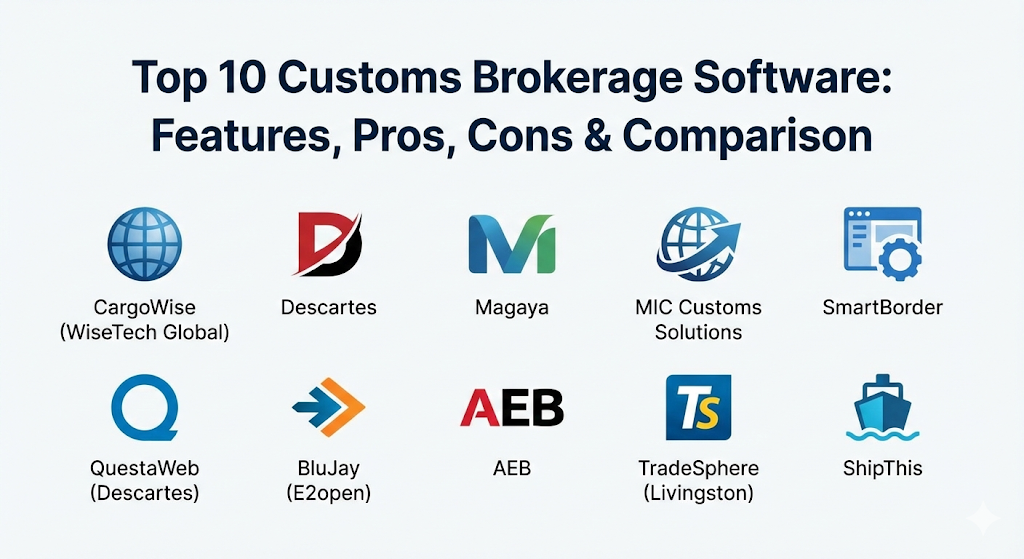
Top 10 Customs Brokerage Software Tools
1 — CargoWise (WiseTech Global)
CargoWise is arguably the most dominant force in logistics technology today. Operating in over 195 countries, it is a deeply integrated ERP designed to handle the entire logistics lifecycle, with its customs module serving as the cornerstone for global compliance.
- Key Features:
- CargoWise Neo: A digital portal giving customers real-time access to declarations, invoices, and shipment status.
- Direct Government Connectivity: Certified for direct filing in almost every major trading nation.
- Automated Workflow Engine: Triggers compliance checks and documentation generation based on shipment milestones.
- Integrated Financials: Automatic tax configuration, dual-currency control, and VAT logic.
- Multi-Mode Support: Handles air, sea, land, and rail customs procedures within a single interface.
- Pros:
- Unmatched global reach and depth, making it the standard for multinational enterprises.
- Strong automation capabilities that reduce the “administrative tax” on high-volume shipments.
- Cons:
- The implementation curve is steep and often requires certified partners to configure.
- Pricing can be high for smaller brokers due to its modular enterprise structure.
- Security & Compliance: SOC 2, ISO 27001, GDPR compliant, and features robust audit logs for financial integrity.
- Support & Community: Extensive global partner network, WiseTech Academy for certification, and 24/7 technical support for enterprise clients.
2 — Descartes Customs & Compliance Suite
Descartes offers a sophisticated suite that focuses heavily on the speed and accuracy of transmissions. Known for its “Global Logistics Network,” it provides one of the most reliable infrastructures for real-time messaging with customs authorities.
- Key Features:
- Type 86 Response: Specific responsiveness to US low-value goods regimes for e-commerce high volumes.
- Automated Commercial Environment (ACE) Certification: Full support for ABI, ISF, and eManifest filing.
- HS Classification Engine: Advanced search tools for finding accurate tariff numbers across different jurisdictions.
- Audit-Ready Reporting: Detailed dashboards that track compliance performance and identifying potential bottlenecks.
- Mobile Visibility: Real-time detention and hold notifications pushed to mobile devices.
- Pros:
- Very responsive to regulatory changes, often updating systems months ahead of new mandates.
- High-speed performance for high-volume filers, with minimal lag during peak times.
- Cons:
- The user interface is functional but can feel “engineered” and less intuitive than newer SaaS platforms.
- Some deeper integrations lack a modern REST API, requiring custom EDI work.
- Security & Compliance: ISO 27001, SOC 2, and secure cloud hosting with multi-factor authentication.
- Support & Community: Excellent customer service with dedicated customs brokers available for technical troubleshooting.
3 — Magaya Customs Compliance
Magaya is a favorite for small to mid-sized logistics providers. It unifies shipping, warehousing, and customs brokerage into a single, user-friendly ecosystem, making it a “control tower” for brokers who also handle physical freight.
- Key Features:
- ACE-Certified ABI Solution: Real-time access to duties, fees, and CBP response messages.
- Entry Type 86 API: Automated mass uploads for rapid release of low-value e-commerce shipments.
- Integrated Billing: A 3-step procedure that connects customs filing directly to customer invoicing.
- FTZ Inventory Control: Specialized modules for Foreign Trade Zone operators to manage compliant inventory.
- Digital Freight Portal: Branded self-service options for clients to track their own clearances.
- Pros:
- Highly intuitive and easy to learn, which significantly reduces onboarding time for new staff.
- Excellent “all-in-one” value for brokers who need warehouse and freight management in the same package.
- Cons:
- Lacks the extreme global breadth of CargoWise for firms operating outside of the Americas and Europe.
- Limited advanced AI classification compared to high-end enterprise competitors.
- Security & Compliance: GDPR compliant, data encryption at rest and in transit, and role-based access controls.
- Support & Community: Knowledge base, regular webinars, and an annual user conference (Momentum).
4 — MIC Customs Solutions (MIC-CUST)
MIC is the global benchmark for technical customs filing, particularly in Europe and for large automotive or industrial giants. Its MIC-CUST platform is unique for its ability to handle “multi-country filing” on a single platform.
- Key Features:
- Global Customs Management: Certified for (self) filing in over 55 countries from a single technological platform.
- AI Classifier: Fine-tuned models that recommend tariff numbers based on historical data and binding rulings.
- Intercompany Automation: Ability to generate an import declaration in one country directly from the export data of another.
- Special Procedures: Native support for bonded warehouses, inward processing, and end-use tracking.
- Interactive Chatbots: NLP-driven assistants to help users navigate complex tariff content.
- Pros:
- The most efficient solution for companies with high-volume intercompany trade.
- Superior AI tools for classification accuracy, reducing the risk of misdeclaration.
- Cons:
- Primarily focused on large enterprises; may be “overpowered” for small local brokers.
- Significant upfront investment and configuration required.
- Security & Compliance: ISO 27001, GDPR, and rigorous internal audit trails.
- Support & Community: Expert enterprise support with a strong presence in the EMEA and North American regions.
5 — SmartBorder
SmartBorder is a high-speed, SaaS-based solution engineered specifically for high-volume US and Canadian customs brokers. It is often cited as the most reliable engine for pure ABI/ACE and ACI filing.
- Key Features:
- ACE/ABI & ISF Filing: Direct connection to US Customs with rapid-fire data validation.
- Smart Query: Instantly pulls historical data to populate new entries, saving massive amounts of typing.
- Real-Time Status Tracking: Immediate notifications on holds, exams, and releases.
- Remote Location Filing (RLF): Full support for filing entries at any port from a central office.
- Simplified Data Mapping: Tools to convert client invoices (Excel/XML) into customs entries.
- Pros:
- Extremely fast; arguably the fastest entry-filing interface on the market.
- Low error rate due to over 700 built-in compliance validations.
- Cons:
- Focused strictly on customs; lacks the WMS or TMS modules found in broader suites.
- The interface looks dated, maintaining a “legacy” feel despite its powerful performance.
- Security & Compliance: CJIS compliant (for law enforcement/secure data) and SOC 2 Type II.
- Support & Community: US-based technical support known for deep industry expertise.
6 — QuestaWeb (by Descartes)
Acquired by Descartes but often maintained as a distinct premium product, QuestaWeb is the leader for Foreign Trade Zone (FTZ) and complex manufacturing compliance.
- Key Features:
- FTZ Management: Automated inventory tracking for importers seeking to defer or avoid duties.
- Global Trade Content: Direct access to up-to-date duty and tariff data for over 100 countries.
- Duty Drawback: Specialized modules to recover duties on exported products.
- Automated Screening: Sanctioned party screening integrated into the entry workflow.
- Landed Cost Calculation: Precise forecasting of total shipment costs including duties and taxes.
- Pros:
- Unrivaled depth in FTZ compliance, which can save manufacturers millions in duty payments.
- Strong reporting tools for internal audits and government inquiries.
- Cons:
- Can be expensive; pricing is aimed at large importers and manufacturers.
- Interface can be complex for users who only handle simple import/export entries.
- Security & Compliance: ISO 27001 and secure multi-tenant cloud architecture.
- Support & Community: High-touch onboarding and specialized consulting for FTZ setup.
7 — BluJay Customs Management (by E2open)
BluJay is part of the E2open Global Trade Network. It is an enterprise-grade, multi-country solution that manages the risk of high-volume multimodal shipments through a “control tower” approach.
- Key Features:
- Global Trade Network: Connectivity to over 40,000 partners including carriers and brokers.
- “Lights Out” Processing: High levels of automation where entries can be filed without human touch if data is clean.
- Single User Interface: Manage multiple countries’ requirements through a unified layout.
- SLA Management: Tracking of internal and external performance against service level agreements.
- Integrated Workflow Queues: Automated assignment of files to specific brokerage teams.
- Pros:
- Excellent for visibility; the “Control Tower” view provides a bird’s eye view of global risks.
- Strong scalability; copes easily with fluctuating business volumes.
- Cons:
- Complex implementation; integrating with legacy ERP systems can take significant time.
- The “per-entry” pricing can become costly for extremely high-volume shippers.
- Security & Compliance: SOC 2, ISO 27001, and multi-language/multi-currency support.
- Support & Community: 24/7 global support portal and dedicated account management.
8 — AEB Customs Broker Integration
AEB provides a unique solution that isn’t just for brokers, but for the companies that hire them. It digitalizes the communication between an importer and their external customs brokers.
- Key Features:
- Broker Instructions: Digital transmission of data from your ERP (like SAP) directly to the broker’s system.
- Status Synchronization: Automatically pulls the status and documents (like EADs) back into your own system.
- Central Document Archive: All customs documents linked directly to the original transaction for auditing.
- Consolidation Tools: Combines multiple invoices into a single broker instruction.
- SAP Integration: Dedicated add-on for seamless connection with SAP S/4HANA.
- Pros:
- Eliminates manual email chains and phone calls between shippers and brokers.
- Ensures the importer has full transparency and an audit trail even when outsourcing.
- Cons:
- Requires the broker to be willing to connect via AEB’s API/Web App.
- Not a standalone filing tool for the brokers themselves; it’s a bridge.
- Security & Compliance: ISO 27001 and GDPR compliant.
- Support & Community: Strong presence in Europe; professional online demos and webinars.
9 — TradeSphere (by Livingston International)
Livingston is one of the largest customs brokers in the world, and TradeSphere is their proprietary technology offered to clients who want a sophisticated automation suite.
- Key Features:
- Trade Management Automation: Broad compliance coverage for imports/exports across multiple jurisdictions.
- Restricted Party Screening: Real-time checks against global sanctions lists.
- Classification Management: Repository for HTS and ECCN codes with historical audit trails.
- Supply Chain Visibility: Tracking of shipments from origin to final border clearance.
- Customizable Alerts: Notifications for exceptions or regulatory changes.
- Pros:
- Backed by the massive intellectual capital of Livingston’s thousands of customs experts.
- Flexible and scalable to fit various business sizes.
- Cons:
- Clients often feel tied to Livingston’s brokerage services to get the most out of the software.
- Recent reviews suggest staff turnover can occasionally impact the quality of the technical onboarding.
- Security & Compliance: SSAE 16 / SOC 1/2 and high-level encryption standards.
- Support & Community: Support is deeply integrated with Livingston’s managed services.
10 — ShipThis
ShipThis is the “modern challenger” in the space, providing an AI-first, cloud-native logistics platform that feels more like a 2026 tech startup than a legacy brokerage tool.
- Key Features:
- AI-Powered Documentation: Auto-extraction of data from PDF invoices using OCR.
- Automated Rate Benchmarking: Integrated quoting and rate management for customs and freight.
- CRM & Automated Billing: Full visibility into customer profitability and invoice status.
- Predictive Analytics: AI that identifies potential shipment risks before filing.
- Modern REST API: Built from the ground up to integrate with any modern web tool.
- Pros:
- The most modern, “clean” user interface on the market today.
- Rapid implementation compared to the enterprise giants.
- Cons:
- Lacks the decades-long direct government filing history of players like SmartBorder or CargoWise.
- Smaller user community and fewer third-party certified consultants.
- Security & Compliance: GDPR compliant and SOC 2 Type I.
- Support & Community: Fast, chat-based technical support and transparent product roadmaps.
Comparison Table
| Tool Name | Best For | Platform(s) Supported | Standout Feature | Rating |
| CargoWise | Global Multinationals | Cloud / Web | Direct filing in 195 countries | 4.8 / 5 |
| Descartes | High-Volume Speed | Cloud / Web | Type 86 e-commerce speed | 4.6 / 5 |
| Magaya | SMB Brokers / 3PLs | Cloud / Web | Integrated WMS / Customs | 4.4 / 5 |
| MIC-CUST | Intercompany / Auto | Cloud / Web | Import from Export data sync | 4.7 / 5 |
| SmartBorder | US/CA ACE Specialists | SaaS / Web | 700+ real-time validations | 4.5 / 5 |
| QuestaWeb | FTZ & Manufacturing | Cloud / Web | Deep Foreign Trade Zone depth | 4.6 / 5 |
| BluJay | Global Trade Visibility | Cloud / Web | “Lights out” automated filing | 4.5 / 5 |
| AEB | Importers (Broker Sync) | Web / SAP Add-on | ERP-to-Broker digital bridge | 4.3 / 5 |
| TradeSphere | Managed Service Users | Cloud / Web | Livingston expert backing | 4.2 / 5 |
| ShipThis | Tech-Forward Startups | Cloud / Web | AI-first OCR data extraction | 4.7 / 5 |
Evaluation & Scoring of Customs Brokerage Software
Choosing the right software requires a balanced look at technical connectivity and operational ease. In 2026, we weigh these criteria according to the current trade environment.
| Criterion | Weight | Scoring Logic |
| Core Features | 25% | Presence of ABI/ACE/CDS connectivity, Type 86, and automated forms. |
| Ease of Use | 15% | Training time required, UI modernness, and “Smart Query” capabilities. |
| Integrations | 15% | REST API availability, EDI standard support, and TMS/WMS connectivity. |
| Security & Compliance | 10% | SOC 2 status, GDPR adherence, and audit trail immutability. |
| Performance | 10% | Uptime during peak volume and transmission speed to authorities. |
| Support & Community | 10% | Availability of 24/7 help and the size of the certified user base. |
| Price / Value | 15% | ROI based on reduced clerical errors and faster cargo release. |
Which Customs Brokerage Software Tool Is Right for You?
Solo Users vs SMB vs Mid-Market vs Enterprise
If you are a solo broker or a small business, SmartBorder or Magaya are the most practical choices. SmartBorder offers the raw filing power without unnecessary overhead, while Magaya gives you the tools to act as a full-service logistics provider. Mid-Market firms find a sweet spot in Descartes or ShipThis, where they can benefit from automation while still maintaining an agile tech stack. Enterprise giants—especially those with a footprint on every continent—almost exclusively rely on CargoWise or MIC Customs Solutions to maintain a single global standard of compliance.
Budget-Conscious vs Premium Solutions
ShipThis and SmartBorder often offer the most straightforward, predictable pricing models. In contrast, MIC and QuestaWeb are premium solutions where the initial setup costs are significant but are justified by the massive duty savings achieved through FTZ or intercompany automation.
Feature Depth vs Ease of Use
If your primary goal is to clear e-commerce parcels at a rate of 10,000 per hour, you need the feature depth of Descartes or SmartBorder. If you want a platform that your team can learn in a single afternoon and provides a beautiful customer portal, ShipThis is the clear winner.
Frequently Asked Questions (FAQs)
1. What is the difference between Customs Brokerage Software and TMS?
A Transportation Management System (TMS) handles the movement of goods. Customs Brokerage Software handles the legal entry of goods across a border. In 2026, many platforms like CargoWise and Magaya combine both.
2. Does this software automatically calculate duties and taxes?
Yes, most systems include a “Tariff Engine” that pulls the current duty rates for a specific HS code and applies them to the shipment value. However, accuracy depends on the user selecting the correct HS code.
3. Is “Type 86” support really necessary in 2026?
Absolutely. With the continued explosion of global e-commerce, Type 86 (US low-value entry) allows for the duty-free release of goods under $800. Software that automates this is essential for any modern broker.
4. Can I use these tools for European customs like CDS?
Yes. While some tools are North America-focused, platforms like CargoWise, MIC, and AEB have full certification for UK and European customs systems.
5. How long does implementation take?
For a SaaS solution like SmartBorder, you can be up and running in a few weeks. For an enterprise ERP like CargoWise, implementation often takes 6 to 12 months.
6. Do these systems provide AI for HS code classification?
Increasingly, yes. MIC and ShipThis lead the pack here, using machine learning to suggest codes based on product descriptions, though a licensed broker should always review the results.
7. Can I file ISF and eManifest through these tools?
Yes. All major US-focused brokerage software includes modules for the Importer Security Filing (ISF) and the electronic manifest requirements for truck, rail, and sea.
8. What happens if the government system (like ACE) goes down?
Top-tier software like Descartes or CargoWise will queue your entries and automatically transmit them the moment the government portal is back online.
9. Are these systems secure from cyberattacks?
In 2026, the standard is SOC 2 Type II and ISO 27001. Since customs data contains sensitive financial and commercial information, security is a primary feature of these platforms.
10. Can I integrate my brokerage software with my warehouse?
Yes. Magaya and CargoWise offer the tightest integration between the customs entry and the warehouse receipt, ensuring that inventory and compliance data are always in sync.
Conclusion
The “best” Customs Brokerage Software in 2026 is no longer a one-size-fits-all answer. It is a strategic choice based on your geography, your volume, and your specific trade niche. If you are chasing global dominance, CargoWise is the inevitable standard. If you are a high-speed US-entry specialist, the reliability of SmartBorder is hard to beat. For those seeking to revolutionize their efficiency with AI, ShipThis or MIC offer a glimpse into the future of trade.
Ultimately, the most successful brokers are those who choose a tool that doesn’t just “file entries,” but one that provides the data transparency and automation required to thrive in a world of frictionless—yet strictly regulated—commerce.

- Top 10 Email Deliverability Tools: Features, Pros, Cons & Comparison - September 6, 2026
- Top 10 Pharmacovigilance Software: Features, Pros, Cons & Comparison - September 6, 2026
- Top 10 Manufacturing Execution Systems (MES) - July 30, 2026