Introduction
An eProcurement platform is a digital hub that automates and manages an organization’s entire purchasing process—from initial request to final payment. Unlike basic purchasing software, a true eProcurement system connects internal requesters, approvers, and procurement professionals with external suppliers in a single, cloud-based ecosystem. It digitizes every touchpoint, eliminating paper forms, manual data entry, and disjointed email approvals.
Implementing an eProcurement platform is a strategic move for controlling spend and boosting operational efficiency. By creating a centralized, rule-based system, organizations gain unprecedented visibility into company-wide spending, which is the first step toward significant cost savings. These platforms enforce policy compliance at the point of purchase, drastically reducing unauthorized “maverick spending.” They also streamline supplier interactions, automate tedious tasks like invoice matching, and provide the data needed for strategic sourcing and better contract negotiations.
In practice, a university uses an eProcurement platform to let departments order lab equipment while automatically enforcing budget caps and preferred supplier contracts. A construction company uses it to manage complex orders for materials across multiple job sites, ensuring proper approvals and delivery tracking. A restaurant chain centralizes purchasing for all locations, gaining buying power and consistency. When evaluating platforms, prioritize intuitive user experience to drive adoption, robust workflow automation, real-time budget controls, seamless integration with your financial systems, and comprehensive supplier management tools.
Best for: These platforms deliver maximum value to medium and large organizations across all sectors, especially those in manufacturing, healthcare, education, retail, and professional services with complex or high-volume purchasing. Key beneficiaries include Procurement Officers, Finance Controllers, Operations Directors, and department heads responsible for budgeting.
Not ideal for: Micro-businesses or solopreneurs with very simple, infrequent purchasing may not justify the investment. Businesses with exclusively ad-hoc, project-based buying (like a boutique creative agency) or those locked into a single supplier for all needs might find the system’s structure overly rigid compared to manual methods.
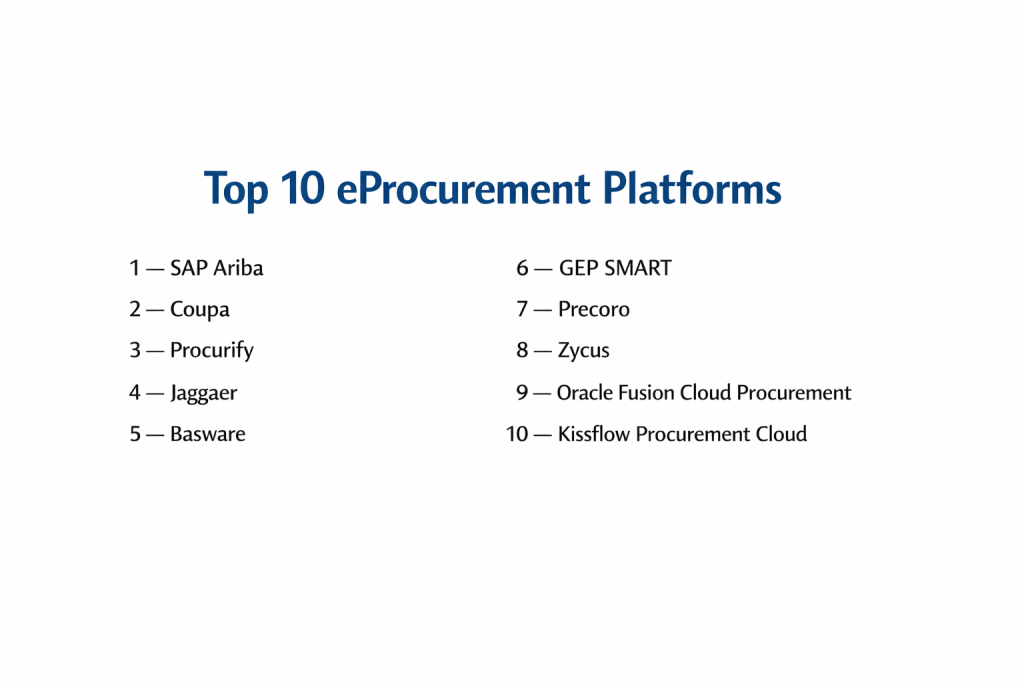
Top 10 eProcurement Platforms
1 — SAP Ariba
SAP Ariba is the enterprise giant, operating the world’s largest B2B trading network. It’s a comprehensive source-to-pay suite designed for large global corporations that need to manage billions in spend across a connected ecosystem of buyers and suppliers.
Key features:
- Global Supplier Network: Access to millions of pre-connected suppliers for frictionless discovery, onboarding, and transaction processing (e-orders, e-invoices).
- End-to-End Process Coverage: Deep modules for strategic sourcing, contract lifecycle management, supplier risk & performance, catalogs, and procure-to-pay.
- Guided Buying with AI: SAP’s “Joule” co-pilot helps users find what they need within policy, while AI automates sourcing events and contract analysis.
- Unified Data & Analytics: A single source of truth for all procurement data, powering advanced spend analysis and predictive insights.
- Supply Chain Collaboration: Tools for collaborative forecasting, inventory management, and logistics coordination with key suppliers.
Pros:
- Unrivaled Network Effect: The sheer scale of its network creates immense efficiency, as many trading partners are already onboarded.
- Enterprise-Grade Depth: Handles extreme complexity, including multi-currency, multi-language, and multi-legal entity requirements out-of-the-box.
Cons:
- High Cost & Complexity: Implementation is a major undertaking, often requiring a small army of consultants and significant internal change management.
- Can Feel Inflexible: The platform’s power and structure can make it feel less agile for businesses seeking rapid, lightweight configuration.
Security & compliance: Enterprise-grade with ISO 27001, SOC 1/2/3, and GDPR compliance. Data is encrypted in transit and at rest, with robust access controls.
Support & community: Tiered support with dedicated enterprise options. A vast global ecosystem of SAP partners and consultants exists for implementation and ongoing support.
2 — Coupa
Coupa is a unified Business Spend Management (BSM) platform celebrated for its consumer-grade user experience and community-driven intelligence. It consolidates procurement, invoicing, expenses, and sourcing into one system focused on driving compliance and savings.
Key features:
- Community Intelligence: Leverages anonymized, aggregated spend data from all customers to provide benchmarks, suggest cost-saving alternatives, and predict price hikes.
- Guided Buying: An intuitive, Amazon-like interface that directs employees to pre-approved suppliers and items, making policy compliance the easiest path.
- AI-Powered Automation (Coupa Advantage): Automates invoice processing, flags expense anomalies, optimizes payment terms, and provides predictive budget insights.
- Unified Platform: A single cloud for procurement, invoicing, expenses, sourcing, contracts, and treasury, ensuring seamless data flow.
- Real-Time Budget & Commitment Tracking: Shows requisitioners and budget owners their available spend in real-time, including pending commitments.
Pros:
- Exceptional User Adoption: Its intuitive design and guided buying lead to high compliance rates, as users are not tempted to bypass a clunky system.
- Tangible, Measurable ROI: The platform is engineered to deliver hard savings through compliance, better sourcing, and early-payment discounts, with clear reporting.
Cons:
- Value-Based Pricing: Its pricing model, often tied to a percentage of managed spend or value delivered, can scale quickly and be perceived as expensive.
- Broad Suite Implementation: Deploying the full BSM suite is a significant project that requires careful data strategy and process redesign.
Security & compliance: SOC 1, SOC 2, ISO 27001 certified. Compliant with GDPR, CCPA, and other global privacy regulations. Offers SSO and granular role-based controls.
Support & community: 24/7 global support with a proactive customer success model. The “Coupa Community” is a major asset for peer learning and best practice sharing.
3 — Procurify
Procurify is a modern, user-centric procure-to-pay platform built for the needs of mid-market and scaling companies. It excels at bringing control and visibility to indirect spend (office supplies, IT, marketing) with a strong emphasis on ease of use and real-time budget enforcement.
Key features:
- Real-Time Budget Guardrails: The system checks purchases against department or project budgets in real-time, preventing orders from being placed if they would cause an overage.
- Streamlined Mobile-First Workflow: Intuitive apps and web interface for creating requests, approvals, and goods receipt from anywhere.
- Integrated Expensing: Automatically syncs approved purchase data to expense reports, eliminating manual entry for employee reimbursements.
- Smart Catalogs & Punch-Out: Easy setup of internal catalogs and connection to supplier punch-out sites for a seamless buying experience.
- Automated Three-Way Matching: Matches purchase orders, packing slips, and invoices automatically to speed up AP processing.
Pros:
- Rapid Time-to-Value: Known for quick, straightforward implementations that deliver clear process improvements and visibility in weeks, not months.
- Unmatched Budget Visibility: Gives budget owners and finance teams a real-time, accurate view of committed vs. actual spend, eliminating budget surprises.
Cons:
- Focused on P2P: While excellent for procurement and spend control, it has lighter native capabilities in advanced strategic sourcing and complex contract management.
- Enterprise Scalability: May require customization or added integrations to support highly complex, multi-national organizational structures with intricate intercompany rules.
Security & compliance: SOC 2 Type II certified, with data encryption and secure cloud hosting. Fully compliant with GDPR and other major privacy frameworks.
Support & community: Highly praised for responsive, helpful customer support. Offers comprehensive online resources and a focus on customer success management.
4 — Jaggaer
Jaggaer is a powerful, modular source-to-pay suite with particular strength in direct materials procurement and complex sourcing. It serves large enterprises in manufacturing, life sciences, and the public sector that require deep functionality for managing production-related spend.
Key features:
- Advanced Direct Material Sourcing: Specialized tools for Bill of Materials (BOM) management, should-cost modeling, and engineering-driven supplier collaboration.
- Supplier Network & Connectivity: The Jaggaer Network facilitates transactional e-commerce, while deep EDI/API integrations support tight supply chain synchronization.
- Modular & Phased Implementation: Organizations can start with standalone modules (e.g., Sourcing, Supplier Management, P2P) and connect them over time.
- Highly Configurable Workflows: Ability to model intricate, industry-specific approval and sourcing processes without heavy coding.
- Integrated Supplier Performance & Risk: Centralized platform for managing supplier qualifications, performance scorecards, and risk monitoring.
Pros:
- Industry-Specific Power: Arguably the strongest solution for manufacturing and engineering-centric procurement where direct material costs are critical.
- Implementation Flexibility: The modular approach allows businesses to tackle their most acute pain point first, spreading cost and change management over time.
Cons:
- Learning Curve: The depth of features, especially in sourcing, can require more extensive training for casual users and procurement professionals alike.
- User Experience: While functional and powerful, the interface has historically been less polished than cloud-native rivals like Coupa, though ongoing updates have improved this.
Security & compliance: Complies with SOC 1/2, ISO 27001, and global data protection laws. Offers dedicated, secure environments for highly regulated industries like government.
Support & community: Enterprise-level global support and access to a network of implementation and strategic consulting partners.
5 — Basware
Basware is a global leader focused on the accounts payable (AP) automation and invoice processing side of the procurement equation. It excels at automating the “pay” in procure-to-pay, particularly for enterprises with high volumes of paper, PDF, and electronic invoices.
Key features:
- Largest Open E-Invoicing Network: Connects buyers to a vast network of suppliers, facilitating seamless, compliant electronic invoice exchange globally.
- AI-Powered Invoice Capture: Advanced machine learning and OCR to automatically extract data from any invoice format with high accuracy, minimizing manual keying.
- Procure-to-Pay Automation: Tightly couples purchasing and invoicing workflows, though its core superpower remains in the invoice-to-pay cycle.
- Compliance & Fraud Prevention: Automated policy checks, duplicate payment prevention, and anomaly detection to protect organizational spend.
- Working Capital Optimization: Tools for dynamic discounting and supply chain finance to improve cash flow.
Pros:
- AP Automation Specialist: Best-in-class for transforming high-volume, complex invoice processing from a cost center into a strategic, automated function.
- Network-Driven Efficiency: Its massive supplier network is a huge asset for driving e-invoicing adoption, which dramatically reduces processing costs and errors.
Cons:
- Perception as an AP Tool: While it has full procurement capabilities, its market reputation is strongest in invoice automation, which can overshadow its P2P strengths.
- Strategic Sourcing Depth: May not offer the same level of sophisticated sourcing and contract lifecycle management as platforms like SAP Ariba or Jaggaer.
Security & compliance: Holds ISO 27001, SOC 1/2/3, and PCI DSS certifications. Compliant with global e-invoicing legal mandates (e.g., CIUS in Europe).
Support & community: Global support services. Its network model creates a unique community focused on standardizing buyer-supplier transactions.
6 — GEP SMART
GEP SMART is a unified, cloud-native procurement platform backed by GEP’s global consulting expertise. It is recognized for its modern, cohesive user experience and comprehensive functionality delivered on a single, integrated codebase.
Key features:
- Unified Cloud-Native Architecture: A single platform for direct and indirect sourcing, procurement, contracts, supplier management, and spend analysis, ensuring seamless data flow.
- Consumer-Grade User Experience: A clean, intuitive interface designed for high adoption across all user types, from casual requesters to procurement experts.
- Advanced Sourcing & Auction Management: Robust tools for RFx, reverse auctions, and total cost of ownership (TCO) analysis.
- Integrated Supplier Management: Centralized hub for supplier information, performance, risk, and collaboration.
- Actionable Intelligence & Reporting: Built-in, configurable dashboards and reports for real-time visibility into savings, compliance, and process efficiency.
Pros:
- Cohesive & Modern Platform: Avoids the “frankenstein” feel of acquired or stitched-together suites, offering a consistent and pleasant user journey.
- Software + Strategic Expertise: The direct link to GEP’s consulting arm provides access to deep procurement transformation knowledge and best practices.
Cons:
- Consulting-Linked Perception: Some may view it primarily as a technology extension of a services firm, though it operates as a standalone product.
- Competitive Market Position: Goes head-to-head with well-established giants, requiring clear articulation of its unified platform advantages.
Security & compliance: Enterprise-grade with SOC 1, SOC 2, and ISO 27001 certifications. Compliant with global data privacy regulations.
Support & community: Clients typically receive support from a dedicated customer success team, integrated within GEP’s broader service delivery model.
7 — Precoro
Precoro is a straightforward, cloud-based procurement and spend management solution for small and mid-sized businesses. It focuses on delivering core procure-to-pay functionality—requisitions, POs, approvals, receiving—with an emphasis on affordability, simplicity, and quick setup.
Key features:
- Intuitive Requisition-to-PO Workflow: Simple, guided process for employees to request items, get approvals, and generate purchase orders.
- Real-Time Budget Tracking: Clear dashboards showing budget vs. actual spend at the department or project level, updated in real-time.
- Vendor & Catalog Management: Maintain a centralized supplier database and create internal catalogs for frequently ordered items.
- Three-Way Match Automation: Streamlines AP workflow by automatically linking POs, delivery receipts, and invoices.
- Essential Reporting: Pre-built reports for spend analysis, vendor performance, and process tracking.
Pros:
- Low Barrier to Entry: Affordable pricing and rapid deployment make it accessible for SMBs beginning their procurement digitalization journey.
- Designed for Non-Procurement Users: The interface is intuitive enough for employees across the organization to use without extensive training.
Cons:
- Limited Advanced Functionality: Lacks deep modules for strategic sourcing, complex contract management, and advanced supplier risk analytics.
- Scalability Ceiling: May not support the needs of large, global enterprises with highly complex, multi-entity procurement structures.
Security & compliance: Uses secure cloud infrastructure with data encryption. GDPR compliant. SMB-focused, so enterprises should verify specific certifications needed.
Support & community: Support offered via email and chat, with a comprehensive knowledge base for self-service problem-solving.
8 — Zycus
Zycus is an AI-powered, end-to-end source-to-pay suite that originated with spend analysis. Its Merlin AI Suite is a core differentiator, embedding artificial intelligence across all procurement processes to automate tasks and uncover insights.
Key features:
- Merlin AI Suite: AI capabilities for autonomous spend classification, contract clause extraction and risk analysis, supplier risk scoring, and chatbot-driven procurement assistance.
- Unified Source-to-Pay Platform: Comprehensive modules covering spend analysis, eSourcing, contract management, supplier management, procurement, and invoice management.
- Cognitive Spend Analysis: Automated data cleansing, enrichment, and classification from disparate ERP systems to provide a single, accurate view of spend.
- Supplier Relationship Management: 360-degree view of suppliers with performance scorecards, risk dashboards, and collaboration tools.
- Configurable Workflows: Flexible process design to align with unique organizational policies and structures.
Pros:
- Deep AI Integration: AI is not a peripheral feature but is woven into the fabric of the platform, aiming to automate complex cognitive tasks.
- Comprehensive, Native Suite: Offers a full range of procurement capabilities on a single, integrated platform, promising good data continuity.
Cons:
- Brand Recognition: While a major player, it may not have the same instant global brand cachet as SAP, Oracle, or Coupa in some markets.
- Implementation Scope: Realizing the full value of its AI and broad suite requires a well-planned implementation with clean, structured data.
Security & compliance: ISO 27001 and SOC 2 Type II certified. Complies with major data privacy regulations. Hosted on secure cloud infrastructure.
Support & community: Provides 24/5 customer support and professional implementation services, supported by a global partner network.
9 — Oracle Fusion Cloud Procurement
Oracle Procurement Cloud is the native eProcurement component of the Oracle Fusion Cloud ERP suite. It is designed for large organizations that run Oracle ERP, offering deep, pre-integrated functionality for sourcing, purchasing, and supplier management.
Key features:
- Native Fusion ERP Integration: Seamless, real-time integration with Oracle Financials, Projects, Inventory, and Supply Chain modules, eliminating data silos and reconciliation.
- End-to-End Process Coverage: Comprehensive capabilities for self-service procurement, strategic sourcing, contracts, supplier qualification, and spend analysis.
- Oracle AI/ML (Embedded AI): Leverages Oracle’s enterprise AI for supplier recommendations, intelligent invoice matching, and predictive analytics.
- Global Compliance & Localization: Built-in support for complex global requirements including multi-currency, tax regimes, and country-specific legal needs.
- Supplier Portal: Enables supplier self-service for profile management, order collaboration, and invoice submission.
Pros:
- Ideal for Oracle-Centric Organizations: For companies standardized on Oracle Fusion, it offers the lowest integration overhead and a unified data model.
- Robust, Enterprise-Scale Platform: Built on Oracle’s secure and scalable cloud infrastructure, designed for performance and reliability.
Cons:
- Ecosystem Dependency: Maximum value is realized within the Oracle ecosystem; integrating with best-of-breed non-Oracle systems adds complexity.
- Implementation Commitment: Typically requires specialized Oracle implementation partners and is a significant project, similar to other enterprise suites.
Security & compliance: Benefits from Oracle Cloud’s industry-leading security certifications (SOC 1/2/3, ISO 27001, PCI DSS). Complies with global privacy standards.
Support & community: Support through Oracle’s global channels. Massive ecosystem of Oracle consultants, user groups (OUG), and online communities.
10 — Kissflow Procurement Cloud
Kissflow Procurement Cloud is a highly customizable, low-code platform built on the Kissflow digital workplace. It’s ideal for businesses with unique, non-standard procurement processes that need a tailored solution without extensive custom development.
Key features:
- Low-Code/No-Code Customization: Visually design and modify forms, workflows, approval chains, and reports to match exact business needs without coding.
- Visual Workflow Builder: Drag-and-drop interface to create complex, conditional, multi-level approval processes.
- Core Procurement Application: Pre-built app covering purchase requisitions, purchase orders, goods receipt, and vendor management.
- Integration Hub: APIs and pre-built connectors to sync data with accounting software, ERP, and other business tools.
- Mobile-First & Responsive: Fully functional on any device, enabling approvals and requests on the go.
Pros:
- Extreme Process Flexibility: Can adapt to virtually any existing or desired procurement workflow, making it perfect for businesses with unique requirements.
- Rapid Prototyping & Iteration: Allows quick building, testing, and refinement of digital procurement processes in an agile manner.
Cons:
- Requires Defined Processes: The “blank canvas” approach means you must have a clear, well-defined process to model; it won’t impose best practices.
- Customization Management: Over-customization can lead to a system that is difficult to maintain, upgrade, or hand over if not carefully documented.
Security & compliance: SOC 2 Type II certified. Features data encryption and granular, role-based access controls. Overall compliance depends on the configured workflows.
Support & community: Standard customer support and an online help center. The broader Kissflow platform community shares workflow templates and ideas.
Comparison Table
| Tool Name | Best For | Platform(s) Supported | Standout Feature | Rating |
|---|---|---|---|---|
| SAP Ariba | Large global corporations needing network-driven scale | Cloud | World’s Largest B2B Trading Network & End-to-End Suite | 4.3/5 |
| Coupa | Organizations prioritizing user adoption & unified spend management | Cloud | Community Intelligence & Consumer-Grade Guided Buying | 4.6/5 |
| Procurify | Mid-market companies focused on intuitive P2P & real-time budget control | Cloud, iOS, Android | Real-Time Budget Guardrails & Fast Implementation | 4.5/5 |
| Jaggaer | Manufacturing & complex direct material sourcing | Cloud | Advanced Direct Material Sourcing & Modular Deployment | 4.4/5 |
| Basware | Enterprises automating high-volume AP & invoice processing | Cloud, Network | AI-Powered Invoice Capture & Large Open E-Invoicing Network | 4.3/5 |
| GEP SMART | Companies seeking a modern unified suite with strategic support | Cloud | Cohesive User Experience & Unified Platform + Consulting | 4.3/5 |
| Precoro | SMBs starting their procurement digitalization journey | Cloud | Simplicity, Affordability, & Quick Time-to-Value | 4.4/5 |
| Zycus | Organizations wanting AI deeply embedded across S2P processes | Cloud | Merlin AI Suite for Autonomous Procurement Tasks | 4.3/5 |
| Oracle Procurement | Enterprises standardized on the Oracle Fusion Cloud ERP suite | Cloud | Deep Native Integration with Oracle ERP/SCM/Financials | 4.2/5 |
| Kissflow | Businesses with unique processes requiring high customization | Cloud | Low-Code/No-Code Customization & Visual Workflow Builder | 4.2/5 |
Evaluation & Scoring of eProcurement Platforms
Use this rubric to assess tools against your specific requirements. Score each category (1-10), multiply by the weight, and sum for a total score.
| Evaluation Category | Weight | What to Look For | Score (1-10) | Weighted Score |
|---|---|---|---|---|
| Core Features | 25% | Does it cover your critical needs (P2P, Sourcing, Contracts, etc.)? Depth in your priority areas? | ||
| Ease of Use | 15% | Intuitive for all users (requester, approver, buyer, admin)? Mobile experience? | ||
| Integrations & Ecosystem | 15% | Pre-built connectors to your ERP/accounting software? Robust API for custom integration? | ||
| Security & Compliance | 10% | Data encryption, access controls, audit logs, and relevant certifications (SOC 2, ISO). | ||
| Performance & Reliability | 10% | System uptime, speed, and ability to handle your user and transaction volume. | ||
| Support & Community | 10% | Quality of onboarding/training, support responsiveness, and available user resources. | ||
| Price / Value | 15% | Total cost of ownership vs. expected ROI (savings, efficiency gains, risk reduction). | ||
| TOTAL SCORE | 100% | / 100 |
Which eProcurement Platform Is Right for You?
- For Small Businesses (SMBs): Start with core control and visibility. Precoro offers the best balance of affordability and essential P2P features. Procurify is a step up for growing companies needing tighter budget integration.
- For Mid-Market Companies: You need scalability and more advanced features without enterprise complexity. Procurify and GEP SMART are excellent choices. Coupa is a strong contender if you’re ready for comprehensive spend management.
- For Large Enterprises: Robustness, global capability, and strategic depth are non-negotiable. SAP Ariba is the network leader. Jaggaer excels in direct materials. Coupa drives compliance through superior UX. Oracle Procurement is the default for Oracle ERP shops.
- For AP/Invoice Automation Focus: If transforming the accounts payable function is the primary driver, Basware is the specialist leader.
- For Unique or Non-Standard Processes: If your process doesn’t fit a standard mold, Kissflow offers the customization needed without full custom development.
Best-of-Breed vs. Unified Suite: A best-of-breed approach (e.g., using Jaggaer for sourcing and Basware for invoicing) can offer deeper functionality but creates integration challenges. A unified suite (Coupa, GEP SMART, Zycus) offers a seamless experience with potentially less depth in niche areas.
Cloud-Native vs. Established Giants: Cloud-native platforms (Coupa, Procurify, GEP SMART) often boast better UX, faster innovation cycles, and easier upgrades. Established giants (SAP Ariba, Oracle) offer immense scale, deep functionality, and strong incumbent relationships.
Frequently Asked Questions (FAQs)
1. What’s the difference between eProcurement and a simple purchasing module in my accounting software?
eProcurement is a strategic, process-centric platform managing the full cycle (request, approve, order, receive, pay) with workflow, supplier management, and analytics. An accounting purchasing module is typically a transactional tool for creating POs and tracking payables, with limited process control and spend visibility.
2. How do we ensure employees actually use the new platform instead of going around it?
Drive adoption through executive mandate, clear communication of benefits, and, most critically, choosing an intuitive platform with guided buying. If the approved path is easier than the rogue path, compliance follows. Training and super-users are also key.
3. Can eProcurement handle services procurement (consultants, contractors, temp labor)?
Yes, advanced platforms have specific modules or features for Services Procurement or Statement of Work (SOW) Management. These help define project scope, manage contractor milestones, track time, and control spending on non-goods.
4. What is “punch-out” and how does it work?
Punch-out allows a user to “click out” from the eProcurement platform directly to a supplier’s own e-commerce website. They shop in a familiar environment, and their cart contents are seamlessly brought back into the procurement system as a requisition, complete with contracted pricing.
5. How important is supplier onboarding in an eProcurement project?
Critically important. The platform’s value is limited if your key suppliers aren’t connected electronically. Choose a platform with a strong supplier network (like Ariba or Basware) or robust supplier portal tools to simplify and incentivize onboarding.
6. What are the typical implementation costs beyond software licensing?
Significant costs include implementation partner fees, data migration, integration development, change management/training, and potential customization. For enterprise suites, these services can often exceed the initial software license cost.
7. How does eProcurement help with sustainability (ESG) goals?
It provides data to track spend with diverse or local suppliers, monitor supplier sustainability ratings, and enforce policies favoring eco-friendly products. This turns procurement into a lever for achieving corporate ESG targets.
8. Can we start with just one module (like eSourcing) and expand later?
Yes, with modular platforms like Jaggaer, Zycus, or Coupa. This “phased implementation” reduces upfront cost and change management complexity, allowing you to prove value before expanding.
9. What is a common mistake companies make during implementation?
Lifting and shifting a broken manual process into a digital system. Use implementation as an opportunity to re-engineer and simplify processes before automating them. Also, neglecting data cleanliness (vendor master, item catalog) will cripple the system.
10. What’s the first step in selecting a platform?
Conduct an internal diagnostic. Analyze 3-6 months of spend data to identify top categories and suppliers. Map your current purchasing process and pinpoint pain points (delays, maverick spend). This creates a fact-based requirements list for vendor evaluations.
Conclusion
The world of eProcurement offers a powerful solution for every stage of organizational growth, from the streamlined control of Precoro for SMBs to the networked dominance of SAP Ariba for global enterprises. The optimal choice is not the highest-rated platform in a vacuum, but the one that most precisely aligns with your organization’s strategic priorities, operational complexity, and technological landscape.
Successful digital procurement transformation hinges on viewing the platform not as an IT project, but as a catalyst for cultural and process change. Its ultimate value is unlocked through clean data, strong executive sponsorship, and a relentless focus on user adoption. By carefully selecting a platform whose strengths match your defined needs, you invest in a system that does more than process orders—it provides the visibility, control, and intelligence to turn procurement from a cost center into a verifiable source of competitive advantage and value creation.

- Top 10 Email Deliverability Tools: Features, Pros, Cons & Comparison - September 6, 2026
- Top 10 Pharmacovigilance Software: Features, Pros, Cons & Comparison - September 6, 2026
- Top 10 Manufacturing Execution Systems (MES) - July 30, 2026