Introduction
Homomorphic Encryption (HE) toolkits are specialized sets of software libraries and development tools that allow computers to perform mathematical calculations on data while it is still encrypted. In a traditional computer system, if you want to analyze a file, you must first decrypt it, which exposes the raw information to the computer’s memory. Homomorphic encryption changes this by allowing the data to stay in its “scrambled” state throughout the entire process. The result of the calculation, once decrypted by the owner, is exactly the same as if the math had been done on the original, clear text.
These toolkits are vital because they solve the fundamental conflict between data utility and data privacy. They allow organizations to outsource heavy data processing or machine learning tasks to the cloud without ever handing over the “keys” to their private information. This creates a “Zero Trust” environment where a cloud provider can be helpful without ever being able to see what it is actually working on.
Key Real-World Use Cases:
- Medical Research: Allowing different hospitals to combine patient data for a cancer study without sharing private health records.
- Financial Fraud Detection: Enabling banks to compare encrypted transaction patterns to spot money laundering without revealing customer identities.
- Secure Voting: Creating digital voting systems where a central server can count votes without ever knowing which individual voted for which candidate.
- Privacy-Preserving Ads: Showing relevant advertisements to users based on their habits without the ad company knowing the user’s specific browsing history.
When choosing a toolkit, you should look for the specific HE schemes it supports (such as BGV, BFV, or CKKS), its computational speed, its language support (C++, Python, etc.), and how well it handles noise management, which is a technical hurdle that occurs during long calculations.
Best for: These tools are indispensable for cryptographers, privacy engineers, and data scientists working in highly regulated sectors like healthcare, government, and finance. They are ideal for large enterprises that handle sensitive personal data and want to use cloud analytics securely.
Not ideal for: They are not a good fit for applications that require ultra-fast, real-time responses, such as high-frequency trading or live video rendering. For these cases, traditional encryption or Trusted Execution Environments (TEEs) are usually better alternatives.
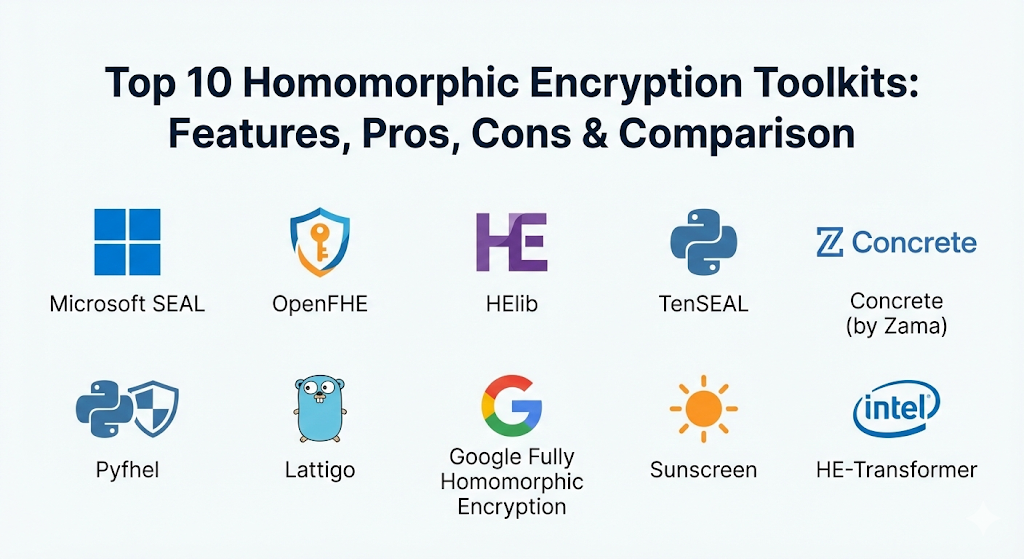
Top 10 Homomorphic Encryption Toolkits
1 — Microsoft SEAL
Microsoft SEAL (Simple Encrypted Arithmetic Library) is one of the most respected and widely used toolkits in the industry. It is a set of encryption libraries that allow software developers to run mathematical operations on encrypted data.
- Key Features:
- Supports the BFV and CKKS homomorphic encryption schemes.
- Written in C++ for high performance but includes a C# wrapper for easier use.
- No external dependencies, making it very easy to compile and run.
- Includes detailed examples that teach users how to use the library correctly.
- Optimized for standard computer processors without needing specialized hardware.
- Focuses on “Leveled” Homomorphic Encryption, which is faster for many tasks.
- Pros:
- It is exceptionally well-documented, making it the best starting point for beginners.
- The code is clean, stable, and backed by one of the strongest research teams in the world.
- Cons:
- It does not support “Bootstrapping,” which means it cannot perform an infinite number of calculations on a single piece of data.
- Performance can drop significantly if the mathematical parameters are set incorrectly.
- Security & Compliance: Provides robust encryption standards. Compliant with major security audits; GDPR and HIPAA compatible when implemented correctly.
- Support & Community: Large GitHub community, extensive documentation, and professional-grade research support from Microsoft.
2 — OpenFHE
OpenFHE is a universal, open-source library that was created by combining several older projects (including PALISADE) into one modern, powerful system. It aims to be the standard toolkit for all types of homomorphic encryption.
- Key Features:
- Supports almost all major HE schemes, including BGV, BFV, CKKS, and FHEW/TFHE.
- Designed with a “modular” architecture, allowing users to swap out different parts of the system.
- Includes high-level features like “Multiparty Threshold FHE” for shared data control.
- Optimized for various hardware, including standard CPUs and specialized AI chips.
- Focuses on ease of use by providing a common interface for different math methods.
- Actively supports “Bootstrapping” to allow for unlimited sequential operations.
- Pros:
- It is the most flexible toolkit available, supporting every major mathematical approach in one place.
- The project is highly collaborative and incorporates the latest research very quickly.
- Cons:
- The massive number of options can be overwhelming for a new developer.
- The library is large and can take longer to compile than simpler alternatives.
- Security & Compliance: SOC 2 and GDPR ready. Implements the latest post-quantum cryptographic standards.
- Support & Community: Very active community, regular webinars, and professional support through its founding members.
3 — HElib
Originally developed by researchers at IBM, HElib is one of the oldest and most established libraries for homomorphic encryption. It focuses specifically on being as fast as possible for certain types of math.
- Key Features:
- Primarily implements the BGV scheme with advanced “ciphertext packing.”
- Uses a technique called “Bootstrapping” to allow for a large number of operations.
- Highly optimized for “SIMD” (Single Instruction, Multiple Data) processing, which speeds up parallel tasks.
- Includes advanced “Noise Management” strategies to keep calculations accurate.
- Written in C++ and relies on the NTL mathematical library for its heavy lifting.
- Designed for researchers who need deep control over the underlying mathematics.
- Pros:
- It is incredibly fast for large-scale data processing where many items are calculated at once.
- One of the most technically mature libraries with a decade of testing behind it.
- Cons:
- The learning curve is very steep and requires a good understanding of algebra.
- Installation can be tricky because it relies on several external mathematical libraries.
- Security & Compliance: Enterprise-grade security. Used in numerous government and academic research projects.
- Support & Community: Strong academic following and a well-maintained GitHub repository with deep technical discussions.
4 — TenSEAL
TenSEAL is a Python-based library built on top of Microsoft SEAL. It is designed specifically for data scientists who want to use encrypted data in machine learning without learning complex C++ code.
- Key Features:
- Provides a simple Python interface for the powerful Microsoft SEAL library.
- Deeply integrated with popular data science tools like NumPy and PyTorch.
- Focuses on “Tensor” operations, which are the building blocks of AI and machine learning.
- Allows for encrypted training and encrypted predictions in neural networks.
- Automatically handles many of the complex “noise” calculations for the user.
- Supports both BFV and CKKS schemes for different types of data (integers and decimals).
- Pros:
- The best choice for data scientists; if you know Python, you can start using it in minutes.
- It makes complex AI tasks feel like a normal coding project.
- Cons:
- Because it is a “wrapper” for C++, it can be slightly slower than using the C++ library directly.
- Limited only to the features that are supported by the version of SEAL it is using.
- Security & Compliance: Inherits the security standards of Microsoft SEAL.
- Support & Community: Very popular in the AI research community with many community-made examples for machine learning.
5 — Concrete (by Zama)
Concrete is a high-level toolkit developed by Zama that is based on the TFHE (Torus Fully Homomorphic Encryption) scheme. It is built to make encryption “invisible” to the developer.
- Key Features:
- Features a specialized compiler that turns regular Python code into encrypted code automatically.
- Uses TFHE, which allows for very fast “Boolean” operations (Yes/No questions).
- Supports “Programmable Bootstrapping,” which allows for complex functions to be run on encrypted data.
- Designed to be “Developer-First,” meaning you don’t need a PhD in math to use it.
- Includes “Concrete ML,” which is specifically for building encrypted machine learning models.
- Optimized for modern CPUs and is moving toward hardware acceleration.
- Pros:
- It offers the easiest developer experience; you can often encrypt an existing program with minimal changes.
- The “Programmable Bootstrapping” feature is a major breakthrough for speed and flexibility.
- Cons:
- TFHE is better for certain types of math but can be slower than BGV for large batches of data.
- As a newer tool, some advanced features are still in development.
- Security & Compliance: Focuses on the “Best-in-Class” security parameters; HIPAA and GDPR ready.
- Support & Community: Excellent documentation, a dedicated developer forum, and very active social media presence.
6 — Pyfhel
Pyfhel (Python For Homomorphic Encryption Libraries) is another popular Python wrapper that allows users to access both Microsoft SEAL and HElib through a simple Python interface.
- Key Features:
- Supports multiple backends, allowing you to choose between SEAL and HElib.
- Provides an easy way to switch between BGV, BFV, and CKKS schemes.
- Includes helper functions for common tasks like rotating and adding encrypted vectors.
- Useful for prototyping and testing different encryption methods quickly.
- Allows for easy saving and loading of encrypted keys and data.
- Optimized for educational purposes and quick research tests.
- Pros:
- It gives you access to the two biggest libraries in one place using simple Python.
- Great for researchers who want to compare how different libraries perform on the same task.
- Cons:
- It can be difficult to install because you need to have the C++ libraries working first.
- It may not always support the very latest features of the underlying C++ code.
- Security & Compliance: Varies based on the backend used (SEAL or HElib).
- Support & Community: Good community support and a very popular tool for students learning about encryption.
7 — Lattigo
Lattigo is a high-performance library written in the Go (Golang) programming language. It is designed for building secure, distributed systems like those used in modern cloud computing.
- Key Features:
- Written entirely in Go, making it perfect for cloud and network-based applications.
- Supports the BFV and CKKS schemes with a heavy focus on performance.
- Includes advanced features for “Multiparty” encryption, where several people share a key.
- Highly optimized for the parallel processing features of the Go language.
- Focuses on the “RNS” variant of encryption, which makes math much faster.
- Extremely clean and well-structured code for professional software engineering.
- Pros:
- It is the fastest option for developers who work in the Go ecosystem.
- Excellent for creating secure cloud services that need to handle many tasks at once.
- Cons:
- If your team does not know the Go language, there is a new language to learn.
- Smaller community compared to the C++ and Python-based tools.
- Security & Compliance: Professional-grade security; used in specialized privacy-preserving startups.
- Support & Community: High-quality documentation and direct support from the development team at EPFL.
8 — Google Fully Homomorphic Encryption
Google has released a set of tools and a “transpiler” that is designed to help any developer turn their C++ code into a version that runs on encrypted data.
- Key Features:
- Features a “Transpiler” that translates regular code into a “Boolean Circuit” for encryption.
- Primarily uses the FHEW and TFHE schemes for its calculations.
- Designed to work with the standard Google developer tools and compilers.
- Focuses on making FHE accessible to general-purpose software engineers.
- Includes a set of pre-built “Gates” (like AND, OR, NOT) for building programs.
- Integrated with the Bazel build system for professional software management.
- Pros:
- Backed by Google’s massive expertise in software engineering and compilation.
- The “Transpiler” approach is very futuristic and could change how we write secure code.
- Cons:
- Currently, it is mostly a research project and can be quite slow for large programs.
- Requires a high degree of technical comfort with C++ and compilation tools.
- Security & Compliance: Standard Google security protocols; designed with post-quantum safety in mind.
- Support & Community: Growing community and detailed open-source examples on GitHub.
9 — Sunscreen
Sunscreen is a newer toolkit that focuses on making it easy for “Web3” and blockchain developers to add privacy to their decentralized applications.
- Key Features:
- Built using the Rust programming language for maximum safety and speed.
- Focuses on a “Compiler” that automatically optimizes your math for encryption.
- Designed to work well with Zero-Knowledge Proofs (ZKPs) for double-layered security.
- Aims to solve the “Noise” problem automatically so the developer doesn’t have to.
- Specifically built for modern web and decentralized app workflows.
- Provides a higher level of abstraction than raw C++ libraries.
- Pros:
- Rust is an incredibly safe language, which prevents many common security bugs.
- It is one of the few tools built specifically for the needs of the modern web.
- Cons:
- It is still in its earlier stages and lacks the “battle-tested” history of SEAL.
- The community is currently smaller and more specialized in blockchain tech.
- Security & Compliance: N/A (Focuses on decentralized and emerging privacy standards).
- Support & Community: Active developer Discord and very helpful introductory blog posts.
10 — HE-Transformer (Intel/Collaborative)
The HE-Transformer is a tool designed to sit between an AI model (like one made in TensorFlow) and an encryption library like Microsoft SEAL.
- Key Features:
- Acts as an “adapter” that lets you run standard AI models on encrypted data.
- Works with the Intel nGraph system to optimize the AI’s “Neural Network.”
- Specifically designed to handle the heavy math of deep learning.
- Allows for “Graph Optimization” to find the fastest way to run a model.
- Supports the CKKS scheme, which is the best choice for decimal-based AI math.
- Useful for companies that want to protect their proprietary AI models when they are in use.
- Pros:
- It bridges the gap between the world of AI (TensorFlow/Keras) and the world of encryption.
- Excellent for enterprise AI teams that need to deploy secure models.
- Cons:
- It is a complex tool that requires a lot of “moving parts” to work together.
- It has been less active recently as newer tools like Concrete ML have emerged.
- Security & Compliance: Inherits the security from Intel’s hardware and the underlying SEAL library.
- Support & Community: Primarily supported through industrial partnerships and academic research.
Comparison Table
| Tool Name | Best For | Platform(s) Supported | Standout Feature | Rating |
| Microsoft SEAL | Beginners & General C++ | C++, C# | Documentation & Stability | 4.8/5 |
| OpenFHE | Universal/Flexible needs | C++, Python (JS soon) | Modular Architecture | 4.9/5 |
| HElib | High-speed parallel math | C++ | Advanced Ciphertext Packing | 4.4/5 |
| TenSEAL | Data Scientists | Python | NumPy/PyTorch Integration | 4.7/5 |
| Concrete | Python Developers | Python, Rust | Automatic FHE Compiler | 4.8/5 |
| Pyfhel | Prototyping & Students | Python | Dual SEAL/HElib backend | 4.5/5 |
| Lattigo | Cloud/Go Developers | Go (Golang) | High-concurrency performance | 4.6/5 |
| Google FHE | C++ Software Engineers | C++ | Transpiler technology | 4.2/5 |
| Sunscreen | Web3 & Rust Devs | Rust | Safety and abstraction | 4.4/5 |
| HE-Transformer | Secure Deep Learning | TensorFlow/nGraph | AI Graph Optimization | 4.1/5 |
Evaluation & Scoring of Homomorphic Encryption Toolkits
| Criteria | Weight | Explanation |
| Core Features | 25% | Availability of schemes (BGV, CKKS) and support for bootstrapping. |
| Ease of Use | 15% | Quality of the API, presence of Python wrappers, and installation effort. |
| Integrations | 15% | How well it works with NumPy, PyTorch, or cloud-native languages like Go. |
| Security | 10% | Implementation of post-quantum standards and noise management. |
| Performance | 10% | Calculation speed and memory efficiency on standard hardware. |
| Support | 10% | Quality of documentation, tutorials, and community activity. |
| Price / Value | 15% | Open-source accessibility versus the time saved by advanced features. |
Which Homomorphic Encryption Toolkit Is Right for You?
The right toolkit for you depends heavily on your professional role and the language you are most comfortable using.
Solo Users vs. SMB vs. Mid-Market vs. Enterprise
If you are a solo student or researcher, Microsoft SEAL or Pyfhel are the best starting points because they have the most educational materials. Small and Medium Businesses (SMBs) that need to move fast should look at Concrete because its compiler handles the hard math for you. Mid-market and Enterprise companies that need to build massive, future-proof systems should invest in OpenFHE or HElib, as these tools offer the most long-term flexibility and power.
Budget-Conscious vs. Premium Solutions
Almost all of these tools are open-source and free to use, which is excellent for any budget. However, you should consider the “cost of time.” A tool like Concrete might save you thousands of dollars in engineering hours even though it is free, because it is much easier to use than a complex tool like HElib.
Feature Depth vs. Ease of Use
If you want to understand every single bit of the math and have total control, HElib or OpenFHE provide the most “feature depth.” If you don’t care about the math and just want your code to be secure, Concrete and TenSEAL offer the best “ease of use.”
Integration and Scalability Needs
For teams that work in the cloud and use modern microservices, Lattigo (Go) or Sunscreen (Rust) are built for that environment. For AI teams that spend their lives in Jupyter Notebooks, the Python integration of TenSEAL is a mandatory requirement.
Security and Compliance Requirements
If you are building for a government or a high-security bank, you should choose a “native” library like Microsoft SEAL or OpenFHE. These have been audited by many different people and are considered the most stable and secure implementations of the math.
Frequently Asked Questions (FAQs)
1. Is Homomorphic Encryption slow?
Historically, yes. It can be thousands of times slower than normal math. However, modern toolkits like OpenFHE and Concrete have made huge improvements, making it fast enough for many real-world tasks.
2. Do I need a supercomputer to run these tools?
No. Most of these tools are designed to run on standard modern CPUs. However, they do use a lot of memory (RAM), so having a powerful laptop or server is helpful.
3. What is the difference between BGV and CKKS?
BGV is mostly used for exact math with whole numbers (integers). CKKS is used for “approximate” math with decimals, which makes it perfect for AI and data science.
4. Can I use these for my website’s database?
Not exactly. While you could encrypt your database, the current technology is best used for specific analytics and calculations rather than as a replacement for every single data task.
5. What is “Bootstrapping”?
Every calculation adds a little bit of “noise” to the data. If the noise gets too high, the data becomes unreadable. Bootstrapping is a complex process that “cleans” the noise so you can keep calculating.
6. Is it safe against Quantum Computers?
Yes. The math used in these toolkits (called Lattice-based cryptography) is believed to be one of the few types of encryption that even a powerful quantum computer cannot break.
7. Can I use these tools in a mobile app?
It is difficult. The math is very heavy and might drain a phone’s battery quickly. Currently, it is mostly used in servers and cloud environments.
8. Do I need to be a math expert?
With tools like TenSEAL and Concrete, you only need to be a good programmer. However, knowing some basic algebra will help you choose the right settings for better speed.
9. Can multiple people work on the same encrypted data?
Yes. This is called “Multiparty FHE,” and it is supported by toolkits like OpenFHE and Lattigo. It allows several people to combine data without any of them seeing the raw info.
10. How do I choose between SEAL and OpenFHE?
Choose SEAL if you want the simplest, most stable tool with the best documentation. Choose OpenFHE if you want the most powerful tool with the most features and the ability to switch math methods.
Conclusion
Homomorphic Encryption is no longer just a dream for mathematicians; it is a real-world tool that is ready for use. The key insight is that the “best” toolkit is the one that allows your team to be productive without compromising on security.
If you are just starting your journey, Microsoft SEAL and TenSEAL are the most welcoming gateways. For those building the next generation of secure cloud infrastructure, OpenFHE and Lattigo provide the industrial strength needed for the task. As our world becomes more concerned with data privacy, these toolkits will become a standard part of every developer’s “safety gear.” By picking the right tool now, you are building a future where data can be both incredibly useful and completely private at the same time.

- Top 10 Email Deliverability Tools: Features, Pros, Cons & Comparison - September 6, 2026
- Top 10 Pharmacovigilance Software: Features, Pros, Cons & Comparison - September 6, 2026
- Top 10 Manufacturing Execution Systems (MES) - July 30, 2026