Introduction
Integrated Circuit (IC) Design & Verification Tools are specialized software platforms used to design, simulate, validate, and verify complex semiconductor chips before they are manufactured. These tools support the full chip lifecycle, from logic design and functional verification to physical implementation and sign-off. As modern chips power everything from smartphones and automobiles to data centers and AI systems, the role of these tools has become critical.
IC design and verification are important because even a small design error can lead to costly silicon re-spins, delayed product launches, and financial losses. With chips becoming smaller, faster, and more complex, manual checking is no longer possible. Advanced tools help engineers catch errors early, optimize performance, ensure reliability, and meet strict timing, power, and area constraints.
Real-world use cases include processor design, memory chips, system-on-chip (SoC) development, automotive safety systems, networking hardware, and AI accelerators. When choosing IC Design & Verification Tools, users should evaluate accuracy, scalability, simulation speed, ease of integration, support for modern design flows, and the strength of verification methodologies.
Best for:
IC Design & Verification Tools are best suited for semiconductor companies, chip startups, research labs, hardware engineers, verification engineers, and system architects working on digital, analog, or mixed-signal designs across industries like consumer electronics, automotive, aerospace, telecom, and AI.
Not ideal for:
These tools may not be ideal for software-only teams, early-stage learners without hardware background, or small projects where simple schematic tools or academic simulators are sufficient.
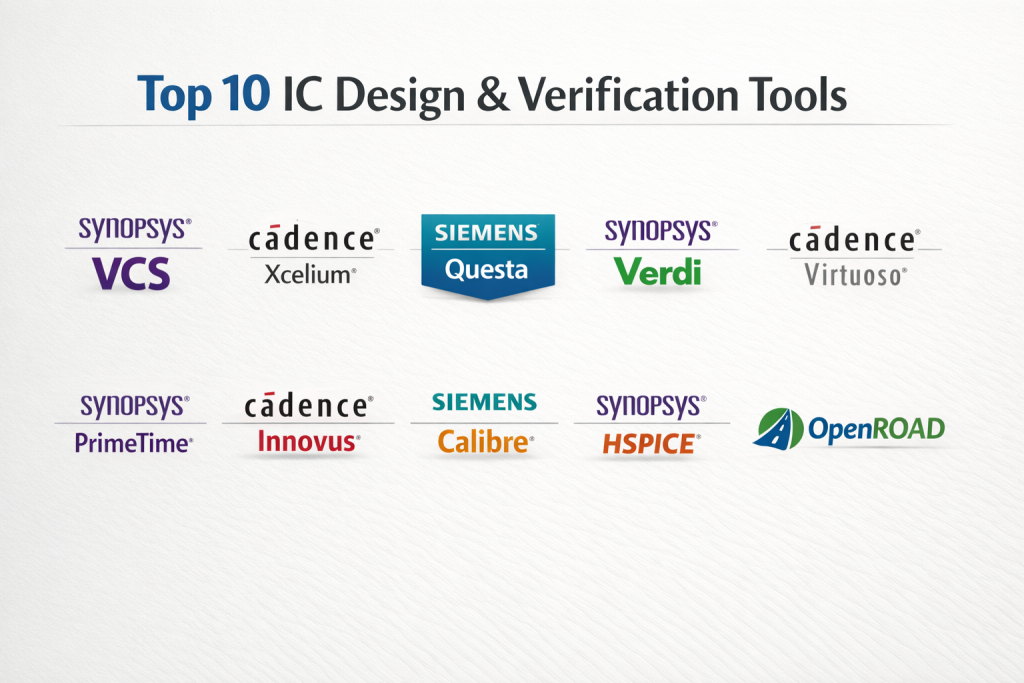
Top 10 IC Design & Verification Tools
1 — Synopsys VCS
Short description:
Synopsys VCS is a high-performance simulation and verification tool designed for large-scale digital and SoC verification.
Key features:
- High-speed SystemVerilog simulation
- Advanced debug and waveform analysis
- Support for UVM methodologies
- Scalable for large SoC designs
- Strong integration with EDA ecosystems
- Formal verification support
Pros:
- Extremely fast simulation performance
- Widely adopted in enterprise environments
Cons:
- Steep learning curve
- Premium pricing
Security & compliance:
Enterprise-grade access controls, encryption support, varies by deployment.
Support & community:
Extensive documentation, enterprise support, strong professional user base.
2 — Cadence Xcelium
Short description:
Cadence Xcelium is a unified simulation platform optimized for functional verification and coverage-driven testing.
Key features:
- Unified simulation kernel
- Advanced coverage analysis
- UVM and SystemVerilog support
- Parallel simulation capabilities
- Debug and visualization tools
Pros:
- Excellent verification coverage
- Strong ecosystem integration
Cons:
- Resource intensive
- Requires experienced users
Security & compliance:
Varies / N/A depending on environment.
Support & community:
Strong enterprise documentation and professional support.
3 — Siemens Questa
Short description:
Siemens Questa is a comprehensive verification platform focused on functional correctness and design reliability.
Key features:
- Advanced simulation and debug
- Formal verification tools
- Coverage-driven verification
- Mixed-signal verification support
- Scalable enterprise deployment
Pros:
- High accuracy and reliability
- Strong verification methodologies
Cons:
- High cost
- Complex setup
Security & compliance:
Enterprise security features, audit support varies.
Support & community:
Robust documentation and enterprise-level assistance.
4 — Synopsys Verdi
Short description:
Synopsys Verdi is a powerful debug and analysis tool designed to complement simulation environments.
Key features:
- Advanced waveform visualization
- RTL and gate-level debug
- Cross-probe capabilities
- Design exploration tools
- Seamless simulator integration
Pros:
- Excellent debugging productivity
- Intuitive visual tools
Cons:
- Dependent on simulation tools
- Licensing complexity
Security & compliance:
Varies / N/A.
Support & community:
Strong professional support and documentation.
5 — Cadence Virtuoso
Short description:
Cadence Virtuoso is an industry-standard platform for analog and mixed-signal IC design and verification.
Key features:
- Schematic and layout design
- Analog simulation support
- Physical verification
- Parasitic extraction
- Custom IC design workflows
Pros:
- Best-in-class analog design
- Highly customizable
Cons:
- Complex interface
- Long learning curve
Security & compliance:
Enterprise-level security, varies by setup.
Support & community:
Large professional user community and strong vendor support.
6 — Synopsys PrimeTime
Short description:
PrimeTime is a sign-off timing analysis tool ensuring accurate performance verification of IC designs.
Key features:
- Static timing analysis
- Power and noise analysis
- Sign-off accuracy
- Multi-corner analysis
- Large design scalability
Pros:
- Industry-trusted sign-off results
- Highly accurate timing models
Cons:
- Specialized use case
- Expensive licensing
Security & compliance:
Varies / N/A.
Support & community:
Professional documentation and enterprise support.
7 — Cadence Innovus
Short description:
Cadence Innovus is a digital implementation platform focused on place-and-route and physical optimization.
Key features:
- Advanced place and route
- Power optimization
- Timing-driven design
- Physical verification integration
- Scalable SoC support
Pros:
- Strong physical design results
- Excellent performance optimization
Cons:
- Resource heavy
- Requires physical design expertise
Security & compliance:
Varies / N/A.
Support & community:
Enterprise support and extensive training materials.
8 — Siemens Calibre
Short description:
Siemens Calibre is a physical verification and sign-off tool used for DRC, LVS, and mask verification.
Key features:
- Design rule checking
- Layout vs schematic verification
- Mask verification
- Foundry-certified flows
- High-accuracy sign-off
Pros:
- Industry-standard verification
- Foundry trusted
Cons:
- Narrow focus
- High cost
Security & compliance:
Enterprise-grade security controls.
Support & community:
Strong vendor documentation and enterprise users.
9 — Synopsys HSPICE
Short description:
HSPICE is a high-accuracy circuit simulator for analog, RF, and mixed-signal designs.
Key features:
- Transistor-level simulation
- High accuracy models
- Mixed-signal support
- Power and noise analysis
- Industry-validated results
Pros:
- Extremely accurate simulation
- Trusted by foundries
Cons:
- Slower for large designs
- Requires expertise
Security & compliance:
Varies / N/A.
Support & community:
Professional documentation and expert support.
10 — OpenROAD
Short description:
OpenROAD is an open-source digital IC design flow aimed at automation and accessibility.
Key features:
- End-to-end RTL-to-GDS flow
- Open-source ecosystem
- Academic and research friendly
- Scriptable automation
- Growing community
Pros:
- Cost-effective
- Transparent workflows
Cons:
- Limited enterprise features
- Smaller support ecosystem
Security & compliance:
N/A.
Support & community:
Active open-source community and documentation.
Comparison Table
| Tool Name | Best For | Platform(s) Supported | Standout Feature | Rating |
|---|---|---|---|---|
| Synopsys VCS | Large SoC verification | Linux | High-speed simulation | N/A |
| Cadence Xcelium | Functional verification | Linux | Unified simulation | N/A |
| Siemens Questa | Formal verification | Linux, Windows | Coverage accuracy | N/A |
| Synopsys Verdi | Debug & analysis | Linux | Advanced waveform debug | N/A |
| Cadence Virtuoso | Analog IC design | Linux | Custom IC workflows | N/A |
| Synopsys PrimeTime | Timing sign-off | Linux | Sign-off accuracy | N/A |
| Cadence Innovus | Physical design | Linux | Place-and-route optimization | N/A |
| Siemens Calibre | Physical verification | Linux | Foundry-certified checks | N/A |
| Synopsys HSPICE | Circuit simulation | Linux | Transistor-level accuracy | N/A |
| OpenROAD | Open-source flows | Linux | End-to-end automation | N/A |
Evaluation & Scoring of IC Design & Verification Tools
| Criteria | Weight | Evaluation Summary |
|---|---|---|
| Core features | 25% | Depth of design and verification capabilities |
| Ease of use | 15% | UI, learning curve, usability |
| Integrations & ecosystem | 15% | Compatibility with EDA flows |
| Security & compliance | 10% | Enterprise readiness |
| Performance & reliability | 10% | Speed and accuracy |
| Support & community | 10% | Documentation and help |
| Price / value | 15% | Cost versus features |
Which IC Design & Verification Tool Is Right for You?
Solo users and students may prefer open-source or academic tools due to cost and simplicity. SMBs often balance cost and functionality, while enterprises prioritize scalability, accuracy, and sign-off reliability.
Budget-conscious teams may focus on open or limited-license tools, while premium solutions suit mission-critical chip development. Users must balance feature depth against ease of use, especially for teams with varying skill levels. Integration with existing workflows, scalability for future designs, and security requirements are key decision factors.
Frequently Asked Questions (FAQs)
1. What are IC Design & Verification Tools?
They are software platforms used to design, simulate, verify, and validate integrated circuits before manufacturing.
2. Why is verification important in IC design?
Verification helps catch functional and timing errors early, preventing costly silicon re-spins.
3. Are these tools only for large companies?
While widely used by enterprises, some tools are suitable for startups and research labs.
4. Do these tools support modern design languages?
Yes, most support SystemVerilog, UVM, and industry-standard formats.
5. Are open-source tools reliable for production?
They are improving rapidly but may lack full sign-off and enterprise support.
6. How long does it take to learn these tools?
Learning time varies from weeks to months depending on complexity and experience.
7. Are these tools expensive?
Enterprise tools are costly, but pricing varies by licensing and usage.
8. Do these tools handle analog and digital designs?
Some tools specialize in digital, others in analog or mixed-signal designs.
9. What is sign-off verification?
It ensures the final design meets timing, power, and manufacturing rules.
10. Can one tool handle the entire IC flow?
Typically, multiple tools are combined to cover the full design lifecycle.
Conclusion
IC Design & Verification Tools play a vital role in modern semiconductor development. They ensure correctness, performance, and manufacturability of complex chips. When choosing a tool, focus on accuracy, scalability, integration, and support rather than popularity alone. There is no single best solution for everyone—the right choice depends on project size, budget, expertise, and long-term goals.

- Top 10 Email Deliverability Tools: Features, Pros, Cons & Comparison - September 6, 2026
- Top 10 Pharmacovigilance Software: Features, Pros, Cons & Comparison - September 6, 2026
- Top 10 Manufacturing Execution Systems (MES) - July 30, 2026