Introduction
Last-mile delivery is the final, and often most complex, leg of the supply chain—transporting a package from a local distribution hub directly to the end customer’s doorstep. Last-mile delivery platforms are specialized software solutions that orchestrate this entire process. They connect retailers, restaurants, and logistics providers with delivery fleets (both internal and external) while providing complete visibility and control over deliveries from dispatch to proof of delivery.
Its importance cannot be overstated, as it is the only physical touchpoint a customer has with an online order. An efficient last-mile operation is critical for controlling skyrocketing delivery costs, which can account for over 50% of total shipping expenses. More importantly, it directly drives customer loyalty and retention; fast, reliable, and communicative delivery experiences are now a standard expectation, not a luxury.
Real-world use cases span from a local restaurant using an on-demand platform to fulfill food orders, to a national retail chain leveraging a sophisticated platform to manage same-day deliveries from its stores, to a 3PL (third-party logistics) company building a dedicated delivery network for multiple clients. When choosing a platform, you should evaluate its dispatch automation, real-time tracking and ETAs, driver management tools, seamless customer communication, proof of delivery capabilities, and robust analytics. The ability to integrate with your e-commerce stack, point-of-sale (POS) system, and warehouse management software is also essential.
Best for: These platforms are indispensable for e-commerce retailers, restaurants and grocery delivery services, courier and logistics companies, and traditional retailers offering omnichannel fulfillment like “buy online, pick up in store” (BOPIS) or “ship from store.” Key roles that benefit include Operations Directors, Logistics Managers, Delivery Coordinators, and business owners scaling their direct-to-consumer delivery.
Not ideal for: Businesses that only ship via national carriers (USPS, FedEx, UPS) for standard 2-5 day delivery may not need a dedicated last-mile platform. Similarly, companies with very low delivery volume (a handful of packages per week) might find the cost prohibitive, relying instead on manual coordination or basic carrier services.
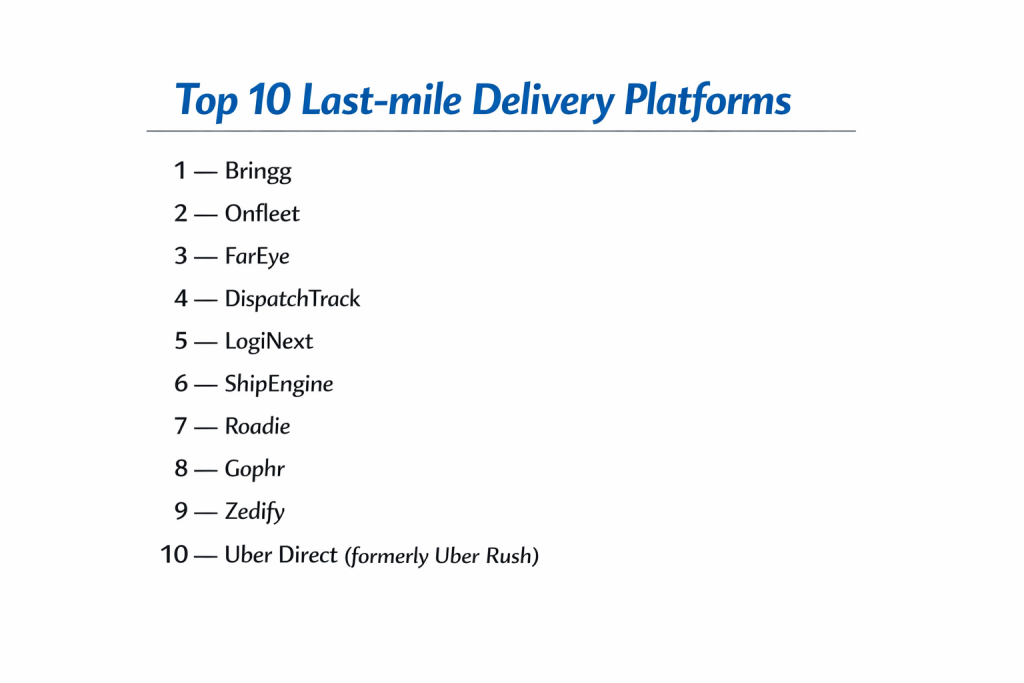
Top 10 Last-mile Delivery Platforms
1 — Bringg
Bringg is an enterprise-grade delivery orchestration platform that acts as a central “command center” for managing multiple delivery fleets, services, and carriers in one place. It’s designed for large retailers and logistics providers who need to optimize complex, high-volume delivery operations.
Key features:
- Multi-Carrier & Fleet Orchestration: Intelligently routes orders to the best-performing carrier (internal fleet, gig drivers, 3PL) based on cost, service level, and capacity.
- Advanced Delivery Experience Management: Provides customizable, branded tracking pages, real-time SMS/email notifications, and delivery windows for customers.
- Real-Time Visibility & Analytics: Offers a live control tower view of all deliveries with predictive ETAs and deep performance dashboards.
- Configuration-Driven Workflows: Highly customizable to match unique business rules without heavy coding, using a low-code approach.
- Extensive Ecosystem Integrations: Pre-built connectors for major e-commerce platforms (Salesforce Commerce Cloud, Shopify Plus), ERP, and WMS systems.
Pros:
- Unmatched Orchestration Power: Exceptional at managing hybrid delivery models (using both private and crowdsourced fleets) for maximum flexibility and cost efficiency.
- Enterprise Scalability & Customization: Built to handle the complexity and volume of large global retailers with highly configurable workflows.
Cons:
- Enterprise Pricing: The platform’s power comes with a premium price tag, placing it out of reach for most small and mid-sized businesses.
- Implementation Complexity: The high degree of configurability can lead to longer and more involved implementation projects.
Security & compliance: Enterprise-grade security with SOC 2 Type II certification, GDPR compliance, and data encryption at rest and in transit. Offers robust access controls and audit logs.
Support & community: Provides dedicated enterprise customer success managers, 24/7 technical support, and comprehensive documentation. Its ecosystem includes a network of implementation partners.
2 — Onfleet
Onfleet is a modern, API-first delivery management platform known for its excellent user experience and developer-friendly design. It’s a top choice for tech-savvy businesses, especially in on-demand delivery (food, groceries, retail), that need a reliable and customizable operational core.
Key features:
- Developer-Friendly API: A robust, well-documented API allows for deep customization and seamless integration into complex tech stacks.
- Real-Time Management Dashboard: An intuitive, data-rich dashboard for live tracking, driver management, and task dispatching.
- Automated Customer Communications: Proactively sends customers SMS/email notifications with live tracking links and accurate ETAs.
- Proof of Delivery Suite: Drivers can collect signatures, take photos, scan barcodes, and add notes directly within the mobile app.
- Performance Analytics: Tracks key metrics like driver efficiency, task completion times, and customer satisfaction in real-time and historically.
Pros:
- Best-in-Class User Experience: Clean, intuitive interfaces for both dispatchers and drivers lead to rapid adoption and minimal training.
- Unrivaled Integration Flexibility: Ideal for businesses that need to embed delivery logistics deeply into their own applications or connect with a wide array of third-party tools.
Cons:
- Cost for Simpler Needs: The premium features and API-centric model can be over-engineered and expensive for operations with straightforward, non-technical delivery needs.
- Limited Built-in Carrier Network: Primarily focused on managing your own or a contracted fleet, rather than providing a built-in marketplace of gig drivers.
Security & compliance: Compliant with SOC 2, GDPR, and CCPA. Data is encrypted, and the platform offers SSO (Single Sign-On) for enterprise customers. Security is a core focus.
Support & community: Offers high-quality technical support and dedicated developer relations. Extensive API documentation and an active community of technical users.
3 — FarEye
FarEye is an intelligent delivery orchestration platform that emphasizes predictive logistics and visibility. It leverages data and machine learning to optimize not just the last mile, but middle-mile and first-mile logistics as well, making it suitable for end-to-end supply chain visibility.
Key features:
- Predictive Logistics Engine: Uses AI/ML to forecast delivery times more accurately, predict potential delays, and recommend optimal routes and resources.
- Dynamic Route Optimization: Real-time optimization that considers traffic, weather, driver availability, and delivery priorities.
- Digital Proof of Delivery & Claims: Comprehensive POD options (signature, photo, OTP) with tools to manage delivery exceptions and claims digitally.
- Carrier Management & Collaboration: Tools to onboard, manage, and collaborate with a network of third-party carriers, including performance scorecards.
- Customer Experience Portal: Provides branded tracking, customizable notifications, and a platform for feedback and returns.
Pros:
- Strong Predictive Capabilities: Its focus on forecasting and pre-empting issues helps businesses move from reactive to proactive delivery management.
- Comprehensive Visibility: Offers a holistic view of the supply chain, which is valuable for businesses managing complex, multi-stage logistics.
Cons:
- Can Be Feature-Overwhelming: The breadth of features covering first, middle, and last mile can make the platform seem complex for companies focused solely on the final delivery leg.
- Global Focus with Regional Nuances: While strong globally, implementation may require careful configuration to address highly specific regional delivery challenges.
Security & compliance: Adheres to global standards including ISO 27001, GDPR, and SOC 2. Employs enterprise-grade data security and privacy practices.
Support & community: Provides global support with regional teams. Offers implementation services and has a partner network for consulting and integration.
4 — DispatchTrack
DispatchTrack is a robust platform with a strong heritage in scheduled and appointment-based delivery, particularly for bulky goods, furniture, and large appliances. It excels in managing complex deliveries that require precise time windows and specialized handling.
Key features:
- Sophisticated Appointment Scheduling: Advanced algorithms for booking, managing, and optimizing routes around precise customer time windows (e.g., 2-hour slots).
- Route Optimization for Large Fleets: Handles complex constraints like driver skills, vehicle types (box trucks, flatbeds), load capacity, and job duration.
- Digital Delivery Workflows: Mobile app guides drivers through multi-step delivery processes, including assembly, installation, and haul-away.
- Customer Communication Automation: Automated notifications for scheduling, pre-delivery reminders, and real-time ETA alerts.
- B2B & B2C Capabilities: Supports both business-to-business (pallet deliveries) and business-to-consumer (white glove home delivery) models.
Pros:
- Industry Leader for Scheduled Delivery: Unmatched depth for businesses where the delivery is an appointment-based service, not just a drop-off.
- Handles Extreme Complexity: Built to manage the intricate requirements of big & bulky delivery, including multi-person crews and job-specific instructions.
Cons:
- Less Focused on Instant, On-Demand Delivery: While capable, its core strength is not in the 30-minute food or grocery delivery space.
- Pricing Structure: Can be opaque and is generally tailored for mid-market and enterprise clients, with less transparent SMB pricing.
Security & compliance: SOC 2 compliant, with data encryption and adherence to privacy regulations. Security features are designed to meet enterprise requirements.
Support & community: Known for strong customer support and success teams. Offers detailed training resources and has an established user base in retail and distribution.
5 — LogiNext
LogiNext is a cloud-automated platform that leverages artificial intelligence and real-time data to optimize field service and delivery logistics. It is particularly strong in markets like Asia and the Middle East and serves a wide range of industries from e-commerce to banking (cash logistics).
Key features:
- AI-Driven Automation: Uses machine learning for intelligent auto-dispatch, dynamic route optimization, and predictive delay alerts.
- Real-Time Tracking & Visibility: Live tracking on an interactive map, with geofencing and live traffic integration for accurate ETAs.
- Configurable Delivery Workflows: Allows businesses to model unique delivery processes, including cash-on-delivery (COD) management, which is crucial in many markets.
- Compliance & Audit Management: Tools to ensure regulatory and safety compliance for drivers, including digital logbooks and vehicle checks.
- Scalable Architecture: Built to handle massive volumes of tracking data and transactions for large enterprises.
Pros:
- Powerful AI & Automation: Reduces manual dispatching work significantly and continuously learns to improve route and resource efficiency.
- Strong in Emerging Markets: Features like robust COD handling and adaptability to local logistics challenges make it a standout choice in regions like Southeast Asia and India.
Cons:
- Global Presence Varies: While growing, its support and market understanding may be deeper in its core regions than in North America or Western Europe.
- Interface Design: Some users note that the platform’s interface prioritizes functionality over modern design aesthetics.
Security & compliance: Compliant with ISO 27001, GDPR, and other regional data protection regulations. Employs high-grade encryption and security protocols.
Support & community: Provides 24/7 global support. Has a large client base and offers dedicated implementation managers for enterprise customers.
6 — ShipEngine (by Auctane)
ShipEngine is not a traditional last-mile platform but a multi-carrier shipping API. It is a fundamental building block for developers at e-commerce companies who need to compare rates, purchase labels, and track packages across hundreds of carriers, including last-mile specialists.
Key features:
- Unified Multi-Carrier API: A single integration point to connect with over 100 pre-negotiated carriers worldwide, including USPS, FedEx, UPS, DHL, and regional last-mile carriers.
- Real-Time Rate Shopping: Compares delivery costs and speeds across all connected carriers at checkout or in the backend.
- Shipping Label Generation & Management: Creates labels, manifests, and customs documents digitally.
- Consolidated Tracking: Provides unified tracking statuses from all carriers through one API or dashboard.
- Address Validation & Serviceability: Verifies addresses and checks which carriers can deliver to a given location.
Pros:
- Unmatched Carrier Choice & Flexibility: Provides the widest possible network of delivery options through one simple integration.
- Developer-Centric Design: A well-documented, reliable API that empowers businesses to build a completely custom shipping and delivery front-end.
Cons:
- Not a Full Delivery Management Suite: Lits built-in dispatch, driver management, or real-time delivery tracking tools. It’s an API for accessing carriers, not managing a fleet.
- Requires Technical Resources: To leverage its full potential, a company needs in-house development capacity to build the surrounding logistics application.
Security & compliance: As part of Auctane, it adheres to stringent security standards. Data is encrypted, and the platform is designed to handle sensitive shipping information securely.
Support & community: Offers strong technical support for developers, including detailed API documentation, SDKs, and an active developer community.
7 — Roadie
Roadie is a crowdsourced delivery platform that leverages unused space in vehicles already on the road. It’s an “on-the-way” delivery service ideal for businesses needing to send same-day, non-standard sized items (like a suitcase or a piece of furniture) over short to medium distances.
Key features:
- Crowdsourced Driver Network: A vast network of casual drivers (Roadies) who are already planning a trip and can carry items, offering scalable capacity.
- Non-Standard Item Support: Specializes in shipping items that don’t fit in standard boxes—up to 100+ pounds and 12 feet long.
- Real-Time Matching & Tracking: Algorithm matches shipments with drivers headed in the right direction. Provides real-time tracking for senders and recipients.
- Simple Sender Platform: Easy-to-use web and mobile interface for booking a delivery, with upfront pricing.
- Insurance & Security: Every delivery is backed by insurance, and all drivers undergo background checks.
Pros:
- Unique Solution for Odd-Sized Goods: Solves a major pain point for retailers and individuals needing to send large, awkward items affordably and quickly.
- Utilizes Excess Capacity: An asset-light, sustainable model that makes use of trips already being taken.
Cons:
- Not for Scheduled or High-Volume Routines: Less predictable than a dedicated fleet; better for one-off or ad-hoc deliveries than managing daily, scheduled routes.
- Geographic Coverage Variability: Driver availability is dependent on existing travel patterns, so coverage can be less consistent in rural areas versus major metro routes.
Security & compliance: Conducts driver background checks and provides insurance coverage for each shipment. Data practices comply with standard privacy regulations.
Support & community: Offers customer support for senders and recipients. The model relies on a community of drivers rather than a traditional employee base.
8 — Gophr
Gophr is a UK-focused, API-driven same-day courier platform. It aggregates vetted local courier companies into a single network, providing businesses with reliable, trackable, and scalable same-day delivery services primarily in major UK cities.
Key features:
- Network of Professional Couriers: Partners with established, licensed courier companies rather than gig economy individuals, aiming for higher reliability and service quality.
- Real-Time Booking & Tracking: Instant quotes, one-click booking via API or dashboard, and live GPS tracking for every delivery.
- Flexible Delivery Options: Offers a range of services from instant (within 2 hours) to pre-scheduled same-day and even next-day delivery.
- Comprehensive API: Allows e-commerce businesses to integrate same-day delivery as a seamless option at checkout.
- Focus on Security & Compliance: All partner couriers are insured, and the platform handles VAT and compliance.
Pros:
- High-Quality, Reliable Network: The curated model using professional couriers often results in more consistent service than purely crowdsourced alternatives.
- Strong UK Coverage & Expertise: Deeply tailored to the logistics and regulatory environment of the United Kingdom, particularly in urban centers.
Cons:
- Geographically Limited: Currently focused on the UK market, making it irrelevant for businesses operating in North America, Europe, or APAC.
- Price Point: Can be more expensive than purely crowdsourced options due to the use of professional courier firms.
Security & compliance: Partners are fully insured and compliant with UK courier regulations. The platform itself employs standard data encryption and security practices.
Support & community: Provides customer support for delivery issues. As an API-first platform, it also offers technical support for integration partners.
9 — Zedify
Zedify is a zero-emission, micro-fulfillment last-mile platform operating in UK cities. It combines a network of urban micro-depots with cargo-bike and electric-vehicle fleets to provide sustainable, same-day delivery for businesses.
Key features:
- Zero-Emission Delivery Network: Core fleet consists of electric cargo bikes and vehicles, offering a carbon-neutral delivery option.
- Urban Micro-Fulfillment Model: Uses small, strategically located hubs in city centers to enable ultra-fast local deliveries.
- Tailored for Urban Logistics: Designed to bypass traffic congestion and low-emission zones, ensuring reliable times in dense urban areas.
- B2B and B2C Services: Delivers for a range of clients, from local retailers to large enterprises needing sustainable urban logistics.
- Technology Platform for Routing: Uses proprietary software to optimize routes for its unique zero-emission fleet.
Pros:
- Market Leader in Sustainable Delivery: The most compelling solution for brands whose environmental, social, and governance (ESG) goals are a top priority.
- Highly Efficient in Cities: Often faster and more reliable than traditional vans in congested urban centers due to use of bikes and micro-hubs.
Cons:
- Very Niche Geographic Coverage: Only available in select UK cities where the network is built out.
- Potential Cost Premium: Sustainable, specialized operations can come at a higher cost per delivery compared to standard van-based services.
Security & compliance: Operates with full insurance for goods in transit. As a specialized operator, it manages compliance with local urban logistics regulations.
Support & community: Provides direct account management and support to its business clients, fostering a partnership approach.
10 — Uber Direct (formerly Uber Rush)
Uber Direct is the B2B delivery arm of Uber, providing access to the vast Uber driver network for scheduled and on-demand deliveries. It allows businesses to offer reliable, tracked delivery to their customers using a familiar technology infrastructure.
Key features:
- Access to Uber’s Driver Network: Tap into the massive, on-demand pool of Uber drivers for instant delivery capacity scaling.
- Real-Time Tracking & Notifications: Provides the same tracking experience as an Uber ride, with live maps and ETA updates for businesses and end-customers.
- Simple Integration: Offers APIs and pre-built plugins for major e-commerce platforms to enable delivery at checkout.
- Variety of Service Tiers: Options range from on-demand (within an hour) to scheduled deliveries for later in the day.
- Branded Experience: Can be presented as the business’s own delivery service, with white-label tracking.
Pros:
- Instant, Massive Scalability: Unbeatable for handling demand spikes (like during promotions or holidays) without investing in fleet.
- Reliable Technology & Familiar UX: Leverages Uber’s proven, reliable app ecosystem, which is familiar to most consumers.
Cons:
- Less Control Over Delivery Experience: The driver is an independent contractor, which can lead to variability in service quality and handling compared to a managed fleet.
- Primarily for Parcels, Not Specialized Goods: Best suited for standard packages (food, retail goods). Not designed for bulky items, white-glove service, or complex B2B deliveries.
Security & compliance: Leverages Uber’s overall platform security, data encryption, and insurance policies. Driver background checks are standard.
Support & community: Support is provided through Uber’s business channels. Being part of a giant platform means resources are vast but can sometimes feel less personalized.
Comparison Table
| Tool Name | Best For | Platform(s) Supported | Standout Feature | Rating |
|---|---|---|---|---|
| Bringg | Large enterprises with complex, multi-carrier delivery operations | Cloud, iOS, Android | Enterprise-Grade Delivery Orchestration & Optimization | 4.5/5 |
| Onfleet | Tech-savvy companies needing a customizable delivery management core | Cloud, iOS, Android | Best-in-Class API & Exceptional User Experience | 4.6/5 |
| FarEye | Businesses wanting predictive analytics and end-to-end supply chain visibility | Cloud, iOS, Android | AI-Powered Predictive Logistics Engine | 4.4/5 |
| DispatchTrack | Scheduled, appointment-based delivery (big & bulky, furniture, appliances) | Cloud, iOS, Android | Sophisticated Appointment Scheduling & White-Glove Workflows | 4.5/5 |
| LogiNext | AI-driven automation, with strong capabilities in emerging markets | Cloud, iOS, Android | Powerful AI for Auto-Dispatch & Market-Specific Features (e.g., COD) | 4.3/5 |
| ShipEngine | Developers needing API access to a vast network of shipping carriers | API (Cloud) | Unified API for 100+ Carriers (Global Rate Shopping & Labels) | N/A |
| Roadie | Sending same-day, oversized, or unconventional items | Web, iOS, Android | Crowdsourced “On-the-Way” Network for Non-Standard Items | 4.2/5 |
| Gophr | Reliable, professional same-day courier services in the UK | API, Web, iOS, Android | Curated Network of Professional Courier Companies (UK Focus) | 4.3/5 |
| Zedify | Sustainable, zero-emission last-mile delivery in urban UK centers | Web, API | Zero-Emission Cargo Bike & EV Fleet with Urban Micro-Hubs | N/A |
| Uber Direct | Businesses needing instant scalability via a gig-economy driver network | API, Web Integrations | Instant Access to Uber’s Massive On-Demand Driver Network | 4.1/5 |
Evaluation & Scoring of Last-mile Delivery Platforms
Use this rubric to objectively score platforms based on your business needs. Assign a score (1-10) for each category, multiply by the weight, and sum for a total.
| Evaluation Category | Weight | What to Look For | Score (1-10) | Weighted Score |
|---|---|---|---|---|
| Core Features | 25% | Does it have your must-haves (dispatch, tracking, POD, customer alerts, etc.)? | ||
| Ease of Use | 15% | Intuitive for dispatchers and drivers? Easy for customers to track? | ||
| Integrations & Ecosystem | 15% | Connects to your e-commerce platform, POS, ERP, or WMS? API availability? | ||
| Security & Compliance | 10% | Data encryption, access controls, and relevant certifications (SOC 2, GDPR, etc.). | ||
| Performance & Reliability | 10% | Platform uptime, accuracy of ETAs, and consistency of the delivery network. | ||
| Support & Community | 10% | Quality of onboarding, support responsiveness, and available resources. | ||
| Price / Value | 15% | Total cost (subscription, per-delivery fees) relative to features and ROI. | ||
| TOTAL SCORE | 100% | / 100 |
Which Last-mile Delivery Platform Is Right for You?
- For Solo Users & Very Small Businesses (Startups, Small Restaurants): You need simplicity and low commitment. Uber Direct offers plug-and-play scalability. Roadie is perfect for occasional, oversized items. Avoid heavy enterprise platforms.
- For Small to Medium-Sized Businesses (Growing E-commerce, Retailers): Prioritize ease of use and clear ROI. Onfleet is excellent if you manage your own fleet. Gophr (in the UK) provides reliable outsourced couriers. DispatchTrack is the choice if you sell large, scheduled-delivery items.
- For Mid-Market to Enterprise: You need robustness, scalability, and deep functionality. Bringg and FarEye are top contenders for complex orchestration. LogiNext is powerful for AI automation and specific regional needs. The choice hinges on whether you need multi-carrier orchestration (Bringg), predictive analytics (FarEye), or deep automation (LogiNext).
- For Businesses Prioritizing Sustainability: Your choice may be driven by ESG goals. Zedify is the pioneer for green urban delivery in its operating cities, though coverage is limited.
- For Developers Building Custom Logistics: If you have a tech team building a unique delivery experience, ShipEngine provides the essential carrier API foundation, while Onfleet offers the best fleet management API to build upon.
Build Your Own Fleet vs. Leverage a Network: Decide if you want to manage (Onfleet, Bringg) or access (Uber Direct, Gophr, Roadie). Managing offers more control and brand consistency; accessing offers instant scale and lower upfront cost.
Feature Depth vs. Ease of Use: Be realistic about your team’s operational maturity. A powerful platform is worthless if it’s too complex to use effectively. Often, a simpler tool that gets fully adopted is better than a powerful one that doesn’t.
Frequently Asked Questions (FAQs)
1. What’s the difference between a last-mile platform and a standard courier?
A platform is software you use to manage or access delivery services. A courier (like FedEx) is a service provider. Platforms can help you manage your own fleet, connect you to multiple couriers, or give you access to a network of drivers.
2. How much does it typically cost?
Cost models vary: SaaS subscription fees (e.g., $200/month for SMB plans), per-delivery/transaction fees (common with networks like Uber Direct), or enterprise custom pricing. Total cost includes integration, training, and any carrier fees.
3. Can these platforms handle returns and reverse logistics?
Yes, most modern platforms have dedicated features for returns management. This includes generating return labels, scheduling pickups from customers, routing returns to the correct facility, and tracking the return status.
4. How important is real-time tracking for customers?
Extremely important. Proactive, accurate tracking is now a baseline expectation. It drastically reduces “where is my order?” (WISMO) customer service inquiries and increases satisfaction. Look for platforms that offer branded tracking pages and automated ETA alerts.
5. What is “Proof of Delivery” (POD) and why does it matter?
POD is digital evidence a delivery was completed. This can be a signature, photo, barcode scan, or OTP verification. It is crucial for resolving disputes, confirming service completion (especially for B2B), and ensuring accountability.
6. Can I integrate this with my online store?
Absolutely. This is a key feature. Most platforms offer pre-built plugins for major e-commerce platforms (Shopify, WooCommerce, Magento) and/or a flexible API for custom integration, allowing delivery options to appear automatically at checkout.
7. How do I handle customer communication about delays?
Leading platforms have automated exception management. They can detect delays (via traffic data or driver input) and automatically send proactive apology messages with updated ETAs to customers, turning a negative experience into a managed one.
8. What’s a common mistake when starting with last-mile delivery?
Underestimating operational complexity. Simply having the software doesn’t guarantee success. You need clear processes for exception handling, driver management, and customer service. Start with a pilot in one city or region before scaling.
9. Are these platforms suitable for international delivery?
Some, like Bringg and FarEye, are built for global operations. Others, like Gophr or Zedify, are region-specific. For international shipping, you often need a platform that integrates with global carriers, which ShipEngine excels at.
10. What’s the first step in choosing a platform?
Audit your current delivery process. Document your average daily volume, peak volumes, delivery areas, customer promises (same-day, 2-hour, next-day), and any special requirements (temperature control, assembly). Use this list as your requirement checklist during demos.
Conclusion
The landscape of last-mile delivery platforms is diverse, with solutions ranging from sophisticated enterprise orchestration engines like Bringg to agile, API-first managers like Onfleet and accessible network enablers like Uber Direct. The “best” platform is not a universal winner but the one that most precisely aligns with your operational model, scale, technical capability, and strategic priorities.
The critical factor for success is moving beyond viewing delivery as a mere cost center. The right platform transforms it into a strategic lever for customer experience, brand loyalty, and operational agility. Invest time in clearly defining your requirements and constraints. Use the evaluation framework to compare options objectively, and never underestimate the importance of a smooth driver and dispatcher experience. In the race to the customer’s doorstep, the right technology partner isn’t just about speed—it’s about intelligence, visibility, and seamless execution.

- Top 10 Email Deliverability Tools: Features, Pros, Cons & Comparison - September 6, 2026
- Top 10 Pharmacovigilance Software: Features, Pros, Cons & Comparison - September 6, 2026
- Top 10 Manufacturing Execution Systems (MES) - July 30, 2026
This is a very insightful comparison for anyone evaluating last‑mile delivery solutions in 2025. The breakdown of features like intelligent route optimization, real‑time tracking, proof of delivery, and driver management captures the core capabilities businesses must consider today — especially as customer expectations for speedy, transparent delivery skyrocket. Last‑mile delivery platforms aren’t just tools for dispatching drivers; they’re strategic systems that improve efficiency, reduce operational costs, and enhance customer satisfaction by leveraging analytics, automation, and seamless integrations with existing systems. For logistics leaders, e‑commerce operators, and fleet managers alike, this kind of detailed pros/cons analysis is invaluable in choosing the right solution that scales with growth and adapts to complex delivery environments.