Introduction
In the high-stakes world of public safety, the ability to organize, track, and analyze information can mean the difference between a stalled investigation and a successful prosecution. Law Enforcement Case Management (LECM) software is a specialized digital ecosystem designed to replace the cluttered filing cabinets and disconnected spreadsheets of the past. These systems centralize incident reports, digital evidence, suspect profiles, and forensic data into a single, searchable digital case file.
The importance of these tools lies in their ability to ensure a secure chain of custody and enhance inter-departmental collaboration. In a modern legal environment, documentation must be “court-ready”—meaning every update, access point, and piece of evidence must be logged with an immutable audit trail. Key real-world use cases include managing complex criminal investigations, tracking internal affairs (IA) complaints, and preparing digital “discovery” packets for prosecutors. When evaluating a tool, users should prioritize CJIS (Criminal Justice Information Services) compliance, ease of mobile data entry, and the ability to integrate seamlessly with existing Records Management Systems (RMS) and Computer-Aided Dispatch (CAD) platforms.
- Best for: Detective bureaus, specialized task forces (narcotics, ICAC), internal affairs units, and medium-to-large police departments that require rigorous documentation and evidence tracking.
- Not ideal for: Small agencies with extremely low case volumes that can manage with basic RMS modules, or private security firms that do not need to adhere to strict federal criminal justice data standards.
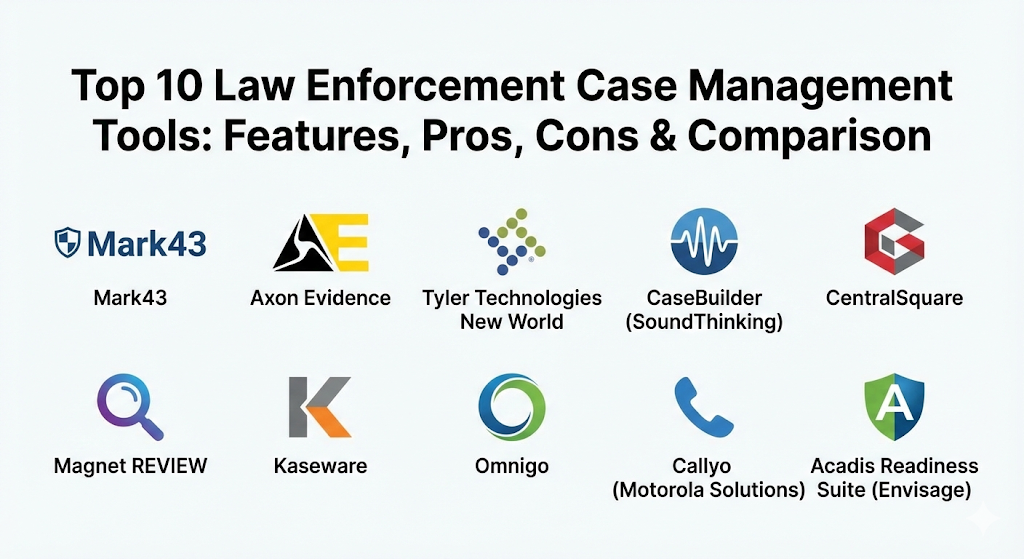
Top 10 Law Enforcement Case Management Tools
1 — Mark43 Case Management
Mark43 is a cloud-native platform that focuses on speed and user experience. It is designed to reduce the “administrative tax” on officers by making report writing and case updates as intuitive as using a modern consumer app.
- Key features:
- Dynamic case folders that automatically pull data from incident reports.
- Integrated property and evidence management for a seamless chain of custody.
- Advanced NIBRS (National Incident-Based Reporting System) compliance checking.
- Open API architecture for easy integration with third-party forensics tools.
- Mobile-first design for real-time updates from the field.
- Collaborative tasking and resource assignment modules.
- Pros:
- Significantly reduces report writing time (often by 50% or more).
- Extremely modern, clean interface that requires minimal training.
- Cons:
- Higher price point compared to legacy on-premise systems.
- Dependent on a stable internet connection for full cloud functionality.
- Security & compliance: CJIS compliant, AWS GovCloud hosted, end-to-end encryption, and multi-factor authentication (MFA).
- Support & community: 24/7/365 US-based technical support, dedicated customer success managers, and a regionalized implementation team.
2 — Axon Evidence (formerly Evidence.com)
Axon Evidence is the industry leader in digital evidence management (DEMS), but it has evolved into a full-scale investigation and case management suite. It excels at linking body-worn camera footage directly to specific case files.
- Key features:
- Unified storage for video, audio, photos, and document files.
- AI-powered auto-transcription and redaction tools.
- “Draft One” feature which uses AI to draft reports based on body cam audio.
- Public evidence submission portal for community tips.
- Direct sharing links for prosecutors and defense attorneys.
- Pros:
- Unrivaled integration with body cameras and TASER devices.
- Automates the most tedious parts of evidence review (like redaction).
- Cons:
- Storage costs can scale rapidly as video resolution increases.
- The interface can feel overwhelming due to the sheer number of features.
- Security & compliance: SOC 2, ISO 27001, HIPAA, GDPR, and FedRAMP authorized.
- Support & community: Massive global user community, extensive online documentation, and “Axon Academy” training modules.
3 — Tyler Technologies New World Case Management
New World is a comprehensive suite built for agencies that want “one source of truth” across their entire operation, from the moment a 911 call comes in to the final court disposition.
- Key features:
- Seamless “Dispatch-to-Disposition” workflow.
- Integrated court and justice system modules.
- Master indices for People, Vehicles, and Locations across the jurisdiction.
- Advanced crime mapping and trend analysis.
- Automated workflow notifications for supervisors.
- Pros:
- Incredible data depth; information entered once flows through the whole system.
- Highly stable and reliable for large-scale municipal deployments.
- Cons:
- The user interface feels “legacy” compared to cloud-native competitors.
- Updates and customizations can be slow and expensive.
- Security & compliance: CJIS compliant, role-based access controls, and full audit logging.
- Support & community: 24/7 support with a large North American user base and annual user conferences.
4 — CaseBuilder (SoundThinking)
Formerly known as ShotSpotter CaseBuilder, this tool is specifically engineered to improve clearance rates for violent crimes. It treats every investigation like a project, providing detectives with a structured roadmap.
- Key features:
- Pre-configured and customizable investigation checklists.
- “Link analysis” to detect hidden relationships between suspects and locations.
- Automated case chronology and timeline generation.
- Integration with acoustic gunshot detection data.
- Supervisor dashboards to monitor unit-wide caseloads.
- Pros:
- Exceptional at helping detectives organize complex, multi-lead cases.
- Includes tools specifically designed for prosecutor hand-off.
- Cons:
- Narrower focus on investigations; less robust for general patrol “records.”
- Best used alongside an RMS rather than as a total replacement.
- Security & compliance: CJIS compliant, secure cloud hosting, and granular permission sets.
- Support & community: 24/7/365 customer support with a focus on investigative best practices.
5 — CentralSquare Public Safety Enterprise
CentralSquare offers a powerhouse suite designed for high-volume operations. It is a “force multiplier” that prioritizes real-time data sharing between agencies and jurisdictions.
- Key features:
- Multi-jurisdictional data sharing (Enterprise Bridge).
- Integrated Jail Management (JMS) and Records (RMS).
- Mobile reporting for tablets and smartphones.
- Field-based reporting with offline capabilities.
- Advanced situational awareness tools for commanders.
- Pros:
- Scale; it can handle the data loads of the largest agencies in the country.
- Strong interoperability between different public safety branches.
- Cons:
- Implementation can be a long-term (multi-year) commitment.
- System complexity requires dedicated internal IT support.
- Security & compliance: CJIS compliant, encryption at rest and in transit, and robust audit trails.
- Support & community: Extensive customer portal, local user groups, and comprehensive onboarding.
6 — Magnet REVIEW
Magnet REVIEW is a collaborative platform designed specifically for the digital forensic age. It allows investigators—even non-technical ones—to review digital evidence from phones and computers securely.
- Key features:
- Web-based evidence review (no special software needed for detectives).
- Consolidates evidence from Axiom, Cellebrite, and other forensic tools.
- Real-time collaboration with tags and comments.
- Automated report generation for digital findings.
- “Magnet One” integration for workflow automation.
- Pros:
- Eliminates the need to pass physical USB drives or hard drives between units.
- Allows non-forensic detectives to easily search through vast amounts of phone data.
- Cons:
- Focused specifically on digital evidence; not a general case management tool.
- Requires other Magnet tools for the best experience.
- Security & compliance: ISO 27001, SOC 2, and secure browser-based access with MFA.
- Support & community: Highly technical support, active forensics community, and “Magnet Forensics” certification programs.
7 — Kaseware
Kaseware was founded by former FBI agents who built the system they wished they had in the field. It combines case management with advanced intelligence and link analysis tools.
- Key features:
- Integrated Link Analysis (visualizing suspect networks).
- Geospatial mapping and analysis.
- Social media and open-source intelligence integration.
- Automated investigative workflows and task management.
- Customizable forms and data entry fields.
- Pros:
- Powerful analytics that help “connect the dots” in complex cases.
- Highly secure, built with national intelligence standards in mind.
- Cons:
- Steeper learning curve due to advanced intelligence features.
- May be “overkill” for small departments with simple cases.
- Security & compliance: FedRAMP, CJIS, and SOC 2 Type II compliant.
- Support & community: Professional onboarding and high-touch support for investigative units.
8 — Omnigo
Omnigo provides a versatile platform that serves not only traditional law enforcement but also campus security and healthcare environments. It is known for its accessibility and incident reporting.
- Key features:
- Integrated CAD and RMS for streamlined data flow.
- Evidence and property management modules.
- Clery Act reporting for campus safety compliance.
- Customizable incident dashboards.
- Mobile access for field-based security officers.
- Pros:
- Cost-effective for smaller departments and private security.
- Excellent for generating compliance-driven reports (like Clery).
- Cons:
- Not as advanced in forensics or link analysis as some competitors.
- The web interface can feel slightly dated.
- Security & compliance: CJIS compliant, secure cloud storage, and role-based access.
- Support & community: 24/7 customer support and a dedicated online knowledge base.
9 — Callyo (Motorola Solutions)
Callyo is a specialized investigative tool that focuses on the mobile aspect of modern cases. It provides secure virtual phone lines and data capture for covert and overt operations.
- Key features:
- 10-21 app for secure, masked communication with citizens.
- i-Sight integration for managing child exploitation and trafficking cases.
- Virtual burner lines for undercover operations.
- Automated recording and transcription of calls and texts.
- Integrated GPS and location tracking for field operations.
- Pros:
- Unique capabilities for undercover and tactical investigative units.
- Requires no special hardware; works on standard smartphones.
- Cons:
- Specific focus on communication; lacks general “file folder” case management depth.
- A niche tool that usually supplements a broader RMS.
- Security & compliance: CJIS compliant, secure government cloud storage, and end-to-end encryption.
- Support & community: 99% customer satisfaction rating; strong support within tactical units.
10 — Acadis Readiness Suite (Envisage)
Acadis takes a unique approach by focusing on “readiness” and internal case management. It is often the top choice for Internal Affairs and Professional Standards bureaus to track officer performance and complaints.
- Key features:
- Internal Affairs (IA) and professional standards case management.
- “Hire-to-Retire” training and certification tracking.
- Early Warning Systems (EWS) to flag officer performance issues.
- Integrated document management and compliance logging.
- Inventory and equipment tracking linked to individual officers.
- Pros:
- The best tool for managing the “internal” cases of an agency.
- Protects departments from liability through meticulous training records.
- Cons:
- Not designed for criminal investigations or external suspect tracking.
- A specialized tool rather than a general-purpose LECM.
- Security & compliance: FISMA-conformant, CJIS compliant, and secure cloud framework.
- Support & community: Strong focus on compliance and legal defensibility; highly responsive US-based support.
Comparison Table
| Tool Name | Best For | Platform(s) Supported | Standout Feature | Rating |
| Mark43 | Modern municipalities | Web, Cloud, Mobile | 80% faster report writing | 4.8 / 5 |
| Axon Evidence | Digital evidence linking | Cloud, Web, Mobile | AI report drafting (Draft One) | 4.7 / 5 |
| Tyler New World | Large-scale integration | On-Prem, Cloud | Dispatch-to-Disposition flow | 4.5 / 5 |
| CaseBuilder | Violent crime investigations | Cloud, Web, Mobile | Investigative roadmaps/checklists | 4.6 / 5 |
| CentralSquare | Multi-agency operations | On-Prem, Cloud | “Enterprise Bridge” data sharing | 4.4 / 5 |
| Magnet REVIEW | Collaborative forensics | Web, Browser-based | Forensic review for non-techs | 4.8 / 5 |
| Kaseware | Intelligence & task forces | Cloud, Web, Mobile | Built-in visual Link Analysis | 4.7 / 5 |
| Omnigo | Campus & Private security | Cloud, On-Prem | Clery Act compliance tools | 4.3 / 5 |
| Callyo | Tactical/Undercover ops | iOS, Android, Cloud | Virtual secure burner lines | 4.9 / 5 |
| Acadis | Internal Affairs/Training | Cloud, Web | Early Warning Systems (EWS) | 4.6 / 5 |
Evaluation & Scoring of Law Enforcement Case Management
Choosing the right software is a critical decision that impacts agency liability and officer safety. We use a weighted scoring rubric to ensure that “flashy” features do not overshadow core safety and security requirements.
| Criterion | Weight | Scoring Logic |
| Core Features | 25% | Evaluation of case lifecycle tools, evidence tracking, and court-readiness. |
| Ease of Use | 15% | How quickly an officer can enter data in the field without extensive training. |
| Integrations | 15% | Compatibility with existing CAD, RMS, and forensic hardware/software. |
| Security & Compliance | 10% | CJIS, SOC 2, and encryption standards are non-negotiable baselines. |
| Performance | 10% | System uptime, mobile sync speeds, and search query responsiveness. |
| Support | 10% | Availability of 24/7 US-based support and quality of onboarding. |
| Price / Value | 15% | Balancing the total cost of ownership against efficiency gains and liability reduction. |
Which Law Enforcement Case Management Tool Is Right for You?
The “right” tool depends heavily on your agency’s size, budget, and the specific types of crimes you investigate.
Solo Users vs SMB vs Enterprise
- Solo/Small Agencies: If you are a small rural department, you may not need a standalone investigation tool. Look for a robust RMS with an “Investigation Module.” Omnigo or Mark43 (scaled down) are excellent starters.
- Mid-Market: Departments in cities of 50k–200k people need a balance of power and simplicity. CaseBuilder or Axon Evidence provide high-end tools without requiring a massive IT department.
- Enterprise: Large metropolitan agencies or state police need CentralSquare or Tyler Technologies. These systems are designed to handle millions of records and thousands of users simultaneously.
Feature Depth vs Ease of Use
- If your primary problem is a backlog of reports, choose a “modern-UI” tool like Mark43.
- If your problem is solving cold cases or complex gangs, choose an intelligence-heavy tool like Kaseware.
Budget-Conscious vs Premium
- Cloud-native tools like Axon often have higher ongoing subscription costs but lower upfront hardware costs.
- Legacy on-premise systems like Tyler New World may have higher maintenance fees and hardware requirements but offer more control over data for agencies with large existing server rooms.
Frequently Asked Questions (FAQs)
1. What is the difference between an RMS and a Case Management system?
A Records Management System (RMS) is for general crime reporting and data storage. Case Management is a deeper tool designed for detectives to track leads, evidence, and investigation progress over weeks or months.
2. Is every tool CJIS compliant?
Not necessarily. While most law-enforcement-focused tools are, you must verify that the vendor signs a CJIS Security Addendum and uses encrypted, secure US-based servers.
3. Can these tools help with Internal Affairs?
Yes. Some tools, like Acadis, are specifically built for Internal Affairs to ensure that complaints are handled with absolute transparency and legal defensibility.
4. How long does implementation take?
Cloud-native tools like Mark43 can go live in 2–5 weeks. Massive enterprise systems like CentralSquare can take 12–24 months for a full jurisdictional rollout.
5. Do I need special hardware to run these?
Modern cloud tools run on standard laptops, tablets, and smartphones. On-premise systems may require specific local servers and networking hardware.
6. Can prosecutors see my case files?
Most systems like Axon and Mark43 allow you to grant “discovery” access to prosecutors so they can view and download evidence without you having to burn CDs or USB drives.
7. Can I use these for undercover work?
Specific tools like Callyo are built for undercover ops, providing secure virtual phone lines that record calls directly into the case file.
8. What happens if the internet goes out in the field?
Most mobile-first tools have an “offline mode” where you can draft reports and take photos, which then sync automatically as soon as you are back in a Wi-Fi or LTE zone.
9. Are there free versions of these tools?
Generally, no. These are high-security, mission-critical systems. However, some tools like Magnet REVIEW offer tiered pricing or free trials for individual forensics examiners.
10. How do these tools help with NIBRS reporting?
They include “validation engines” that flag errors in your reports before you submit them to the FBI, ensuring your agency gets credit for its data and remains eligible for federal grants.
Conclusion
In 2026, a law enforcement agency is only as effective as the data it can leverage. Transitioning to a dedicated Case Management system is no longer a luxury—it is a requirement for modern accountability and efficiency. Whether you prioritize the AI-driven automation of Axon, the tactical agility of Callyo, or the comprehensive scale of CentralSquare, the goal remains the same: faster clearances, safer communities, and absolute transparency.
The “best” tool is the one your officers will actually use. If a system is too complex, they will revert to handwritten notes; if it’s too simple, it won’t stand up in court. Evaluate your agency’s specific needs against the weighted criteria above, and choose a partner that values your community’s safety as much as you do.

- Top 10 Email Deliverability Tools: Features, Pros, Cons & Comparison - September 6, 2026
- Top 10 Pharmacovigilance Software: Features, Pros, Cons & Comparison - September 6, 2026
- Top 10 Manufacturing Execution Systems (MES) - July 30, 2026